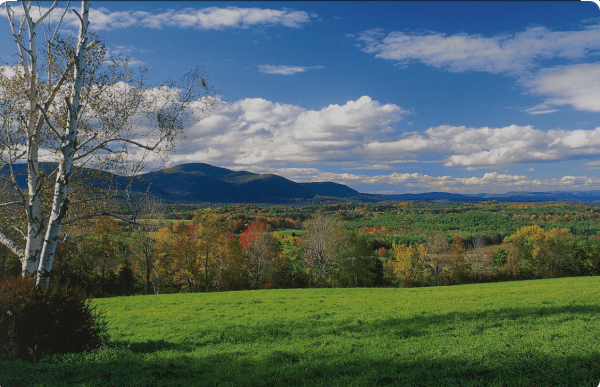
In the summer of 1953, my father rented a small 17th Century farmhouse in the Berkshire foothills outside Deerfield, MA. We had no running water, no central heating, little electricity, but we had plenty of solace and a henhouse full of needy fowl, the care of which was entirely mom’s responsibility. She was at the time pregnant with her third child and thoroughly unprepared for the life Dad expected her to embrace.
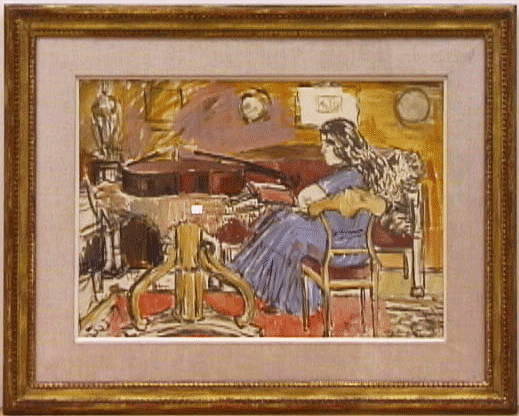
The child of prosperous parents, mom had led a life of privilege. Even after they were forced to flee their beloved home in Europe to escape the Nazis, the family continued to live comfortably, and Mom certainly never learned how to clean a coop after a fox raid or how to keep her hands clean and soft when daily egg gathering was required. She endured. But she was never truly happy except when she was playing the cello she brought with her into exile. After the cello broke, and her life was consumed by children and chores, she was never quite happy. But she endured.
From her, I learned endurance. But I also learned that endurance is not really enough for a life. We need more.
Election Anxiety has me in its grip. I know I am not alone. When I lie awake at night fretting my what-ifs, I feel myself embraced by half my countryfolk, who are most likely feeling exactly as I am. Terrified. But next week, come what may, I’ll have a bit of comfort. My little sister Helen is traveling to see me.
Deep in the dog days of August 1953, my father drove my brother David and me to Bayside, Queens, to our grandparents’ home. For me, it was a familiar second home – my cousin Johnny and I had lived with our grandparents off and on before either of us had siblings. For David, however, it was unsettling. “I wanna go home,” he cried. “Duke (our spike-toothed boxer) needs me.” He was right about that.
We stayed in Queens for a few days. Mom gave birth and, as was the custom in those days, she “luxuriated” in the hospital long enough to convalesce. Later, she regaled us with stories about Dad making her walk into the first stages of labor at the Forrest Park Zoo, and how no zoo would ever be tolerable again. She said it was a good thing that Dad had burned the coffee and ruined breakfast that morning, as there was less for her to heave. But I was oblivious. I had my cousin Johnny, my near-twin, and after Dad called to say we had a new baby sister, I was without anxiety. A sister was a good thing. And there was no reason to rush back to Deerfield. She had not yet arrived there.
When we did get home, David was crushed. Duke had run away. He was in residence now at the Deerfield Boys’ Academy, where he had been gratefully adopted. I didn’t care. I had no interest in Duke. I had new responsibilities.
We lived that year in a 17th C farmhouse in the remote Berkshire foothills of western Massachusetts. Mama was responsible for the henhouse, where foxes routinely wreaked havoc that she had to clean, and where hens laid messy eggs she had to gather. We had no running water, so water had to be pumped and stored, and all water for cleaning and bathing had to be heated on the stove. Chores were endless, and now that we had this new baby, I was expected to help more than ever. At night, when Mama was exhausted by the chores and the work of chasing David and tending her infant, I got to stay up past my bedtime to hold Helen, feed her her bedtime bottle, and rock her to sleep while Mama dozed on the couch beside us.
I bonded with my little sister. And she understood from the very beginning that we belonged to each other. Over the years, we played, we fought, we talked, we yelled; she told my children I taught her guitar, but she was the gifted one. I sort of introduced her to sex and drugs; she gave me rock’n’roll by way of her beloved Beatles and Monkees, whose music was foreign to me. I grew because of my sister, and she found new possibilities because of me.
It’s been eight years since I last saw her. Time, distance, families, and careers have kept us apart. In the intervening years, much has happened to sever ties among the remaining siblings, but we have sharpened our connection. I cannot wait to see her.
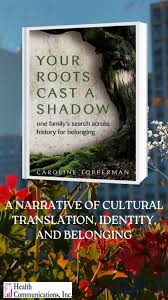
Caroline Topperman’s book Your Roots Cast Your Shadow is a MUST READ.
In Your Roots Cast a Shadow, author Caroline Topperman takes her reader down into the chasms of her family history and proves that finding your roots can be both enlightening and liberating.
So many of us who are descended from damaged, displaced families find ourselves left with mere snippets of our forebears’ memories, carefully curated glimpses of what they deemed acceptable for future generations to know. We wallow in guesswork and strive to build our sense of self from the shadows they cast. So much is left out that we find ourselves veritably blind, searching through a dark forest of innuendo that leads as much to speculation as to revelation.
Caroline Topperman has had considerably more success than some of us. Her remarkable parents and grandparents, who suffered through years of hardship that required travels to the far corners of the world, were less guarded. As they went, they scattered enough carefully chosen, indestructible truths behind them that Topperman was able to build a network of paths to meticulously follow. At the end of the end of her multiple trails, she has found rich morsels of story, kernels of history that have provided the means with which she could build a memoir of one family’s struggle to assert their right to live happily ever and leave behind a meaningful legacy.
Topperman’s examination of her multi-rooted family tree, opens with glimpses of her maternal grandparents’ life in Lwow, Poland, just before WWII. They were young, Jewish, intellectual, and proudly unwilling to put up with Nazi or Communist maltreatment. The odds they were up against are all too familiar, but Topperman spins the tale with ever-expanding dramatic flair that is able to surprise, shock, and comfort even the most knowing among us. Both her grandparents found voices, became activists, and prevail. Of her maternal grandparents, Topperman writes, “So many people are blinded by religion, and communism was my grandparents’ religion. . . . They weren’t part of a conspiracy to overthrow the western world; they were simply looking for a way to make the world a better place.”
Direr circumstances surrounded Topperman’s paternal grandparents, who fled from Warsaw to Kabul, Afghanistan, where her grandfather led the construction of Highway AH1 through the Kyber pass, where her grandmother taught gym in a local school, and where her father was born. Eventually, they returned to Poland by way of Uzbekistan, but their journeys were far from over. By the time Topperman and her sister were born in Ontario, Canada, both her parents’ families had nearly traversed the world.
Topperman’s story has many branches emanating from the roots she discloses here. Without sycophancy or flattery, she honestly presents the stalwart men and pioneering feminists who were her predecessors, and she shares her own quest to find her place among them. “Home,” she concludes in the title of her final chapter, “is where the compass lands.” That may be true. But having read the book, I would add that home is where the compass lands. . . but first we must learn how to turn on the light.
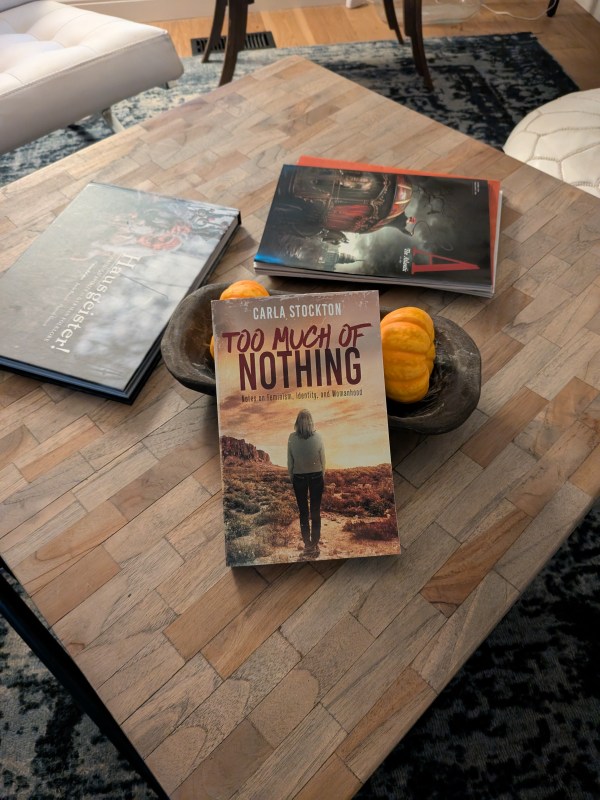
Ah, Too Much of Nothing turns out to be a lot of SOMETHING!!
A brief introduction. . . .
It is exciting to see the response to my book release. I am humbled by the encouragement, the delight, the validation I am receiving from friends and acquaintances. At the same time, it is difficult to feel like I am constantly seeking the limelight. . . . But so much has gone into this book. Like child rearing, book writing takes a village. The people I shared the MFA experience with at Columbia — my cohorts Livia Lakomy, Elizabeth Walters, Sukriti, Lacy Warner, Mahad Zara, Andrew Lewis, Sean Quinn and a few others — took me seriously, convinced me that I had something to say worth reading. My friends Mari Alkus Bonomi, Bea Schwarz, Maryanne Aubin, Gail Gallagher, Peter MacIntyre and a few others stood patiently on the sidelines with streamers and megaphones yelling, “Go girl!” My first editor E.B. Bartles made mammoth suggestions and intelligent edits. Then Caroline Topperman, at Ash Mountain Press, did the next deep and deeply insightful edit, after which Andi Cumbo added her own kind of brilliance. . . . You get the picture. This is my first solo book, but I don’t plan to allow it to be the last, and every moment of this process encourages me to press onward.
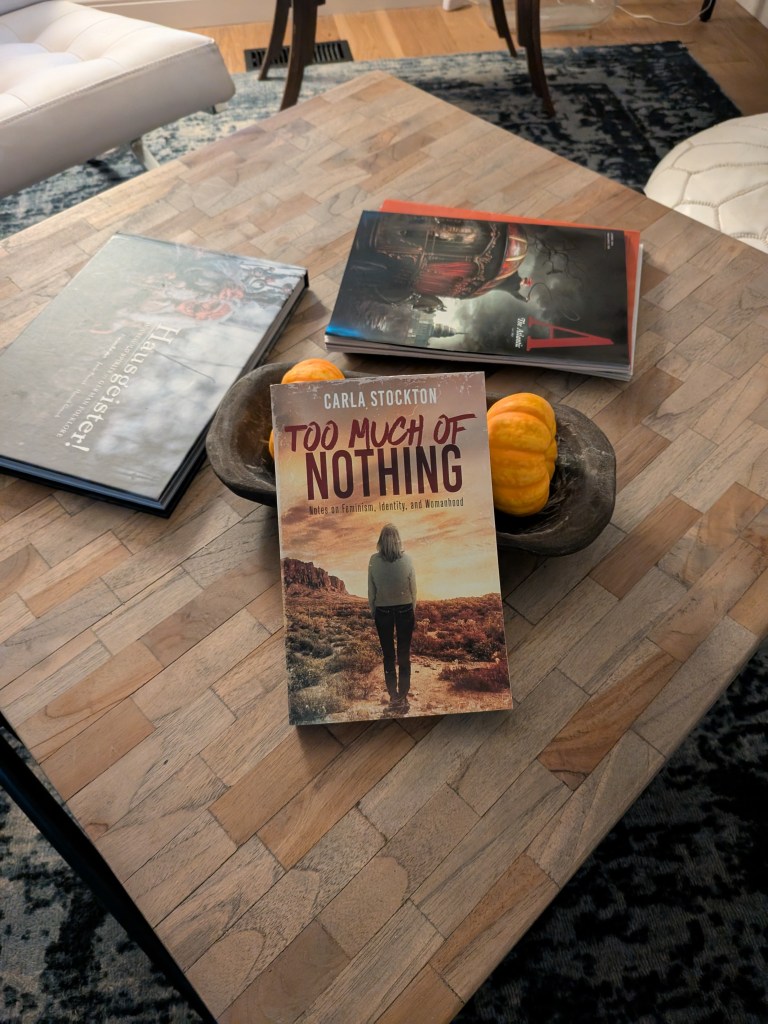
I have lived much of my life in and through books. I wandered into Alice’s Wonderland without a moment’s disbelief. I fell in love with Mercutio and imagined myself his unnamed lover. I signed impatiently when Torvald called Nora his squirrel and cried huge tears of relief when she left him. Books were never just reading material. Books took me to worlds and people, places and adventures that could carry me far from any pain that childhood or adolescence could conjure. Readers who delve into my own book Too Much of Nothing: Notes on Feminism, Identity and Womanhood will find me navigating those venues, meeting those people, and bringing them with me to my reality to enrich my readers’ experiences. Dive into my magical rabbit hole and chortle with Samuel Beckett, tzikatch with Henrik Ibsen, laugh aloud with Lucas Hnath. . . . They — and so many more — have been such great companions. It’s a pleasure to share them now.


 carlastockton.me