Every summer until I was four, my mother’s older sister Herma and her Serbian artist husband Borislav invited the whole family to share their bungalow on a beach along the Long Island Sound in New London, CT.
My memory of the house – undoubtedly flawed by time and distance — is of a single-story expanse with multiple windows standing upright, tall in every room. Their diaphanous, draped white curtains fluttered and danced in the omnipresent breezes. No matter how hot the air might be elsewhere, the briny, vanilla-scented cool of the beach enveloped us when we entered that house.
My father, usually staid, reticent, and subdued, transformed the minute we arrived. As he got out of our car, he shed his grumpy silence and turned giddy. He seemed to me one of those sea creatures we used to order from the bubble gum cards. Add water, we were told, and the creatures would animate. Salt sea air was enough for Daddy. He would bound into the house, ebulliently embrace the assembled relatives, and rush to any corner that afforded him enough privacy to change into his swim trunks.
We children – the first three of eleven cousins-to-be – were always his first invitees. “I’m off to the water,” he’d announce. “Who’s with me?”
Cousin Peter, eight years older than I, remained aloof. He thought himself too mature to be so childishly exuberant. Johnny, eight months my junior, could only go where his mother took him. He adored my dad his Uncle Alfred, but he would stay behind.
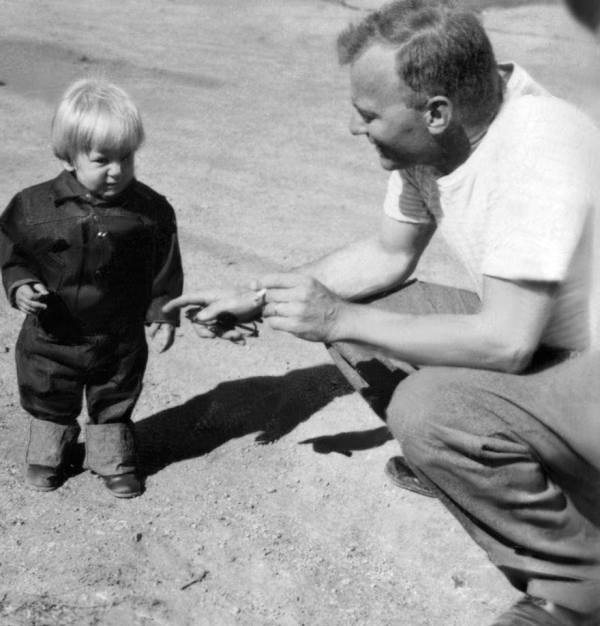
I could not wait. I would strip down to my crisp white drawers, ask my mother to secure my towhead mop into tight braids, and follow him into the gently undulating water. He walked slowly, watching my every move, coaching me to tiptoe carefully over rocks and shells, beckoning me to stop and marvel at the crabs and jellyfish that tickled my shins and scraped my toes. Once, a crab mistook part of my foot for a tasty morsel and chomped down hard. I screamed, more afraid than injured, and my father laughed. “Too bad for that little guy. You’re way too big a prey for him.”
In the afternoon, Dad would take a blanket down to the edge of the Sound, wrap himself up, put a hat on his head, and coo, “Nothing like the lullaby of the ocean to sing me to sleep,”
Then he would nap for what seemed like hours, while Peter, dressed in his cowboy chaps and holster, would point his toy pistol and chase Johnny and me all about the beach. Our mothers would watch us, laughing and applauding, as though we were brilliant actors in a spellbinding film.
Nowhere else, at no other time were we all as insouciant as we were then. Uncle Borislav would join us on our beach blanket when he took a break from his easel, and if there were no Yankee game on the radio, Johnny’s father my Italian Uncle Fernando would be there as well. Borislav would do magic tricks, and Fred would tell silly jokes. No one ridiculed my father, cocooned nearby. We were, in those moments, entirely happy.
The best parts of any New London weekend were the early mornings. Daddy would wake me before dawn to walk with him and watch the tide come in. We would stroll along the waterline, giggling at the horseshoe crabs scuttling away, peering strenuously into the darkness for a glimpse of a ship or a dolphin. Wading in, we’d let the deepening water lap at our legs.
Later , when the tide was lowest, he would invite me to a grand adventure.
“Come on,” he’d chortle. “Let’s walk to China.”
“I don’t want to go to China,” I’d laugh. “I wanna see Paris?”
“Sure! But you have to hold my hand. It’s a very long walk.”
As we walked further into the Sound, the water level remained unchanged for what seemed like miles. Further still, where I became buoyant, he’d hold me while I half swam among the sailboats lazing in the summer sunshine.
“Maybe we won’t get all the way to Paris today,” Daddy would sigh at last. “Let’s come back tomorrow.”
Dad’s ordinarily worked tirelessly, as he had a lot to prove. To his in-laws, he sought to prove he was worthy of my smart, well-educated, cultured mother. To his children, he needed to prove that he was impervious. Most, of all, to himself, he had to prove he was worthy of redemption.
Work and prayer were his salvation. He had devoured Calvinism as a boy and was convinced that any outward show of happiness might bar his way to Heaven. Only by the water did he allow himself spontaneous expression of pure pleasure.
At the beach I savored his fleeting laughter. I milked his joy and made it mine.
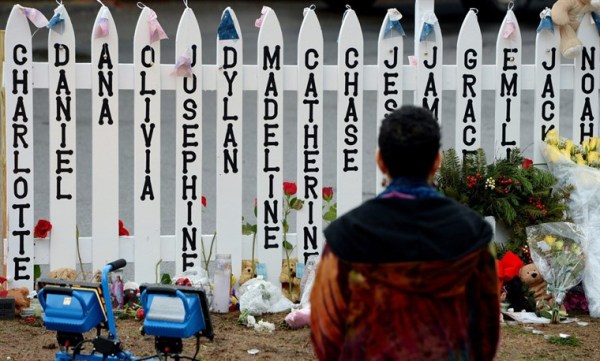
Once upon a time, I was proud and unabashedly grateful to be a part of this remarkable experiment called the USA. Then suddenly, in a blaze of terror, fifteen children were brutally assassinated, 24 more were wounded, and countless more left with interminable PTSD. In the aftermath, our collective failure to heal the national addiction to guns murdered my faith in my country. Today, I feel like an orphan. The country that gave my family refuge, the place I felt comforted, safe, no longer feels like home.
I began to feel betrayed.
Just weeks after the Colorado tragedy, as I prepared to teach my first period of the day at a Connecticut high school, a shooter invaded our premises. The principal commanded us to lock our doors, to stay on the floor where we could not be seen through the windows that faced the hallway, and to wait there for updates. My students and I crouched against the wall of the room, terrified of what might happen.
Nothing did. The gun-toting stranger never fired a shot and was caught. But I decided then and there that I could not put myself in this kind of jeopardy anymore. I wasn’t just afraid of being shot – though I definitely was! – I could not envision being forced to watch in terror as children were mutilated. I didn’t have it in me. I quit teaching, went on to other things. And I got involved in trying to make a difference.
I wrote letters, posted blog rants, called lawmakers, and spoke out wherever and whenever I had a platform. Sent money to the groups promising to fight for regulations.
Guns proliferated. Every year brings a new array of tragedies wrought by angry teenagers or disgruntled postal workers or distraught fathers or rabid fundamentalists. . . all armed with guns. And oh, Sandy Hook.
Surely, I told myself, the images from Sandy Hook must change everything. Even if the men in our culture insist on suborning murder by clinging to their guns, surely Grandmothers, mothers, aunts, teachers, sisters. . . the women of America will rise up to ensure that our babies are not so easily jeopardized. Sure there will be an outcry to eradicate the monstrous misuse of weaponry that inflicts such terror.
I was wrong. Even as Alex Jones defamed the Sandy Hook victims, even as assault weapons continued to violate sanity, nothing changed. The horror persists. Today, I a longtime friend, a woman I respect and admire, posted a plea on Facebook for concerned citizens to write to Congress and demand they defeat the assault weapons ban, that they protect our right to bear arms, that they stop the Democrats’ bill to curb the insanity.
How can anyone justify the stockpiling of semi-automatic pistols and rifles? I empathize with those people who feel so threatened they might put their faith in a gun, but I reserve none for those who believe that our government should not – cannot – regulate the way in which guns are bought, owned, operated. Without regulations, our children are never out of danger.
Never.
Since the Columbine High School shooting in 1999, nearly 300,000 students have been on a campus during a school shooting. 949 school shootings have taken place since the Sandy Hook Elementary School exploded in December 2012. Just yesterday, February 13, four more people were shot to death at Michigan State University. So much carnage. Not only the dead. . . . the wounded, the destroyed families, the traumatized children and teachers who bore witness. Communities forever changed.
In January 2023, a six-year-old child walked into school with a 9 mm handgun in his little backpack. He shot his teacher and was miraculously stopped before he turned the gun on his classmates. The trauma of that day will live on in every one of those first-graders’ hearts and minds to their last breaths. Yet “given the child’s age, no charges will be brought,” reported the local police chief. Nor have charges been brought against the parents.
The absolute degeneracy that the case of the six-year-old shooter represents is stultifying. We live in a time, in a country where a small child, who must be reminded to put shoes on his feet to walk out the door, can blithely pack a gun and shoot his teacher. Ours is the only country in the world where this is possible.
I have a daughter and a grandchild living in Turkey. Every day someone asks me how I can stand knowing the dangerous conditions of their life there. I am frequently asked, “Can’t you insist they come home?” Danger? Sure, there are difficulties for a western woman living there, and there is volatility. But no one in Turkey, except the military police protecting the airports, carries an assault weapon. No child would dream of going to school with a pistol in his pocket. In Turkey, even earthquakes are more predictable than gun violence is in the US.
The gun industry is a cartel. It controls our lives in subtle and critical ways. And we allow it to keep on keeping on.
I was nine in 1957, when my father wrenched us from our Longmeadow, MA, home and relocated us to Saranac Lake, NY. The trip, in those days, was a long one. None of the endless interstates we now take for granted existed. The journey took us along country roads through western New England, and we meandered into the Adirondack High Peaks area by way of Brattleboro, Rutland, Ticonderoga.
In truth, we didn’t meander. Our makeshift caravan – a small, rented truck and a white Pontiac Chieftain – was far slower than that. Each of the vehicles inched its way north, groaning beneath the weight of the burden it carried: our lives.
Dad had extended the truck’s driver and passenger seats with boxes, crates, and books, which he covered with blankets and pillows on which my 6-year-old brother David and our 3-year-old sister Helen could luxuriate. The Pontiac resembled a Grapes of Wrath conveyance, windows and doors straining to hold back a tsunami of small furniture, pots and pans, household goods; a bicycle and a tricycle strapped to the exterior. Mom, 8.5 months pregnant with her fifth child, drove the car, and I rode shotgun . . . wishing for a gun. It was my job to wrangle and entertain 15-month-old Alfred, restlessly climbing, relentlessly squealing, refusing to sit still.
After stopping for dinner in dark, cold Rutland, Dad adjusted the blankets and pillows in the truck so that David and Helen could sleep. Mom and I did the same for Alfred in the backseat of the car. We still had a long way to go.
Instead of sleeping, Alfred wailed and screamed and climbed back and forth between the car’s seats, using my shoulders as a diving board, pulling my hair, prying at the door in attempts to jump out. Mom never stopped driving. Dad had no way of knowing what was going on in the car, and she could not risk losing sight of the truck. When I finally managed to wrestle Alfred down, force him into my arms, and wedge a bottle into his mouth, I sang, rocking him, till he passed out.
It began to snow, and Dad stopped to put chains on the tires. Our destination was yet four hours away.
“Don’t you move, Carla,” my mother hissed when Alfred was finally asleep. I bristled at the menacing tone, unempathetic to the fact that she was monstrously pregnant, hardly able to fit behind the wheel of that car, robbed of any residual patience for a petulant tween or a perseverating toddler.
For four straight hours, I sat with the pressure of that large little person on my lap and a growing pain in my coccyx.
The temperature dropped to -46º. Wind swirled in a cacophony of winter wonders, and the snow danced blizzard-like about us. Neither mom nor dad could see five inches ahead of them, but they drove on.
Anyone who has traveled the North Country through dark winter mountain nights knows how treacherous that drive was, how close we likely came to oblivion.
We arrived in Saranac Lake in the wee hours of the next morning.
Dad’s truck haltingly crawled its way to what he remembered was the road that led to the cavernous house he had rented, nearly careening off a railroad bridge in the process. As soon as he righted himself, he stopped. We all stopped.
Mom rolled her window down a bit. Dad yelled to be heard above the din and rage of engines and wind, “Don’t turn the motor off. We’ll never get it started again.”
He dismounted from the truck to look around with his flashlight. More blowing snow reflected back at him as he walked a few feet in every direction and then stood at the foot of a hill, squinting and grunting.
Helen began to cry. Worried that we might wake people in the area, Dad opened the truck and lifted her out of the warm bed. The cold stung her, and she wailed again.
“I think this is it,” he finally said as he absent-mindedly put Helen down next to him.
Suddenly the air was pierced by a howl more terrifying than any banshee or dybbuk could have emitted. It was Helen’s. She was standing barefoot. On icy pavement. At 46 below zero.
I placed Alfred on the seat and jumped out of the car to scoop her up and put her back into the truck. Dad grunted again and returned to his driver’s seat. Mom motioned to me to put my now-squirming little brother back on my lap.
We continued the last three-tenths of a mile to our new home, and two days later, Mom taught us to ski down the hill we had climbed.
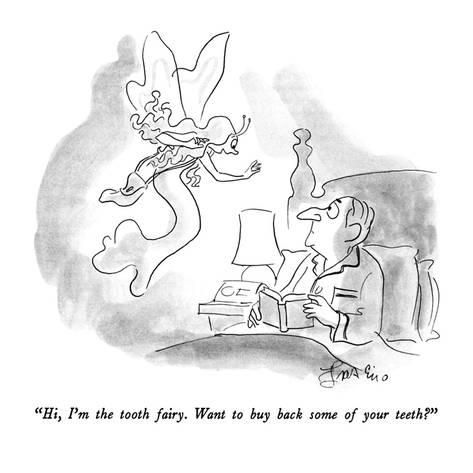
My father was eleven years old when he was summoned to his father’s bedside. “Remember this, my son,” the old man said. “Respect your mouth. Teeth can kill you.”
Grandfather knew whereof he spoke. He promptly died. . . felled by a cluster of abscessed teeth extracted too hastily in the days before Penicillin.
I grew up with that story in my head, reiterated over and over by my ever-grieving dad. By the time I reached old age and the disintegration of my own teeth, I had seen similar results in others. One close friend would have died of myocarditis, a heart infection that resulted from an untended tooth, had she not undergone open-heart surgery.
Our vulnerability is no secret. Even though people talk about dental work as though it were cosmetic frivolity, we all know better. So how is it that dentistry has become a golden calf we must worship from afar?
Last Sunday I woke up with what I was sure was a broken tooth. I had suspected that I might be grinding my teeth at night. Here was proof.
Knowing better than to seek help on a Sunday, I began first thing Monday morning to call the various oral surgeons around New York City in and out of my insurance network. In each case, I explained that I had a broken tooth. In each case, I emphasized the fact that it was increasingly painful. In each case, I said I can come in anytime. Alas, there was no room at the inn. No appointments whatsoever anywhere in town.
Then, miraculously, I found an oral surgeon with an appointment . . . ten days later.
“Can you wait that long?” The receptionist asked cheerily.
“I hope so, “I said doubtfully. I had already called fifteen doctors’ offices. “I guess I’ll have to take my chances.”
“Okay, then,” she chortled chipperly. “Next Thursday it is, at 11 AM.”
“You don’t have anything earlier?”
“I’m sorry. The doctor only comes in on Thursdays, and he does not begin his day till 11.”
Okay. At least I had an appointment.
By Wednesday, the tooth hurt whenever anything as invasive as my tongue got near it. I began to talk like Daffy Duck, spitting words with a sibilance that wet my clothing. By Friday, I was in real pain. Ibuprofen, acetaminophen, aspirin individually and collectively offered little relief.
I called every “Emergency Dental” number I could find.
“Sorry,” said one typical respondent, when I asked for an appointment. “Dr. only comes in on Saturdays, and he is booked up through July.”
I called the emergency rooms at every hospital in town. In the olden days, before Covid, Beth Israel, now Mt Sinai Union Square, had an oral surgeon on duty in their emergency room, of whose services I gratefully availed myself a few years ago. Nowadays, that ER, like every other ER in Manhattan, tells me the same thing: “There is no dental specialist on staff here. You can come in, and a doctor will treat your pain, so that hopefully (yes I am hopeful) you can wait till you can see your dentist.”
I finally found a clinic in Washington Heights, open Monday-Saturday, first come first served. I called to be sure they would take me and my insurance. Since they don’t answer the phone till 9, I was out of luck for that day. “We open at 7,” said the kind voice on the other end. “Be here by quarter of seven, when we open the doors. We stop treating patients when we reach capacity, and that usually happens by 7:30.
“Do you take my insurance?” I queried. She checked.
“We do,” she said with great delight. “No problem.”
I arrived as instructed at 6:45. There were five people ahead of me, which meant, I figured, that I had a reasonable chance of being seen. I stood behind them, waiting in the cold, windy morning, as more and more prospective patients arrived. It was 7:45 when they finally opened and began letting us in one at a time. My turn came just as the sun was beginning to warm my back. The receptionist looked at my insurance card and shook her head.
“We can’t take this one,” she sniffed. “Their office isn’t open on Saturday, so we cannot verify your eligibility or what to charge you.”
“It’s okay,” I said after ascertaining the exorbitant cost. “I’ll pay out of pocket. My insurance will reimburse me for what they do cover.”
Now she shook her head vigorously.
“We won’t be able to verify that you were our patient. We do not have the personnel to fill out the paperwork.”
It wasn’t absurd enough that they claimed my insurance company is not open on weekends — I mean it’s Medicare, and it serves old folks! — but to tell me they won’t sign off on the work so that I might be reimbursed? Now I was furious
This woman was either lying or she was part of the laziest workforce in America. Either way, I was not about to stay and let them excavate my mouth. Wordlessly but with a sniff of disgust, I left.
On the bus headed back to Harlem, I decided to go to the Web MD near my house. At this point, I figured if I at least got a prescription for antibiotics, I had a better chance of surviving till I saw an oral surgeon. The people there had no trouble accessing my insurance information, and I was seen right away.
Doctor checked my ears. “Ears look good,” she said.
“That’s a relief,” I snorted, trying to keep the sarcasm out of my voice. “I wasn’t sure if the tooth had pierced my eardrum.”
She laughed and wrote me a prescription for penicillin. By Monday the pain had subsided. It’s Tuesday now, and I am confident I’ll make it to Thursday. So long as I refrain from eating and talking, I’ll be okay.
My situation is far from unique. According to the website EmergencyDental.com, over 800,000 Americans showed up in Emergency Rooms in 2019 seeking dental care and were turned away. The number is likely to quadruple this year. That’s a problem for all of us, not just in terms of tooth trauma. Emergency Room care creates costs for taxpayers, and the resulting illnesses compound the shared expense.
For some, the cause of this scramble for the emergency room is the high cost of dental care. When I was young, my husband and I both worked, and between us, we were adequately covered for cleanings once a year, regular check-ups, and a filling or two as needed. Such coverage was not unusual. Nowadays, my annual cleaning and requisite fillings are on the Medicare House, but all Medicare plans are not so generous, and fewer and fewer employers offer dental benefits with healthcare coverage. Of course, the working poor, who are neither covered by employer benefits nor eligible for Medicaid, are entirely disabled. Private dental insurance, which is typically provided by Dentistry associations, is almost as prohibitively expensive as the services theoretically covered.
Regular cleanings and exams by reputable doctors can run patients upwards of $800 before any major work is done. A single extraction is likely to cost nearly $2000. There are clinics that offer less expensive care to people in poor neighborhoods, and most of them accept Medicaid though not Medicare. There the wait for any kind of care there is absurdly long, and, in the time of Covid, sitting in a crowded unventilated space with people coughing and sneezing and children running around for hours is, at very least, terrifying.
Chain store dentistry, such as Tend, et al., claim to be offer transparent, affordable cost, but their advertising is largely false. The reviews on the Tend website, for example, tell the tale. Patients regularly complain that the cosmetics of the space are great, but once in the company’s clutches, patients are treated unprofessionally. Personnel, they say, use the tactics of used car salespeople, and bully “clients” into buying services they did not plan for.
A typical complainant wrote that, in need of emergency care, she called and was relieved to get an appointment. “That turned out to be the first disappointment. . . . The emergency dental services they advertise are not true. The dentist comes up with a treatment plan and you have to pay for all of it upfront, even services you don’t receive that day. Horrible horrible experience. Left there with a few less hundred dollars with zero work done, in pain, and lost a day of work.”
Several reviewers complain of ill-prepared dentists, who are unable to numb their patients, who order prosthetics that do not fit, and leave their patients with gaping holes for days after scheduled appointments to place a crown or fill a tooth. They say that the company charges for services unrendered. One disgruntled customer told me, ”I am obsessive about brushing and flossing and using mouthwash, but I had a slightly chipped tooth I needed to have examined. I’m on an unpaid furlough from work, but I didn’t want my tooth to go untreated. Tend promised to do a cleaning, x-rays, and exam for $350. That seemed reasonable, and, based on how lovely the people were on the phone, I went in expecting to love Tend. What a mind-blower when they told me I needed a deep cleaning that would require two visits and would cost me $1200. In addition to my $350. The dentist kind of laughed at me. ‘Oh, no,’ She said. ‘We won’t clean your teeth unless you agree to accept our recommendation.’”
A few years ago, I complained to a young dentist, who was working on my teeth, about how hard it is to get good dental care. “Teeth can be as harmful to our health as any vital organ,” I asserted. “And yet when we do find a reputable practioner, we have to pay ridiculous prices for services rendered.”
“Yeah,” he agreed. “I don’t get it.”
He sighed and commiserated, “I’m from Canada, and it’s just as bad there. As good as our national health care is, we have no coverage for dental work.”
“What do you think is the problem?” I asked.
“I’m not sure,” he bemoaned. “Dentistry gets no respect. People don’t realize that teeth can kill you.”Carla Stockton
Carla Stockton is aging as gracefully as possible in Harlem, NYCARLA STOCKTON FOLLOWS
Covid-19 has been kind to me so far. I suffered a bit from the usual wishing to be out in the world with friends, the ordinary desire to be back in the routines, to return to exploring the city I love. Still, no one close to me died, was displaced by unemployment or afflicted with hunger. I managed to teach online, and my income, while diminished by falling enrollment, has been sufficient. I can pay my rent. I can buy food. I am whole. As are my family and closest friends. I am grateful for my great good fortune.
There have been, however, some collateral damages.
Such as the reliable soundness of sleep.
An alarm in the abode above me sounds at 2 AM. My overhead neighbor has made his presence more audible of late. He bounces balls and hammers nails at the oddest hours. A personal trainer, he seems to have clients who suffer from pandemic time dissociation. His doorbell rings. Dumbbells crash to his floor and shake my ceiling. A torrent of new-age violins accompanies the scuffling of feet and then the singsong squeak of sneakers running in place.
By 2:30 AM, the outside world comes screaming through my open window. The pandemic has turned deep night, when police are less likely to be vigilant, into a time for blatant socializing. It’s too early in the morning or too late at night to be woke about the disturbances from the street.
My open window admits the uninhibited voices of day laborers out in the predawn cold hoping against hope for some kind of work to fall off a truck. Rapped repetitions and heavy bass runs blast from angry speakers. Salsa and reggaeton bleed from whining car radios. Scurrying feet of squealing kids, who should be tucked in at home, scrape the streets.
Once awake, I lie in bed fighting fears I was can no longer keep at bay, the ones I used to control with ease. I stuff my ears with earbuds, listen to podcasts, novels, short stories that distract me. And then I drift into a semi-sleep from which I wake feeling tired all over again.
There’s also the loss of hugging.
We all hug less than we ever did. Even post-vaccination, I find it hard to trust that touching, holding onto human flesh is safe for those around me. My closest and dearest friends, once demonstrative to a fault, now withhold their affection.
I wear a mask in the presence of my grandchildren, and though I long to return to cuddly sleepovers, to lying in bed telling stories and listening to theirs, they remain a threat to the unvaccinated around me. So I curtail my contact. It’s a painful abstinence that seems a small price to pay.
At times the absence of love’s simplest physical ministration has led to more permanent deprivation. By losing physical contact, I lost touch altogether. I truly believed what I said whenever I promised, “When this is over, we’ll catch up.” Then I went about my business and made do with what was in my reach, and I began to repel intimacy with anyone outside my purview.
In the earliest days of the virus, I would call to invite an old friend, who lives just beyond a two-mile walk from me, to meet for a *socially distanced visit in the park. She inevitably responded, “I don’t want to interrupt your work,” or “I know you’re busy, and I won’t distract you.” At first, I protested, but then I heard her implication: “I have closer people to see today. I won’t extend beyond my pale.” I understood. I accepted the rejection and honored the choice that she’d made. We spoke regularly by phone, sharing our individual experiences with the quarantine. Then we spoke less often, and finally came a day when we said we’d catch up the next week but did not. I failed to make that call.
Though either of us could have been the one to follow through, I embraced her recrimination for not having stepped up. “Your apology sounds insincere,” she scolded when I did call.”I must consider whether I want to be your friend.” Honestly, I understood her rebuff. I was remiss. In fact, I was thinking what I clearly heard in the substance of her subtext.
“It’s too hard now. It’s been too long, and I’ve filled all the gaps where our friendship used to be. I’ll be moving on.”
The losses are incalculable, but they are losses I will live with. Like everyone else, I make adjustments to a life that will never be normal again. Each of us shapes and reshapes a new way of being that won’t necessarily embrace what was. Those relationships that can be born anew will prevail, but some will scatter.
We’ll never be the same, but we must count our lucky stars.



 carlastockton.me