Memorial Day Musing (from Medium.com)

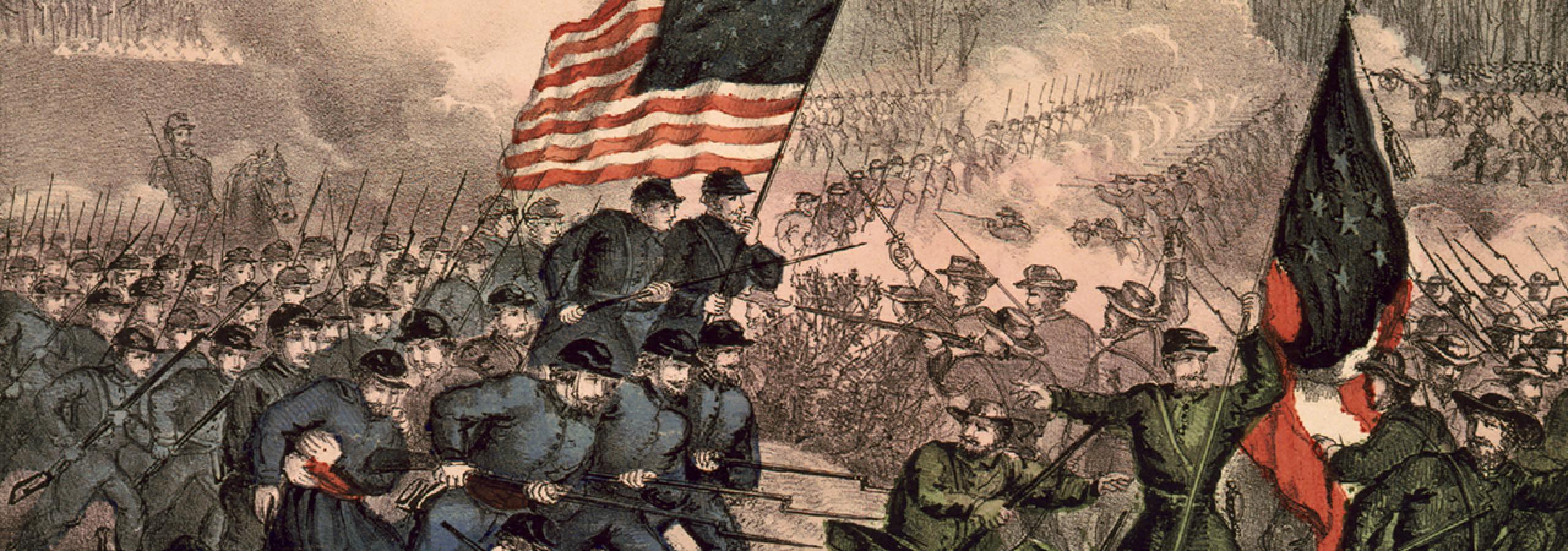
The Second Battle of Bull Run, August 28–30, 1862–15,000 Union troops died in two days, and the Confederacy wond a decisive victory. Hiram Terwilliger fought valiantly and (barely) survived.

Memorial Day Musing

Insomnia plagued my childhood. My mother was a refugee from Nazi Europe, who never spoke outright about what had happened back there. Eavesdropping on the muffled conversations she had in clandestine German with her sisters and parents, however, I felt the anguish wrought by the dismal truths they shared. I inferred that some dark force was out there, still looking for us. When I closed my eyes, I pictured evil monsters, and I could not sleep.

In those days, my father was rarely home. He traveled around the country, representing, depending on the year, surgical supply or pharmaceutical firms. He repaired machinery, consulted with physicians, sold his products, and was often absent for weeks at a time. When he was at home, he was the center of my universe. In his presence, I felt safe. We had animated, prolonged family dinners. There were Sunday afternoon restaurant meals and bedtime stories that extinguished the nightmares.

Mom was not one to wait bedside until I drifted off to sleep, but Dad reveled in the opportunity to display his performance repertoire. It was a rich one that included Biblical episodes delivered with dramatic flourish, Chaucerian tales recited in crisp, Middle High English, a medley of Protestant hymns sung in a sonorous baritone, and, my personal favorite, tales of his grandfather’s Civil War exploits.
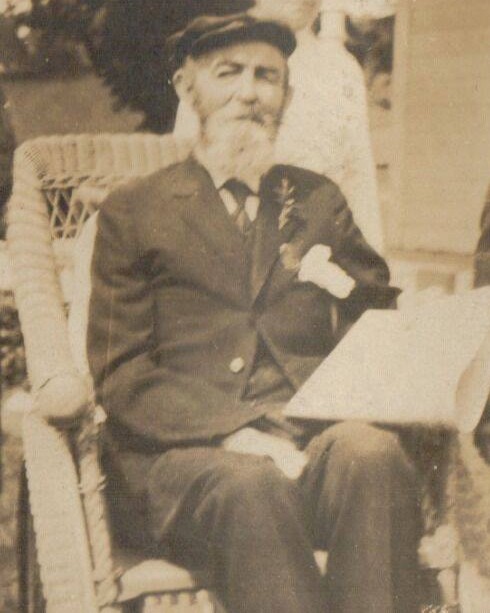
Hiram H. Terwilliger(1838–1935), ca. 1923

Hiram H. Terwilliger was my father’s maternal grandfather and the god of his idolatry. A gentleman farmer in the Catskills, Hiram was descended from a line of Dutchmen who had emigrated from the Netherlands early in the second decade of the 17th Century. By the time of the American Revolution, in which Hiram’s own great-grandfather had distinguished himself as a warrior patriot, they had begun to intermarry with English landowners and had taken their place in the highest echelons of Knickerbocker society. Dad’s narration of this family lore always had a pointed purpose: Terwilligers take heritage seriously. It defines how they are to live their lives..

A lay preacher in the Dutch Reformed Church, my great-grandfather was a rabid abolitionist. He and his sister Sarah were conductors on the Underground Railroad, and the family farm was a relay station. Though passionately pacifist, when the purveyors of human beings refused to end their vile trade, Hiram enlisted in the Union Army, in 1861. He was wounded and sent home mere months after he joined. As soon as he was healthy again, he re-enlisted, this time elevated to the rank of Corporal and subsequently to Sargent.
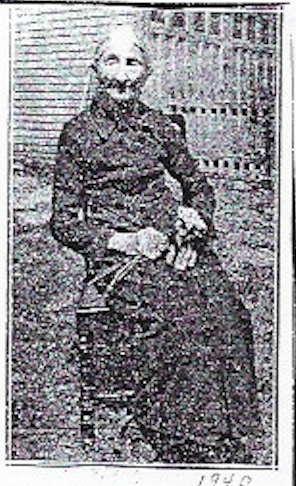
Sarah Elizabeth Terwilliger Warren(1840–1940), ca 1940

In 1862, at the second Battle of Bull Run, Hiram was shot nine times, sustaining at least three wounds that should have killed him. He refused to fall. After retrieving the Union flag from the ambushed color guard, Hiram kept moving, leading his battalion into the fray. I can still hear my father’s tear-stained voice whispering, “He said he would not rest so long as all Americans were not free.”

Recovery from the wounds and from the subsequent surgeries was long and painful. Summoned to the hospital in Fredricksburg, where Hiram had been taken from the field, Sarah, who volunteered with the corps of battlefield nurses, cared for him until he was well enough to travel. She accompanied him back to the family homestead, where she dutifully nursed him for over a year.

Though they both married and lived separate lives, brother and sister remained to committed to the cause that nearly killed him.

Sarah, who lived to age 100, was a popular local heroine, known in Ulster County as Auntie Warren, her married name. She became a suffragette. Hiram marched with her. He preached universal suffrage from his pulpit and took his message to conferences and convocations around New York and New England. Toward the end of his life, Hiram suffered paralysis from his waist down but continued to preach from his wheelchair. Whenever he heard of discriminatory practices enacted against any of his neighbors, Hiram was there to preach equality. He had a special affinity for Native Americans and was a continual thorn in government’s side, writing letters and making sermons admonishing the powerful hypocrites, who betrayed the People with broken promises and violated treaties.

Dad would finish Hiram’s story with a grand flourish as he looked into my sleepy eyes with a singularly intimidating look. “And so,” he would whisper, “now you understand your responsibility.”

“My grandfather nearly died,” Daddy would whisper as he left the room. “So that what happened to Mommy’s family in Europe will never happen to people here”

Since Mommy had clearly suffered from whatever it was that befell her beloved home, I embraced his assertion. She had escaped the Nazis and had come to America because here she could be safe, and her children would be protected from discrimination.

Every year of my growing up brought new awareness of America’s salient truths. People were not safe here. Discrimination was rampant. My father’s best friend was a physician, who was forced to take maintenance jobs in order to feed his family he finally found a hospital willing to grant him admitting privileges. I spent a weekend billeted with a Mohawk family on the St. Regis reservation, and I was appalled to come face to face with what my white forebears had done to this proud, generous people. By the time I graduated from high school, I deeply understood the hypocrisy of the opening words of the Declaration of Independence, grasped the depth of the evil perpetrated on villages in Korea and Viet Nam in the name of American democracy. My great-grandfather’s story became my reassurance, my inspiration.

I attended Malcom X lectures, marched with Martin Luther King, Jr., explored the beliefs of Muslims, Hindus, Buddhists, et al. I studied languages and traveled abroad so that I could obtain a deeper understanding of the world around me I believed that it was possible to be an American, and to uphold the rights of humankind, to extol the virtues of immigration, to embrace multiculturalism. I struggle now — a struggle exacerbated daily by new events, such as this week’s brutal murder of George Floyd and the idiocy of Christian Cooper’s encounter with a white woman’s performative fear in Central Park — to suspend my disbelief.

I miss the days when I bought into the myth of America. Once a year, I force myself to make a valiant effort to retrieve my faith.

Every Memorial Day, I doff my cynicism and think about old Hiram Hauslander Terwilliger and his sister Sarah Elizabeth Warren. While many of the principles they espoused are still unwon, their story reminds me that we can do better. Men and women before and since have given their lives to the belief that we will do better.

The future of this country demands that we must do better.
Corporal Hiramm Hauslander Terwilliger, 1861

A View from the Edge (Reposted from Medium.Com)

These days, my oldest grandchild, age 11, often telephones me from her home in Westchester. We have not seen each other since mid-March, and we are not used to so extended a separation. We normally spend at least a weekend a month together. So, she calls to tell me about her day, to ask for advice choosing the right word to complete a verse of the song she’s writing. Then she asks me to tell her what my day has been like here in the valley of the shadow of COVID-19. Last week, she issued a challenge.

“You should record your observations, Lala. Write down what you see, what you hear.”

I wish I had more to share with her. It embarrasses me to admit that, in truth, I am observing little. My sequestered life leaves me out of the loop, experiencing this crisis vicariously. Watching through the veil of social distance puts me at odds with my natural inclination to engage with the world around me.

In fact, I hardly know myself. At 72, I have always taken pride in being somewhat intrepid. Growing up in a remote region of upstate New York, I spent many teenage nights listening to the Milkman’s Matinee on WNEW in New York City. I would lie in bed straining for reassurance that the vigilant denizens of my emerald city were monitoring the myriad dangers that lurked beyond the mountains. I nurtured the delusion that confronting the things that threatened me meant I could control what happened to my family and me. Then I grew up and migrated to the city, became an insider at last. I traded my childish notions in on a thick skin, an existential shell that enabled me to be nosey, be involved, observe from the inside of whatever’s going on, to calmly assert myself wherever I might be relevant.

These days I am never free of the unfamiliar knot of anxiety in my stomach. At night, I succumb to sleep only after setting the timer on the television. Its mindless banter drones out the perseverating voices in my head shouting, “Run. Run.”

When I wake, I walk.

Each morning, sunrise finds me on the far west side of Morningside Heights. I dodge the occasional runner, sidestep the meandering drunks, race the sparse but speeding traffic and hike toward Riverside Drive. It’s a great time to be out. The eerie city is more like it was in olden days — two months ago — no emptier than it is on any predawn weekend morning I would venture into. Pink wisps of clouds linger over the Hudson, and a floral profusion of varicolored petals dance contentedly in the springcold breeze. Finches, cardinals, robins sing without restraint. For them the absence of people means the absence of danger.

I notice that there is little garbage to mar the pristine landscape, and the lifeless blue gloves strewn insouciantly about remind me why the sudden clean is as disturbing as it is delightful.

Too soon light begins to blanket the streets. The absence of cars, the desolation of sidewalks, the darkened storefront windows revive the irksome panic, and I hasten back to my little apartment, to my illusion of safety.

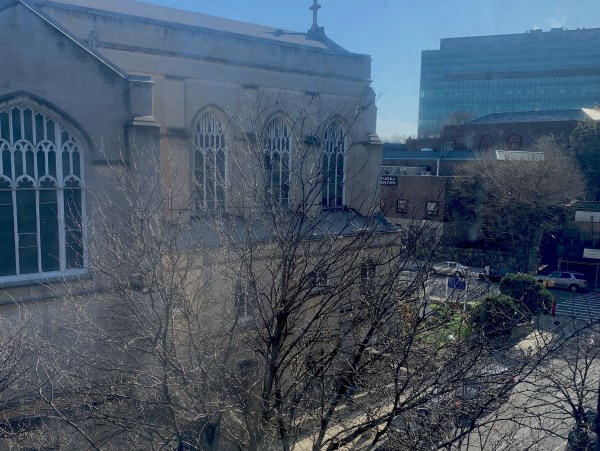
My seventh floor windows overlook a dormant Catholic Church and its tenants: a vacant parochial and empty charter school. Cars park in front of the buildings all day, all night, unencumbered by the “NO PARKING ON SCHOOL DAYS” sign. No steady stream of worshippers, no laughter of children at recess, no chatter of activity outside the corner bodega clutter the air. Occasionally someone plugs in a boom box and blasts loud rap while he cleans his car. Several times a week, a zealot with a microphone stations herself on a nearby corner to scream end-of-the-world warnings to the deserted streets and open windows. Sometimes at night a drunken cluster of errant youngsters gathers to blast music and throw bottles and chicken bones at the church walls. Until the FDNY arrives and points a megaphone blaring, “Please disperse . . . COVID-19. . . . “

Because there is nothing I can hope to control, because I cannot dive into the fray, I deliberately limit how much I take in. From up here, it’s easy to look away from the harbingers of disaster. I avoid electronic babble and listen mostly to my I-Tunes library, When I do seek something to watch, I am more likely to choose Larry David reruns than Governor Cuomo’s Dire-side chats.

What I see from my precarious tower is mostly a world torn between fear and disbelief. It is fear that governs the new abnormal, a fear exacerbated by the counter-intuitive way we are forced to respond to the crisis. It is the wont of most humans to lean on one another when we are threatened. This virus forces us apart at a time when we most need to cling to one another.

All around me fear expresses itself as derision or anger. A neighbor blurts obscenities then laughs maniacally because I don’t join her unmasked self in the elevator. When I pass her from my 6-foot distance, she scowls. On Amsterdam Avenue, fights break out over small disagreements. In grocery stores, beleaguered cashiers yell at customers who ask too many questions.

Everyone feels powerless. A weak imposter president, who would gladly sacrifice every one of us to the gratification of his ego, endangers us all. This reckless narcissist defies science and encourages the covidiots, who worship him, to flaunt their disregard for herd immunity. He suborns sedition by promoting rebellion against state governments that insist on sheltering. Our citizenry is caught between logic and farce, between sanity and idiocy. Confusion augments the fear and compounds the anger.

Few among us are free from financial concerns. Many in this time of Covid-19 teeter on the edge of an ominous precipice. One of the lucky few with a job I can do remotely, I am obligated to keep working. I cannot afford to be ill. No net is in place to catch me. Should the scourge erase my limited salary or eliminate my miniscule annuity, I would be left without resources.

I am not unique. Widows and divorcees in NYC are typically under-equipped for disaster. We comprise a confederacy of older New York women, who have cast ourselves adrift on an ageist, sexist sea of limitations. When I pass my cohorts in the grocery store or on the street, I can see my strain mirrored in their eyes, etched in their faces.

Also reflected there is the lingering doubt that we will ever see our progeny again. We are repeatedly told that we are at great risk. Who among us will get out alive?

Many of our children, now in their thirties and forties, comprise the essential work force and are constantly in harm’s way. My son’s wife, a fearless physician, who specializes in the care of newborns, is back at work in her hospital, having wrestled with the disease and won. My daughter’s husband, too, a pilot for an international airline, has probably been through an unconfirmed case. These two and sare emblematic of their co-generationists. Even as they protect themselves with maximum caution, will they be safe enough?

I hate to disappoint my granddaughter. Her mother the doctor would be a much more reliable narrator, were she less engulfed in the maelstrom of responsibility with more freedom to record what she sees.

The only light I am able to shed is a lesson I learned in high school French class, where first I encountered La Peste, Albert Camus’ chronicle of a plague year in Oran, Algeria in the 1940s. Frequent references to this book have been cited since the pandemic began. And for good reason. Though Camus meant his pestilence to symbolize the Nazi occupation of France, it is a perfect mirror of our current morass.

The Oran plague is allegorical, Camus’ exploration of what happens when The Absurd engulfs reality and renders it incomprehensible. A cautionary tale. There will always be, Camus asserts, diseased rats of one kind or another that will rise up and roust the world from its complacency. There is no antidote that can change uncertainties to reassurances, threats to promises. No messiah is on the way. Our only hope of vanquishing our foes is to find the best that is within ourselves and live with grateful enthusiasm in our present, providing the most comfort we know how to give to those we care about.

We can’t know what’s coming, and there is only so far we can go to stave off disaster. The rest is submission. Submission to the belief that all things pass. That there will eventually be sunshine or a rainbow. . . .

Or at very least a nice big puddle to jump into at the end of the storm.

Carla Stockton
18 April 2020

Motherless Child (Reposted from Medium)

Bad news from the Bronx. The virus has killed my student’s mother. He’s only seventeen. She must have been young. Horrifying the alacrity with which his world is disemboweled.

No preparation, no goodbyes, no final words of wisdom or instruction. Just here today hi-mom-i’m-home, gone tomorrow, empty house. COVID-19 wins. Mom is dead. She’s been murdered by an invisible assailant, abetted by the country’s evil leadership that refused to enact precautions until it had spread unchecked, until it was too late to prevent the catastrophe that is our Now. I am overcome with impotent rage. What must he be feeling?

In saner times, I could perhaps visit him, take the family a covered dish or a tear-moistened cake. Even if that were possible, he’d probably hate it. I would have at his age. But still I want to reach out. I want to tell him I know what he’s going through, I guarantee his life will get better, and he will prevail. Would I be lying? Not entirely.

Years ago, as a teenager, I learned out of nowhere that my mother wasn’t coming home. The message was brutal. An unlicensed driver had plowed head-on into the van she was driving. He was a blind drunk, they told me, who left her a mess of shattered bones, profuse bleeding. Her prognosis was bleak.

At first, I felt nothing. When the initial numbness wore off, I succumbed to a seething, bottomless anger that sharpened the pain. I thought the only way I would overcome my voracious ire was to kill the driver or kill myself. The impulses passed, and my story ended more happily than this boy’s.

My mother did not die.

We were dissembled, but she was alive. Further, the evil that upended my mother’s life had a specific shape, a recognizable form. My student’s mother’s assassin is an insidious, invisible monster, empowered by the administration of a Nation that should have been her refuge. There is no justice to be sought. No stopping the demon. No closure. I had that much.

The drunk driver was apprehended, fined, incarcerated. It satisfied me to know that his children would be kept from him the way I was kept from my mother.

For the first few months, I saw my mother intermittently, for brief intervals. I stood silent at the foot of her hospital bed as she meandered between the black void of her unconscious and the small, rectangular room. I didn’t try to talk. That would have been futile. She didn’t know me or any of her seven children. Even when she was awake, she was unable to focus for more than mere seconds before she lapsed back into her quasi -comatose state. Doctors could not be sure she would survive, but they were certain she was in imminent danger of losing her leg.

My anger turned inward as I shifted into ersatz adulthood. There seemed no other solution but to become my own mother and to care for my siblings. I was fifteen, at best a poor imitation, a second-rate surrogate. I failed miserably, which fueled my self-loathing. There was no one to lead me. My father, paralyzed by his fear of losing mom, sat endlessly by her bedside, holding her hand. He only occasionally left her to eat or to shower or to make perfunctory, fruitless attempts to find us assistance. I applauded, often assisted the demise of the erstwhile caretakers. Eventually, there was no other solution but to temporarily entrust the care of the younger children to friends and relatives.

For twenty months, mom lay between life and death. She survived the initial danger and then a second, the invasive surgery to save her leg. Once the kids were safely ensconced, I wandered dysfunctionally through my rudderless adolescence. I ate too much, read too much, cried too much and talked to no one. Without a mommy, I did not matter.

Still, I was the lucky one. Mother’s presence returned, and for a year, she commandeered our household from the hospital bed installed for her on the first floor. She martialed our activities, relying on me to potty train my baby brother, to quiet the restless quarreling and mischief of the others, to maintain order. I did laundry, cooked meals, and drove everyone to their appointed rounds. I was no better at it than I was before, but I did have guidance.

In the evening, when Dad was late returning from his sales routes and the kids were asleep, Mom and I talked. We argued over the symbolic implications of The Brothers Karamazov’s Grand Inquisitor. We compared Kennedy assassination conspiracy theories. We listened to music and planned for the week ahead. For the first time, Mom allowed herself to open up, to share the details of a life she had kept carefully concealed: her childhood in Europe, her escape from the Third Reich, her myriad losses. I felt trusted for the first time, almost her equal. Without realizing it, however, I had lost the ability to trust her.

I did not tell her about the man on whom I had a serious crush. Nor did I confess that I was terrified of the drinking among my peers, which defined all social engagements. She was impatient with my “scribbling,” the journaling I did on weekend mornings when chores needed doing, so I shared little of myself. I won speech contests, wrote prize-winning essays, starred in our class play, and she came on her crutches to applaud me. But I could not tell her that I was desperately lonely and, despite my outward extroversion, inordinately shy. I wanted to explain — but how could I without suggesting recrimination? — that those two years without her had robbed me of my ability to make friends because my carefully-constructed emotional walls blocked out the sunshine of healthy attachments. When I chose a faraway college I had never seen, I lied and said it was the only school that would have me. I could not find the words to confess that I needed to escape her omnipresent limp, the dizzying reminder of that devastating message: your mother’s not coming home.

My student’s predicament reminds me how grateful I should be.

That boy will never know the kind of reversal of fortune that was my gift. His mother won’t be there to cheer at graduation or help him buy the corsage for his virtual prom date or sign off on his AADA (American Academy of Dramatic Arts) loan applications. She cannot hold him now, wipe his tears, soothe his anguish. She’s never coming back.

If I am still ferreting through the damages wrought by my two years of aimless self-destruction, at least I have the consolation of an adulthood spent getting to know my mother as a woman, as a friend.

It’s my natural impulse to want to put my arms around this student, to offer him a shoulder or an arm or whatever support he might be willing to accept. But between Metoo and our absurd new Abnormal, contact is impossible. I can only send him virtual hugs, electronic condolences.

So I stand aside and hope he will be allowed to grieve as long as he wants. That he has the license to remain a boy until he is fully ready to be a man. That when the time comes, he will mature into someone who is without the weight of anger, someone who can, in the absence of justice, find his own closure.

4/1/2010

In Just Spring. . .

Melancholia visits me in Springtime. Every year since I was a child. Without fail. March and April drown me in my rising anxiety. Summer approaches

My malaise sprouts from multiple roots. Daylight Savings for one. An extreme morning person, who functions best between the hours of 4 and 11 am, I am never able to get enough sleep. The extended daylight delays my night slumber so that being alert and productive when it’s most natural for me to be so is nearly impossible. I dreaded DST when it would descend in April. Now they foist it on me in March, even before the season has officially sprung.

Heat’s another. Especially in the time of global warming, I shudder each time I  try to envision what to wear as I slog through sweaty days of teaching and social engagements. Never well shaped for scanty suiting, my body is most comfortable disappearing into layers of winter wear. Summer terrifies us.

This year, however, my despondency is exacerbated by the relentlessly untenable political reality in which our country is enmired. I’m already exhausted from the interminable campaigning. The orange imposter and the bloated goons who give him power have robbed me of the homeland I used to trust. The Democrats have turned discourse into hate-mongering.

And women have once again been relegated to the back of the bus. That’s where Elizabeth Warren has gone. And I am bereft.

What is it about America that its ship of state inevitably seeks to keep a Great White Father at its helm? Despite the fact that every one of them finds ways to deceive us as he happily manipulates us into believing he is good for the country?

Why are we so averse to having a woman lead this nation?

In this primary race, the single candidate who was everything America used to stand for was a woman. Smart and sensitive, educated and empathetic, powerful and personable, Warren had a progressive agenda that was no mere demagoguery. She really did have a plan.

And yet. . . . The progressive wing of the party put their weight behind a blustering windbag whose sound and fury signifies less than nothing. All he really offers, as far as I can see, is a penis. And a loud voice. (At least his single standing opponent in the race has Warren-like decency.  At least there’s that.)

Warren’s bid for the Presidency is the victim of sexism for sure. More hideously, it is proof that ageism, ubiquitous for women over 60, is kinder to men. Both remaining candidates are far more doddering than Elizabeth Warren will ever be. Still, here we are.

All of which puts me in a sadder state than ever this spring. The birdsong outside my window reminds me that my granddaughters are growing up in a society that is no more mature than the one that bred me. The one that believed that a new, slender cigarette was a sign that we’d come a long way, baby.

My sadness knows no bottom.

Travels With Grandma — Where Was Tina Fey When I Needed Her?

“What’d you think?” I asked my granddaughters as we made our way out of the theater. We had just seen Mean Girls on Broadway, had stood with the obligatory standing ovations, were still engulfed in the screaming appreciation from the audience. Typical Saturday on Broadway.

I wondered if my companions shared the enthusiasm.

“Well, it was good,” the younger one, who is nearly nine, proclaimed without a trace of self-consciousness. “I mean, the story was great. But what I didn’t like was there was just too much singing. Really loud singing.”

The kid’s got a future in theater criticism. She is the same granddaughter who, at age 4, left Lincoln Center declaring, in her loudest outdoor voice, that the children’s performance of the NYC Ballet we’d just attended was “. . . the worst show I have ever seen.” She was right then, and she’s right now.

The ballet was off the day we went; the choices seemed odd for a program targeting small children. And frankly, Mean Girls does have way too much mediocre music that is more shouted than sung. I kept wishing I could tell the Sound Supervisor that the balance was off, the overall effect totality deafening.

Also the show is preachy. Deliberately so. As the two misfit greeters tell us at open, “It’s a cautionary tale. . . . “ They ask, “How far would you go to be popular and hot? Would you resist temptation? You would not.” Clearly, we are here to be taught a lesson.

Normally, such a messianic tone would irritate me. Especially since I would never have chosen this particular experience had there been affordable tickets available for anything else a pair of preteenagers might like. Yet I found myself softening a bit as it coursed its way through, highlighting the best and worst in teenage girls, illuminating what they all need to know about themselves. In the end, I found myself tearing up.

Everyone in this made-up world learns their lesson. All the girls, every one a mean girl in one way or another, live happily ever after in the bosom of acceptance and empowerment. Why was there no Tina Fey Girl Power script for my generation?

How much different so many of our lives would have been – would be – were we encouraged to love ourselves, to seek success, to nurture one another. The messages we received sought to obliterate our self-esteem, our ingenuity, our independence. Some girls were lucky enough to have mothers who were unafraid to encourage them to defy the system, but for most of us, defiance meant dishonor. Mothers were embarrassed, fathers were angry, and teachers, like later employers, withheld the markers of success. We learned that we needed to play the game by rules the men made, and we needed to have their favor, which meant we were in competition with one another. No one undermined women more thoroughly than women.

Things haven’t changed much since then, which is why Mean Girls is so potent. Too many women still settle for second best, still acquiesce to standards that are beneath them, still seek to be whatever they think men want them to be, still undermine one another.

Thank goodness this vibrant musical is here to remind us (over and over) that 1) “It’s all fine till someone gets hurt,” and 2) “We’re all stars. . . . “

Unfortunately, as my pint-sized reviewer asserted, “They made music out of every little idea, even when there was almost no idea there. And the music wasn’t even that good.”

The songs are unmemorable – not one stuck in my head and had me humming my way out of the theater. Moreover, neither of the grandkids, both veterans of several school musical productions, who know everything on Spotify and the entire score of Hamilton backward and forward, left singing a single ditty.

Nowhere in this play is there a shred of subtlety. The instruments blare. The voices scream, even when they could whisper. The lyrics are simplistic, lacking grace. No poetry. Every message, every image is so emblazoned in neon it feels disingenuous.

Worst of all, it’s rarely funny. Tina Fey’s voice reading the “Turn off your cellphone” address just before curtain is the funniest thing in the show.

And yet, I warmed to the play. A little. And the youngsters in the audience – most of them girls – loved it. At the stage door afterward, 52nd Street throbbed with the excitement of well over a hundred females aged 6-20, waiting in the cold, screaming as each of the actors emerged from the theater, begging for autographs and selfies.

As my granddaughter said. It was pretty good.

——————————————————————

Mean Girls

Story by Tina Fey                     Music by Jeff Richmond                Lyrics by Nell Benjamin

Now playing at the August Wilson Theater, 245 W. 52nd Street, New York, NY 10019