Notes From A Temporary Curmudgeon – Day 4

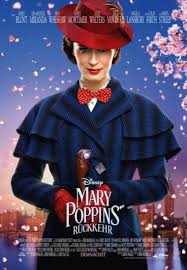
4. Mary Poppins Returns 
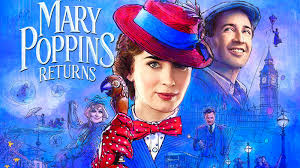
My daughter and I love Mary Poppins, and we share a high regard for Emily Blunt and Lin-Manual Miranda. How could we resist trekking to the theater the day the new film opened in Bangkok?

How could we know that the best part of the film was that which followed the previews but preceded the feature. The part where we stood at attention to show our abject admiration for the King of Thailand, to watch a short documentary covering his life story and listened respectfully to the rousing national anthem? After that, the experience was generally tedious and vacuous. A complete disappointment.

 Nothing was fresh except Blunt’s performance. Miranda’s expression never changed from beginning to end of the film, and his songs and scenes were sappy, over-acted, void of either humor or interest. Fortunately for us, some of the cartoons transfixed my grandson for a little while, and he was happy to eat popcorn and sit quietly. But before long, we had to pull out his little iPad so that he could return to the thrall (for the 90th or so time) of the endlessly repetitive episodes of Paw Patrol we had previously downloaded. I was relieved to have the Paw Patrol distraction myself. Rob Marshall’s film is a kettle of tasteless, rubbery squid. Not exactly delicious fare for a diehard vegan.

I know I’m not “normal.” I’m back to where I am with Mrs. Maisel. Everyone else loves the achievement. I feel like that lone little boy at the storybook parade shouting, “But the emperor is naked . . . .” At least with Mary Poppins, I am not alone. My daughter shared the displeasure.

This was especially upsetting for me. I am an inveterate Poppins fan. I began reading the books to myself before I was 5, and I read them to my many siblings in the intervening years before I grew up and shared them with my own progeny. I saw the trailer for Mary Poppins Returns, and I could not wait to see the whole movie – it looked like it might have something in common with the original P.L. Travers’ stories on which it was based.

Alas, I was wrong. This so-called adaptation bore almost no resemblance to the material co-writers David Magee and Rob Marshall theoretically translated for the screen.

Magee and Marshall eliminated everything Travers wrote. Except the title character, who is, I should add, played superbly by Emily Blunt. Were that she had had a script worthy of her talent.

To be fair, they did insert Blunt’s Poppins into momentary glimpses of the various sequels P.L.Travers actually wrote. For the most part, however, the writers have created an entirely new set of characters that they have stuffed into a story that is no more than a very distant cousin of the fantastical tales Travers told about her mesmerizing British nanny.

I have read that the writers at Disney found the original material too dark. Ironic that.

There must be a Disney trope that demands that, in order to be significant, a film for children must begin with youngsters dealing with the tragic and sudden loss of their mothers. This seems to constitute a leit-motif for young audiences. I’m confused. What’s darker than the premise that three children under 11 have had to grow up all too quickly in the wake of their mother’s horrific, untimely death?

The “too-dark” material of the P.L. Travers books features no dead mothers. In Travers’ Mary Poppins Comes Back or Mary Poppins Opens The Door, all the Banks family members are very much alive. Including the parents who first endure and then engage Mary Poppins over and over again. Jane has not grown up to defy her class station and take up the sword of socialism as is her Emily Mortimer film shade, and Michael Banks is not the widower portrayed by Ben Whishaw.

Both siblings remain children through every one of the Poppins books. Two of five very realistic children, in fact. Their fantasies are not always sweetness and light, but they are always wildly creative. The children wander in and out of conundrums and dilemmas they encounter in their dream worlds, but they never fail to come home to their ever-loving if somewhat misguided parents. Two of them.

Conversations with sea slugs and other unlikely animal heroes, who figure adorably and prominently in the books, are apparently too disturbing for a children’s film. By contrast, the threat of homelessness is clearly unthreatening enough an adventure for modern children. The original Travers material never once suggests, as the film insists, that the house the family lives in is in jeopardy. Mary Poppins’ role as savior is to liberate the children from the ignominy of unmannerly behavior. She protects them from the failure to be imaginative. She struggles against their individual and collective loss of innocence. She never has to fight thwart the bank manager’s evil intentions.

Obviously, Travers wrote far too darkly for a children’s musical.

On the other hand, a dance sequence populated by multitudinous men cavorting with a single female becomes, in the world of Disney, no more than a tasteful romp. Dozens of dirty chimney sweeps in step with one young Poppins and a leering Miranda felt creepy to me. Not one female dancer in the crowd. I guess kids must accept that women can never be cast as chimney sweeps (we certainly can’t ask women to play males), especially not in the 1950s version of the 1890s that’s been put on this screen. It just wouldn’t be right.

An aside here . . . did the Script supervisor not notice that the skyline shots were far too modern for the theoretical setting?

In both Mary Poppins Comes Back and Mary Poppins Opens the Door, Travers takes the children to places where they are forced to learn about their responsibilities to self and country, to parents and each other. Many of the characters are loony. But there is no person or situation nearly as sinister as any of those Marshall interjects into his version.

In the book, for example, Mrs. Turvy, played in the film by Meryl Streep, is madly contrary. She has to be. She is happily married to Mr. Topsy. The concept of a husband-wife partnership in comic turmoil must have been a controversial concept for Marshall and his merry men. Mr. Topsy has been eliminated from the film. The magical couple that spends most of their episode laughing at the absurdity of it all have been replaced by the innocuous cardboard figure allotted to Ms. Streep. Turvy without Topsy floats obnoxiously in a tone-deaf, flat-bottomed skiff of a song. Oh well, at least there’s a happy message — Meryl Streep can still do accents.

My favorite of the Travers sequels was Mary Poppins Comes Back. Poppins returns just when Jane and Michael appear to be turning into impossible children. They won’t bathe properly, won’t sit at the table long enough to finish eating, won’t speak respectfully to their parents. The Banks family has expanded to include twins Jon and Barbara, who are just about to age out of infancy and become toddlers.

Another aside here: Unfortunately, Marshall wrote Jon and Barbara out of the equation entirely, along with Annabel, the youngest child, who appears somewhat later. I understand compressing the three characters into one. Composite characters are a great way to avoid clutter. But did they have to dump three children and add a Georgie? Would a spirited little girl child have been less viable an idea than this vapidly incorrigible Georgie Disney has invented here?

Anyway, in Mary Poppins Comes Back, the twins’ moment of maturity is a poignant one. Their friend the local starling, who lives on the Banks’ second story ledge, has been coming daily to converse at length with the twins, who have always been fluent in starling. Then one day he arrives and asks, as he does every day, for a bit of biscuit. Neither twin responds. Neither twin is pleased to see him. Neither twin has anything to say. Poppins explains to the frustrated starling that human children lose their ability to talk to animals when they are no longer infants, no longer connected to their primitive past.

Yup that’s just the kind of scary reality that could keep your preschoolers up at night. Good thing this film has protected us by providing the un-terrifying mediocrity of a meaningless script peopled by vacuous characters performing derivative musical numbers.

Thank goodness my grandkids are safe. 
Notes From the Temporary Curmudgeon – Day 3

3. Being a mouthy, Western woman in Asia.

Every time I return to Asia – and I have been going periodically for the past seven years – I realize how entirely out of place I am there.

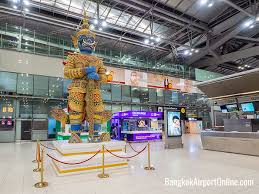
To begin with, I hate the climate and the air pollution over there. As soon as I step out of the airport in Taiwan or in Bangkok, I am reminded of Tom Hanks emerging from the airplane that has taken him to Thailand in Volunteers (HBO Pictures, 1985). “Oooh. Jeezuz H. Christ,” he moans, shielding his eyes from the glare above him. “We must be a mile from the sun.”

Bangkok p0llution this week

The air is hot and steamy, and the smog drifting in from China sits squarely overhead.Pollution index hovers characteristically in winter between red (horrible) and purple (get out).


“China is the single largest source of PM2.5 pollution, not motor vehicles or power plants. . . .”

I’m a New Yorker. My feet are my transportation of choice. I cannot walk in Asia.

Pedestrian travel is high risk. In the first place, sidewalks are rare. In Taoyuan, Taiwan, where my family lives, a beautiful, broad sidewalk will disappear at the end of a block, dumping the walker, trike rider, stroller pusher, or other intrepid walker into the narrow street. The oncoming drivers, especially those on motor bikes, hardly see anything that might impede them. They rarely notice anyone, least of all women on foot. They bear no obligation to observe caution and avoid colliding with the living beings clogging up their streets.

In Bangkok, sidewalks are equally intermittent and rare.

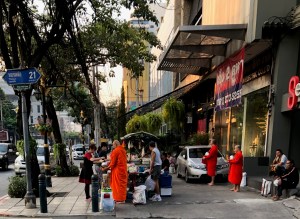
Those that do exist are too crowded for easy navigation. Street food vendors, priests and their sacred altars, resting Maylaysian workers, and full-sized trees in gigantic planters in the center of the walkway impede foot traffic.


In both countries, the law has little or no bearing on drivers’ behaviors. In Taiwan, motorbikes swarm through red lights without so much as slowing down. In Bangkok, drivers customarily bend or break all traffic laws. Crossing a street there is no less dangerous than crossing the Grand Canyon on a tight rope.

In Asia, my northern European structure makes me feel like an abominable snowman publically, embarrassingly melting. I’m too big, too loud, too profane, too averse to obsequies. My feet are gigantic, and I galumpf into rooms where my dainty, demurely quiet Asian counterparts stare at the anomaly that is me. I. Me.

I try to hide my frustrations when I am unable to make myself understood, but my resting face insists on looking angry, and my voice insists on blaring above a whisper. I am incapable of delicacy.

Worst of all, I am a quintessential New Yorker. I voice my pleasure as well as my displeasure in every situation. I yell at drivers who try to kill me. That is not the custom in Asia. There, it is considered impolitic, uncouth to complain even in situations where there are legitimate reasons for complaint. I read recently that in the Buddhist community, complaining or scolding disrupts the karma of the person being addressed. I don’t want to hurt anyone, so I try to remember to bury my discomfort.

Which often whips up a perfect storm. If I hold back, I am frustrated. If I let go, I am embarrassed. Either way, I’m guilt-ridden.

I’ll never be compatible with that world.

Notes from the Temporary Curmudgeon – Day 2

2.The Great Let-Down – The Amazing Mrs. Maisel!!  

Even to those of us who subscribe to the various entertainment portals, there is a distinct limit on what is available for consumption overseas. Netflix is quite generous, offering a wide range of choices, but I had watched all I cared to see on the interminable flights over. Which I thought was okay as I could not wait to binge on The Amazing Mrs. Maisel. But ten minutes into the first episode, I was already fed up with this season’s offering.

Sorry, my many friends and family who love this show. I’m no longer with you!

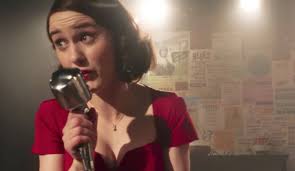
The show seems to have diminished to a series of one-liners delivered by hollow caricatures posing as characters, every one of which is a solipsist with no genuine concern for anyone else. The writers resort to easy, improbable resolutions for every dilemma, and they vacillate between including awareness of the title character’s children and forgetting they exist. No kidding – I was screaming for a Script Supervisor watching the second episode, when the baby was left in the car for hours, and no one even remembered she was there till nearly the next day.

Clearly, the writers have not studied Chekov’s rules for writers of scenes and short stories. There are dozens of interludes, characters, props that exist with no tie to anything essential. And there are far too many props, characters, and interludes that portend surprise and fail to deliver. The Jewish characters are played by fakers, who have no clue what it means to be Jewish, and the script relies on Clichés and stereotypes to tell their ridiculous tales.

Which brings my rant to something more widespread than simply a problem in an Amazon original series.

When will Hollywood get it that it’s okay for Jews to play Jews?

Yellow facing has ended. Asians are hired to play screen versions of themselves. Hollywood and the outlying broadcast gods make at least a modicum of effort to cast Native Americans (including native South and Central Americans) in native roles, to allow South Asians to play Indian and Pakistani characters, etc. Yet gentiles still play Jews pretending to be Jewish. Pretending. Not acting.

This is all part of a long-standing tradition with Jewish characters in film and television. Jews are rarely played as deeply nuanced, real-life people. Instead, they persist as cardboard cutouts. Cartoons. Intensely, grotesquely broad-stroked, either ultra-religious, ultra evil, or ultra ridiculous. In this series, we are totally, ridiculously evil and pseudo-religious.

We all laughed back in 1960 when Otto Preminger cast Sal Mineo as Dov Landau, whom Leon Uris wrote as a scrawny, malnourished concentration camp inmate, who barely survived by learning the art of counterfeiting. Preminger didn’t trust the author’s character and changed him to a swarthy, hale and hearty explosives expert. Okay, it was the ‘60s. And Preminger was making a statement.

A box-office statement enhanced by his casting the gorgeously gentile Paul Newman as Ari Ben Canaan. At the time few knew that, as Adam Sandler would attest, Newman was half-a-Jew.

Jews were used to being played by Italians and WASPS. Gregory Peck was terrific in Gentleman’s Agreement, but he sure wasn’t believably Jewish. It was okay. We all understand that films were, as they still are, driven by their potential ticket sales. In the 1960s the Jewish actors with the mojo to put bums in seats were scarce at most.

The actors were there in Hollywood. Working undercover. Because once upon a time in the West being Jewish – like being gay or Lena Horn black, etc. – out in the open, was to concede to a career of being consigned to playing Native Americans and Asians and all those “lesser” ethnicities who couldn’t get SAG cards.

Today there are many Jewish people out there in the entertainment world. They are out in the open. And as popular as any of the goyim. Which renders ridiculous that British gentile Clair Foy should be cast as Brooklyn-bred, defiantly Jewish Ruth Bader Ginsberg (On the Basis of Sex). The days when one would cast Sir Ben Kingsley as Mahatma Gandhi are thankfully behind us. Clair Foy was a remarkable Queen of England, but as a Jewish intellectual, she’s a silly cartoon.

I guess I’d be less insulted if I thought Rachel Brosnahan, Tony Shalhoub, and Marin Hinkle deserved all the accolades they’re getting. All three are wonderful actors – I am a particular fan of Tony Shalhoub. But they have all swerved way out of their lanes. Their accents are as flat as their affect. None of them made me laugh, despite being in constant one-liner delivery mode. They all persist in imitating characters for whom they lack empathy. There are so many terrific Jewish actors out there. Why was none of them cast?

It would have be so nice to have our people look like real people for a change.

Notes From a Temporary (we hope) Curmudgeon – Day 1

From the week before Christmas till the penultimate week of January, I was in Asia. For some of the time, I was in Taoyuan, Taiwan then moved for the last two weeks to Bangkok, Thailand. I was immersed in the world of the two-year-old grandson, who was my constant companion.

That meant that, for the most part, I was absorbed intellectually and emotionally by the mercurial disposition of the little boy. But when he descended into the quiet of sleep, I found brief opportunities for critical thought, just before the curtain of fatigue closed over my brain. The internet was unstable, but I was able to search intermittently for both news of home and moments of entertainment. Thus, in the narrow alleyways of my own mind as it intersected with the limited scope of the available worldwide web, I found enough material to support a series of rants.

I was unusually cranky. It was hot in Asia. I am no fan of high temperatures. The hot weather exacerbated the extreme anxiety wrought of my distanced observation of the travesty that has become my beloved country.

From over there, it was difficult to assess the degree to which my homeland’s future was tenuous, but it wasn’t hard to picture the Orange Imposter standing on the steps of the Capitol Building grinning while Washington burned. A hideous manifestation of

Theater of the Absurd — an ersatz president strutting and fretting his too long hour upon the stage, pizzicato-ing across the instrument of our American government, threatening to pop the strings and break the neck. My reaction to things was probably more negative than it might have been had I stayed home.

I declaim my rants. I realize I am a victim of my own White Privilege, preyed upon by my sensitivity to an unstable internet connection and an Asian climate.

I acknowledge here that I am an outlier. My opinions and reactions reflect (nearly) none of my confederates’, my cohorts’, my co-anyones’. I react on my own, according to my own lens.

Thus beginneth the venting of my steam. . . Over the next few days, one rant a day. . .

1. The journey across the world.

I usually fly Taiwan’s own EVA Air. The service is terrific, the bathrooms are immaculate, the 777s offer sufficient leg room for my aching knee. Best of all, the company offers slippers that make it easy to shed shoes and still wander the ample aisle space and ward off PAD (peripheral Arterial disease). Unfortunately, I was traveling at exactly the same time as the myriad Asian kids leaving their American schools to spend the holidays at home, and EVA was booked solid.

I resorted to Qatar.

The flight over was miserable. Puddles in the bathrooms threatened dropped clothing, and in the absence of complimentary slippers, stocking feet. The

Airbus E350 has aisles too narrow for easy navigation. The endless sitting made my inner thighs ache. Seats are configured such that I was unable to sit up straight, and the strain on my back worsened as each of the 13 hours it took to get to the first stop (Doha) dragged on. No inflight entertainment soothed the soul either. Every film on the agenda was an action or horror film. I’m too old for those. Instead, I watched the Netflix shows I had downloaded, which meant that I used up the shows I was saving for later.

Truth is, I was already predisposed to be disgruntled. Unlike most airlines, Qatar’s policy is to charge a customer $350 when s/he makes a reservation and changes within 24 hours. The website promised a 72-hour grace period, but it turned out that was only for tickets purchased online.The website was inaccessible on the evening I wanted to book. The price they advertised was expiring that night so I phoned Qatar Air and booked with the company. It turned out that I had chosen the incorrect date and had to cancel. only two hours after booking. Hence, I was obliged to forfeit the $350.

I hope I will never have to fly Qatar again. (NB: There is an addendum to this entry at the end of the book of rants.)


A Note from the Writing Teacher. . .

To my students, who are struggling with personal essays. . .

So, for me, the pleasure in writing comes from the careful choreography of words and phrases, the shaping of a dance that is the process of making a story. No piece is ever entirely free of ways to make it better, but through thoughtful revision, any writing can be rendered fit to perform.

I’ve been writing the same story for over two years. There have been many versions, some comprising around 3,000 words, one over 10,000. I struggle. How do I tell this story most effectively? How many substories– digressions — do I allow into the narrative? That’s the challenge. That’s the dance.

Is this dance a tango, a foxtrot? Could it be a three-act ballet?

Here’s the story. It’s about my mother. Specifically about my mother and her relationship to her cello. When she and her family were forced to leave Europe and leave behind everything and everyone they loved, she was told she could take only one thing with her. She chose, of all things, her cello. Imagine fleeing across Europe, being stopped at every border by guards who would kill you with little provocation, dragging a cumbersome cello. That cello must have symbolized the whole world she was abandoning. More than that. It contained her sister’s soul – her near-twin sister, her closest ally and dearest companion, who had died a few years earlier. That cello conveyed the music her own mother had lost the ability to sing.

I knew that instrument. I was an only child for nearly four years, and every night she would play as I lay awake wrestling my own fears trying to sleep. I had absorbed from her a sense of foreboding, a fear of dangers I could only intuit. Dangers I suspected she escaped but didn’t know how to name. She could not speak them. But in the dulcet voice of the cello, all her losses, all her pain, seemed to grow tolerable. I could hear her face relax, her smile broaden. All those memories of love and sorrow seemed to have found a place in her heart where she could love them without malice.

My father broke the cello. He didn’t mean to, but he ruined it. How does he fit into this tale? If I tell the whole tale, it becomes sadder.

Shall I write about the flight from Europe and the way the cello facilitated her adjustment to America? Do I write about the way the cello soothed our collective lives? Or do I write about my parents’ marriage and how the death of the cello killed it? That’s all contained within the scope of this project. Each iteration has more or less of every aspect. And then some.

Like the way I tried to emulate and heal that woman. How I wanted her to love me as much as she loved that cello. How much of that should I keep in . . . or edit out?

I wrestle with this the way you wrestle with perfecting your personal essays. You want to tell a story. But you are not sure which story will it be. How do you narrow it down?

A journal helps. You can make notes, write passages, tinker with time and place. Which story can you tell most openly, holding the least of your emotion back? Into which one do you feel most comfortable immersing yourself? Follow that one. . . even if it leads you into steps you never expected to learn. In the end, choose the story that chooses you. It will. At some point, while you’re searching for the right words, hoping for the best inspiration, it will tap you on the shoulder and ask you for your hand.

And that’s when the dance will begin in earnest.