Thankful for Home. . . .

One of Mayor-elect Mamdani’s promises is that he will rout out the evil landlords from NYC, and that worries me.  By whose estimation are landlords deemed as such?  To what measure do we hold them?  And who decides which landlords deserve to be punished?

In my building in Harlem, for example, there is much discussion about how we are neglected. There have been some dire problems, and we are without a full-time superintendent, without a maintenance man, without real support.  As frustrating as that is for us tenants, it is too easy to blame the landlords, too facile to call them negligent.

Running a building is an expensive, difficult operation.  Especially in a building that tries to accommodate those of us who truly NEED to be paying rents that are realistically affordable. Affordability is a word that has no real meaning in most of the city these days — directly across the street from my building is one that the NYC lottery has offered as “affordable,” a word defined by starting prices of $4400/month for a studio apartment. For whom is such a sum affordable? Not for most of us in my building.

Ours is a rent-stabilized building that houses 130 units, some of whose tenants are living on Section-8 vouchers and some who are unable to meet their monthly obligations, for which the landlords are merciful.  We have had our share of sink and tub drainage problems, and it is absolutely clear that the plumbing and disposal systems, built in 1984, might need replacing; but, for the most part, even without the full-time help, things usually right themselves in due time.  People complain there is no heat, but the city regulates landlords, and while I would prefer there were NO HEAT at night and a little more heat by day, I am sure our landlord is meeting their obligations. Occasionally, we face other problems endemic to the city, but within a reasonable amount of time, they are usually dispatched. If we are not treated like guests in a 5-star hotel, well, we’re not guests in a 5-star hotel. We are working folk who come home to a stable building protected by a security guard and maintained with enough care that we certainly never suffer the slings and arrows of the sort Mr. Mamdani refers to as evil landlording.

I would never want the responsibility of providing housing to so a disparate group as the group housed in our building comprises.  We come from all walks of life, all kinds of culture, and we can be a demanding lot, who, overall, get whatever we need.  The landlords have an incessantly huge task.  One I do not envy.

On this Thanksgiving, I am grateful for the roof over my head.  And for the management that keeps my building functioning. 

Thank you, Park Management. 

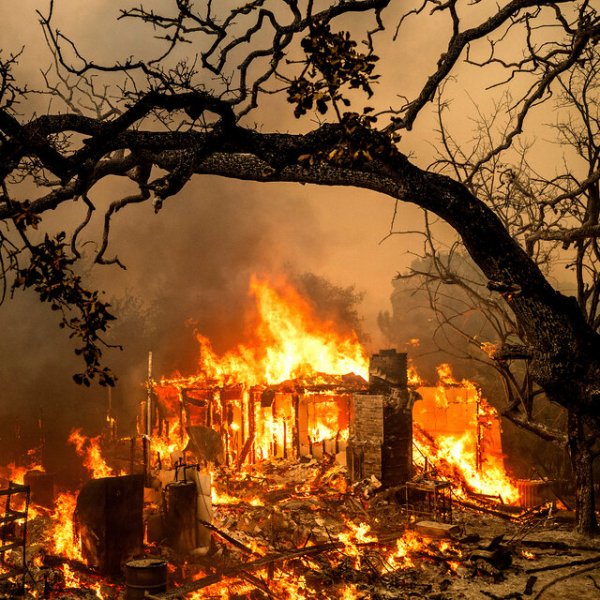
Nation on Fire

City on fire!
Rats in the grass
And the lunatics yelling in the streets!
It’s the end of the world! Yes!
City on fire!

Stephen Sondheim

I don’t think I have ever been as confused, angry, and depressed by current events as I am today. I recognize neither my country nor my compatriots.  Which is why I am compelled to chime in, though I admit that nothing I have to say is new; nor do I say anything that has not been said by better speakers.

 In the wake of the Charlie Kirk assassination, it has become painfully clear that this nation, which I have always regarded as a refuge, is burning down.  How can it be that a nation so theoretically dedicated to the proposition that all men are created equal, a country wedded to the right of free speech, a commonwealth so purposefully focused on individual rights, has become such a sewer of discontent, maliciousness, and vitriol?

It should be easy to be inured to the violence that surrounds us all.  Every time I activate any device, the newsfeeds report another stabbing, shooting, beating, shoving . . . some action taken against a victim whose only crime was disagreement.  But my skin never becomes thick enough to let it all slide off, and Charlie Kirk has enlivened all the danger signals, has brought all the fire warnings to the fore.

Like many fellow boomers, I had hardly heard of Charlie Kirk before his murder. If I considered him at all, I thought he was a loud millennial signet Trump-eting to his young flock.  But, once his death became the stuff of everyday obsession, I made it my business to find out who and what he actually was. 

I see now that he was a spokesperson for the insecure youth of America, those who are caught in the maelstrom of the overzealous, radical far-left ideologies that dominate their surroundings.  While Kirk’s beliefs represent those I long ago rejected, and though I disdain his politics, I understand how he attracted youngsters who needed his firm, unwavering reassurances that there might be a way to find peace and light through Jesus Christ and Donald Trump.  I agree with none of his words, but having watched multiple videos of his interactions and speeches, I can find no evidence of his being a bully or a mean-spirited man.  I see an overconfident alpha male inviting people to debate with him, people who gladly engage.  He argued vigorously, but he was no Grand Inquisitor dictating conversion.

I have family members who are born-again Christians, and I know that in their hearts, they believe it is their duty to save the world by convincing us all to pronounce commitment to their version of Jesus Christ.  When Erika Kirk spoke in the immediate aftermath of her husband’s death and at the funeral, I was struck by how much she sounded like people I love.  I disagree with them almost entirely, but their intentions are pure.  And intention must count.  Erika Kirk deeply believes it is her Christian duty to forgive her husband’s assassin, and Charlie Kirk deeply believed it was his mission to save America’s youth.

Kirk should not, however, be hailed as a martyr.  The unhinged young man who shot Charlie Kirk represents no cause, is not a faithful follower of any philanthropic group. Tyler Robinson may be confused, and he may be lost in his political beliefs, but he did not kill Charlie Kirk for any reason but his own personal compulsions, whatever they are. 

In both camps, free speech is the true victim, the real martyr.  It is dangerous these days to express beliefs of any kind, and there is a vacillating definition of the word “freedom,” the freedom that is at the core of the national dissonance that keeps getting louder. 

The problem is not whether Charlie Kirk was right or Jimmy Kimmel was wrong.  The problems that rule our daily lives are whether the guy who passes you on the highway gets to take your right of way without being shot at, and whether your friends get to say they don’t want to eat fish for dinner without fear of being stabbed for disagreeing with you or if the woman waiting for the #4 train she deserves to be pushed in front of an oncoming train because she didn’t say “excuse me,” when she bumped into you.

Both sides daily stoke the fires. Neither side seems willing to brandish an extinguisher. And that’s why the fires are consuming us all.

Lucky’s Not Good Enough

I wanted to love We Were the Lucky Ones, a Hulu original series.  After all, the story resonates with me.  Like my real-life Jewish family, the family in the show is dispersed by the Nazi invasion, set adrift in the world.  It’s a masterful series, well acted, realistically written, and beautifully shot.  Yet, after the second or third episode, I found myself feeling sick, resenting the artistry of it.  The why eluded me at first.

The drama is certainly harrowing.  An embattled family encounters every possible horror that the Holocaust meted. They witness, narrowly escape, suffer aftershocks, and move on. The music is Schindleresque sad, and the scenes of torture and cruelty are horrifying.  But that’s not it. Nothing in this show is any worse than what Keneally or Spielberg depicted or what Primo Levi described.  No loss is any more heartbreaking than those Daniel Mendelsohn memorialized.  There is nothing to see in this series that we haven’t seen in any one of the honorable Holocaust museums across the world.   So why does this show so offend me? 

Over my head, I hear the whirr of helicopters, and I run to the TV to check the local news. On the screen, hate-spewing,  pro-Palestinians rally on my Alma Mater campus, just up the street from my home.  An angry child-woman glares into the camera and shouts, “They are weaponizing the holocaust” while hundreds scream, “From the river to the sea.” 

At another gathering in midtown Manhattan, youngsters in checkered scarves and green, white, black, and red flags scream “Free Palestine.” A middle-aged man proudly waves a Hamas flag.  Online, a headline from the ADL: “Chicago Sees Rise in Antisemitism and Activism Amid Action by Anti-Israel Groups.”

There it is. Now I get it.

Our stories are betraying us.  It’s time to revise.

Real life has become scary, and those of us who inherited our parents’ PTSD, who were born with memories we cannot decipher, are reliving the dreams we cannot comprehend of the terror they fled.  The specters that used to visit only by night are fully animated by day.  Once upon a time, the anticipation of violence was easily quelled by stories that assured us that the world was sufficiently sorry; pogroms were a thing of the past. We believed our parents when they reminded us that this is America, after all, and we could feel safe.  No more.  Those night fears loom omnipresent over my home, my security, my grandchildren.  The stories no longer heal.

The haters are wrong.  It is not that we are weaponizing the Holocaust or antisemitism.  But we are hiding behind it.  We hold up our past like medals won in the Suffering Olympics that proclaim our capable willingness to suffer.  There is no more reassurance in the idea that it can’t happen here because clearly it can.  And it will if we let it. 

Those who wish for our annihilation are fueled by our pain.  Many display their own medals and say we have not suffered nearly enough.  Others are simply irritated by what they perceive as our whining insistence that enough is enough. 

We have to stop thinking that this approach will work. Many in the world deem it passive aggression.  We have to stop apologizing for our coreligionists who are fighting for the survival of Israel.  We have to stop disclaiming our right to fight back.  We have to take control of the rhetoric and paint ourselves as a far more positive, authoritatively powerful people. As Rabbi Diana Fersko recently wrote for Tablet magazine, “We have to stop running defense” (“American Jews Should Become a Little more Israeli” April 1024).  Just because millions of us were killed in the holocaust doesn’t mean we must beg for survival by reminding our foes we don’t deserve to be exterminated.  Would we be any less deserving if we had not suffered the mass murders? 

Art is a wonderful place to find relief and transformation.  Which is what so many writers and filmmakers, artists and curators have done by insisting on telling our truth.  But at this moment, the profusion of new Holocaust reenactments feels like a Hail Mary play that is doomed to failure.  We cannot think that because Hulu shows The Lucky Ones for ten weeks on their streaming app our detractors will suddenly see the folly of their ways and back off.  Will one Jewish family’s miraculous survival of that great apocalypse convince the world to watch any less dispassionately while the Ayatollah rattles Iran’s nuclear sword?   Not a chance.

We should have more films like Munich or Raid on Entebbe or even Exodus. We need to see heroes like Liev Schreiber’s character in “Defiance,” heroes who defied the stereotypes and showed our refusal to let the world beat us up.  There should be more series like Tehran that explore the ways in which Israel and world Jewry are endangered every minute of every day by adversaries who hate us for no reason but that they do. We should have filmmakers creating films like Watching the Moon at Night that expose Hamas leaders’ vitriolic calls for the extermination of all Jews everywhere. We need documentary footage of Jews standing up to the hate, holding their ground. . . winning.

We cannot expect the world to feel sorry for us just because we wear our thorny laurels in public.  People are not moved by pictures of dead Jews.  They take those images for granted.

Of Pasha And Pancakes

My father loved pancakes.  My mother made them often, but he especially loved the pancakes that the women of the United Methodist Church served every Easter morning after sunrise service. 

Perhaps the pancakes tasted sweeter when filled with the spirit of revelation.  Perhaps he just liked the way the pancakes were uniformly round, thin, and warm, so unlike the ones my mother made.  Hers were always misshapen, and by the time they got to his plate, they were routinely cold.  I suspect that in his mind, my mother had not mastered the gentle American art of making pancakes, as she had most assuredly not mastered the compleat art of Easter.

Oh, she got the gist. She understood that Easter was, like Passover, a celebration of renewal, of rebirth.  I was born in the wake of the Holocaust that drove her to the US, and though she never said as much, I know that the symbolism of Easter and Passover were reminders that she was fortunate to have a life that had transcended the ashes that consumed so many of her loved ones. She abjured the images she admitted to later, images of Easter pogroms in her father’s Polish shtetl. She embraced our celebratory rituals – coloring eggs, making paper flowers, painting murals for the dining room that exploded with the glory of springtime.  We lived in several places in the northeast, where winters then were long and bitterly cold.  The warmth of spring was a welcome reprieve.  But she never made Easter about Christ.

Nor did she make pancakes on Easter Sunday.  Easter Sunday was the one Sunday we broke with the weekly tradition of attending church together. 

On that morning, because I sang in the choir, Dad woke me early, and we went together to Sunrise Service, after which he stood in line, first for pancakes, then for seconds.  He chatted with the parishioners, schmoozed with the minister and the assistant minister, and then he drove back to the house to get the rest of the family. I would watch from the choir loft with a modicum of embarrassment as Dad, Mom, and my six siblings, all dressed in the new Easter finery that Mom herself had sewn, filed in.  They were, as always, about ten minutes late, and the congregation seemed amused as they filled a pew at the front of the nave. 

After the service, Dad was like a little boy.  He could not wait to get us home to our Easter baskets, which he had personally filled with candy and little toys.  Then we’d have brunch, which Mom would serve with pride. The other food varied with the years – when we were flush, we had meat and cheeses, and when we were not, we had whatever we could afford – but three critical items never changed.  At every Easter brunch, we ate the eggs we had colored the day before and the Passover matzahs she had hungrily opened that morning.  We always had chicken soup and matzah balls.  Dad made fun of Mom for the matzah.  She could have chosen toast, he would chide.  Or she could have made pancakes.  She would smile and say, “You already had your pancakes, and you don’t like mine nearly as much.” 

The year I was about 6, the toys in our basket included tiny taxidermized chicks.  My mother was appalled.  She said something I didn’t understand about carrying the imagery of Easter too far.  When I realized what I had in my hand, I shrieked and ran to the backyard, where I buried the weightless thing in Mom’s tomato garden. Years later, Dad remembered the day more vividly than I did, and I believe he blamed it for a cataclysmic change that came over me when I was twelve.

Until then, I never questioned our tradition of attending church together every Sunday. I was deeply committed to my father’s religion and, from the time I was 5, I sang in the choir, often emotion-laden solos with tears running down my face.  Easter was my teariest time –  tears of mourning for  the crucifixion and tears of joy for the resurrection.  My father was intensely proud. 

Then, in the middle of my final tween year, I experienced a reversal of faith.  I told my father that I respected Christianity deeply, that I believed in its tenets regarding love and forgiveness. But the basic mythology had lost its appeal. I could no longer believe in the stories; they did not ring true.  Dad and I fought bitterly over what he considered my blasphemy, but I was obdurate.  I would no longer participate in the rituals of the religion, and I would no longer attend church with him. He acquiesced.

My denunciation hurt him deeply.  I am not sure he ever truly understood what made me an apostate, but he never blamed me.  He never shunned me or made me feel awkward about it.  Our fight on the day I announced it to him was the last time he even addressed it. Until the year my first child was born.

Fifteen years after my lapse of faith, my husband and I moved to be near my parents’ home, where we reinstituted our family celebrations.  When Easter arrived, I was four months pregnant.  We spent the day with my parents, who had prepared Easter baskets for my teenage siblings still at home and another for my unborn child.  Mom was in the kitchen putting the last-minute touches on her Easter brunch, and I was pouring water into each of the glasses on the beautifully set table when my father asked me what religion we had chosen for the baby.

“Will you raise your kids as atheists?”  He asked. 

I laughed.  My husband had left Catholicism for many of the same reasons I abandoned Dad’s religion, and we had several times discussed our plan for our family’s religious education. Atheism had never been a consideration.

We wanted our children to have a solid background so that when they reached the age of renouncing traditions, they would have something to reject with authority.  No dropping out without a foundation for our offspring.  We decided on my mother’s religion, which seemed to us to be both logical and reasonable. 

“Besides,” I said to Dad.  “There’s no way around it.  Mom’s Jewish.  That means I am too.  And my children are as well.”

“Yes,” he said, nodding thoughtfully. “It’s a sound choice.”  Then, with a twinkle in his eye that was tinged with just the slightest hint of accusation, he added,   “You do love those matzahs.  And with Passover, the only dead chickens will be in your soup.”

Taking Cover

A Rant: The Trouble With Guns.

Columbine changed my relationship to America. 

Once upon a time, I was proud and unabashedly grateful to be a part of this remarkable experiment called the USA.  Then suddenly, in a blaze of terror, fifteen children were brutally assassinated, 24 more were wounded, and countless more left with interminable PTSD.  In the aftermath, our collective failure to heal the national addiction to guns murdered my faith in my country. Today, I feel like an orphan. The country that gave my family refuge, the place I felt comforted, safe, no longer feels like home. 

I began to feel betrayed.

Just weeks after the Colorado tragedy, as I prepared to teach my first period of the day at a Connecticut high school, a shooter invaded our premises. The principal commanded us to lock our doors, to stay on the floor where we could not be seen through the windows that faced the hallway, and to wait there for updates.  My students and I crouched against the wall of the room, terrified of what might happen. 

Nothing did. The gun-toting stranger never fired a shot and was caught.  But I decided then and there that I could not put myself in this kind of jeopardy anymore.  I wasn’t just afraid of being shot – though I definitely was! – I could not envision being forced to watch in terror as children were mutilated.  I didn’t have it in me.  I quit teaching, went on to other things. And I got involved in trying to make a difference.

I wrote letters, posted blog rants, called lawmakers, and spoke out wherever and whenever I had a platform.  Sent money to the groups promising to fight for regulations.

Guns proliferated. Every year brings a new array of tragedies wrought by angry teenagers or disgruntled postal workers or distraught fathers or rabid fundamentalists. . . all armed with guns.  And oh, Sandy Hook.

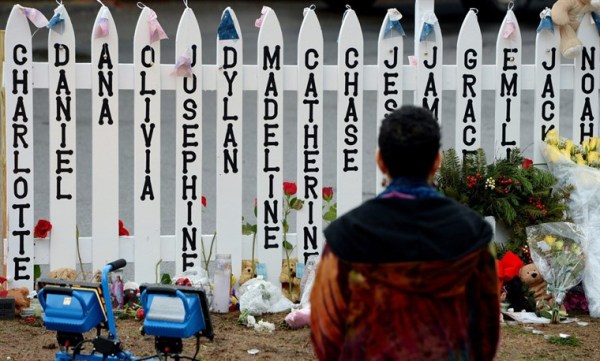
Surely, I told myself, the images from Sandy Hook must change everything.  Even if the men in our culture insist on suborning murder by clinging to their guns, surely Grandmothers, mothers, aunts, teachers, sisters. . . the women of America will rise up to ensure that our babies are not so easily jeopardized.  Sure there will be an outcry to eradicate the monstrous misuse of weaponry that inflicts such terror.

I was wrong.  Even as Alex Jones defamed the Sandy Hook victims, even as assault weapons continued to violate sanity, nothing changed.  The horror persists. Today, I a longtime friend, a woman I respect and admire, posted a plea on Facebook for concerned citizens to write to Congress and demand they defeat the assault weapons ban, that they protect our right to bear arms, that they stop the Democrats’ bill to curb the insanity.

How can anyone justify the stockpiling of semi-automatic pistols and rifles?  I empathize with those people who feel so threatened they might put their faith in a gun, but I reserve none for those who believe that our government should not – cannot –  regulate the way in which guns are bought, owned, operated. Without regulations, our children are never out of danger.

Never.

Since the Columbine High School shooting in 1999, nearly 300,000 students have been on a campus during a school shooting.  949 school shootings have taken place since the Sandy Hook Elementary School exploded in December 2012.  Just yesterday, February 13, four more people were shot to death at Michigan State University. So much carnage.  Not only the dead. . . . the wounded, the destroyed families, the traumatized children and teachers who bore witness.  Communities forever changed.

In January 2023, a six-year-old child walked into school with a 9 mm handgun in his little backpack.  He shot his teacher and was miraculously stopped before he turned the gun on his classmates.  The trauma of that day will live on in every one of those first-graders’ hearts and minds to their last breaths.  Yet “given the child’s age, no charges will be brought,” reported the local police chief.  Nor have charges been brought against the parents.

The absolute degeneracy that the case of the six-year-old shooter represents is stultifying.  We live in a time, in a country where a small child, who must be reminded to put shoes on his feet to walk out the door, can blithely pack a gun and shoot his teacher.  Ours is the only country in the world where this is possible.

I have a daughter and a grandchild living in Turkey. Every day someone asks me how I can stand knowing the dangerous conditions of their life there.  I am frequently asked, “Can’t you insist they come home?”  Danger?  Sure, there are difficulties for a western woman living there, and there is volatility.  But no one in Turkey, except the military police protecting the airports, carries an assault weapon.  No child would dream of going to school with a pistol in his pocket.  In Turkey, even earthquakes are more predictable than gun violence is in the US.

The gun industry is a cartel.  It controls our lives in subtle and critical ways.  And we allow it to keep on keeping on.