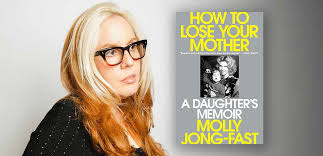
When Molly Jong Fast’s How to Lose Your Mother: A Daughter’s Memoir (Viking 2025), I resolved to avoid it. I mean, Erica Jong, author of my liberation, facilitator of my most humorous self-deprecation. I didn’t want to know the sad, selfish underbelly of my hero. Then, one day, I listened to an interview with the author, and I thought, “Well, if I can listen to this book in her voice, maybe I’ll learn something.” I did. I found the audio book narrated by the Jong-Fast herself, and, wow, am I glad I did.
Once I relented, I found myself feeling enormously grateful to Molly Jong-Fast for sharing her mother’s missteps, blunders, neglect, and abuse. It made me more aware of my own mistakes and offered me a sense of what my own children might have felt at times in their childhood.
Erica Jong was nothing like me. She was glamorous, well-connected, and a star with a severe drinking problem. I was and had nothing of the kind. But I am a writer, and I know now that too often in my children’s lifetime I felt I had relinquished my Self on their behalf, and I am sure I unwittingly hurt them in some of the ways this mother hurt this daughter. Erica Jong’s dementia and her singular life view prevent her from understanding what happened to her daughter, but with any luck, I still have some time. To make some repairs. Or at least to let my kids know I care. I am sorry.
At base, How to Lose Your Mother: A Daughter’s Memoir, is an everywoman story. When I wrote my memoir, I struggled with how to depict my mother, who suffered multiple traumas too few years before I was born to have sorted them out; she grew to be the mother everyone wished were theirs, but there was always a regret between us for what we could not have. I realized, as I wrote and forgave us both, that the complexities of the mother/daughter conundrum are much the same for even the happiest of pairs. Each mother, each daughter is a reflection of the other. As my mother’s face becomes more clearly the one I see in the mirror every day, I understand more deeply how normal we actually were.
I am grateful to Molly Jong-Fast for the mirror she held unto my nature in much the same way I remain grateful to Erica Jong for Isadora Zelda White Stollerman Wing . . . and later for Serenissima and the sensual dive into Jessica Shylock’s world. . . . as well as so many other pages of entertainment and enlightenment.
How to Lose Your Mother: A Daughter’s Memoir is a lovely — if oftentimes harrowing — read, a book any daughter is liable find herself and her mother in. A terrific experience.
City on fire! Rats in the grass And the lunatics yelling in the streets! It’s the end of the world! Yes! City on fire! Stephen Sondheim
I don’t think I have ever been as confused, angry, and depressed by current events as I am today. I recognize neither my country nor my compatriots. Which is why I am compelled to chime in, though I admit that nothing I have to say is new; nor do I say anything that has not been said by better speakers.
In the wake of the Charlie Kirk assassination, it has become painfully clear that this nation, which I have always regarded as a refuge, is burning down. How can it be that a nation so theoretically dedicated to the proposition that all men are created equal, a country wedded to the right of free speech, a commonwealth so purposefully focused on individual rights, has become such a sewer of discontent, maliciousness, and vitriol?
It should be easy to be inured to the violence that surrounds us all. Every time I activate any device, the newsfeeds report another stabbing, shooting, beating, shoving . . . some action taken against a victim whose only crime was disagreement. But my skin never becomes thick enough to let it all slide off, and Charlie Kirk has enlivened all the danger signals, has brought all the fire warnings to the fore.
Like many fellow boomers, I had hardly heard of Charlie Kirk before his murder. If I considered him at all, I thought he was a loud millennial signet Trump-eting to his young flock. But, once his death became the stuff of everyday obsession, I made it my business to find out who and what he actually was.
I see now that he was a spokesperson for the insecure youth of America, those who are caught in the maelstrom of the overzealous, radical far-left ideologies that dominate their surroundings. While Kirk’s beliefs represent those I long ago rejected, and though I disdain his politics, I understand how he attracted youngsters who needed his firm, unwavering reassurances that there might be a way to find peace and light through Jesus Christ and Donald Trump. I agree with none of his words, but having watched multiple videos of his interactions and speeches, I can find no evidence of his being a bully or a mean-spirited man. I see an overconfident alpha male inviting people to debate with him, people who gladly engage. He argued vigorously, but he was no Grand Inquisitor dictating conversion.
I have family members who are born-again Christians, and I know that in their hearts, they believe it is their duty to save the world by convincing us all to pronounce commitment to their version of Jesus Christ. When Erika Kirk spoke in the immediate aftermath of her husband’s death and at the funeral, I was struck by how much she sounded like people I love. I disagree with them almost entirely, but their intentions are pure. And intention must count. Erika Kirk deeply believes it is her Christian duty to forgive her husband’s assassin, and Charlie Kirk deeply believed it was his mission to save America’s youth.
Kirk should not, however, be hailed as a martyr. The unhinged young man who shot Charlie Kirk represents no cause, is not a faithful follower of any philanthropic group. Tyler Robinson may be confused, and he may be lost in his political beliefs, but he did not kill Charlie Kirk for any reason but his own personal compulsions, whatever they are.
In both camps, free speech is the true victim, the real martyr. It is dangerous these days to express beliefs of any kind, and there is a vacillating definition of the word “freedom,” the freedom that is at the core of the national dissonance that keeps getting louder.
The problem is not whether Charlie Kirk was right or Jimmy Kimmel was wrong. The problems that rule our daily lives are whether the guy who passes you on the highway gets to take your right of way without being shot at, and whether your friends get to say they don’t want to eat fish for dinner without fear of being stabbed for disagreeing with you or if the woman waiting for the #4 train she deserves to be pushed in front of an oncoming train because she didn’t say “excuse me,” when she bumped into you.
Both sides daily stoke the fires. Neither side seems willing to brandish an extinguisher. And that’s why the fires are consuming us all.
Walking in the almost cool, late August air today, I felt a premonition of Fall. Crisp air, cornflower sky. Finally. . . October’s on its way.
October has always been a special month. My birthday, my youngest child’s birthday, the year’s first cold snap, darkening afternoons. This time, however, the October snippet hit me with an image of Marilyn Joan Alkus Bonomi.
Mari and I met on an October Saturday in 1987 at my youngest’s birthday party, a party I hoped would help us get acquainted with our new neighbors. We had just moved from Arizona to Connecticut, and none of us had been prepared for the culture shock we would encounter. Fitting in was challenging, and a party seemed like an opportunity to make some friends, to show our new cohorts that while we might not have mastered the eastern way of dressing and speaking, we were just plain folks like everyone else. Personally, too, I hoped that an adult or two would come to the party and stay, be a welcoming presence . . . or at least a fellow parent with familiar sensibilities.
Mari was the one. She swept in, deposited her daughter in the midst of the other children, then sat down next to me and opened a conversation that drew me in, made me feel instantly connected. It was a stream of consciousness into which we were able to immerse ourselves every time we were together for the next nearly forty years of our enduring friendship.
We had lots in common. Her daughter and my youngest were the same age and had already begun to bond, which meant that Mari and I were destined to see one another often. We were both English teachers with a deep connection to the theater; she was well established in Connecticut, and I was looking for a job. We shared a nearly obsessive love of rhetoric and a penchant for lost souls. Though humanist Jews, we had both chosen husbands who were Jesuit-trained Catholic schoolboys.
Over the course of that first year, her daughter and mine became besties and formed a union that included my older daughter; Mari and I were fused.
Because of Mari, I quickly found a job. At the birthday party, she had been delighted to learn that I planned to substitute teach while I sought permanent employment. “That is wonderful news,” she said. “I teach at Amity, in Woodbridge, one of the best schools in the country. Can you tell I’m proud? Anyway, we never have enough good subs. I’ll put your name in.”
She did. I spent much of that year subbing at Amity and loving it.
One day, when we were lucky enough to have lunch together, she pointed to a lanky man leaning in among a group of students, listening intently and chatting with them. “See that guy?” She asked. “That’s Stu Elliot. He’s one of our Assistant Principals. A good man. A great administrator. See how he interacts with the kids? He is special, which just means we won’t have him for long. He’ll have his own school any day now. Which is why I want you to meet him. He will want to hire teachers of his own choice, and you would be a perfect addition to any team he takes on.”
We spent ten minutes talking to Stu, and I agreed. He was remarkable. A year later, he became my principal at the high school next door to my house. I could not have been more fortunate, and my gratitude to Mari never diminished.
Our friendship ran deep. Her child was at my house almost as often as mine was at hers. We celebrated holidays together and commiserated when we were both unhappy. Our contact lapsed a bit as each of us traversed the hard road of divorce and redefinition, but we found one another again in time to have a few great years as senior citizen sisters. Though never enough time to fully share our appreciation for years of a deeper-than-blood kinship.
Since 1987, my life has been fuller in dozens of ways because of Marilyn Joan Alkus Bonomi. Though she will live on in her daughter’s eyes, in her grandson’s laugh, in my heart, in my soul, in my very vivid memory, I shall miss her voice, her presence, the soft touch of her abiding love.
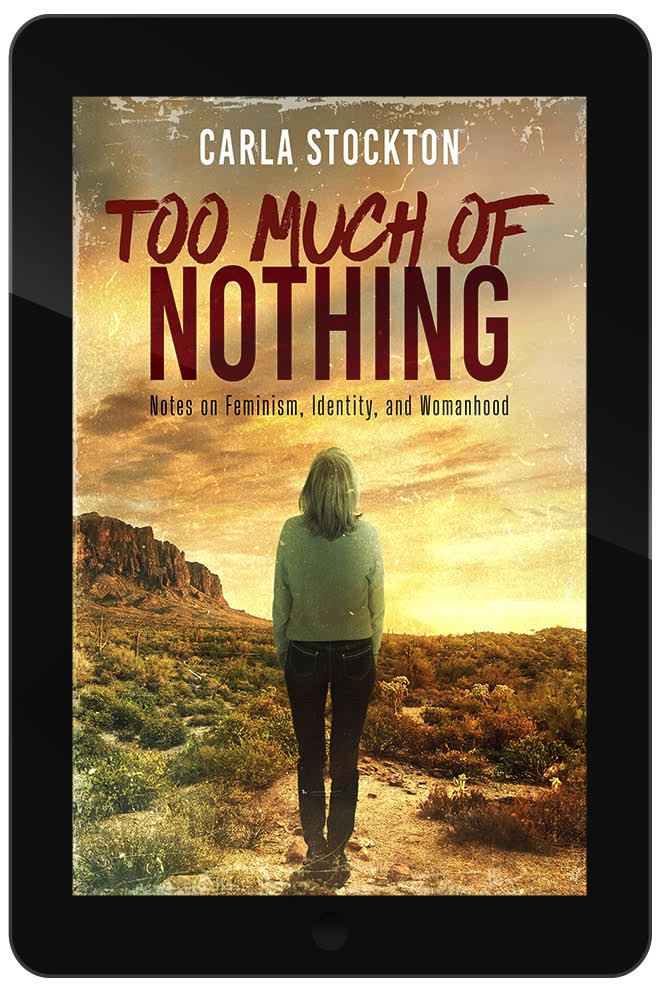
Too Much of Nothing: Notes on Feminism, Identity, and Womanhood (Mountain Ash Press, October 2024) was not the book I expected my first solo book would be. I had spent two years compiling stories about my mother’s immigrant family, my father’s eccentric past. They comprised the MFA thesis that I planned to publish. My readers disagreed.
“Make this your second book,” they said. “What’s most interesting in this work is the story you tell with you as the central character. Write about you first. Then write them.”
I revamped, reassuring myself that my next book would be the tribute to my family I felt compelled to write. Once I got past Book #1, I would return to the compendium of family stories, the histories of my displaced and troubled forebears, to honor their memory with my carefully chosen words.
Once Too Much of Nothing was launched, I moved into the process of preparing the next book by focusing on my immigrant mother’s trauma and her family’s survival and planning for the research that would delve more deeply into Dad’s ancestry. I began preparing to depict the layered amalgam of culture and sorrow my parents’ union created.
The journey has been fascinating . . . . Their background is rife with drama. The forces that drove mom’s clan out of Europe in 1939, coupled with the tales of my father’s Dutch family, provide a rich tapestry of escape, survival, and the power of love. Best of all for me as a true New Yorker, their stories converge in the Catskill mountains and coalesce into one truly American chronicle.
When I read Russell Shorto’s Taking Manhattan: The Extraordinary Events that Created New York and Shaped America, I realized again how important the story I plan to tell really is.
I’ve been a Shorto fan since, as a New York sightseeing guide, I read his Island in the Middle of the World, his history of New York City, which argued that everything we identify as American comes from the cultural stew that simmered in New Amsterdam/New York. That stew, according to Shorto, contained generous portions of the Dutch, English, and Jewish traditions that bubbled in my identity. Shorto’s newer book re-examines the history even more sharply, and he plumbs the depths of tropes that any child who attended Junior High in New York State was fed as the history of our state.
We all knew that the Dutch established a community here and called it New Netherland, that New Amsterdam, their city at the tip of the Manahatta Island, was its capital. Then, in 1664, the English arrived on the banks of the Hudson River, seized New Netherland, and renamed it New York. Then, the Dutch slinked away to the corners of history.
Not exactly the truth, Shorto proves.
According to documents that have only recently been translated, there is much more to the story that we did not know. The Dutch West India Company, acting not as agents of the monarch but as agents of the world’s second international trade union (the first being the Dutch East India Company) stole New York – and what are now Delaware, New Jersey, much of western Massachusetts, and Rhode Island – from the natives and built a society that encouraged diversity. They were not inherently more tolerant than the English or the Spanish, but they found that a multicultural world was conducive to profitable business. And business was what they were all about. They were willing to accept anyone and everyone from anywhere at all, so long as there was money to be made. What the Dutch West India Company did not do was to protect its people from the reprisals by the understandably angry natives, and they failed to create a workable government.
The British Civil War had just ended, reestablishing the English crown. King Charles II realized that his ravaged country needed to curry influence in the new world in order to replenish his coffers. He put his brother James in charge of asserting their presence, and James sent emissary Richard Nichols to take possession of land that now constitutes most of the Northeastern United States seaboard.
After spending some time in the Massachusetts Bay Colony negotiating peace between royalists and Puritans, Nichols, well-educated and conversant with Dutch success, sailed down coast and up the Hudson River to negotiate with Peter Stuyvesant for a transfer of power. No shots were fired; no animosity resulted. As soon as his signature was affixed to the document, Stuyvesant made a brief visit to his European homeland before returning to Manhattan and settling down on his large farm at the south end of the island. He died a very wealthy, satisfied New Yorker.
Nichols knew that a system that worked needed no reworking, and the Dutch system worked. He brought in military forces to protect the citizenry, to maintain loyalty to the King, and to uphold the law. But the Dutch remained in positions of political and social prominence. The array of religions and nationalities that had thrived under the Dutch retained their status as well.
In the story Shorto tells of my city, I see my mother and my father as central characters. My father’s paternal English roots English planted themselves in Massachusetts, Maine, New Hampshire in the 1620s when they fled the Church of England, around the same time as his maternal folks were landing in New Netherland. Members of the Dutch Reformed Church, Dad’s second and third great-grandparents likely originated as Walloons, Calvinists who wandered away from the perils of Catholic Belgium and France into New Amsterdam by way of Holland.
Likewise, my mother’s people had spent generations seeking a safe homeland. Out of the Russian Pale of Settlement, into Poland/Ukraine, to Zagreb by way of Vienna, and eventually to Kingston, NY, once a Dutch enclave called Wiltwyck.
I will write about my parents. But I will write about them as fictional characters in a time when unions like theirs were the stuff that fueled the sensibility that built the United States.
My parents’ fictional personae will inhabit 17th-century New Netherlands. He as the son of parents who arrived in 1624, for the purpose of establishing a future in nieuwe wereld. She as the child of a Lisbon-born Jew, whose family, dispersed by the Inquisition, had found refuge in Dutch Recife, Brazil, until the same Inquisition sent them scrambling to New Amsterdam.
My protagonists are Lia and Izaak. Neither’s story is unique, but each has a singular voice and a profoundly individual presence. Theirs is a timeless story shared by millions, but their details are theirs alone.
A good friend who lives and writes in Mumbai, posted a substack story about her misadventures in Bollywood. I shared some parallel experiences, and I am here to share my full reply. . . .
Yes, Sukriti, we have lived a kind of parallel existence. I am here to recount this failure of mine because it gave me strength to move on, to find new paths. . . . Don’t get me wrong. I wish I might have succeeded. But, as with so many things in life, it is what it is, and I am where I am. . . .
And so the story.
Once upon a time . . . a loooong time ago . . . . My very young self thought I should be an actor. I believed that if I worked hard, took whatever roles came my way, and learned the business well, I might evolve and become a director, or, better yet, an auteur. I could make it. Big.
It did not take long for me to realize that I was not cut out for the profession I so desired. I did not have the right look, the right attitude, the right anything. As an actor, I realized, I was a really good writer.
So, no problem, I thought. I would work on becoming a Hollywood writer.
At the same time, I was married to a person who had been non-definitive about whether we should reunite. We had shared the Broadway dream and settled in New York, but he moved home to his mother in San Francisco when Hepatitis made a mess of his liver . . . and his stamina. I was unclear as to whether our relationship was finished, a fact that proves again and again to me how unplugged I was, but I had the notion that it was up to me to patch us back together. Three days after I arrived in San Francisco, I was on a bus, bound for LA, too humiliated to go back to NY and admit my abject failure. What the heck, I figured. There was theater in LA. And, more importantly, there were movie producers waiting for scripts to be written.
Lucky for me, my first cousin was the Great American Director Peter Bogdanovich. He had at that time made his first – and to my mind his most profound –film Targets, and he was gearing up for The Last Picture Show. Unlucky for me, we were not Coppolas; cousins in my family have not been good at leaning on or propping one another up. When I arrived in LA and called him, Peter laughed and said I should be a paperback writer. It was a good goal to have. That message I got. Loud and Clear.
Peter’s wife then was the extraordinarily talented, profoundly ambitious Polly Platt. I did not meet her on that visit. She was busy putting together the script for which she was uncredited and was carrying the lion’s share of producing tasks, for which she got insufficient recognition at best.
I stayed in LA for a short time, but I hated it. In the few months I stayed, I managed to dodge a few casting couches that would have been unfruitful anyway, contracted scabies without any sexual contact, interviewed with several prospective employers with no interest in me whatsoever, found a job in a coffee shop, and was fired for feeding a homeless man. Admitting total defeat was the only choice I had. So I headed back to NY, back to college, back to a more plausible life.
But I still wanted to be a screenwriter.
Some years later, having just turned 40 and contemplating what path my life should take, I returned to Hollywood, this time to meet with my esteemed (former) cousin-in-law. I liked her, and her invitation to meet gave me hope that perhaps she might be willing to mentor me.
We had a lovely lunch. She listened to me as I spoke of my dreams. She read some of my work and asserted that I did indeed have talent. She did advise me. But she did not encourage me.
Instead, she did me a kinder favor.
“Stay back East,” she said. “Raise your kids. Write for yourself. You’re already too old for this place.”
Then she looked at me with a distinctly kind twinkle in her eye and said, “Besides your age, you’re at least 40 pounds too heavy. No one will even talk to you. Don’t waste your time.”
It was sound advice. I was not thin. I had three kids, a husband, and a satisfying job teaching and directing educational theater. Without malice or regret, I did as she suggested.
Eventually, I did collaborate on a very good screenplay, and through connections I managed to make for myself, I got an appointment with people at Paramount Pictures. Once again, I flew to LA, bypassed any meetings with family, and went directly to Robert Evans’ office. There Evans’ accolytes, assistants, staff, who had theoretically read the script and invited me to meet with them, hosted me three days in a row. We talked about the way the script would go, the possibilities, the legs it had. Finally, they said they loved it. They would option it, and they could not wait to get it up on the screen.
“You’ll hear from us tomorrow,” Evans’ right-hand person said to me as I left for the last time. “We’ll email you the contract agreement first thing in the morning.”
I smiled, thanked them, and was about to leave when the assistant quickly added, “This is a great script. Really. We are very excited. We’re gonna walk down the aisle, across the red carpet together. This one’s a prize winner.”
That was on a Friday afternoon in 2005. I watched for that email through the weekend, through the next week. Perhaps even through the next month. But I understood.