Hometown Revelation

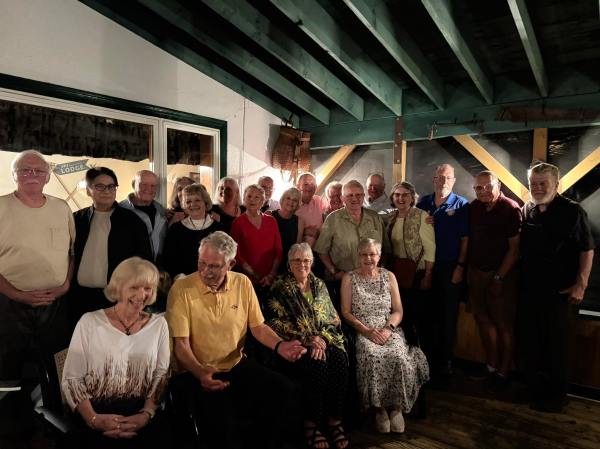
Photo by Richard Amell, SLHS Class of '65

Sixty Years On. . .

Returning to Saranac Lake, the town where I spent my latter childhood years, used to be all about my mother and my brother David. Both were much loved for good reasons; each had a particularly large presence among the locals and made a difference to many.  In the old days, I felt suffocated and extincted by the size of the welcome I always got for them.  Mom’s friends and David’s admirers were legion, and I could not walk down the street without being greeted with, “Hey, I knew your brother,” or “Carla, you’re Charlotte’s daughter.  She was an amazing woman.”

Heck, I didn’t even have to be in our hometown.  Once, my then 20-something-year-old son and I drove through a blinding blizzard to spend a weekend in Lake Placid, the tourist mecca nine miles and a huge cultural ethos away from Saranac Lake.  We checked into the Hilton Hotel and went to the bar to unwind before sleeping.  Within minutes of being seated, three people at the bar realized I was a Swett and sat themselves next to me to  regale me with stories of David when he was the bouncer at a bar over on the lake.  Soon, another three people came over to tell me what a great teacher mom was the year she taught bio at LPHS.

It was something of a relief to be anonymous, to duck into their legacy.  I was content to linger in the long shadows Mom and David had cast years before. 

Over the years, I remained in touch with only one person, the grown-up boy I counted as my best friend from 6th grade on, the boy with whom few in our class knew I had a relationship.  He had gone to college, been engaged, been sent to Viet Nam, and moved down south, but we stayed connected though I had not seen him since he visited me in New York on his way to Viet Nam in 1969.  I would have seen him if he had been in town when I was there, but he was not. 

 I loved taking my family to visit Saranac Lake, and we went as often as we could.  We camped at White Pine Camp before it was renovated.  We hiked up to Copperas Pond.  We canoed or boated out onto the lakes. But since my one true pal was not there, I felt no compulsion to call anyone else.  I didn’t expect that anyone would remember or care.  David and Mom were the ones that counted.  I did not.

Everything changed for me when  the 35th Reunion of the Class of 1965 rolled around.

In 2000, on the verge of leaving my husband and having buried my mother just a few months before, I got the notice that a reunion was in the works.  I wasn’t sure how I felt about facing my classmates, but I was sure I needed to find a way to feel grounded.  I had just begun to flex my creativity and was experimenting with a new career; the idea of being among the people who knew me before I left my chrysalis was comfortingly attractive.

The opening event was a meet-‘n’-greet at the Belvedere Restaurant, a hometown tavern, where many of my classmates had learned to drink as teenagers but to which I had never been.  I parked my car outside the restaurant, and before I got halfway out of my car, a familiar form appeared at the top of the stairs.

“SWETT!!!” He exclaimed, addressing me, as people had when we were young, by my embarrassing last name.  “You’re here!!!”

The surprise greeter was John, the boy who sat behind me in 5th grade. The one who dunked my braids in an inkwell then cut off the ends, who was grateful I didn’t complain to the teacher but simply laughed.  He was the boy who told me to shut up when I argued with a teacher about the legitimacy of a request we were expected to honor. He was never someone I thought of as having any real interest in me, but he had always been there.  And now there he was smothering me in hugs.  He led me in. 

Inside, I was greeted by people, many of whose faces I barely recognized. My oldest, best friend was there, and I buried myself in his affection but felt no reason to hide for long.  There were so many cherished memories assembled.  Gail, who lived down the hill from me when we first arrived in town that winter of 1957.  Her dog Mike nearly scared me to death. Later, when we both moved across town, Gail was once again down the hill from me, always my neighbor and a kindred spirit. Marsha, whose 4th grade birthday party invitation eased my transition from Massachusetts outsider to Saranac Lake resident.  Nancy, my high school bestie, and Maryanne, with who made me laugh as we walked together down the hill from school in the springtime. I rediscovered Karen, whose baby brother was born within weeks of mine. And shy Art, who had seemed so disinterested in anything academic but had evolved into a High School History teacher.  Then there was Penny, whose friendship was a constant aspiration though she seemed to disdain me, enveloping me in a hug. 

Within minutes of arriving, my classmates reminded me that though high school was not my finest hour, it was a time that deserved to be remembered.  The campaign for senior council president, the regional chorus festivals, jazz band, speech contest, the town centennial pageant. . . . 

People still effused about David or Mom. But I realized I, too,  belonged.  My fellow townspeople were, along with David and Mom and all the Swetts, the main characters in the play that was my life in this town.  I felt embraced and accepted, and I understood for the first time that the play wasn’t over yet!

I struck up correspondences, albeit spare, and looked forward with great anticipation to whatever came next.

At the fiftieth reunion, naturally, some of the best people were not there.  Old age, illness, family events, death.  Nancy was no longer with us, and John was clearly ill.  But we had a blast.  Gail and I hosted the culminating ceremony together, and we formalized our belief that we were sisters of the most bonded sort, members of a family of disparate siblings, who’d grown up in a community founded on the idea that a town exists to care for one another. 

The people who fostered the growth of Saranac Lake in the late 19th C arrived there in order to give or find relief from TB; the tradition defined the town and trickled into everyone’s consciousness.  Saranac Lake became a refuge for veterans of WWII and Korea, boys who needed a quiet, caring place to raise their families and set the world aright.  Refugees from places like the Swiss Alps who needed to be in the familiar protection of the granite mountain walls that surrounded us.  We were raised by survivors who nurtured one another’s survival, and we members of the Class of ‘65 bonded to one another as our parents did to our town. 

Returning last month for our 60th Reunion, I had feared that David’s recent death would make it painful to hear his virtues extolled.  I was wrong. This great extended family we’d both been part of shared memories that made mine more vibrant.  I missed him more and at the same time a bit less because he was there with us in more hearts than just my own.

There were far fewer of us this year to revel in the joy of sharing one more party.   So we made a solemn promise to one another: we won’t let ten years pass before we do it again.  Ours is a special joy we must nurture fervently.
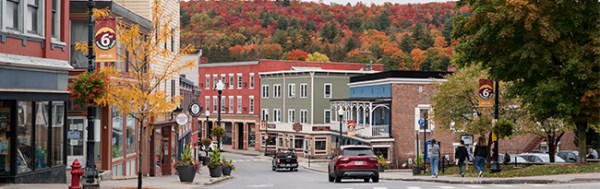
Saranac Lake, NY, began as an outpost for hunters but gained fame and population as a medical center for Tuberculosis sufferers.

Lightning Forever. . . .

In 2016, my friend B treated me to a Southwest adventure. We flew to Phoenix, visited family before we drove to Sedona and on to New Mexico.  After seeing friends and family in Albuquerque, we parked ourselves in Santa Fe, where we planned to stay before taking the High Road to Taos winding up with family in Los Alamos.  The trip was gorgeous in many ways, but a definite highlight was meeting Rock’n’Rolll legend Lou Christie.

Lou had been on our flight from NY to Albuquerque, and we had noticed him.  How could we not?  What an icon of pop culture he had been for most of both our lives. Lou Christie wrote and sang the musical score for almost every event of my adolescence.  We were impressed, but we didn’t bother him.  Until we saw him in Santa Fe.

He walked into the lobby of La Fonda Hotel as we roamed through looking for a public restroom.  I could not resist.  Neither could B.  I don’t remember exactly what we said to him or why he engaged with us, but when we left the hotel, I had his personal phone number and an invitation to call him about an interview for my “get Read” column in the Columbia School of the Arts publication Catch and Release.

Now that Lou is gone, I thought I would re-share that interview. . . .

—————————————————————

If I were a photographer, and the shutter had just closed, I would be confident that I had just grabbed the money shot.

“Lou,” I ask toward the end of our three-hour interview, “what have been the major forks in your life?  The professional ones, the places where you could have gone one way, but you chose to go another. . . ?”

 “Oh, wow,” he muses. I love that question!” 

We’ve been talking long enough for me to truly understand why he likes it so much, why he is so visibly moved. Lou Christie has been doing what he’s doing most of his life, and what he’s been doing is reinventing himself, reconfiguring the formulae that take him and his melodious voice onward and upward.

We were seated among colorful iconography on orange furniture in the cozy, New Mexico-inspired sitting room he has built atop what used to be the roof of a 1940s tenement building in Hell’s Kitchen, in midtown Manhattan, where he has lived since the early 1970s.  He bought his apartment when it went coop, and the landlord was selling dirt cheap; knowing exactly what he wanted and being ever in control of his destiny, he simultaneously bought the air rights so that he could add his a second story of his own design, connected to the first by a picturesque spiral staircase, lit by a skylight and a sliding glass door that leads to the patio with a view of lower Manhattan and the Hudson River. 

Despite the low price, the decision to purchase the place took some deliberation.  Hell’s Kitchen was among the least desirable neighborhoods at the time, a rough area dominated by the Westies, a deadly alliance between the Italian and Irish mobs,  and by Puerto Rican and Anglo youth gangs.  The ones immortalized in West Side Story.  But Lou Christie recognized an opportunity to get in on the first wave of gentrification, and by the 1980s, the Javitz Center was underway, the Westies were disempowered, and the kids were back in school.  He had bought himself a haven.  Now, he has transformed a perfect example of simple, utilitarian working-class architecture into a Southwestern style country dasha, a brilliant transformation.

And the perfect metaphor for the life and times of Lou Christie.  

When Lou moved into Hell’s Kitchen, his star had begun to rise in earnest.  Thanks to New York radio stations and American Bandstand, Christie’s had become the voice of its generation.  The insistent falsetto, half pleading, half scolding, all simply celebrating the fact that it could get that high, played on all the hit radio stations.  WABC’s hitmaker Bruce “Cousin Brucie” Morrow,  was a fan, as was WNBC’s gravel-throated Robert Weston “Wolfman Jack” Smith.  “If those guys liked you, you were in.”   

“I was a fifteen-year-old farm boy from Glenwillard – yes, it’s a real place, less than twenty miles out into the boondocks in the environs of Pittsburgh, PA” –  when I realized I wanted to sing, just sing. I wasn’t Lou Christi in those days.”

Lou was born Lugee Giovanni Sacco,  a name reconfigured from the longer Sicilian Saccosso at Ellis Island, and he always loved to sing.  And to color outside the lines.

“My father, who had been schooled to become a priest or a doctor, was my first role model: he chose a path less traveled and became a steel mill worker. Then he came home every evening to farm our 100-acre property.  Both my parents were musicians, and instead of spending evenings watching television together, we usually got together over music-making.

Lou was the second of six children, having trailed his sister Amy into the world by 18 months; when Lou was nearly fourteen, his parents solved a marital crisis by having four more kids: Maree, Marcie, Shauna and Peter.   “We all had to chip in then,” he says, smiling slyly.

 “We never knew any different; we just took care of one another, helped mom take care of the house and dad take care of the farm. But we were always singing.  I don’t remember ever NOT singing.”  From the beginning, Lou was the family lead singer, and his sisters and brother naturally provided the backup. 

“See? Now, there’s the first fork.  I knew I wanted to be a singer.  But I had to make some choices.  Am I better off going into Classical?  My teacher thought I should do that.  Or should I find great standards to sing?  But wait, should I write my own stuff?  I had a great range – I sang the lowest bass in my school choir and the highest tenor with equal ease.”   

He also had a counter tenor range, the ability to sing the really high notes. 

“SI kept asking myself, what voice should I choose?”

His falsetto won and forged a path to classic rock ‘n’ roll.

 “I didn’t want to be a choir boy.  My father was a great bread winner, all day long he was a slave in the steel mill, and then he came home and farmed his land. I was a happy kid, but I didn’t want to be like him.  Not me.  I wanted the levis, the painted jeans, the purple shirts all the way.  I just knew this was it, and I knew instinctively how important it was to remain master of my own career.

“I was so focused.  You know.  I gave up a lot, like my teen years, but I got exactly what I wanted because I went after it.  You know that book The Secret? They must have been following my life . . . because that’s what I did.  I concentrated my efforts on getting what I wanted,  and I made it happen every time.”

Lou got wind that there signed up for lessons with “a guy in Pittsburgh, who recorded local artists.”  After a single session, the producer sent Lou home to make a demo tape.  “He told me my voice was already good enough.”

“What you really need,” the teacher said, “Is a backup group.”

Lou grins at the memory.

“’Oh,’ I said to him. ‘I got my group.’  We’ve got a sound you’ve probably never heard.  Kinda like three mice.  Because I sing high, and I have another guy, and he sings up here too, and a girl. . . so then he said, ‘ Okay.  Go put something together, make me a demo tape, and let me hear what you got.’ ”

When Lou brought the demo back to the studio, the producer was impressed enough to put Lou’s group on the vocal backgrounds for a song called Ronnie Come Back, by a girl called Marcy Jo, on the Robbie Records label.  Everyone loved the sound of the background, and the record was a big hit, climbing the national charts and reaching the top 20. Lou and his mice never got paid.

“Then we did a follow up with Marcy called When Gary Went in the Navy, and four more, and they were all hits though they never paid us.  Heck, I was still in school. I couldn’t even drive yet.” 

After a few more non-paying hits with Marcy Jo, Lou chose a new path and set his standards by creating Lugee and the Lions.  “I was Lugee, and my sisters and the same group of little kids that were always around me sang as the Lions.”  Lou’s dad drove the group all over Pittsburgh, where they sang for weddings, mall openings, parades and the like, and eventually the positive attention brought him Twyla Herbert.  And thus he reached yet another fork in his road.

“I could see right away. . . that woman was pure genius.  When she proposed working together, I still had to question myself. . . .

“There I was at another fork.  This woman was special. She was twenty years older than me, had a degree in classical music, was a classical pianist, didn’t know a doo-wop from a dust mop.  But she was brilliant.  Just brilliant.  And I could see we could be good together, really good!”

He chose to give collaboration a go, and together, Christie and Herbert wrote The Gypsy Cried, in the style of Valli’s Sherry – it took them all of fifteen minutes – and, he said the experience was surreal, something like what he imagined it would be like to be on an acid trip though he had no experience with drugs.  “There was something about our chord patterns.  They were more classical or more international, made the music more interesting instead of the standard 4 chord progressions, the usual wha wha wha. . . “   The song established a musical partnership spanned the next 47 years, until Twyla Herbert’s death in 2009. 

“I never wanted to make a record that sounded like anyone else. My voice had this falsetto, these octaves to work with, and I didn’t want to record anything that wasn’t uniquely mine.”

By 1966, when Lou and Twyla wrote Lightning Strikes, which shot almost immediately to #1 on the European and American billboard charts, Lou knew beyond doubting he had made the right choice both in going into the business of creating songs with Twyla Herbert and in sticking to his falsetto.  The only choice he didn’t like for a long time, until he got accustomed to it, was the recording company’s choice of his name. 

“I just wanted to be Lugee!”

But the bosses dubbed him Lou Christie.  And Lou Christie soared to fame and fortune.

He never took his good luck for granted. 

Still, the path was never smooth.

“Even good managers can be really dumb. I know because I had one. . . . Bob Marcucci tried to sway me from my path, and I had to fight tooth and nail to stay the course.” 

Marcucci told Lou that he would have to grow up, lose the falsetto, sing more standard arrangements of old songs.  But Lou tried it Marcucci’s way just once.

“I went to my gig in Framingham, outside Boston, and I sang all the standards, all the classics. ”  It was a disaster.  Fans hissed and booed, screaming for “Lightening Strikes.”

“It made sense to me. I mean, can you see  me doin’ Ol’ Man River? I’m boring myself just thinking about it.”

Lou left the songs in a dumpster and vowed to listen only to his own advice.  He toured extensively, singing the hits, getting his audience to its feet in adulation, singing along.  He knew what worked. His easy style on stage coupled with his obvious natural delight in being there sold him. 

Lou stops and thinks for a moment.  When he speaks, he is back in the present.

“Now I’m sayin’ to myself, I’m 72, and I’m sayin’ ‘See? It still works.  I’m still here.’” 

That was 2016.  Lou’s concerts were never less than packed.  His life was never perfect.  He had married, divorced, raised two children, lost one to a tragic accident, and he had persisted in touring and sharing the joy of his presence with family, friends, and, most of all with fans.

Like his myriad fans, I am left with the memory of a warm, witty man with a singular mission.

“Once upon a time,” Lous said to me just before we ended our interview, “I only wanted to share the good side, the fun side because I don’t believe you can make a career out of talking about all the bad things in life.  But maybe it’s time to start mentioning it.  Everyone thinks I’ve had a flawless life.  Part of the reason is I project that kind of forward thinking, and I’m a peaceful person. I have never wanted to get stuck in my anger or my bitterness. 

“But you know, I am still so naïve  There are a lot of people out there who live on bitter – more of an addiction than any wine or beer or shot or pill.  I don’t want to be one of them. 

“Maybe I will write that book.”

Travels with Grandma – Customers Beware

Until this summer, I believed that Small Business deserved my true allegiance. 

I was raised to believe in American small business. My father often declared that America would be nothing without them. “We owe them our allegiance,” he would say.

In the days before my parents had so many children that we began to resemble the shoe-dwelling nursery rhyme family, my dad worked for medical suppliers, big businesses with deep pockets.  They supported his travels and provided generous expense accounts. He could, in those days, afford the finer establishments along his various routes, but he chose instead to support the small business owners wherever we went.  We stayed in family-operated motels in Maine, a cabin on the Navajo reservation in New Mexico, an aging couple’s dilapidated cottage in Far Rockaway.  In those days, he made good money, but he felt stifled.

When he was nearly fifty, seeking to free himself from the shackles of the corporate bosses, Dad bought a small toy distribution company and became the middleman between toy manufacturers and the very small businesses that dotted the landscape of upstate New York. He traveled incessantly then, and he preferred to stay in boarding houses, to tolerate subpar accommodations rather than patronize the area’s successful hotels and motels. It was, he insisted, his responsibility to support his colleagues’ efforts to survive.

“I would rather pay too much for an everyday Joe’s honest efforts than support the corporations that want us all out of the way.”

I believed him.  And I believed, too, in supporting small, independent business owners.  Dad struggled mightily to maintain an income sufficient to support his family, and he was proud to be in control of his destiny, to own his share in his America.

In his memory, when I travel, I often choose small, local establishments over the mega-corp concerns that dominate the industry.  For the most part, I have been happy with that choice. I have found moms and pops to be friendly, accommodating, and eager to meet my needs or to suggest alternatives. I have been proud to contribute to their longevity, to help ensure that America will always be a place where small businesses can thrive among the giants.

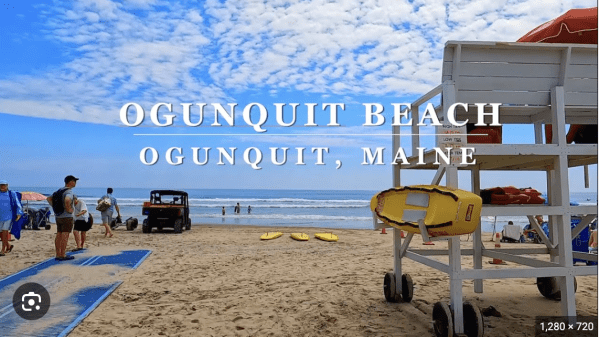
Unfortunately, that was then. Now I am disabused of my fervent devotion to the self-sustaining tourism businesses.  After a few encounters with properties that were understaffed and badly maintained despite exorbitant prices; after being told that the bad conditions are the result of the fact that “no one wants to work,” which makes me even more skeptical about the high prices, I am done.  The final blow happened this past month in a place I expected perfection, where instead I encountered not just disappointment and disenchantment but also fraud and chicanery.  I have been cheated by the Sea View Motel in Ogunquit, ME.

I have family visiting from abroad for the summer, and we decided to take a long-overdue vacation in the beautiful northeast.  We had a lovely stay in a small hybrid corporate-and-local establishment in the Adirondacks, about which I will write anon, and then we thought to spend two days in Maine, a state where I have endless memories of delightful family time spent in family-owned hotels that my father chose.  We found the Sea View online and – much to our own chagrin – booked our room through Hotels.com.

In the photos online, the Seaview looks sumptuous.  Large, clean rooms beckon, and the lovely blue water of a large pool sparkle from the electronic page.  The comments – which I only later realized were from pre-Covid days – were positive, and the price was reasonable, commensurate with the other properties in the area.

When we arrived, we were immediately disappointed and had a bad feeling about the place.  The structure was rundown, and the stairways looked steep.  We asked the clerk if we could look at a room before we checked in.  He gave us a key to a room on the top floor, and we went up.

The ascent was painful.  Steep, rickety stairs are not inviting to a septuagenarian such as I and intimidating to one with hip problems as is my travel companion.  But we persevered. As we crossed the deck of the second story, I tripped on one of the many loose floorboards and fell. I was unhurt, but I must admit that I was further frightened.

The minute we opened the door of the room, we knew we could not stay there.  The furniture and accessories, including the bed and bedding, looked as though they had not been replaced since the ‘60s, and we were enveloped in a musty smell tinged by urine and bleach.  The bathroom was not clean, and it was equipped with no safety elements. The bathtub was slick, and there was not one place for anyone to grab onto to prevent a fall.  Around the bed were signs of looming critters.  We hightailed it out of there without checking in.

We returned to the clerk, who was entirely without curiosity when we told him we were displeased.  He offered us no alternative.  I admit that we had just driven a great distance, and I was not in a particularly articulate state, but when I gathered my wits and tried to explain to him why we could not stay there, he was dismissive then downright rude.  We left without checking in and went to a chain motel up the street.

In the chain motel, for the same price the Sea View demanded for its abominable accommodations, we got a clean, spacious room with brand-new beds – more comfortable than any I have ever slept in – with clean, new furnishings and a full breakfast. 

We appealed to hotels.com for help. We had very naively believed that booking through a monster from overseas would protect us from the kind of treatment the Sea View was giving us.  But Hotels.com abrogated responsibility, telling us that the manager had to approve a refund. They have no power over the establishment’s owners. They did, however,  contact the manager, who lied to them by saying we had stayed there.  Hotels.com, in the person of someone chatting to us from deep in South Asia, that we should reach out to the manager of the motel and instruct them to contact Hotels.com. I made several attempts by email and by phone to reach the motel management.  No one ever responded. 

For absolutely NOTHING, during high season when they most probably rebooked both nights, the motel charged the full fee of nearly $300 per night.  If that is not theft, I don’t know what is.

Sea View has ruined my faith in small business.  If I can go to a Hilton property and for less money than a run-down, unsafe, unsanitary room costs in a place like the Sea View, why would I waste my money trying to help a management that clearly has no interest in helping me?  I would have gladly accepted their charging me for as much as one night for the trouble of making a reservation and having it canceled.  But to charge another $300 for a night that was canceled well in advance is unacceptable.

How can small businesses hope to survive if they are not held to a higher standard of behavior?  If they are free do defraud their customers, to ignore their needs, then they will have to endure bad reviews.  Like this one.

I can’t help but think that the change in our national attitude toward theft and fraud bears at least part of the blame. In a country where thieves can brazenly walk out of CVS carrying hundreds of dollars without prosecution, in a country that seeks to elect a charlatan and a cheater to the highest office in the land, in a country where all bars of justice and morality have been lowered to the ground, anyone can scam others with impunity.

The Sea View Motel is not alone.  They have simply joined a growing army of double-dealing swindlers who will gladly bilk the working stiffs among us out of what they claim as their share of what is rightfully ours.

I wonder if my father would be willing to stay in a Marriott today.  He would have hated the owners of the Sea View.  He would have called them duplicitous cowards. Which is what they are.

The Enduring Endurance of Charlotte and Her Pig

In November, I shall have been a mother for fifty years.  I never envisioned the possibility that one day my children would be older than I was when both my parents were dead, that I would outlive my younger brother, and that I would be a grandmother older than my own was when this fifty-year-old, her fourth great-grandchild,  was born. . . . The breadth of it all amazes me.

That my children survived my parenting is another source of amazement.  Having grown up the too-often surrogate parent for my many siblings, I thought I would naturally take to it.  I’d have perfect children because I’d be a perfect mom.  Of course, I was wrong.  Dead wrong.  In so many ways.  I was subject to so many ineptitudes.

But one thing I got right was entertainment. 

We did not have a color television until the firstborn reached the age of 11.  It just didn’t seem necessary.  As a result, Saturday morning cartoons were easily abandoned in favor of playing outdoors. At night, no one ever begged to stay up for just one more show or sneaked back into the living room to steal a look at what mommy and daddy were watching. From the time they were tiniest tots, they wanted stories.

Stories were commonplace in our house even before the first of our blessed events.  Stories were a tradition begun during their father‘s and my courtship. In our first conversation, we discussed Mahler’s Kindertotenlieder, based on Friedrich Rückert’s stories of dying and dead children.  We often camped, and we read to one another under the stars . . . works as innocent as Alice in Wonderland as self-conscious as I’m OK You’re OK. One of my motivations to have children was the impetus to continue reading stories aloud, to sharing adventures vicarious and fabulous.

At first I sang the stories.  I’d warble convoluted folksongs with sad or inspirational themes or I’d set the story of our day to some monotonal melody or stitch it into a familiar tune and add the story of a journey we had made.  Then came the infinite rides we took with books.

We traveled with a bear of little brain on honey-seeking safaris, with elephants from the African savannah to Paris, in a car to the Eifel Tower, to a balloon over the ocean, the big, blue ocean, then on to a tropical island and back to Africa.  We laughed at the silliness of an urban monkey whose curiosity continually got him into and out of trouble.  We marveled at the D’Aulaire’s version of Greek mythology, tzikached at Aesop.  The child who is now turning 50 had a penchant for maps and atlases so we read about faraway places and charted journeys they would take as adults.  We soared through those books. 

Even after all were more than competent readers on their own and were devouring books by themselves, we read as a family.  Especially when we traveled. 

Road trips were our vacations of choice, and we drove across the country listening to story cassettes, precursors of Audible recordings.  Heroes travled with us.  Robin Hood and Little John.  A young Fox and a basset hound. Bambi.  Under the stars in our campsites or as we wound down in a small motel room, we read aloud until the reader fell asleep.

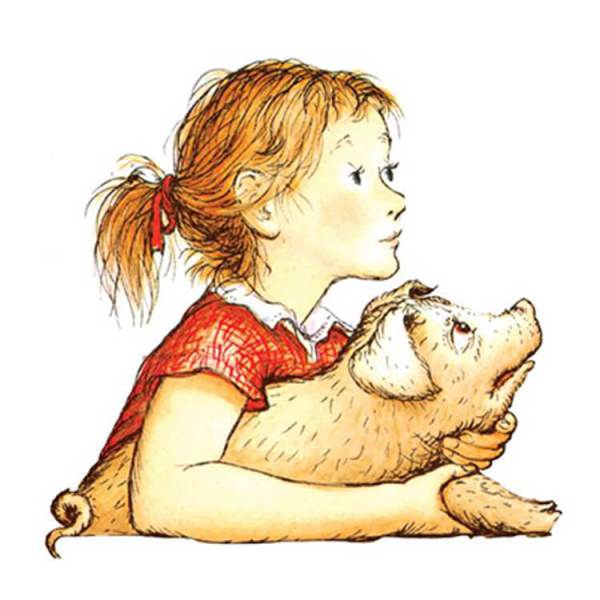
A favorite author in the post-picture-book days was E.B. White.  Charlotte’s Web came first, and we read it more than once.  It became our favorite. When the first film version emerged, we saw it together and critiqued it harshly.  We reread the book and saw the newer version, which we judged with the same rigor. We loved that book.

The other White books and the essays were lovely.  But none ever had the pure cachet we afforded Charlotte’s Web.  I hadn’t thought about that in a very long time. After all, a 50-year-old child has been a grown up far longer than they were a child.  Reading to my babies resides among the cherished memories of a time long gone.

But time has been kind, and new book memories have settled in, thanks to grandchildren who have loved stories as much as their predecessors did.  Two have already passed through our read-aloud nights and are firmly ensconced in teen sensibilities. But I still have one little person left with whom to share the stories.

He lives far away, but we Zoom almost every night.  After a little talking, sometimes a game or two, I read him to sleep.  In past months, we’ve coursed through 26 Junie B. Jones books, and twelve books about dogs and pirates and wizards. Most recently, I have wandered back with him to the pleasant joy of Charlotte’s Web

The sheer beauty of the book moves me to tears every single night.

The narrative voice is soothing, even as White describes the prospect of his hero being reduced to bacon and lard, even as he takes us through a mountain of manure into a rat’s nest.  Somehow, no matter how ugly the world is, this author finds the words to reassure us that there is reason to be calm, reason to hope that on the next page there will be something fun and joyful.

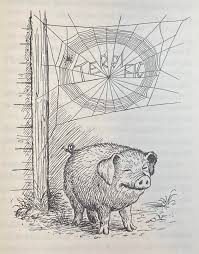
When the human child Fern’s mother asks her pediatrician if he understands the writing in Charlotte the Spider’s web, the doctor admits that he doesn’t.  But, he continues, he doesn’t understand how a spider spins a web in the first place.  “When the words appeared, everyone said it was a miracle.  But nobody pointed out that the web itself is a miracle.”

The humblest of realities, a spider’s web.  A miracle.  What a lesson for children.  And expressed in a prose that is smoothly American English at its best.

“Well, who taught a spider?  A young spider knows how to spin a web without any instructions from anybody.  Don’t you regard that as a miracle?” The doctor asks.  The real miracle is the writing.

My children were young in the Arizona desert, and my grandson lives in a country with a Mediterranean climate. Yet all learned what to expect from a New England winter, what makes fall a season of amazement, why spring springs exuberantly from E.B. White.

“The autumn days grew shorter. . . . The maples and birches turned bright colors and the wind shook them so they dropped their leaves on the ground. Under the wild apple trees in the pasture, red little apples lay thick on the ground.”

No Netflix series, no Nickelodeon animals can bring the world to more vibrant life.  Nothing on Youtube compares with the deep satisfaction even an 8-year-old derives from hearing about Charlotte’s affectionate, abiding friendship for a spring pig.  And nothing – not even the most sensitive Disney films like Bambi or Soul will ever demonstrate more positively to a child that life includes death, that happiness includes grief, that joy bursts forth from the meanest of realities.

Prodigious marvels are all around us. Even in in a “warm delicious cellar, with garrulous geese, the changing of seasons, the heat of the sun, the passage of swallows, the nearness of rats, the sameness of sheep, the love of spiders, the smell of manure, the glory of everything.”

When I celebrate this fiftieth anniversary of parenting, I shall light a candle of gratitude to E.B. White and his Charlotte for teaching my progeny I’ll always be with them, and they never need to look far for the joys I’ll have left behind.

Charlotte's Web
by E.B.White

Yom Kippur Confession — Goodby to King David

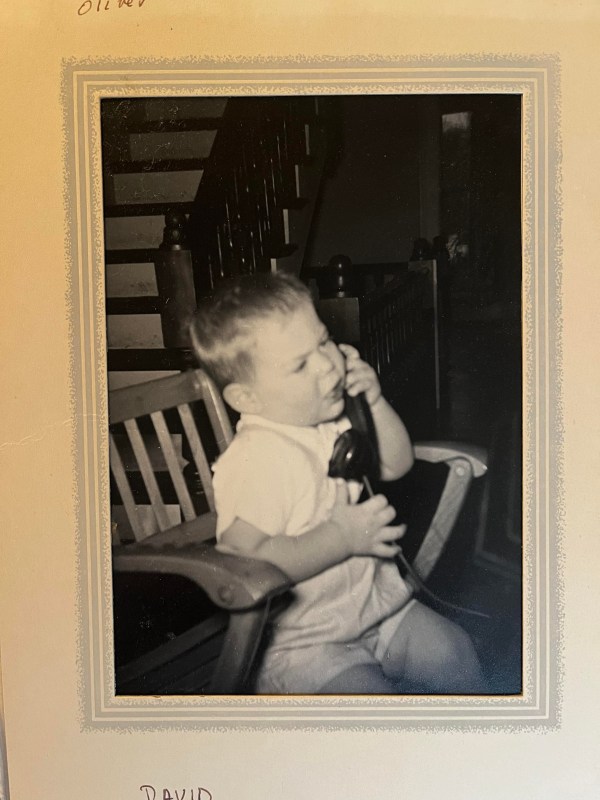
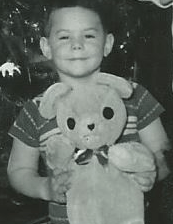
David, Age 4

I didn’t need a brother.  I certainly didn’t want one.  I liked being the center of my parents’ universe, the special doll of my much older half-sister.  Besides, I already had cousins who were like siblings when we were together, who were kind enough to leave me to return to my charmed realm. 

What egocentric three-year-old in her right mind would want the disruption of a younger sibling?

And yet I got one.

At first, he was little more than a nuisance. Smelly, wrinkly, ugly red but inevitable.  I accepted him.  And I accepted that I was responsible for him.  I even loved him. Before I was 4, I was happy to help with the laundry, comfort him when he cried, give him his bottles, sing him to sleep.

The second year was fraught.  He was ill most of the time.  Tracheal bronchitis, pneumonia, flu, ear infections.  He sucked up every ounce of attention my parents had to give, and I was their willing accomplice.  We coddled him, nurtured him, protected him. 

The day he began Kindergarten, his inability to hear enraged the principal, who thought he was simply ignoring her when she called us in from the playground.  I intervened, yelling at her, taking her hand off the ear by which she was about to lead him into school.  He was my responsibility.  I had to take care of him.

By the time I was in 5th grade, we had moved twice – once to a new state and then across town to our fourth new school in less than two years.  David had evolved into a magical boy.  People loved him.  He was powerful, smart, witty.  Everyone he met was his new best friend. He no longer needed me, and it was a good thing because the fact of five subsequent siblings, a veritable separate family, required that I no longer attend to him.

Yet David was still the victim of multiple ailments.  He was inevitably the first one to get sick and the last one to be well.  I remained healthy as the proverbial farm animal, the last to get sick and the quickest to recover. 

I was jealous, and that year I impulsively succumbed to my jealousy. It was the first and the last time I was ever jealous of David.  The experience chastised me.

The Asian flu arrived in our town sometime between my birthday in early October and Hallowe’en.  Fewer and fewer kids were coming to school.  David was felled in the first days of the epidemic.  Our siblings who were not yet in school had runny noses and low-grade fevers, but they were not terribly ill.  I had no symptoms. Whatsoever.

Which seemed like a terrible injustice.

Because I was the designated caregiver, I volunteered to look after David, who was quite ill.  I took him his meals and sat with him while he moaned himself to sleep. Then I lay down next to him and breathed as close to his mouth as I could before I licked the plate and utensils he had used as I carried them down to the kitchen for washing. I was determined to have a bit of this flu for myself.

I was so successful I nearly died.  For six days I ran a fever over 104, and at the end of the week, I had a three-day nosebleed. 

I have never been so sick before or since.  The experience was a powerful lesson.

What I learned was what a hero my brother actually was.  He so often survived battles with bugs like the one that struck me, and he paid a price.  Hearing loss, asthma, compromised immunity.  Eventually diabetes. 

Through it all, he was ever cheerful, ever willing to go out of his way to participate in athletics, at which he excelled, ever warm and supportive to his friends and neighbors. Everyone loved David.  And they loved him for a reason. 

They recognized his genuine lust for life and his commitment to having the best it could offer him, even if he had to pay a price for the privilege.

As a brother, he was certainly not perfect.  I was nowhere near a perfect sister.  Yet we were one another’s permanency.  So long as we were in the world together, we knew that we were grounded in some kind of family.  By 1999, both our parents were gone, but I was not an orphan until David left last February. 

I didn’t want a brother.  I thought I didn’t need one. But I did.

I needed David.