New Normal
In 2003, I left my home, my marriage, my comfortable suburban life and set out to work hard, to experience setbacks, and to carve out a modicum of comfort that included the freedom to roam the world. Predictably, it took a while for me to achieve mobility. For the first seven years, I did all my roaming in the city of New York, guiding bus tours around the city I loved. The job nearly killed me.
I daydreamed my escape.
I’d envision myself venturing out to places I knew from my mother’s childhood stories – her birthplace in Austria and home in Croatia, her parents’ hometowns in Ukraine – and those I’d imagined my father’s people left behind in the 1600s. Places like Utrecht, The Netherlands, Somerset, UK, Scotland.
But when my daughter relocated abroad, she coopted my travel plans.
In 2012, I reached the age my generation had targeted for retirement, and my child invited me to visit her world. At the time she was living in Thailand, a place I had never even considered for my bucket list. But it’s where she was, and I was keen to see what it was that held her there. So off I went. First to Bangkok, a side trip to Bali, and then to Samui, the Edenic island where she lived and worked. In the intervening years since then, I have visited her three times in Thailand, once in Hong Kong, twice in Taiwan, and most recently twice in Turkey.
None of these were places I’d have sought. But each has mesmerized me in one way or another. Each has equally repelled me.
The people of Thailand are the gentlest, most personable people I’ve ever met, and the scenery in most of the places I’ve been is breathtaking. But the climate is far too hot far too much of the time for my taste. Poisonous snakes and soi dogs are never far from my consciousness. And the cities are antithetical to my desire to walk in that they have obstructed or nonexistent sidewalks and street vendors that impede all movement. 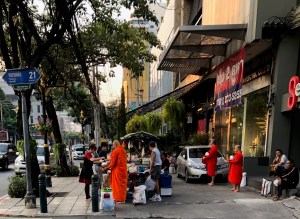
Hong Kong is – and I speak here as a New Yorker! – far too crowded, too overrun with teeming flesh and filthy refuse. Conversely, I find Taiwan too orderly, too polluted, too rules-driven; finding food there is a challenge, as it is expensive as well as often inedible.
And Turkey, well Turkey . . .
Is a confusing assortment of dichotomies and paradoxes. I find myself excited to go there and aching to leave the minute I arrive. The people are warm, friendly. Or they are aggressive, willing to shove your car off the road in order to gain a few seconds of driving time or to avoid braking. The food is delicious, but the spices can be shockingly voracious. Islam is the primary religion of the country, but stores, especially pharmacies, are closed on Sundays, and the liquor is as destructive to weekend calm as it is anywhere else. Gorgeous landscapes abound, punctuated by spectacular sunrises and sunsets. But they lie in the omnipresent, foreboding shadow of Musa Dagh.
Since my daughter and her family live in Turkey much of the year, and because I am absolutely addicted to the pleasure of my grandson’s company, I shall continue to return often. I’ll learn to love being there. Especially if I can learn more of the language.
Does it matter that I doubt I will ever feel entirely at home?
——————————————–
Fear Displacement
I get a real kick out of watching people’s faces when I say I’m off to Turkey. Again. Brows wrinkle, cheeks migrate upward, eyes show their pain by squinting.
“Well, then,” they’ll say in husky tones of genuine concern, “You be safe now. Be careful.”
It’s never clear to me of what they feel the need to warn me. The same people, should I bid farewell and head to the subway or embark on a cross-park sojourn, would smile and wave without a moment’s dismay. Yet multiple dangers like armed druggies, hungry coyotes, angry raccoons lurk in the city’s parks and construction sites. These same folk would simply wish me a lovely good time were I to tell them I was heading for Walmart or the movies or, say, Houston or Orlando. Is it not true that mass murderers lie in wait in such hinterlands?

I have no fear of Turkey. I do admit to holding a bit of a grudge – I want the country to own up to the Armenian genocide. And there are cultural norms that I don’t understand. Yet I feel far safer in greater Istanbul or in the coastal villages near Izmir or Antalya I have visited than I do anywhere in America these days.
Well-armed, vigilant police patrol the cities, parks, public places. I’m a savvy city kid, and I know enough to be conscious of my surroundings to keep my valuables close. At least in Turkey, it is unlikely that suddenly, without warning, some enraged young man will jump from the shadows and aim an AK-47 at those of us unlucky enough to be in his line of fire. Turkish roads are scary because drivers are impatient, reckless. But the kind of violent road rage I see on the streets and roadways of my country every day doesn’t exist in Turkey. No guns sit on racks over windshields there. The military and the police are the only ones who can get away with packing.
When I go to the Istanbul Airport, I know that everyone who enters the huge open space must go through a metal detector, must withstand the scrutiny of a no-nonsense security check before they enter. When I’m at JFK or LaGuardia or Newark, I am always struck by how vastly unprotected the areas are, how easily the myriad people wandering in and out could get away with annihilations.
Ironically, the officials maintaining my safety in Turkey are far less intimidating than those at the gates in the US. My prosthetic hip inevitably sets off the alarms, and the TSA folk at JFK and Newark too often treat me as though I purposely require that they pat me down, and they pat me down with a vengeance. It’s humiliating and often painful. I have never once been assaulted by a security person in Turkey. They apologize. They treat me respectfully. They are gentle.
A friend recently marveled at my willingness to travel to Turkey. “It’s so far,” he said. “So foreign.”
“You’re going on an equally distant journey,” I posited. “I mean, Alaska . . . it’s far, and it can be pretty creepy, no?” I was thinking about the high crime rate in Anchorage, the recent shootings in Seattle, where my friend must catch a connecting flight. I envisioned airports open and vulnerable.
“Nah,” he said. “It’s in the US.”
My point exactly.
——————————————-
Yemek (Eat)! 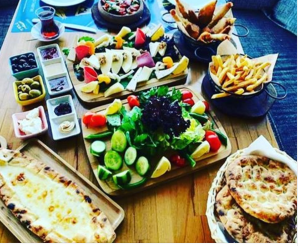
In December, when I had booked my flight, I told my students that I would be flying to Istanbul the day after our final exam. I expected them to be shocked or fearful. College freshmen are singularly self-concerned, and I thought they would worry that I might not get their grades in on time. Instead, they surprised me.
“That’s so rad,” said one boy.
“Lucky,” said another.
“Omigod. You’re gonna get fat,” exclaimed a girl in the back row who had not spoken once all semester. Everyone stared at her, “I mean,” she stammered, “The Food. It’s so incredible. You’ll be eating nonstop.”
Her mother, it turned out, is Turkish, and she visits her babaanne (grandmother) every year.
I smiled. Having summered there already, I was well familiar. The food is exceptionally delicious. At the same time, it can be a culinary adventure.
In the first place, the food is ipso-facto organic. Turkey is one of the few remaining countries in the world that is entirely self-sufficient when it comes to food production – if Turkey allows a foreign label to distribute food in Turkey, the product must be grown and processed in Turkey; farming is a major occupation country-wide, the life’s blood in more ways than one.
Industrial farming does not exist. Farms are owned, operated, maintained by close-knit extended families, who share clusters of multi-story living quarters at the farms. They eschew the use of pesticides and appearance enhancers, and they are opposed to genetic engineering.
As a longtime vegetarian –a vegan but for the use of honey and an occasional eggwhite – I especially appreciate the multivarious textures of flavor in the vegetables, flavors that titillate my taste buds. The distinctiveness in every bite is singularly unmistakable. Cucumbers are melony, tomatoes have a robust richness I remember from my mother’s long-ago garden. At the same time, however, I am constantly aware that there is likely to be a kick delivered from some sector of any given dish. Spices insist on surprising the palate. Eating is like riding in a car behind a seemingly mild-mannered hanim (woman) in a delicate hijab. Watch out lest she suddenly swerve or stop or make a turn in front of you. Likewise, peppercorns or a dried biber (pepper) show up on the tongue without warning to remind you not to be fooled by the prevailing air of relative calm.
While no restaurant has any dearth of vegetarian options in Turkey, it is clear that the people here love their meats, and I am told their meats are delicious. Like the vegetables, the animal protein sources are nurtured and maintained with loving pride. Farmers take care to provide humane and uncrowded conditions for the animals that sacrifice their lives. No chemical enhancements or antibiotics spoil the purity of the flesh or the integrity of the dairy products.
What saves me from the fate of which my student forewarned is that I am essentially not a sweets lover. If I were, then Turkey would indeed be dangerous. Especially at the sumptuous buffets that are laid out for brunches every weekend. So many desserts, so little room to spread them out. Puddings and pies, Baklava, Tavuk gögsü (chicken breast pudding, which is often made without the chicken breast), cakes and sugary fruits, chocolate pistachios, Turkish delight (enormously popular rose- or orange-infused jellied candies),and the one thing I can be a sucker for: halvah(a thick, honeyed sesame paste), et al., present themselves for over-indulgence.
Luckily for me, I’m not easily seduced. Even halvah repels when I remember the discomfort of the sugar rush it inevitably delivers. I am not fooled by the melt-in-my-mouth sweetness. I know it will never really like me.
Then, too, too much of a good thing can be disenchanting. One week during my stay in Turkey, we went to a resort in Antalya, a hotel that operates like a giant, stationary cruise ship. Once checked in, a visitor need not want for anything. Snacks and light foods are served 24/7 at various stations about the massive place. Drinks of all kinds flow endlessly. And three times a day, double doors swing open to a ballroom bursting with tables laden with food.
There are stations for every kind of culinary experience. Hot foods – stews, casseroles, roasts, fried foods, side dishes – sequestered from the cold foods such as bean pastes, salads, myriad pickle options, olives, dolma, a panoply of fresh fruits and vegetables, and the endless tables of colorful desserts. The first day we arrived, we marveled. We ate. We enjoyed. But the array never changed. And we found that the food was likely to be recycled, reused the next day; there was a staleness about it that made even the fresh rocket seem dull and tasteless by the time we’d been there a while.
It was a relief to get back to Istanbul, to the fresh produce in the markets, to our own home cooking, to the brunch buffets in the restaurants along the shore.
——————–
Toddler in Ephesus
Late December
My little grandson cannot wait to go to Kusadasi. He’s not terribly impressed by the fact that it’s the closest I’ll ever get to experiencing ancient Greece or with the notion of seeing the Aegean Sea or remnants of archaic worlds. He loves to fly. Airport? We’re going to the airport? “Let’s go!”
And a taxi. We’ll ride to the airport in a taxi. “C’mon, Mommy. Are you ready? Hurry up, Gran’maw.”
In the taxi, he watches the road. His father is a pilot, and he has flown more often in his three years than most people fly in a fifty. Traveling to an airport in a taxi is as natural as breathing.
“Look out,” he warns our non-English speaking driver, who is blissfully unaware. “Red light. You have to S T O P. . . . Oh, no, do you go that way, or that way?”
I remind him that the driver knows what he’s doing and deserves to be trusted. He settles back and contents himself with counting buses, assessing cranes, watching for airplanes in the sky. Then he falls asleep. It’s an hour-long ride. His nap will serve us well.
At the airport, he climbs dutifully into his stroller. “I can have a squeezie (a squeezable fruit treat he favors over candy) while we check in?”
At the gate, he counts the airplanes taking off, landing. When our plane arrives at our gate, he jumps up and down. “That’s our airplane. We can get on.”
The flight reaches Izmir in forty-five minutes flat, and another cab takes us the remaining 80 km to our hotel, a lovely inn nestled in a tightly knit complex of shops, restaurants, hotels, fish markets, and bazaars on the Aegean Sea. The windmills and trucks, stoplights and birds along the way have kept the boy busy, and when we arrive at the hotel, he proclaims, “Here’s my home.”
The name Kusadasi means Pidgeon Island in English, and it’s not clear whether the name derives from the shape of the island on which its protective fortress lies or from the flocks of foraging birds that dominate the sandy beaches. It hardly matters.
The town sits on a sandy lip of a beach that smiles wanly at the lapping waves shimmering teal-to-turquoise as the sun ambles along. Fishing boats and yachts, kayaks and sailboats bob about beyond the breakers, and tourists meander the streets with no apparent imperative except soak in the warmth. It’s a peaceful place. Like a fantasy. For me, the perfect respite from current events that perseverate. For my little buddy, it’s the perfect place to explore.
Each morning we set out on a mini-constitutional. Glee overcomes him the minute he sees a slide in one of the several playgrounds that dot the sea walk, and he dashes up the stairs chanting “Up the stairs. Down the slide” and makes himself giggle as his tush hits the ground.
Sailing insouciantly through the air in a swing, he makes up songs about flying and sailing that he combines with those he’s learned. “Sing a song of sixpence pocket full of rye, I zoom to Bangkok (or Singapore or Timbuktu) on a bicycle built for two. . . “
Innumerable feral cats amuse him endlessly as they strut about the streets. He crouches to touch each one that comes close enough, and he squeals with delight at the softness of their fur, the strength in their tails. The cats are remarkably well fed, with shiny, fluffy, healthy-looking coats. He offers the possibility of affection with the back of his unopened hand, and they oblige him by purring contentedly as he strokes the tops of their heads, tickles them beneath their lower jaws.
At an amphitheater on the main street, we watch as a bevy of homeless felines cavorts about, eating the food local people have left them, napping in the make-shift shelters someone’s built them. My boy is delighted but refuses to walk with me when I say we must back to the hotel. He wants to stay and watch his “friends.”
“Remember?” I prod him. “We saw a few cats living at the Chinese restaurant. Let’s go say hello to them.”
“Stop for a muffin?” He asks.
“Of course.”
At Starbuck’s (Yes, Starbucks. Sorry!) I lift him so his head is higher than the counter, and he tells the barrista that he’d like a chocolate muffin. We sit while he eats it, and we discuss our plans for the day.
“First the cats at the Chinese Restaurant! Second my home!”
At first, he is testy. Why is the promised land not right ahead of us. I tell him to be patient, and he slyly invents a game. At every building, at every street sign his eyes dance with mischief. “Is this the Chinese Restaurant?” He laughs at his own cleverness, sufficiently amused until we reach the restaurant. It does not disappoint. Several large cats and a trio of kittens are there to entertain him, and he breaks into a symphony of laughter that takes us all the way “home”
After we return to Istanbul, he insists on visiting and revisiting the photographs. “Look at me – I following a duck. Hear me, Gran’maw? ‘Quack, quack.’” The video of at him riding a carousel dolphin in the indoor playground makes him thoughtful after his fifth viewing. “It was raining. Remember, Gran’maw?”
And then, “Oh, and look at this, Grandmaw. . . The cannon!” He is standing guard at the Kusadasi fortress. “ Look at me. A pirate – Hear me? ‘Ahoy, mateys, fire in the hole!’“ Gales of guffaws telegraph his pleasure.
His favorite photos are the ones we took the day we walked through centuries-old ruins. “Look ‘t grandmaw. ‘s Ephesus,” he crows. I wonder if he’ll remember that day when he’s my age. How we climbed stairways built by the Greeks in the 10th Century BC. How delighted he was to sit, giggling, on a stone toilet in a communal outhouse dug first by the Romans and then modernized by the Roman Christians. As I marveled at the thought that Constantine might have defecated there, my grandson exclaimed, “Look!! People made poopie here!!!”
As though for his personal pleasure, regal cats adorn the remains of the 2nd C Library of Celsus. In the photos, they perch on pedestals like Egyptian gods, silky felines deigning to allow human contact. Power resides in their graciousness.
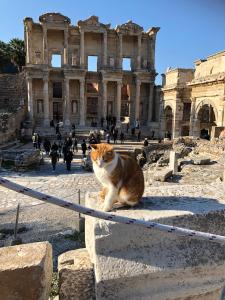
Clearly, that little boy in the photos is aware of his own potency as they respond to his touch by gently pressing their heads against his hand.”Haha. That tickles, gran’maw.”
In the photos, I am clearly breathless in the great amphitheater.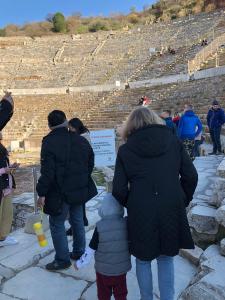
Imagining Dionysian competitions, Plautus comedies, Roman Olympic games. My grandboy cares only that I hold his hand so he can use the narrow stone walls as his balance beam. In my head there’s a joke about finding a seat – nearly 40,000 await here – but he distracts me, so enthralled he is by the colors in the masonry. Someday perhaps he’ll be impressed that he visited a theater that drew audiences from all over Europe and Asia for over 2,000 years. But at this moment he has his sights set on a hillside nearby, where a herd of sheep descends. Their collar bells clang in unison with their guide dogs’ barking. “I can barely see them,” he says, mimicking a phrase he’s heard far too often in his favorite video. “I hear them. Hear them, Gran’maw?”
Just before he falls asleep in the taxi headed back to Kusadasi, he snuggles close and exclaims, “I like Ephesus. We have fun there!”
————————
Paradise Lost/Paradise Regained
Do people in the States go to private doctors these days? I mean, do the majority of the population, who are minimally insured at best, have a personal pediatrician on speed dial or a family GP at beck and call? I wonder if people more often look to Urgent Care facilities and HMO Clinics for sage advice.
I was fortunate as a young mom. I raised my little ones in two very different communities, and in each I relied on a wise pediatrician for counsel and guidance. Each of those physicians was level-headed. Neither proclaimed a diagnosis without asking my opinion, and both were thorough and sensitive to the children’s concerns and fears. We all endured some harrowing health moments, through which these gentle heroes held my trembling hands and steered us out of danger.
In Turkey last month, I found myself wondering what most Turkish parents do when their children are ill As outsiders, my daughter and I found ourselves in a position to wish either one or both those medical angels was alive. We most assuredly would have called him the second night we were in Antalya.
Let me backtrack and say that going to Antalya turned out to be a great choice. But not for the reasons we expected it would be. My daughter had booked a week in a luxury hotel, a kind of stationary cruise ship on the Mediterranean coast. Though their massive water park and beach activities were shut down for the winter, the hotel offered a week of total relaxation, replete with three meals a day and a perpetually stocked minibar, for less than I might have paid for a room in the Tulsa, OK, Motel 6.
From our balcony, we had a spectacular view of the dormant water slides and the graygreenroyalblue Mediterranean just beyond them. 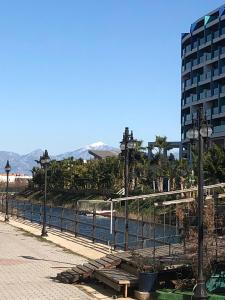 If we looked left, beyond the hotel flanking ours, we could watch the snow accumulate on the tops of the several the Taurus Mountain peaks that tower over the region. On the first floor of the hotel, there was a children’s playroom with a small garden of colorful balls and a fast wooden slide designed to entertain a child if there should be rain. At the bar, wine, beer, and whiskey flowed freely . . . and at no extra charge. An on-site spa with Thai masseuses stood at the ready from early morning till well after the dinner rush, and a footbath stocked with flesh-eating, skin smoothing garra rufa fish required no reservation. There were even family films screened nightly in the hotel cinema. Theoretically, a heavenly place for a true vacation.
What it turned out to be was the perfect place to wait out the flu.
On our second day in Antalya, my grandson seemed listless. He wasn’t hungry. The multiple tables spread with enticing confections that he’d found irresistible the day before were entirely uninteresting. All he wanted to do was lie in his mother’s or grandmother’s protective arms and watch videos or sleep. Clearly not himself.
Overnight, he spiked a fever. I knew it was not a dangerous fever, but it was high enough to send a clear signal that he was ill. The hotel, aware of its responsibility to be the compleat home away from home, advertised a doctor on board, in an office that opened at 9AM. We called at 9:01.
There was no doctor. There was, however, a matronly nurse, who arrived in our room with the English-speaking guest relations representative(a person to whom we owe enormous gratitude). The “nurse” was very sweet, but I doubted immediately that she had any real medical training. She took his temperature and immediately told us through our interpreter not to panic. She would, she assured us, prevent his having convulsions by wrapping him in cold, wet towels to reduce his temperature. His temperature was not quite 103. He was in no danger. We eschewed the towel treatment and asked to be directed to a doctor.
They gave us the address of a private hospital that would accept my daughter’s ex-pat insurance plan, and we called a cab to take us there. The hospital was nearly a half-hour away, and much to our relief, the cab driver waited to take us back. A valiant gesture that turned out to be!
In the hospital, we waited endlessly in an open area, where coughing, vomiting and the injured hordes came and waited or were directed to the triage room. It was a cold day, and there was no heat in the building; attendants, nurses, doctors, and maintenance people were indistinguishable from one another as they all wore their outdoor street clothes.
When we were finally taken into a treatment room, our little boy was prodded and poked by several people, none of whom washed their hands or wore gloves. I was embarrassed by my inability to speak Turkish and worried that we would know nothing about what ailed him.
Fortunately, the Attending Physician, who came to have a look, spoke English. She suggested we admit him for an overnight stay. In his room, she told us, they would strap him down, take his blood, and take him to a lab for a series of x-rays.
I know that, as adults, my kids are invariably embarrassed by my forthrightness, my unwillingness to do as I am told, my reluctance to accept advice I do not trust. But I wasn’t about to worry about whether I’d make my daughter blush. I was unconvinced. “Why not do a culture first?” I inquired.
The doctor moved closer to examine my face before she replied. “Oh, yes, we could do a swab. But blood and x-ray would tell us more.”
“No,” I said firmly. “Let’s find out whether he’s got something bacterial or viral, and then you can prescribe medication. If, after a day or two he is no better, we’ll think about blood tests and x-rays and overnight stays in hospital.”
She agreed. Reluctantly. She wrote of my impudence in her report. Then we waited.
And waited. While we waited, we defended our screaming child from an attendant intent on forcing alcohol rubs on him. His fever was already responding to the ibuprofen we’d administered earlier and had dipped to below 101. There was no possible reason for any such treatment.
Another doctor entered. She repeated every step of the exam performed earlier. She, too, suggested a hospital stay, x-rays, blood. Again I opened my NY Jewish mouth and said no, explained our agreement with the previous doctor. This doctor, a very young woman, was less skeptical. She smiled and nodded.
And sent us back to the outer corridor to the reception desk to pay for the swab. Then we waited and waited until a teenager – well, he looked like a teenager – wearing hat, coat, and mucklucks suddenly materialized in front of us.
Before we could ask who he was or what he wanted, the youngster timidly and awkwardly thrust a q-tip into the baby’s nose, pulled it out and smeared the wet cotton across a petri dish. Then, in a scene that seemed ripped from my own 1960s childhood, he closed the dish, placed it in a plastic bag, put the culture into a glass cylinder, and popped it into a pneumatic tube. Off it went to some diagnostic lab in the sky, and off we went to find a warmer, less exposed place to wait.
Again we waited. An hour passed while we sat on a narrow bench in another wing of the hospital that was no less public but was slightly less crowded. We saw the doctor returning from her lunch break and asked her if she had the results yet. She promised to get them and, good to her word, brought them to us almost immediately.
“It’s flu,” she said. “Influenza A. I’ll prescribe an anti-viral. If he does not improve or if he has trouble breathing or if he does not get his appetite back in 48 hours, please bring him back.”
“Thank you,” my daughter said. “We’ll be sure to have him see a doctor if he’s not better by then.” She is very tactful. She never said what we were both thinking, that we would NEVER bring him back here.
We thanked the doctor, and then she warned that we still had a problem. It was Sunday. The pharmacies – eczanes – were closed. Nationwide, in this predominantly Muslim country, for reasons we were unable to ascertain, pharmacies are closed on Sundays, even though most businesses operate as usual. “The receptionist will give you a list of those that are open,” our resident explained. “There you might fill the prescription.”
“You mean,” I asked, well aware that anti-virals only work if they are ingested in the earliest stages of the virus. “That there is no pharmacy here at the hospital, no dispensary where we might get a day’s supply to tide us over?”
“Unfortunately, no. Only in the stores on our list.”
The list lied. Not one was open. We returned to the hotel, and because our guest relations Godsend-of-a-staff-member was still there, she was able to pinpoint two eczanes that were possibilities. She called them. Only one was actually open, and they did not have the anti-viral in stock. Another pharmacy, closer to our hotel, opened early the next morning, and there we found the magical elixir.
Shortly after taking his first dose, our little patient was fever-free and hungry albeit still listless and weak. That’s when his mommy fell ill.
The rest of our week in Antalya was all about convalescence for everyone but me. I had a flu shot back in NYC.
[I later learned that people don’t tend to get flu shots in Turkey. Doctors don’t prescribe them. To have a vaccination, it is necessary to buy the inoculation from a pharmacist – not on a Sunday! – and take it back to a hospital, where a doctor administers it. The H1N1 virus has made a decided comeback in Turkey, and there are myriad strains of flu circulating the country, but prevention seems undesirable.]
As the designated well person, I was truly able to appreciate our Antalya retreat. Being in that hotel made life easy for all of us. The minibar attendant delivered water, juice, and seltzer every morning. The wait staff carried trays of food to our room three times a day. The maids kept our sheets clean, our towels fresh, our room spotless. The sunrises and sunsets enthralled us, relieved us of any reluctance to stay put in the room. Each day we opened the balcony door, and in rushed the wintergorgeous smell of the sea, the delicious reminder that we were on vacation.

On the Seventh Day, renewed and re-energized, we flew back to Istanbul.
Share this and follow me; I'll follow you!




 carlastockton.me