Rough Flight

Most of the time during the excruciatingly long Flight, I was wishing it would finally end already. 
At first, during the distressing, taut crisis in the air, my anxiety was choking me.  Last month, flying back to the States from Thailand, I had five hours of violent turbulence, where food and silverware were flying off trays, flight crew members were sitting belted into their jump seats counting their worry beads, and elderly Asian people were defying the order to remain buckled by wandering up and down the aisles moaning.  On that flight, I reached a point where I couldn’t cope with the tension anymore, so I took a melatonin pill and passed out knowing that I’d either wake up to a restored calm or I wouldn’t wake up.  But watching Flight, I couldn’t take a pill, and it was clear that the tension was only just beginning.

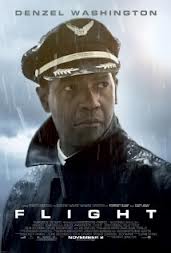
My inquietude came from what I disliked about the film more than from the drama unfolding on screen, however.  To begin with, as a tremulous flyer at best, I found watching Pilot William Whip Whitaker (Denzel Washington) consume vodka, beer and cocaine just before flying infuriating and terrifying.  His arrogant, self-satisfied, cocksure, un-empathetic demeanor repelled me.  As much as I love Washington’s work — and he played this part with absolute aplomb — I couldn’t find anything sympathetic about this character, and while I kept waiting for an arc and an epiphany that would make me care, I never quite forgave him for being so cavalier a jet pilot.
 

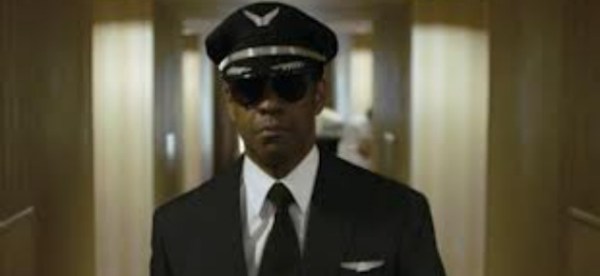
It got worse as the plot thickened.  Or rather as the flimsy rubber band of a plot stretched itself and with it my suspension of disbelief.  Whitaker boards the plane like a rock star, primed and ready for his performance.  He downs some black coffee with “lots of sugar, lots of sugar” and guzzles a few hits from the oxygen supply before he wrestles wantonly with bad weather on takeoff.  Then, just as they are easing into the 35 remaining minutes of the flight from Orlando to Atlanta, something goes terribly awry, culminating in the crash of the plane.
Okay, this is where it gets sticky.  And by sticky, I mean it sticks in my craw that I can’t figure out what the film was about.  We watched the fearless pilot order his copilot to push the limits of the elevator (the piece at the rear of an airplane that controls its pitch), instruct his flight crew captain to push some manual control levers, invert the plane so it could stabilize and then glide into a field, and we saw the plane crash.

There was never a moment where we thought Whitaker was blameless.  Yet it seems as though director Robert Zemekis wants us to find him innocent.  And of course, the movie is about the investigation to ascertain whether mechanical failure or human error cost the lives of the two flight attendants and four passengers who died and destroyed the plane.

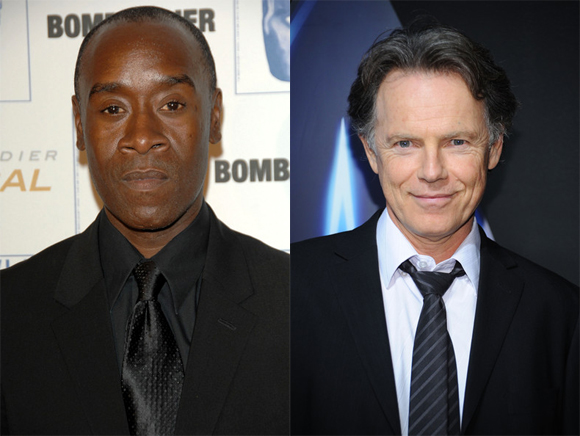
The movie lurches about long after the storm and the crash are over.  As depth of Whitaker’s alcoholism reveals itself, we get to see Washington deftly embody a truly self-destructive man.  Tamara Tunie, Kelly Reilly and Bruce Greenwood provide terrific foils, and Don Cheadle once again disappears into a role that’s clearly a lot more vivid than it was on the written page.  For added Oscar buzz, John Goodman once again steals the light from everyone else with his portrayal of Harling Mays, who could just as well have been named Walter Sobchak (Lebowski’s sidekick). But overall the film is very dissatisfying.


There is no real arc.  We see the alcoholism ebb and flow, but we don’t see for one minute any of its roots or the path of its destruction.  We know more about Nicole’s (Reilly) drug addiction than we do about Whitaker’s, and when he has his turnaround at the very end, there is no real motivation for it.  The epiphanal moment appears elusive of inducement — he has a brief moment where he cannot defame the memory of his heroic flight attendant/lover who has died saving a little boy’s life, but it’s not enough; his estranged son, his ex-wife, his friends, his career were all inconsequential, but a fleeting affair with a young woman makes him come to his senses?  Well, that’s just senseless.

Zemeckis has a great opportunity here.  He could explore the infrastructure of an industry that teeters on the brink of disaster but does nothing to seek out and clean up the source and substance of the kind of abuses this pilot flaunts.  We come to find out that everyone has known all along that Whitaker’s a lying drunk, and no one has done one blessed thing to get him to stop.  How can this be?  I want an investigation.

Alternatively, Zemeckis could explore the root of the disease Whitaker suffers.  But until the sudden turn-around at the end (oh, did I spoil this for you?  Sorry!), all we see is a man who loves being drunk, wallows in the oblivion he creates for himself but who never reveals how he got here.

In the end, though it should have been obvious from the beginning (as my friend pointed out, the damage to the elevator, which caused all the trouble, was clearly the result of Whitaker’s cowboy antics near the start of the film), the film allows that Whitaker really is guilty.  (Were we in denial right along with the whole aviation industry?) He deserves to go to jail.  And, “though it may sound strange coming from a guy in here (sweeps arms, indicating co-prisoners in an institutional meeting room), for the first time I’m free.” Hunh?

All of a sudden, as though Zemeckis realized 130 minutes into the edit that he needed an ending so he went back and shot one quickly, Whitaker admits he’s an alcoholic, becomes a devoted AA member, creates a stable relationship with Nicole and reconciles with his son Will, nicknamed Knuckles.

Flight ends with Knuckles visiting Whip in jail.  He must write his college essay, and he has chose to write about “The Most Interesting Man I Never Knew,” a.k.a., his father.  Will turns on his recording device, saying, “So, tell me Dad.  Who are you?”

Whitaker hugs the boy tearfully and answers,  “That’s a good question.”

You betcha.

Now playing http://www.imdb.com/title/tt1907668/

Shakespeare Slept Here . . . Didn’t He?

“The ‘Arden’ of the play is Ardennes of northern France, rather than a forest which once existed in Warwickshire, which may or may not have adjoined the cottage in which Anne Hathaway, who may or may not have married Shakespeare, may or may not have lived.  But bardolatry trades in certainty, not in the slippery elusiveness of documentary fact: the buildings have acted as objects of pilgrimages and shrines of worship for generations, and that in itself is an assurance of their value.”  Bardolatry: or The Cultural Materialist’s Guide to Stratford-upon-Avon, by Graham Holderness

The Daily Mail reported(http://bit.ly/UsDyPL)  last Thursday that “a tempest is brewing around the 16th Century thatched farmhouse” where Anne Hathaway was courted by her lover William Shakespeare,” that a developer has just received the go-ahead to build a housing development just 238 English Yards from the sacred home.  All around the world, the faithful watch in fear and trembling.  And with good reason.

In 1995, when I paid my first visit to Stratford-Upon-Avon, which was, remarkably, my first trip to the UK, I was definitely a believer.  I was a faithful bardolator, an adherent to the Shakespeare Myth.  I still am.  No matter how much evidence I see that Shakespeare wasn’t any of the things we believed him to be, I remain steadfast.  He is the one True Bard, the creator of the most significant Words in the English language.

Consequently, the first time I arrived in Stratford-upon-Avon, I experienced a moment of great disappointment.

Birmingham

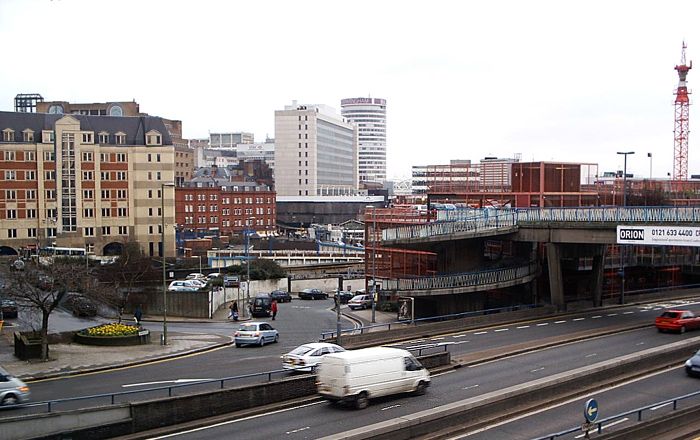
In all fairness, the letdown had begun in Birmingham, where my plane landed.  Bardolatry, especially for Americans is often accompanied by a hefty serving of Anglophilia, and walking across town to the train, I was fervently hoping for a Dickensian array of shops and homes. To my dismay, I’d found Birmingham surprisingly modern, clean, hip and prosperous.  Not what I’d expected at all.  Then, as my train lurched into Stratford-Upon-Avon, and my heart began to race with the excitement of being in Shakespeare’s hometown, a huge Safeway Supermarket came into view, and at that moment the conductor announced we’d arrived.  I was crestfallen.

I had earned a summer in Stratford-Upon-Avon, and I had expected to be whisked directly into the world of the Bard, to be swept into the late 16th Century, to immerse myself into that lyrical, romantic world that had engendered the richest poetry, the most fabulous drama in the English language, and here I was face-to-face with a 20th Century American icon, where hordes of cars (there was a petrol station there as well) and shopping carts conglomerated among bustling locals.  I shook my head and followed my directions from the train station into Albany Street, where I was to be billeted for the duration.

Albany Street

In Albany Street, I began to regain my equilibrium.  While I hadn’t found the Avon I had sought, I was, at least, surrounded by 19th C houses, a street straight from the pages of an illustrated Dickens, where the Old Curiosity Shoppe must surely stand.

Vicki, the woman who owned the house that was to be my home met me at the door with a great wave of excitement.  “I love these workshop summers!” She enthused. “I get to meet so many wonderful, interesting people who come here because I live in this magical place, and I get to make a profit from it too!”

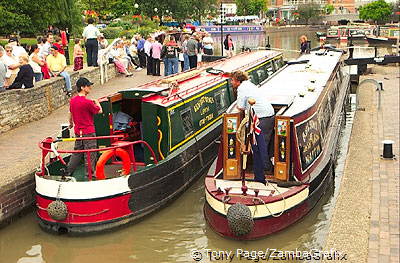
She had bought her house, a Victorian construction, the year before and had put considerable effort and money into restoring it.  It was a brilliant little house, and those of us lucky enough to live there got to know both Vicki and her charming 5-year-old Eve.  She was a single mother with two grown children as well as her little one, and all three of the adults had learned to fend for themselves with the aid of their fortuitous placement in the land of Shakespeare.  Vicki took in boarders, her older daughter cooked at an inn near the Royal Shakespeare, and her son lived on a river barge and drew pen and inks of Union Canal and River Avon scenes for the visiting school marms and aspiring actors who flocked to his floating studio. 

They were typical Stratford-upon-Avon-ites, this family, inextricably linked to the notion that there was a guy named William Shakespeare, who did write the comedies, tragedies, histories and sonnets that bear his name.

So, to create a large industrial, 800-home community replete with new schools, businesses, shops and a health center, will necessarily affect the cultural materialism that has supported the people of this town since the 18th Century, when entrepreneurial actor/producer/playwright David Garrick organized the first Stratford Jubilee in 1769.

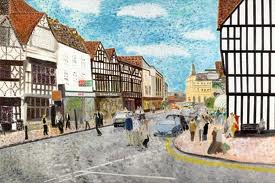
Artist Lydia Fine’s view of downtown Stratford

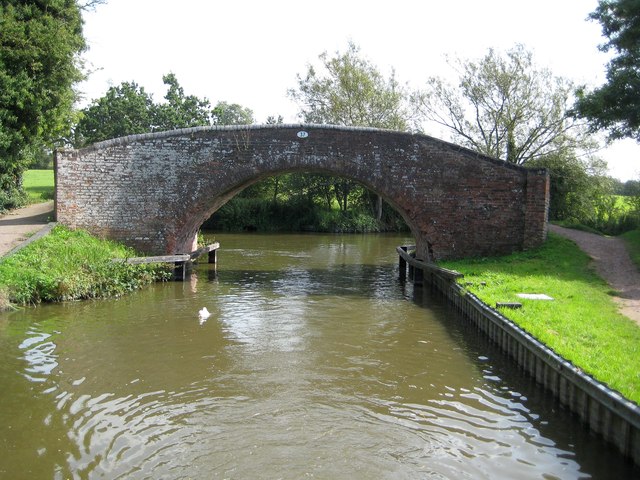
The towpath — also a cow path — along the Union Canal makes for miles and miles of picturesque walking

As soon as I was settled into my room at Vicki’s that first day, I wandered into the High Street, and I found myself breathless with wonder.  Slope-roofed, unevenly constructed Tudor homes, including the birthplace of John Harvard, lined the way, and on the Avon, as along the Union Canal, boats meandered lazily as though they were still mired in some magical, mystical long ago.  Over the course of that summer, I took classes in The Edward VI Grammar School, where Shakespeare learned his English, Latin, Greek, and numbers; I attended performances at every theater in the Royal Shakespeare enclave, and I drank my pints at the Dirty Duck.  I existed in the blissful fairy tale belief that I was living a life touched by my hero’s.  I was transformed, imbued with the healing power of my bardalotry, and because I was surrounded by the physical manifestations of the life he must have led, I could assure myself that the experience was authentic.

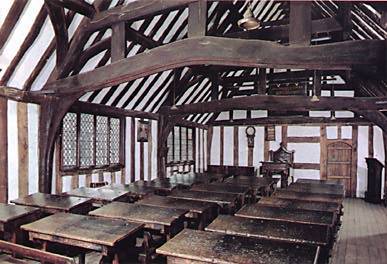
King Edward VI Grammary School actually has records of Shakespeare’s attendance here

Many of the lecturers who came to speak to us that summer were among the blasphemers, but, as James Joyce would have said, blasphemy is closer to faith than blind, indifferent adherence to a creed, and I embraced their suggestions that Shakespeare was at least a collaborator and at worst a plagiarist, working with or stealing from the likes of Thomas Middleton, Christopher Marlowe, Ben Jonson and others.  They only served to make my love grow stronger.

After all, here I was, among the houses and churches and shops and trees and bushes and flowers that were living proof that a man named Shakespeare, or something, lived her in this town, or hereabouts, and he wrote great works of everlasting glory that I could not read without weeping at the beauty of the words. Did any of the naysaying matter?  Not a twit.  So long as the physical accouterments of the place called Stratford-Upon-Avon bore witness to the achievement of the canon, the sun was in its heaven, and all’s right with the world.

Avaunt, black towers of middleclass evil.  Find another bit of land on which to establish the realm of your 21st Century business.  Leave quaint the streets of Stratford-Upon-Avon, and leave chaste the hearts of all bardolators.

Thailand Variations

Some random observations garnered during my nearly three weeks in Thailand . . . .


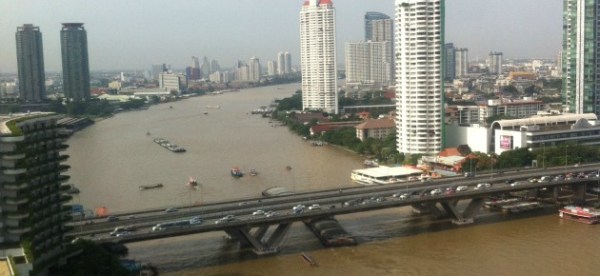
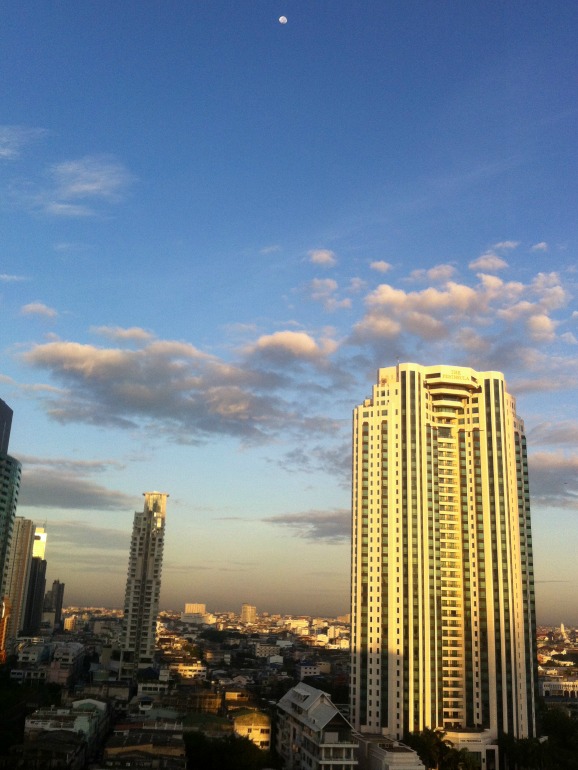
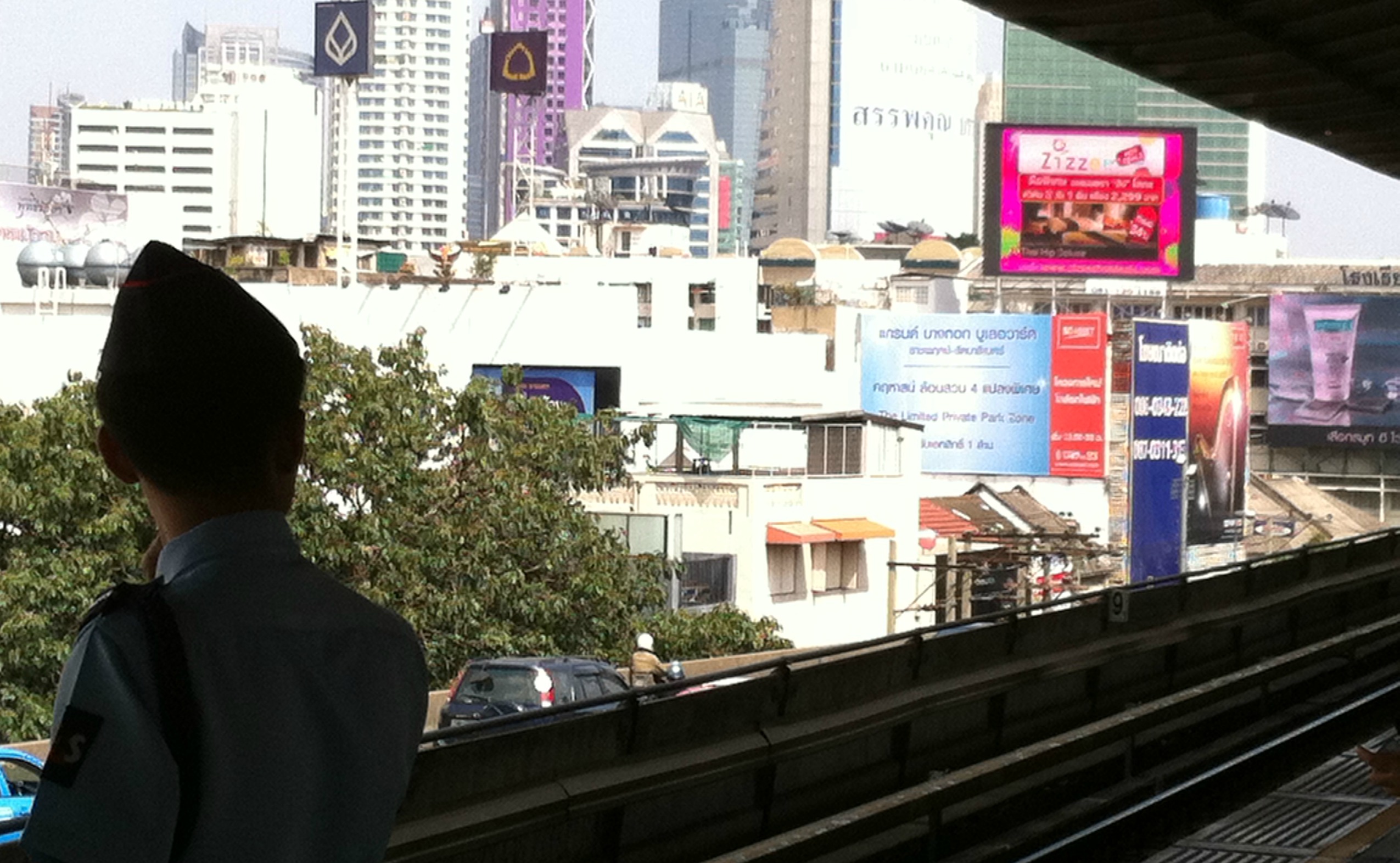
Westerners tend to have the image that Asia, especially a country like Thailand, is backward, inferior to the US in sophistication, in industry, in awareness.  But I certainly saw no sign of any lag.  In fact, in the city, there were far more solar panels, far more signs reminding people to conserve, far more toilets with low flush options than I ever see in this country.  Bangkok is a cosmopolitan, multi-cultural center, and it’s more like New York than it is different, a polyglot city with multihued textures of all kinds.

I must admit that I was, to begin with, quite wary.  Because I had just read 1493, I was constantly aware of what the author calls The Columbian Exchange, the signs of Cristobal Colon’s rearranging of our crops, diseases, homelands.  Thailand is a perfect little empirical test case of a country.  It is near enough to Manila, the eipcenter of the Colombian trade routes, and it is a reflection of all the travelers who have visited for whatever purpose, but it is also a country that has been a crossroads since before the intersection of east and west.

The Thai people, apparently, were the Nanchaoan, living in the mountains of Tibet where they had settled after a migration out of India, through southern China and the Hunan province, moving gradually into the great river valleys of mainland Southeast Asia and settling among the Khmer, Mon and Burman populations whom they encountered on the way. By the 12th century they had established several small states in Upper Burma (Shans), the Mekong valley (Laos) and the Chao Phraya valley (Thais).  Along the way to their becoming Thai, intermarriage, mingling of cultures, sharings of all kinds created a diverse population who established the country of Siam in 1929.In fact, the word Thai itself connotes a congregation of various peoples, so the introduction of western crops, habits, ideas, etc., was embraced enthusiastically, and its effects are evident everywhere.

American corn — maize — is a favorite treat.  Corn appears in all kinds of ways in the abundant street markets — it’s an ingredient in their coconut cakes, it’s available roasted on a stick, just like at the NYC street fairs, and it’s sold in bags, de-cobbed and bagged all by itself.  Sweet potatoes dominate any number of dishes, and they, too, are sold roasted or sweet at both city and rural markets.

In Bangkok, a cacaphony of languages can confuse any eavesdropper.  Dutch, Russian, English of all sorts, German, Spanish intersperse with local words, and everyone, even in backwater corners of the islands, speaks at least enough words of English to buy and sell the abundant array of international products.

The sophistication of the Thai society is evident in some surprising ways.  Sitting in the lobby of the Chatrium Hotel, a mainstream, 5-star luxury establishment on the river that is frequented by businesspeople from around the world, I noticed a transvestite putting on makeup.  No one stopped to stare or point, and no one among the hotel staff seemed the least bit uncomfortable.  Overall, gay life is open and out in Bangkok, as it is in Ko Samui; certainly wherever I went, men and women held hands with and openly embraced co-genderists, and they were, if not flamboyant, then entirely without embarrassment.  I learned that to be a lady boy can be a great honor.  In many cases, little boys are chosen to be raised as girly-boys so they will grow up to be truly feminine, comfortable in women’s garb.

Teeth cleaning, a medicinal art that was already popular in China as early as the 14th Century, is highly evolved in Thailand . . . and very inexpensive.  For less that $20, a reputable dentist will clean your teeth using the airflow method — it feels a bit like sandblasting — and follow that with the traditional ultrasonic and then polishing techniques of the west.  It can be jarring to see signs that offer “Laundry” and “Teeth Cleaning” services under one roof, but that’s more a matter of real estate than business partnerships.  Further, it is very easy to find a good endodontist who will do inexpensive root canal, and implants, crowns and dentures are priced way below American counterparts, and they are superior.

Medicine in general is fairly inexpensive and accessible.  Not surprisingly, Thai plastic surgeons have perfected sex change operations and offer them safely, relatively painlessly and incredibly affordably.  Because there is no stigma, the procedures have been part of the mainstream surgery menu for many years.

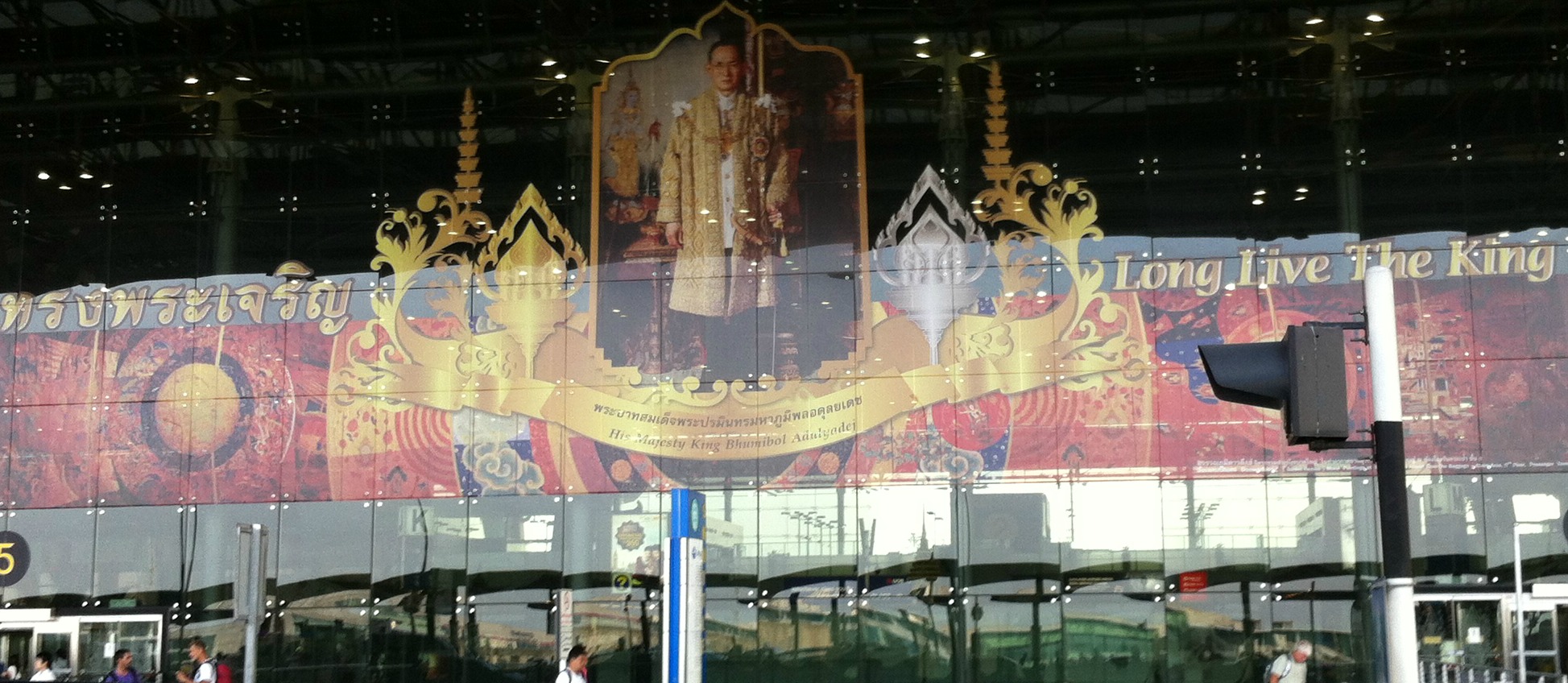
Though Thailand proclaims to be a parliamentary monarchy, the King, descended from the line only begun in 1929, is omnipresent.  At the airport, at the movies, on billboards on the streets, in public bathrooms and shopping malls . . .his image is pasted everywhere.  At the movies, before the start of a feature film, everyone stands and watches a very moving, highly propogandized film depicting the happy, fulfilled people of Thailand praising their king, whose image caps the short in a burst of extraordinarily emotional music.  

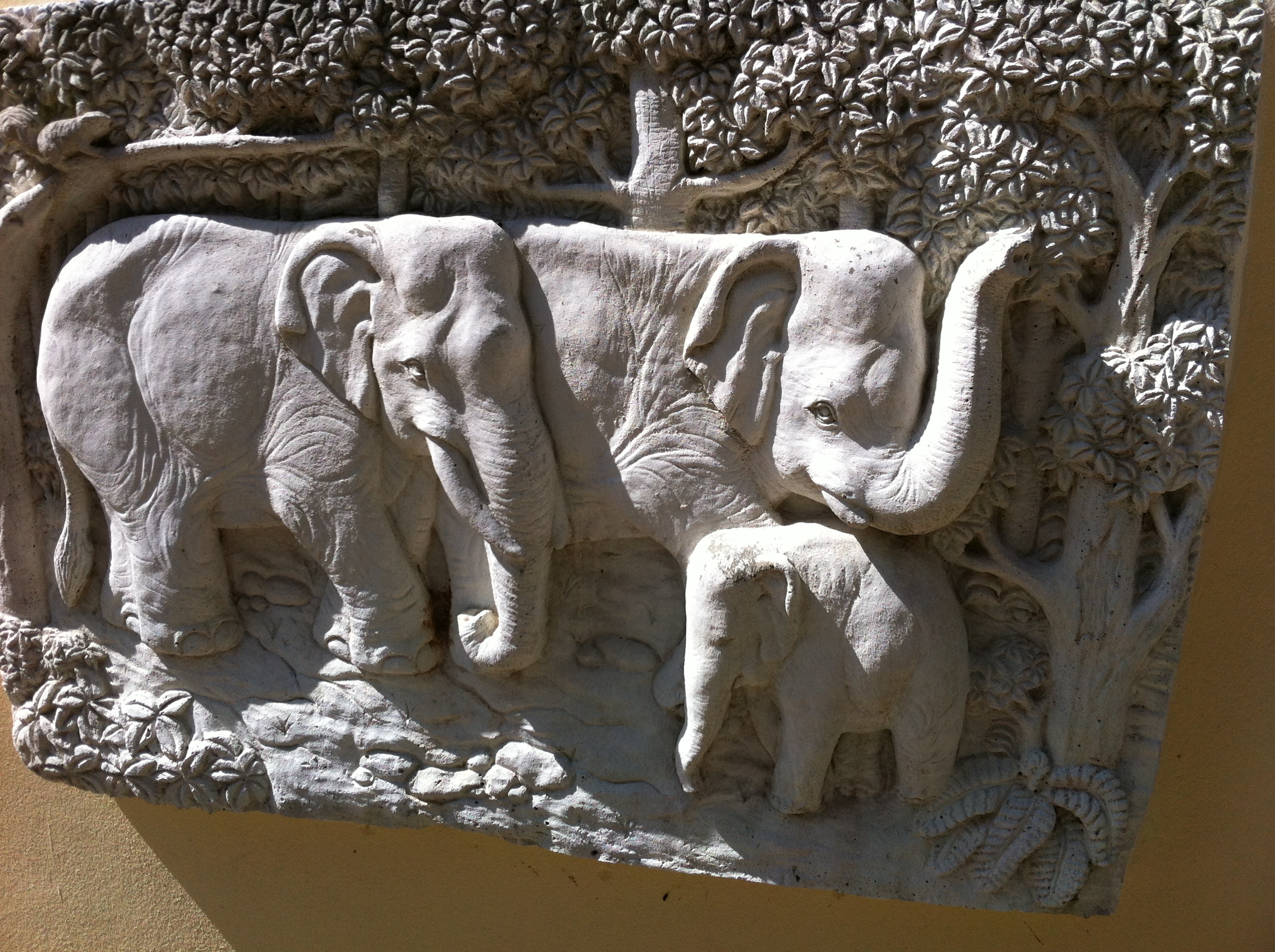
 One thing that deeply disappointed me, however, was the absence of true respect for the indigenous animals.  Though their pictures are everywhere, no elephants are to be seen except at tourist parks, where the elephants are used as mules to take visitors for looks at the natural landscape.  

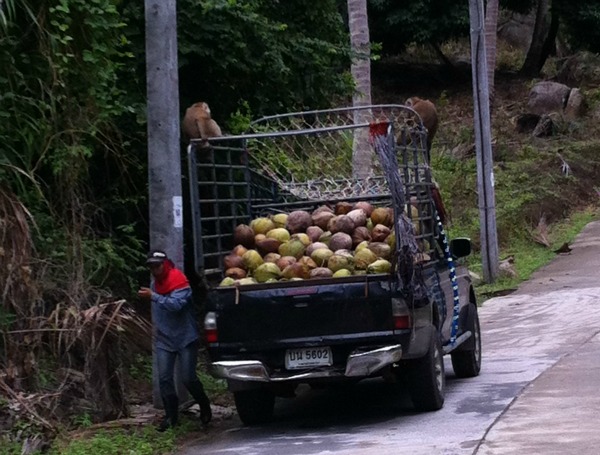
The animals are misused, and they are incarcerated, and their wild counterparts seem to have vanished into the hills beyond anywhere I would have visited.  Monkeys, also depicted on posters and logos as though they are beloved by all the people, are seen mostly on chains — in parks or on trucks that carry them to the coconut trees they are trained to harvest.

.

Floating in Paradise

Tom Hanks, arriving in Thailand in as a rather unwilling Peace Corps recruit in the film Volunteers (1985),  looks out into the seering sun, surveys the landscape to which he has just arrived, and says rather desperately, “Jesus *H* Christ, we must be a mile from the sun!”

I was lucky.  When I arrived in Ko (Ko is Thai for island) Samui it was already October, and while it was far warmer than I prefer my autumnal temperatures to be, the cool breezes wafting off the Gulf of Thailand, the autumn rains blowing in from higher ground kept things downright comfortable throughout my sojourn there.  I had been told I was headed to Heaven, and nothing  about my 8-day stay disabused me of that notion.

 When I entered Bangkok, having arrived from New York by way of Detroit and Tokyo, the customs official who stamped my passport grinned largely when he read my local address.  “Oh, you go to Samui!  You very lucky.”  He looked me straight in the eyes to make sure I had got his drift.  “Heaven.  Samui Heaven!”

Thais are proud of this island with its langorous beaches and island calm.  The concierge in my Bangkok hotel told me it was his dream to go to Ko Samui.  He said he has to work too much and can’t get away, but if he could ever get a vacation, he would head straight for Samui.

Who wouldn’t!  In October, Samui is a veritable perfection.  When the rains come, they cool the jungle, refresh the air, descend deliciously.  After they leave, the air is clear, crisp, clean.  Everywhere you go are sandy beaches, and when the fishermen are not dumping their garbage, the beaches are downright pristine.  The water remains warm enough that you never need to acclimate; just jump right in!  And yet they have just enough chill to envigorate.

Lots of expats live on the island, and that makes it very comfortable to be a “foreigner” in Samui, but it also poses a challenge.  If the quiet, serenity of Lamai or Netong, for example, or the solitude of Boku seem commonplace, then the crowding and the noise of Chaweng can be jolting.  Night life in Chaweng — especially along the routes of the Sexpats, foreigners here for a deeper plunge into Thai hospitality.   Dance club owners, fight promoters, even bar girls’ agents roam the streets in vans equipped with loudspeakers and recorded music to accompany a speaker extolling the virtues of the establishments, inviting all who are hungry to come imbibe.

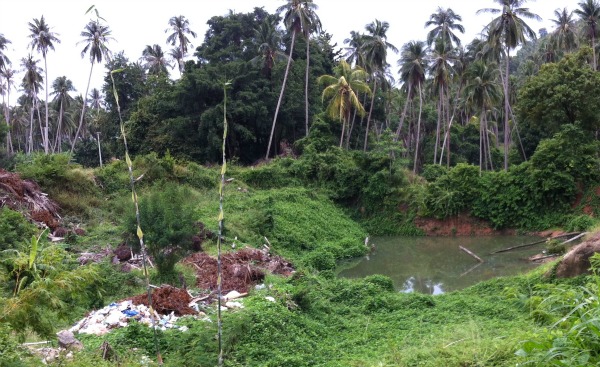
Expats, naturally, bring development to any Paradise, and on Samui, construction is everywhere.  Crews are brought in from cities around Thailand and other countries to work on the sites; they are bused from their communal housing to the workplace in the morning and bused back in the evening, and the signs of their work can be seen in the most unexpected of places.  Unfortunately, where a sense of conservation and preservation is thematic on the island, its rank oposite is equally so.  Impromptu garbage dumps abound in the jungle, along the beaches.

Funny thing about expats is that they pretend to know more about the place than the natives.  Maybe, in some cases, they do.  But, like NY sightseeing guides, they make things up, pass fiction off as truth.  I overheard one guy, who’s lived there, he said, for fifteen years, say that the garbage washes in from Hong Kong and China, that the pollution comes from as far away as Seoul.  “Not our garbage you’ll see out there in the water.  It’s all stuff from far away.”

In any case, as I said before, I was lucky. I saw no garbage in the water. But I was told that there are times when the beaches are piled high with discarded nets and food containers, thrown off the fishing boats; algae find their way to some of the coves, and jelly fish, wrenched from elsewhere by storms, will taint the joy of swimming.  But I was never subjected to any of that.  All I saw were lovely white beaches and clear, inviting water. Because you’re on the Gulf of Thailand, you don’t even have the interference of waves.  I told you, just enough gentle undulation and the weight of salt to remind you you’re in an ocean.  Paradise.

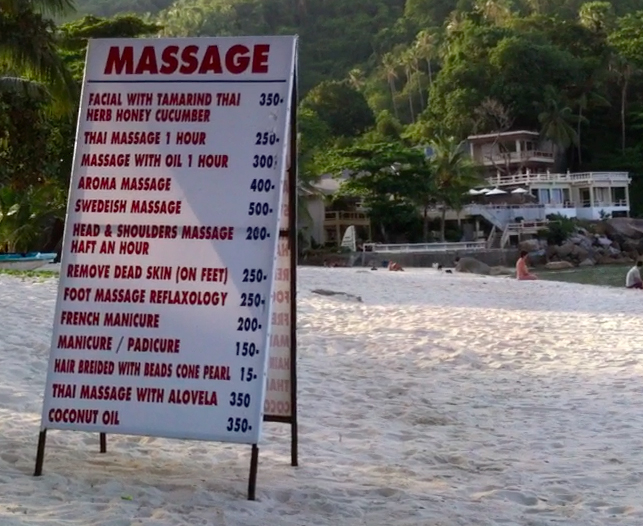
Massage enthusiasts must love these beaches.  Everywhere you go, there are impromptu massage tables set up to enable a client to can lie down, listen to the sound of the gentle surf, bask in the sun, and indulge him/herself in relaxation.  And on top of that, it’s Thai Massage — very hot these days!

All along the shorelines, food mongers gather, offering every kind of seafood and fresh fruit and vegetable one’s imagination can conjure.  Like coconut water?  You needn’t walk fifty steps between sellers offering to open a freshly fallen coconut and make available to you its succulent and refreshing juice.

There are lots of coconuts on the island, and the natives are very good at gathering them.  They’ve got cheap help too — local monkeys are trained to climb the trees, twist the giant nuts from their limbs and throw them to the ground for harvest.  Of course, this can create something of a hazard to beware of — a coconut thrown from a height of 60 feet (frankly, even a coconut pulled by its own gravity from a height of 60 feet) can do real damage to your head and other bodily parts.  Even Paradise has its dangers.

More exist than meet the eye, actually. Like serpents and such also live here.  As I was about to go for a walk down the jungle path that led from my home base to the beach, I was warned, “Just in case. . . if you see a snake, let it pass.  People get hurt because they don’t see the snakes and step on them or something try to catch them.  Just let them pass.”  What kind of snakes, I wonder aloud.  “Cobras — especially King Cobras — and vipers mostly.

At the CDC office where I got my travel shots, I was warned to avoid bats and mosquitoes.  “Sleep in clothing,” the doctor told me.  “Bats will bite you while you sleep, and you won’t even know it. And wear Deet so the mosquitoes leave you alone.”  I saw a couple bats flying by in the evening when were were out, but I remained unmolested.  Though there are mosquitos on Samui, malaria is rare, but dengue fever, another mosquito-bourne disease, is less rare.  Still, it’s not considered threatening enough to cause alarm, and few among those living here would even consider using Deet.  We did carry a naturopathic bug spray around with us, and that seemed to suffice; one night, when we went for dinner at a beautiful beachfront restaurant, the waiter brought us bug spray with our menues; we did apply the substance, and we were left alone.  Didn’t I tell you this is paradise?

Some beautiful places are plagued by rats, but I saw none on Samui.  What Samui does have is a large population of feral dogs. They congregate like rats, menace local runners, threatening small pets;  they also lounge around in the middle of the road, creating a serious hazard for drivers, especially for those on the ubiquitous motor bikes.

And, speaking of perils, the motorbike riders are their own kind of menace.  There are so many of them that they have developed a kind of entitlement, a stance, at least,  that suggests that they believe they own the road.  Driving a car or walking can be risky because there is little awareness on the part of the swarming bikes’ drivers that there is anyone else on the road, and a little scooter can do great damage to a small car or little person attempting to navigate around it.

But these are minor impediments to an environment that is otherwise without flaw.

Dancing in Lunacy – Bali Part II

When I flew to Bali, I expected a paradise would await me, but the visit was a complete disappointment.

From Ubud, we chose to go to Nusa Dua, just as unknown to us as Ubud had been, but with the advantage, from my irrational, malaria-phobic point of view, of being on the ocean, away from the jungle and the rice paddies.

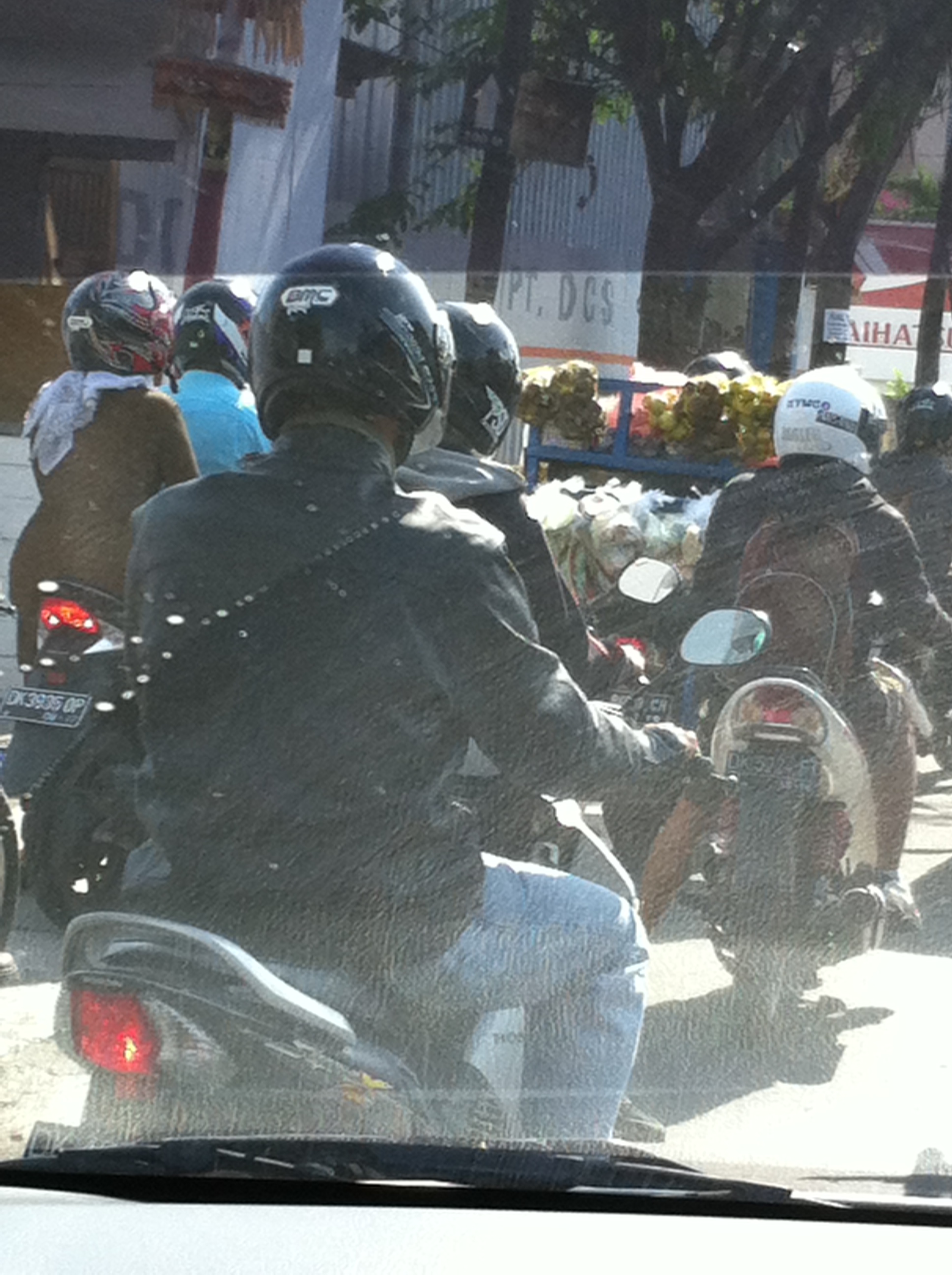
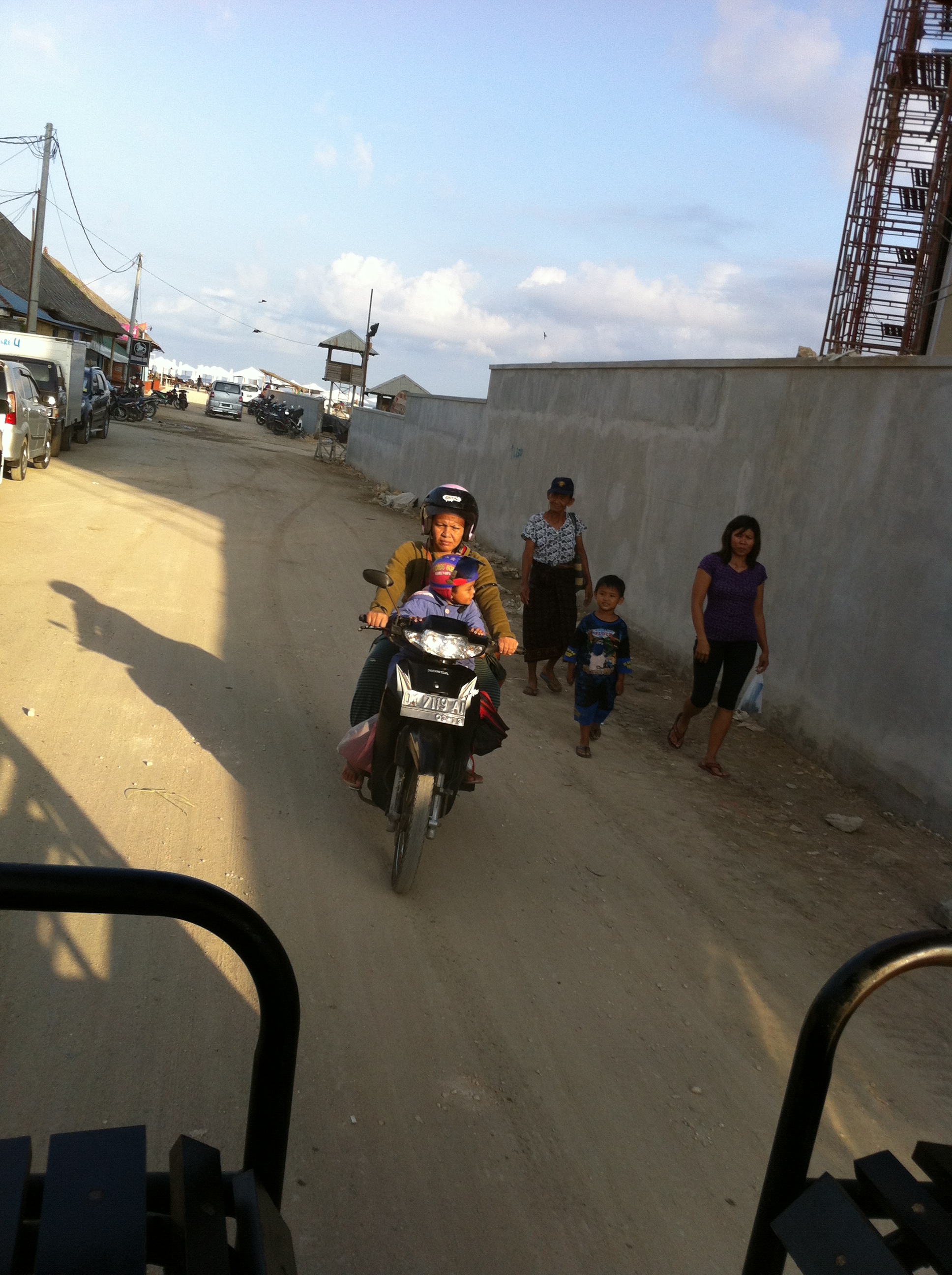
To get to Nusa Dua, as to anywhere else, one must take a taxi or hire a car.  There is little to no accessible public transportation, and distances are deceptively long.  Funny thing, though, whenever we asked someone in Bali how long it takes to get from one place to another, the standard answer was “Maybe 45 minutes.”  We learned quickly that 45 minutes was a rough estimate that could mean anywhere from a hal-hour to a whole day.  From Ubud to Nusa Dua, “45 minutes” meant a two-hour trip, spent mostly in kind of slinking rather than moving slowly behind buzzing armies of motorbikes.

Nusa Dua is a construction site.  There are a few lovely resorts, but there are far more works in progress.  In a few years, the place will be more developed than Miami Beach, but for now, it’s evolving. Hordes of workers on motorbikes murmur in in the morning and out in the afternoon; the hotel we stayed in provides a shuttle to both the beach and the local mall that serves as a town center.  The beach is close enough  to walk to, but the road is not nearly safe enough to try that.

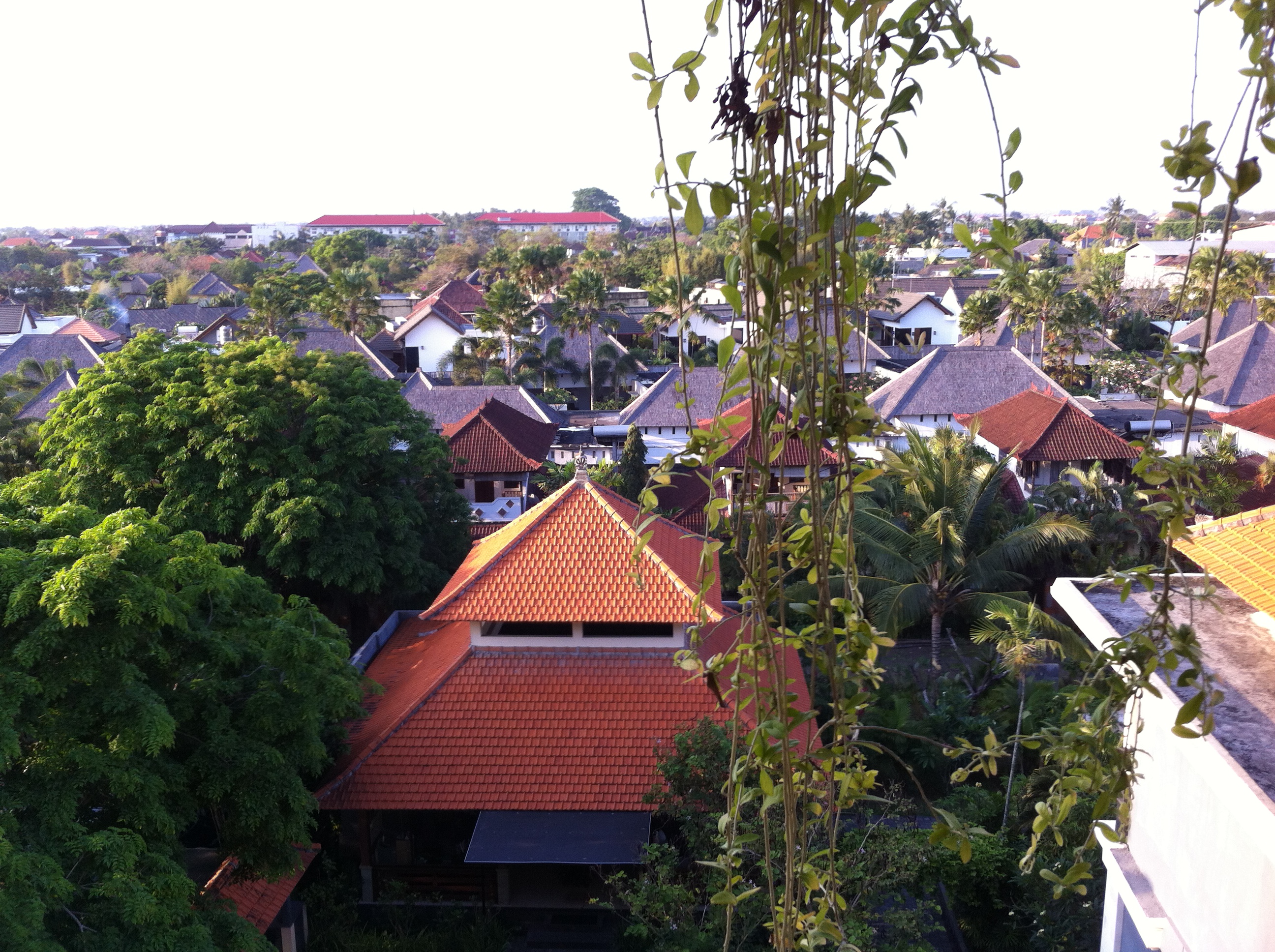
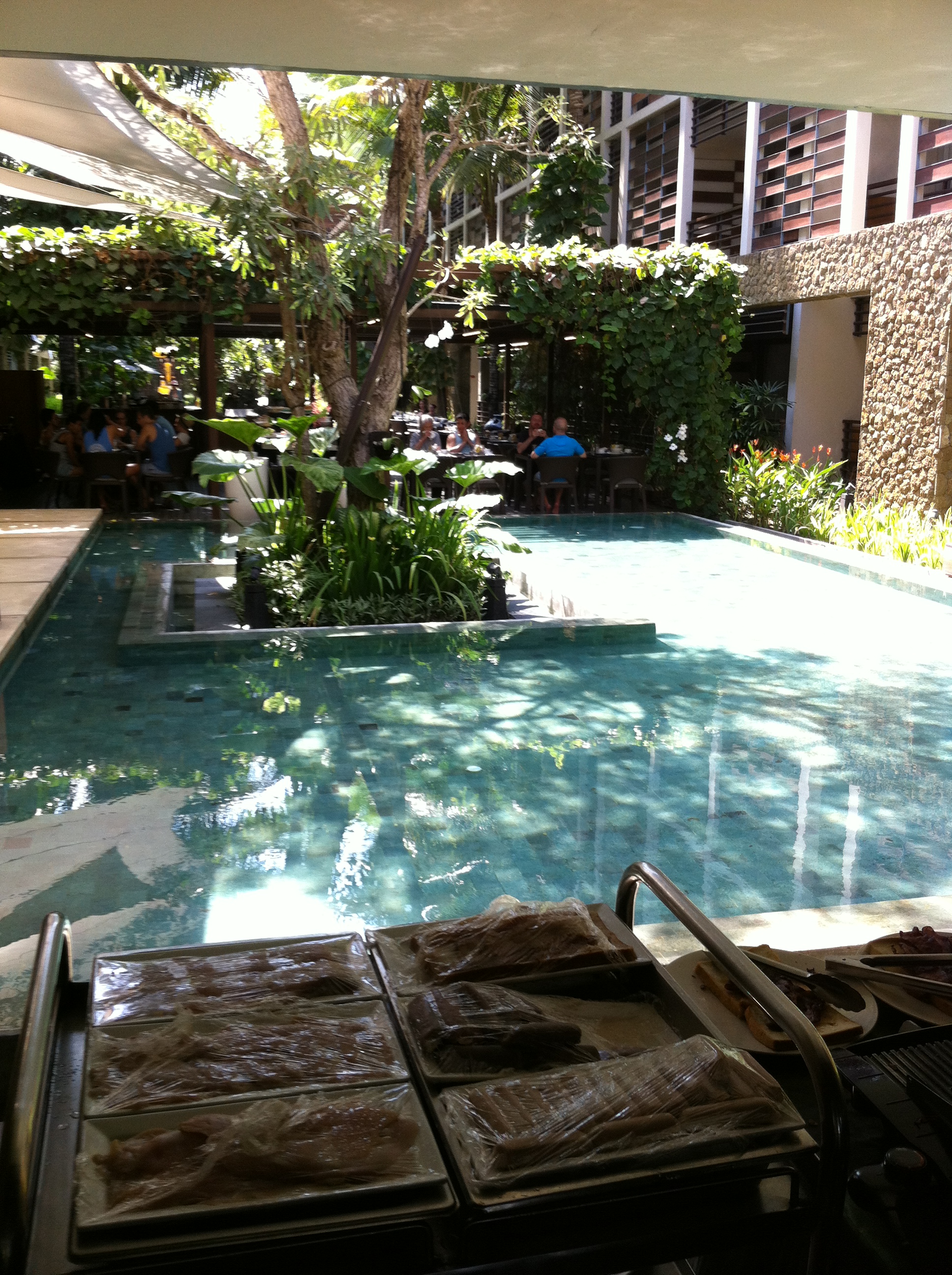
The hotel we chose was the Swiss Belhotel, only open a year and already showing signs of wear in the rooms, which are constructed of inferior quality products.  However, the ambience was delightful, and the food at the breakfast service was wonderful.  The grounds, however, make the place downright regal.

The pool, or rather the two pools, one with a waterfall and vegetation that would have startled Eve with its splendor, were magnificent!  The grounds were so lovingly nurtured that I counted eight distinct colors of the bougainvillea that flaunts its beauty everywhere.   Birds of Paradise, Frangipani, Jasmine and Kasia dance in the breezes, singing lullabys to the myriad orchids that punctuate the space. To complete the idyll, just next door to the hotel is a small farm with the miniature cows that wander the hills here, and roosters strutted even the hotel grounds, promising to wake us first thing in the a.m.

As we had learned to expect, the Swiss Belhotel was staffed by overzealous servers, every one of them falling over themselves to give us what they imagined we might want, forcing on us what we weren’t sure of.  I tried to take a cup of coffee out of the breakfast room, but I was stopped by a young woman, who insisted that she carry it for me; she couldn’t even hand it back to me at the door but had to carry it in to place it upon the desk for me. 

The mall was fascinating.  Called The Bali Collection, the mall is a kind of Carribean-styled area with lots of shopping and dozens of restaurants, each with hawkers out front beckoning visitors in.  We were there during off-season, so many of the restaurants were empty.  That didn’t stop the live music.  At least three restaurants had bands playing ridiculously bad covers of pop ’80’s and ’90’s to empty establishments.  Completely empty.

The truth is that nowhere in Bali did we find an absence of sound.  The most omnipresent noise, aside from motorbike hum, was in the blaring loudspeakers, featuring nonstop technobabble rock, but who inevitably played over and over what seemed to be the favorite number of the moment:  The Black Eyed Peas 2009 hit “It’s Gonna be a Good Good Night.”

One evening we chose a restaurant for dinner thinking we’d get some good fish.  We  didn’t.  But we did get a  “free cocktail,” a thimble-sized cup bearing a sweet, pineapple-y concoction.  When we didn’t raise our glasses fast enough for the waiter to feel he had done his duty, he took my hand and folded it around the cup to help me raise it to my mouth.  It took every ounce of energy to constrain myself here.  I am, after all, a New Yorker.  Enuf sed.

From Nua Dusa we went to Seminyak, a bustling, over-populated tourist throng.  This time we endured a comedy of language error that I will be laughing about for years.

We arrived at The Haven, on the main street, and asked to look at the room we had booked online.  It was unacceptable, overlooking a party-central pool area. Loud, dirty, congested, the ambience was anything but congenial. So we asked to see another room.  That one was not better.  Because we had a language barrier, it was hard to make ourselves understood.  I finally got the clerk to understand that we don’t like the noise.  “Not worry,” she smiled, bowing. “Only loud noise nighttime.”

A manager arrived to assist.  His English was great.  I told him we just wanted to see something that was not facing this infinite revelry.  He said that he had space in the Studio, but it will cost more.  Well, it turns out that more is a mere $10 US added to a rate of $60/night (I booked the room through Agoda.com), and I said that if the place were quiet, it would be well worth it.  So began a comedy of errant room searching.

The manager summoned a bellhop.  He gave the young man the room number he wanted us shown, and he instructed him, further, that he was to take us to the room then to take us to the Studio Lobby, which was on the other side of the hotel grounds.  Our shepherd nodded enthusiastically, smiling, saying, “Yes, yes. Yes, Boss. Okay.”

The first room he took us to was right above the one we had booked.  Not in another part of the hotel.  He couldn’t get the room open — natch; he did not have a key for that room — and no one answered, so we left.  We kept trying to explain that we were in the wrong wing, but he simply kept nodding.

We went to another room in the same wing.  This time a very disgruntled Russian came to the door.  Inside, his girlfriend moaned her displeasure.  Our boy was very embarrassed.

Now he thought to ask someone.  After a deep conversation, he turned to us, bowed and indicated we should follow him.  We did — across the wide expanse of the hotel, up stairs, down stairs, into an elevator, up to the forth floor; and then we were transported to another world.

Quiet, staid, dignified, the Studio is actually another hotel altogether.  There are villas here and duplex one-and two-bedroom units as well as what they call studios, rooms with an alcove for sitting and working.  The room he showed us was a deluxe.  Bigger than the original room, it faced a pristine, quiet, inviting pool, and it even featured, on the balcony, a cushioned couch-style seat.  We said we would take it.

He led us out again and, over our protests that we were supposed to stay in this wing, he led us back to the original desk.  At this point, the clerk explained to me that our bellperson is not only very new, but he comes from an area where they speak a local language, and he is still learning Indonesian.

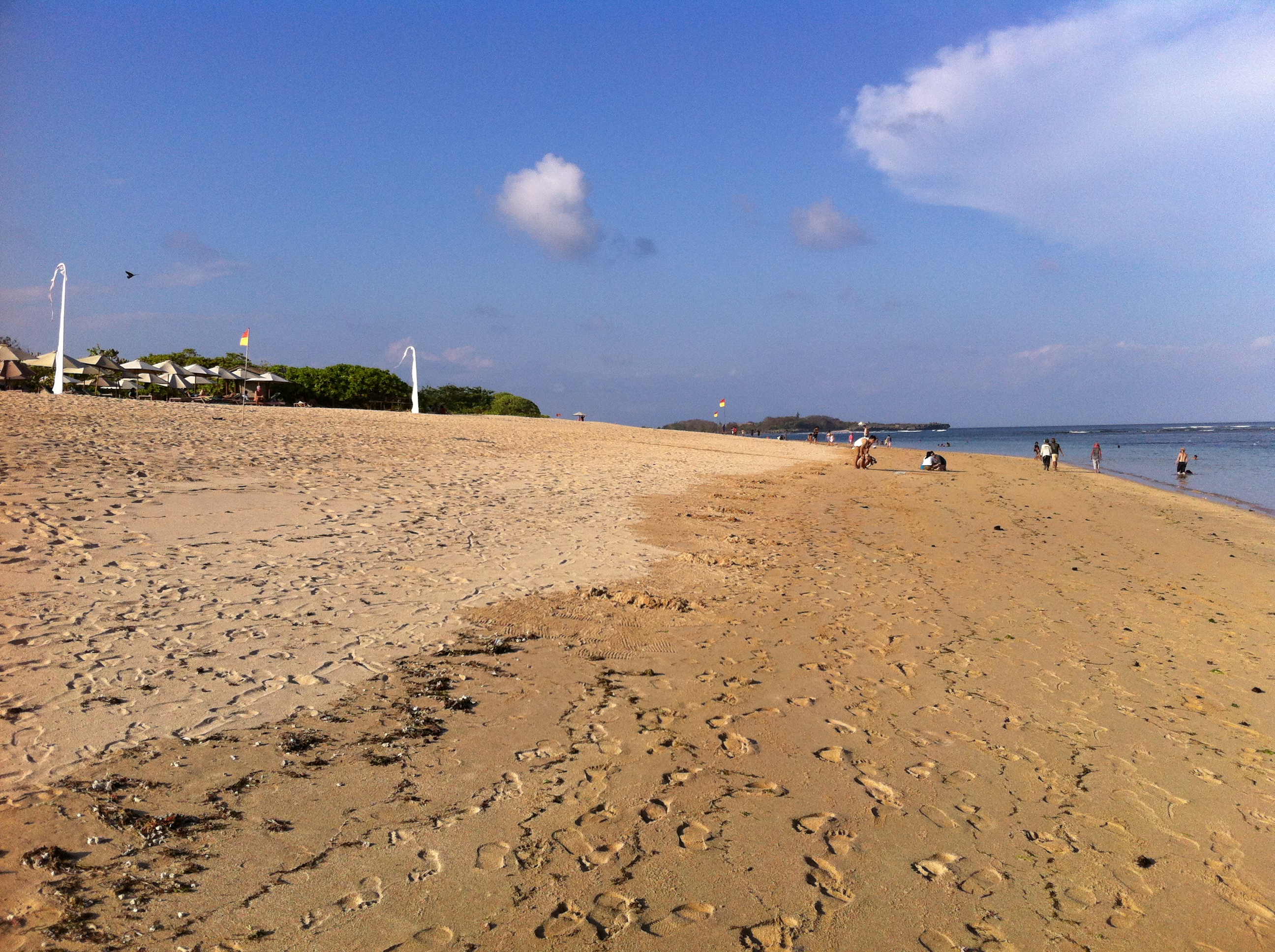
In any case, we settled into the lovely room, then walked (WALKED) to a beach that for all the world could have been Venice Beach, CA, and then went in search of a place to dine.

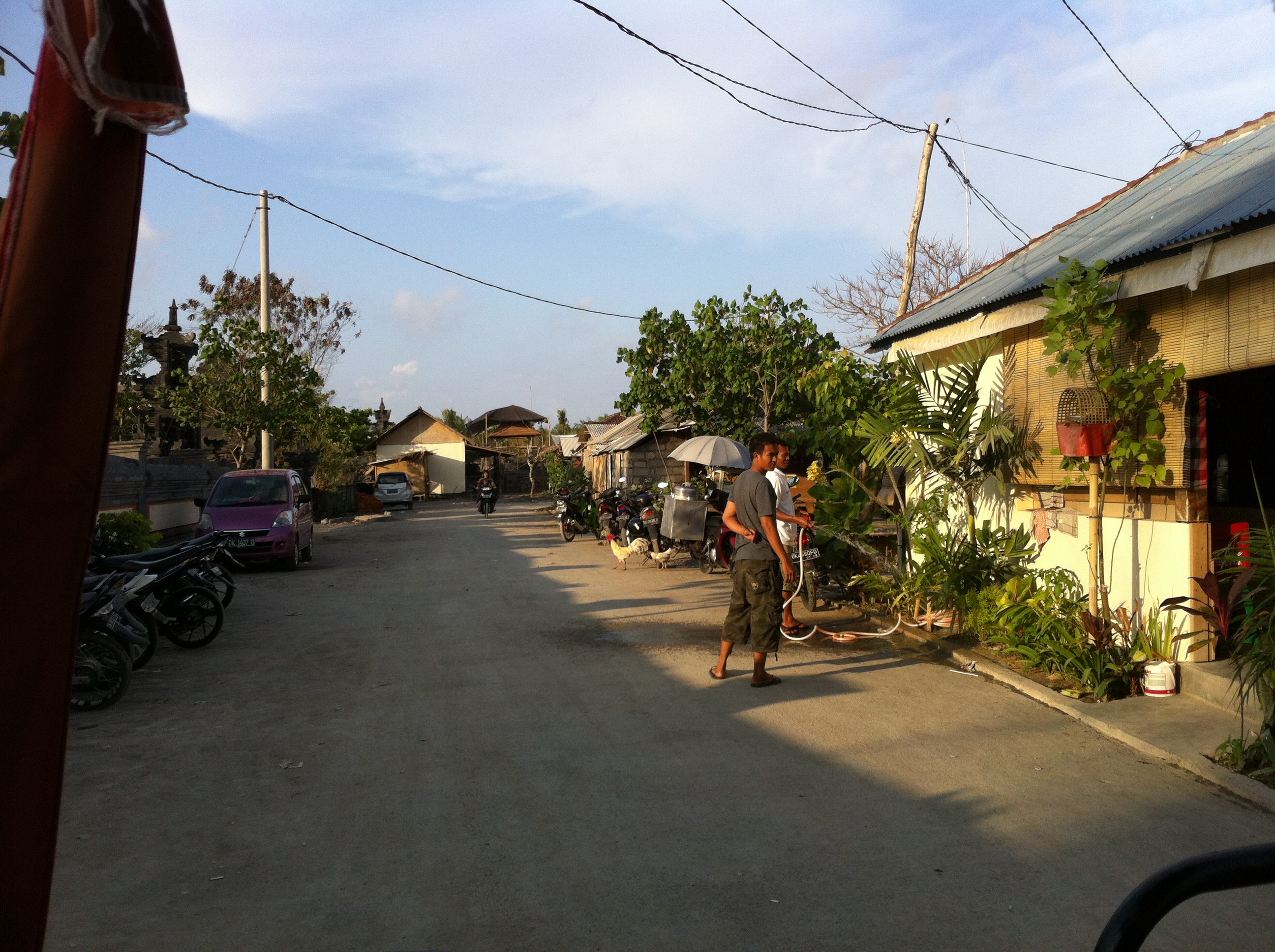
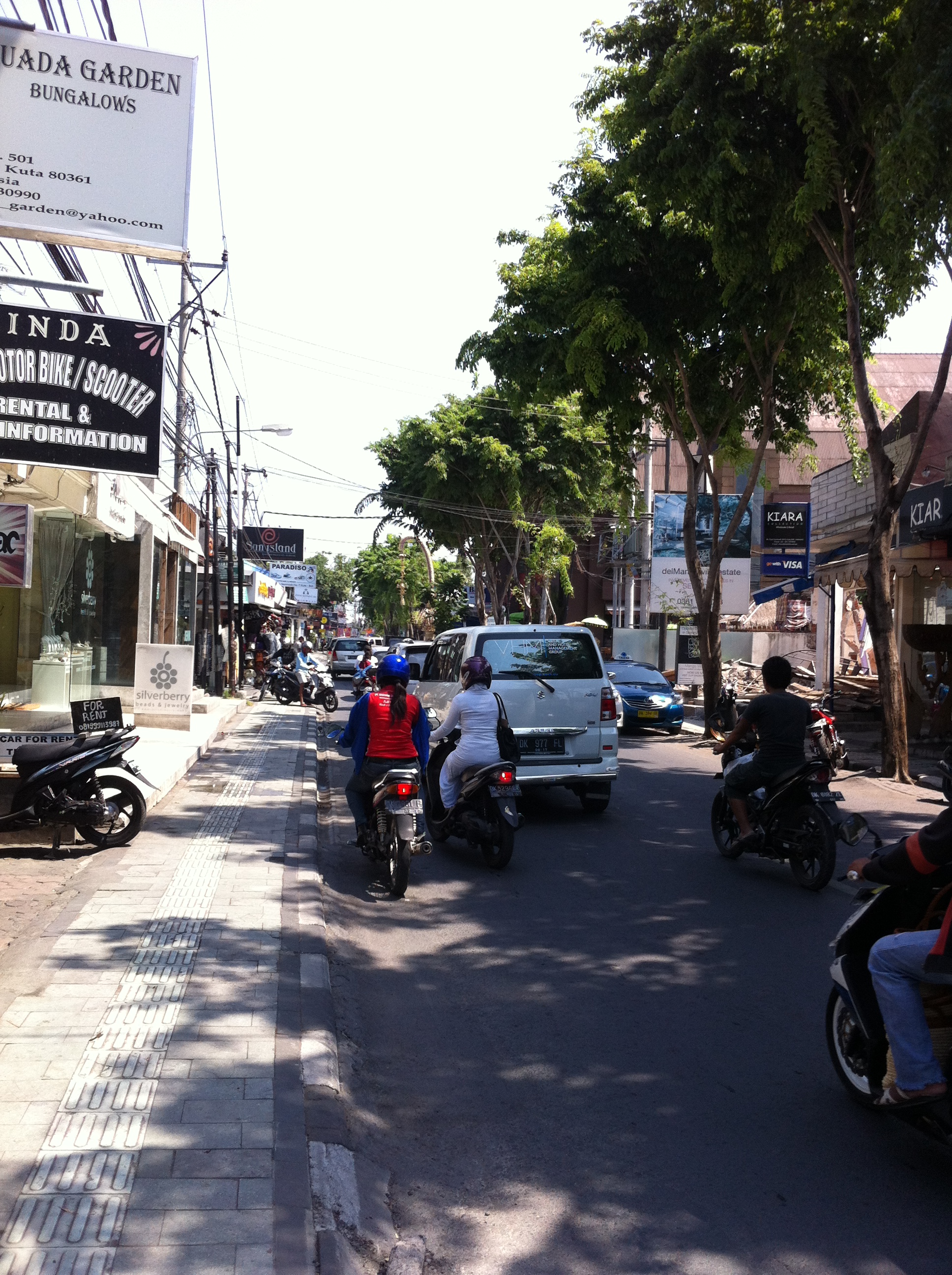
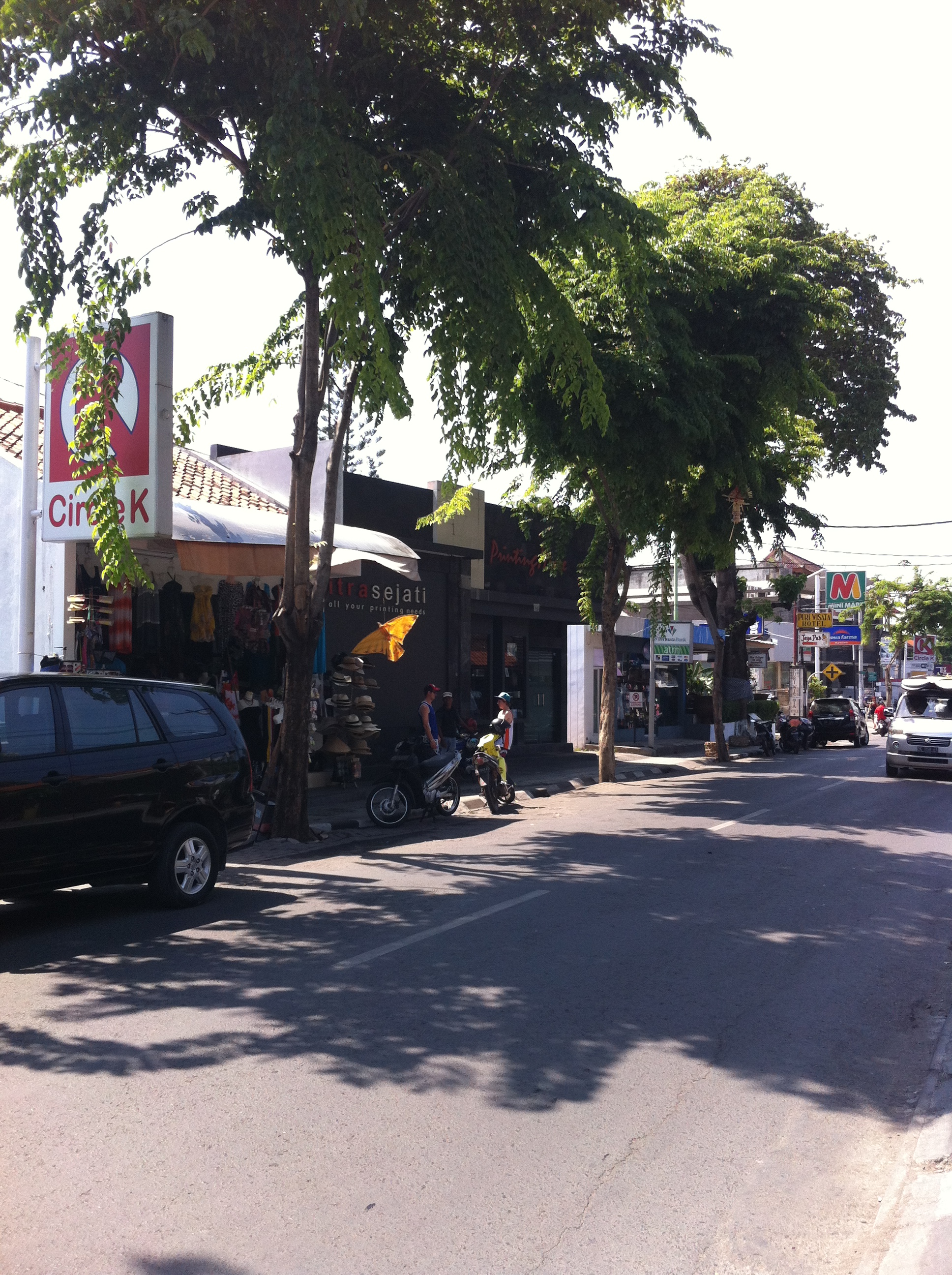
Walking in Seminyak is almost as challenging as it is in Ubud.  Troops of motorbikes, like so many buzzing drones exiting an apiary, congregate everywhere in clumps, maneuvering en masse among the suvs and trucks on the street.  There are narrow sidewalks, in very bad disrepair, that are at least not in the middle of it all. To get across, a pedestrian must raise a hand and wait for the traffic to stop; the motorbikes rarely stop unless they are behind larger traffic that forces them to do so.  We shopped in the delightful but, again, overzealously-manned shops and bought a mediocre dinner at a local take-away before returning to our room.  Next day, more of the same.

Breakfast, which is included as it was at Belhotel, is an elegant affair, and the food is sumptuous, well-presented.  But don’t try to take food out to your room; as with the previous hotel, staff is obliged to do the “work” for you.  The food here was actually the best we had in Bali.  None of the restaurants — and we tried various levels of price — in the five days we were there was better than okay, and in Seminyak, the food we had was overall atrocious.  Tasteless, greasy, without distinction; everything we tried (we were really trying to get to know the local food) was no better than blah. On our last night in Bali, the dinner we had — after much consideration and walking around looking at possibilities, we ordered from the hotel restaurant — was downright awful.

The coup de grace happened at the airport.  Coming into Bali, we had been told that we should have with us $25 US per person to buy our visas.  But no one told us that on our exit from the country we would need to pay an airport tax just to get in to our gate.  The most disheartening aspect of this was that the tax was levied in local Rupiyah and would have been the equivalent of about $15 apiece.  We had already converted our money to Baht for the return to Thailand, which, the official told us, was perfectly acceptable.  Of course, we paid double for our misstep; in Baht, we paid the equivalent of $30 each!

Just another day Paradise!