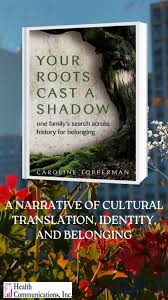
Caroline Topperman’s book Your Roots Cast Your Shadow is a MUST READ.
In Your Roots Cast a Shadow, author Caroline Topperman takes her reader down into the chasms of her family history and proves that finding your roots can be both enlightening and liberating.
So many of us who are descended from damaged, displaced families find ourselves left with mere snippets of our forebears’ memories, carefully curated glimpses of what they deemed acceptable for future generations to know. We wallow in guesswork and strive to build our sense of self from the shadows they cast. So much is left out that we find ourselves veritably blind, searching through a dark forest of innuendo that leads as much to speculation as to revelation.
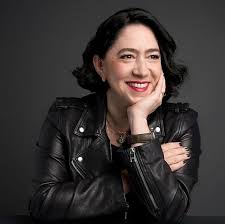
Caroline Topperman has had considerably more success than some of us. Her remarkable parents and grandparents, who suffered through years of hardship that required travels to the far corners of the world, were less guarded. As they went, they scattered enough carefully chosen, indestructible truths behind them that Topperman was able to build a network of paths to meticulously follow. At the end of the end of her multiple trails, she has found rich morsels of story, kernels of history that have provided the means with which she could build a memoir of one family’s struggle to assert their right to live happily ever and leave behind a meaningful legacy.
Topperman’s examination of her multi-rooted family tree, opens with glimpses of her maternal grandparents’ life in Lwow, Poland, just before WWII. They were young, Jewish, intellectual, and proudly unwilling to put up with Nazi or Communist maltreatment. The odds they were up against are all too familiar, but Topperman spins the tale with ever-expanding dramatic flair that is able to surprise, shock, and comfort even the most knowing among us. Both her grandparents found voices, became activists, and prevail. Of her maternal grandparents, Topperman writes, “So many people are blinded by religion, and communism was my grandparents’ religion. . . . They weren’t part of a conspiracy to overthrow the western world; they were simply looking for a way to make the world a better place.”
Direr circumstances surrounded Topperman’s paternal grandparents, who fled from Warsaw to Kabul, Afghanistan, where her grandfather led the construction of Highway AH1 through the Kyber pass, where her grandmother taught gym in a local school, and where her father was born. Eventually, they returned to Poland by way of Uzbekistan, but their journeys were far from over. By the time Topperman and her sister were born in Ontario, Canada, both her parents’ families had nearly traversed the world.
Topperman’s story has many branches emanating from the roots she discloses here. Without sycophancy or flattery, she honestly presents the stalwart men and pioneering feminists who were her predecessors, and she shares her own quest to find her place among them. “Home,” she concludes in the title of her final chapter, “is where the compass lands.” That may be true. But having read the book, I would add that home is where the compass lands. . . but first we must learn how to turn on the light.
In November, I shall have been a mother for fifty years. I never envisioned the possibility that one day my children would be older than I was when both my parents were dead, that I would outlive my younger brother, and that I would be a grandmother older than my own was when this fifty-year-old, her fourth great-grandchild, was born. . . . The breadth of it all amazes me.
That my children survived my parenting is another source of amazement. Having grown up the too-often surrogate parent for my many siblings, I thought I would naturally take to it. I’d have perfect children because I’d be a perfect mom. Of course, I was wrong. Dead wrong. In so many ways. I was subject to so many ineptitudes.
But one thing I got right was entertainment.
We did not have a color television until the firstborn reached the age of 11. It just didn’t seem necessary. As a result, Saturday morning cartoons were easily abandoned in favor of playing outdoors. At night, no one ever begged to stay up for just one more show or sneaked back into the living room to steal a look at what mommy and daddy were watching. From the time they were tiniest tots, they wanted stories.
Stories were commonplace in our house even before the first of our blessed events. Stories were a tradition begun during their father‘s and my courtship. In our first conversation, we discussed Mahler’s Kindertotenlieder, based on Friedrich Rückert’s stories of dying and dead children. We often camped, and we read to one another under the stars . . . works as innocent as Alice in Wonderland as self-conscious as I’m OK You’re OK. One of my motivations to have children was the impetus to continue reading stories aloud, to sharing adventures vicarious and fabulous.
At first I sang the stories. I’d warble convoluted folksongs with sad or inspirational themes or I’d set the story of our day to some monotonal melody or stitch it into a familiar tune and add the story of a journey we had made. Then came the infinite rides we took with books.
We traveled with a bear of little brain on honey-seeking safaris, with elephants from the African savannah to Paris, in a car to the Eifel Tower, to a balloon over the ocean, the big, blue ocean, then on to a tropical island and back to Africa. We laughed at the silliness of an urban monkey whose curiosity continually got him into and out of trouble. We marveled at the D’Aulaire’s version of Greek mythology, tzikached at Aesop. The child who is now turning 50 had a penchant for maps and atlases so we read about faraway places and charted journeys they would take as adults. We soared through those books.
Even after all were more than competent readers on their own and were devouring books by themselves, we read as a family. Especially when we traveled.
Road trips were our vacations of choice, and we drove across the country listening to story cassettes, precursors of Audible recordings. Heroes travled with us. Robin Hood and Little John. A young Fox and a basset hound. Bambi. Under the stars in our campsites or as we wound down in a small motel room, we read aloud until the reader fell asleep.
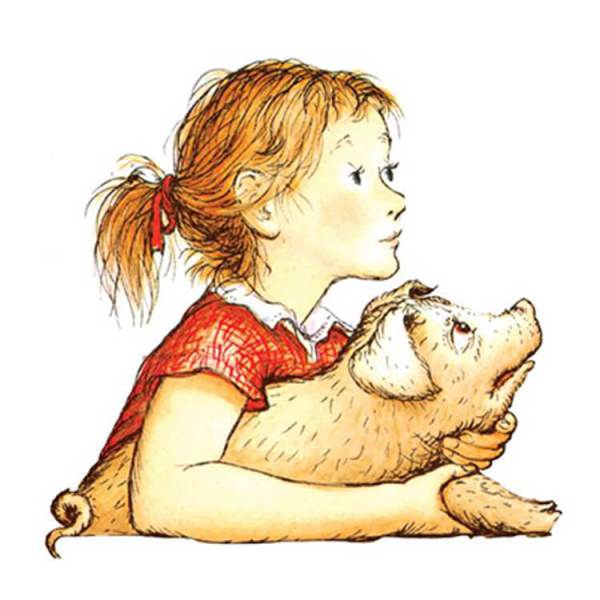
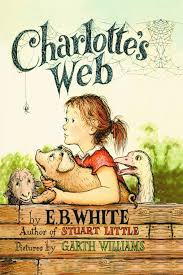
A favorite author in the post-picture-book days was E.B. White. Charlotte’s Web came first, and we read it more than once. It became our favorite. When the first film version emerged, we saw it together and critiqued it harshly. We reread the book and saw the newer version, which we judged with the same rigor. We loved that book.
The other White books and the essays were lovely. But none ever had the pure cachet we afforded Charlotte’s Web. I hadn’t thought about that in a very long time. After all, a 50-year-old child has been a grown up far longer than they were a child. Reading to my babies resides among the cherished memories of a time long gone.
But time has been kind, and new book memories have settled in, thanks to grandchildren who have loved stories as much as their predecessors did. Two have already passed through our read-aloud nights and are firmly ensconced in teen sensibilities. But I still have one little person left with whom to share the stories.
He lives far away, but we Zoom almost every night. After a little talking, sometimes a game or two, I read him to sleep. In past months, we’ve coursed through 26 Junie B. Jones books, and twelve books about dogs and pirates and wizards. Most recently, I have wandered back with him to the pleasant joy of Charlotte’s Web.
The sheer beauty of the book moves me to tears every single night.
The narrative voice is soothing, even as White describes the prospect of his hero being reduced to bacon and lard, even as he takes us through a mountain of manure into a rat’s nest. Somehow, no matter how ugly the world is, this author finds the words to reassure us that there is reason to be calm, reason to hope that on the next page there will be something fun and joyful.
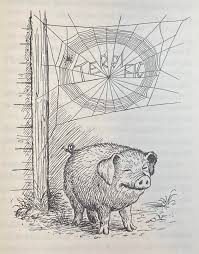
When the human child Fern’s mother asks her pediatrician if he understands the writing in Charlotte the Spider’s web, the doctor admits that he doesn’t. But, he continues, he doesn’t understand how a spider spins a web in the first place. “When the words appeared, everyone said it was a miracle. But nobody pointed out that the web itself is a miracle.”
The humblest of realities, a spider’s web. A miracle. What a lesson for children. And expressed in a prose that is smoothly American English at its best.
“Well, who taught a spider? A young spider knows how to spin a web without any instructions from anybody. Don’t you regard that as a miracle?” The doctor asks. The real miracle is the writing.
My children were young in the Arizona desert, and my grandson lives in a country with a Mediterranean climate. Yet all learned what to expect from a New England winter, what makes fall a season of amazement, why spring springs exuberantly from E.B. White.
“The autumn days grew shorter. . . . The maples and birches turned bright colors and the wind shook them so they dropped their leaves on the ground. Under the wild apple trees in the pasture, red little apples lay thick on the ground.”
No Netflix series, no Nickelodeon animals can bring the world to more vibrant life. Nothing on Youtube compares with the deep satisfaction even an 8-year-old derives from hearing about Charlotte’s affectionate, abiding friendship for a spring pig. And nothing – not even the most sensitive Disney films like Bambi or Soul will ever demonstrate more positively to a child that life includes death, that happiness includes grief, that joy bursts forth from the meanest of realities.
Prodigious marvels are all around us. Even in in a “warm delicious cellar, with garrulous geese, the changing of seasons, the heat of the sun, the passage of swallows, the nearness of rats, the sameness of sheep, the love of spiders, the smell of manure, the glory of everything.”
When I celebrate this fiftieth anniversary of parenting, I shall light a candle of gratitude to E.B. White and his Charlotte for teaching my progeny I’ll always be with them, and they never need to look far for the joys I’ll have left behind.
NB: I wrote this right after Sandy Hook and have updated it, though the only thing that has changed is that there are many more Mays, more people left in the wake of senseless slaughter. . . . ——————————————————
I’ve been thinking a lot about my friend May these days. May’s not her name, but everything else I write about her will be faithful to the person I knew.
May and I taught together in a fairly small English department in a mid-sized town in Connecticut. She was a veteran by the time I began teaching, though we were nearly the same age. She is one of those exceptional people called to teaching, and while I did not agree with her approaches, she was undeniably driven to spend her life in a classroom. She loved her work, loved her school, loved her students.
More than that she loved her family. Her husband was a semi-retired business owner, and together they trained show dogs and horses. Their daughter, whose disabilities made her dependent on them for life, was sheltered in unfettered warmth. But the light of May’s life was her talented, intelligent son.
May never tired of sharing photos and mementos from her son’s glory days in high school, then college; her only complaint was that he remained single, and she longed for him to bring her grandchildren. Then, just before I left my position as a teacher in the room down the hall from May’s, her son did marry, and he married a girl May easily adored. Beside herself with joy, May was confident that grandchildren were finally on her horizon, and she could not wait.
I didn’t see May for a lot of years. I had moved to another school and then left teaching altogether; I hardly thought about her. But when Newtown happened, I saw in a news story that one of the children murdered there had her last name. Unwilling to imagine the bottomless pain of being a parent of a Newtown parent, I dismissed the name as a coincidence until a week later, when someone I knew from that town wrote me to tell me that the child whose name I had noticed was indeed May’s grandson.
Connecticut is a small town, and May’s was not the only family I knew whose hearts were buried in that awful rubble. But having reached grand-motherhood myself, having spent so many hours hearing the golden son stories, the news of May’s loss struck me like a serrated knife slicing away the edges of my heart. I couldn’t even write to her. I hadn’t been in touch with her for over twenty years; it felt disingenuous to write of sympathy, of love. I was dumbstruck.
There is no bottom to the kind of despair I envision in the wake of such a loss. And today, for the 294th time this year, another group of grandmothers’ lives have been strangled by an angry man carrying a gun, and by the deranged, terroristic forces in our society, who claim it is his inalienable right to carry that weapon with which he has slaughtered her child’s child.
It is time to stand up as a nation and say ENOUGH. We will take no more. We will make it stop. And we must do it now. We have no time to lose. We are all being watched through the sights of those guns, and it is up to us to hobble them for once and for all.

 carlastockton.me