Thanksgiving could have been a sad day for me. I dreaded it.
Alone with my grandson in a place where no holiday exists, I expected I’d miss it all. But I didn’t.
The day was as unThanksgiving-ly as I expected. People were at work, kids at school, and the rain was relentless. No decorations adorning the stores, no premature Christmas music wafting on the air. And, to my surprise, no soggy sobbing from morning till night. I was fine.
Once upon a time, when I was part of the huge, giggling gaggle of disparate personalities we called family, the cozy congeniality of the holiday was indeed beautiful. And bountiful. As the day approached, the smell of baking pies, the sight of the giant turkey defrosting in the fridge filled me with genuine, near-tears rejoicing. The thought of that convocation and the laughter that would resound from the dining area were what motivated my excitement for Thanksgiving, and I made sure I could participate in the whole ritual year after year, with family or with friends, depending on where I was.
Times, however, change. The characters in my memory story have morphed into strangers or moved off the planet, and in their absence, rather than nostalgia, I am left with a more realistic picture of the holiday scene.
Instead of laughter and conviviality, my stomach churns at the thought of the after-dinner bloat battle. Turkey never agreed with me, and because we ate little sugar every other day of the year, along with the indigestible bird, the pecan and pumpkin pies caused turmoil in my digestive tract, from which it took days to recover.
The minute the last crumb of desert was wolfed down, the company split into small cliques. Some went to watch football on TV while others went out to play or ride horses or visit friends. We were no longer connected once the food was cleared.
And then the cleanup. The inevitable sorting of leftovers, boiling the carcass to make a soup, washing greasy pans that revived the after-dinner queasiness.
No, I did not miss any of it.
This year, my grandson and I went for a long walk, made chocolate chip cookies, talked about people who were not there to share the day with us. We laughed. He got silly, as small boys do, and we ate fried rice. It was a great day. A day that filled me with boundless gratitude.
Much better for me than a day of gorging into gassy oblivion. I spent the day with a precocious child, whose doe eyes shine with my mother’s dark brown wonder and remind me how lucky I am that she escaped the Holocaust and found her way to my father. We looked at pictures of cousins who visited us last summer – cousins with my father’s April blue eyes that teared with joy when his children gathered round him. I told him about the Thanksgiving my brother, whom he will never get to know, took his mother up a mountain and taught her to drive . . . at the tender age of 9. Then I reminisced about a holiday I spent with my long-gone sister and her now-departed sons and how her daughters remind me how very strong and powerful she actually was. We watched a video of a time we spent with my son’s children, each of whom bears the name of one of my parents, one whose eyes are dark and inquisitive like mom’s and the other whose eyes are oceanic, sensitive like dad’s. The laughter resounded in my memory. The joy of holiday moments, the ones where we joined hands and thanked God for blessing us all by keeping us alive, for sustaining us, and for bringing us to this season.
In November, I shall have been a mother for fifty years. I never envisioned the possibility that one day my children would be older than I was when both my parents were dead, that I would outlive my younger brother, and that I would be a grandmother older than my own was when this fifty-year-old, her fourth great-grandchild, was born. . . . The breadth of it all amazes me.
That my children survived my parenting is another source of amazement. Having grown up the too-often surrogate parent for my many siblings, I thought I would naturally take to it. I’d have perfect children because I’d be a perfect mom. Of course, I was wrong. Dead wrong. In so many ways. I was subject to so many ineptitudes.
But one thing I got right was entertainment.
We did not have a color television until the firstborn reached the age of 11. It just didn’t seem necessary. As a result, Saturday morning cartoons were easily abandoned in favor of playing outdoors. At night, no one ever begged to stay up for just one more show or sneaked back into the living room to steal a look at what mommy and daddy were watching. From the time they were tiniest tots, they wanted stories.
Stories were commonplace in our house even before the first of our blessed events. Stories were a tradition begun during their father‘s and my courtship. In our first conversation, we discussed Mahler’s Kindertotenlieder, based on Friedrich Rückert’s stories of dying and dead children. We often camped, and we read to one another under the stars . . . works as innocent as Alice in Wonderland as self-conscious as I’m OK You’re OK. One of my motivations to have children was the impetus to continue reading stories aloud, to sharing adventures vicarious and fabulous.
At first I sang the stories. I’d warble convoluted folksongs with sad or inspirational themes or I’d set the story of our day to some monotonal melody or stitch it into a familiar tune and add the story of a journey we had made. Then came the infinite rides we took with books.
We traveled with a bear of little brain on honey-seeking safaris, with elephants from the African savannah to Paris, in a car to the Eifel Tower, to a balloon over the ocean, the big, blue ocean, then on to a tropical island and back to Africa. We laughed at the silliness of an urban monkey whose curiosity continually got him into and out of trouble. We marveled at the D’Aulaire’s version of Greek mythology, tzikached at Aesop. The child who is now turning 50 had a penchant for maps and atlases so we read about faraway places and charted journeys they would take as adults. We soared through those books.
Even after all were more than competent readers on their own and were devouring books by themselves, we read as a family. Especially when we traveled.
Road trips were our vacations of choice, and we drove across the country listening to story cassettes, precursors of Audible recordings. Heroes travled with us. Robin Hood and Little John. A young Fox and a basset hound. Bambi. Under the stars in our campsites or as we wound down in a small motel room, we read aloud until the reader fell asleep.
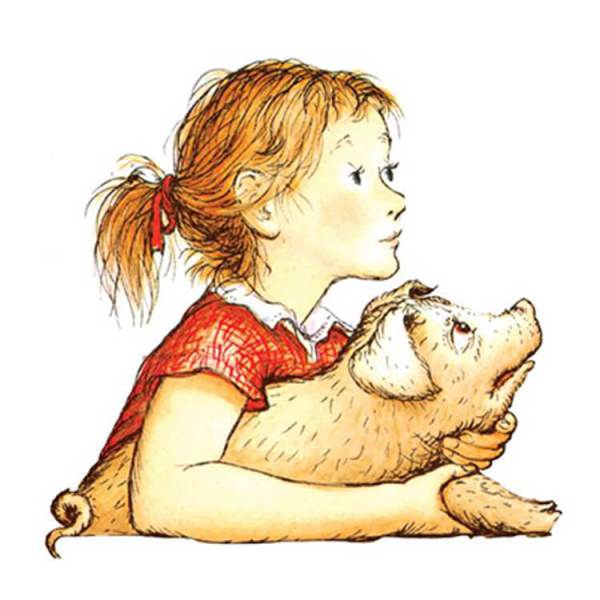
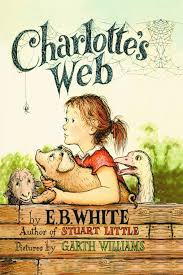
A favorite author in the post-picture-book days was E.B. White. Charlotte’s Web came first, and we read it more than once. It became our favorite. When the first film version emerged, we saw it together and critiqued it harshly. We reread the book and saw the newer version, which we judged with the same rigor. We loved that book.
The other White books and the essays were lovely. But none ever had the pure cachet we afforded Charlotte’s Web. I hadn’t thought about that in a very long time. After all, a 50-year-old child has been a grown up far longer than they were a child. Reading to my babies resides among the cherished memories of a time long gone.
But time has been kind, and new book memories have settled in, thanks to grandchildren who have loved stories as much as their predecessors did. Two have already passed through our read-aloud nights and are firmly ensconced in teen sensibilities. But I still have one little person left with whom to share the stories.
He lives far away, but we Zoom almost every night. After a little talking, sometimes a game or two, I read him to sleep. In past months, we’ve coursed through 26 Junie B. Jones books, and twelve books about dogs and pirates and wizards. Most recently, I have wandered back with him to the pleasant joy of Charlotte’s Web.
The sheer beauty of the book moves me to tears every single night.
The narrative voice is soothing, even as White describes the prospect of his hero being reduced to bacon and lard, even as he takes us through a mountain of manure into a rat’s nest. Somehow, no matter how ugly the world is, this author finds the words to reassure us that there is reason to be calm, reason to hope that on the next page there will be something fun and joyful.
When the human child Fern’s mother asks her pediatrician if he understands the writing in Charlotte the Spider’s web, the doctor admits that he doesn’t. But, he continues, he doesn’t understand how a spider spins a web in the first place. “When the words appeared, everyone said it was a miracle. But nobody pointed out that the web itself is a miracle.”
The humblest of realities, a spider’s web. A miracle. What a lesson for children. And expressed in a prose that is smoothly American English at its best.
“Well, who taught a spider? A young spider knows how to spin a web without any instructions from anybody. Don’t you regard that as a miracle?” The doctor asks. The real miracle is the writing.
My children were young in the Arizona desert, and my grandson lives in a country with a Mediterranean climate. Yet all learned what to expect from a New England winter, what makes fall a season of amazement, why spring springs exuberantly from E.B. White.
“The autumn days grew shorter. . . . The maples and birches turned bright colors and the wind shook them so they dropped their leaves on the ground. Under the wild apple trees in the pasture, red little apples lay thick on the ground.”
No Netflix series, no Nickelodeon animals can bring the world to more vibrant life. Nothing on Youtube compares with the deep satisfaction even an 8-year-old derives from hearing about Charlotte’s affectionate, abiding friendship for a spring pig. And nothing – not even the most sensitive Disney films like Bambi or Soul will ever demonstrate more positively to a child that life includes death, that happiness includes grief, that joy bursts forth from the meanest of realities.
Prodigious marvels are all around us. Even in in a “warm delicious cellar, with garrulous geese, the changing of seasons, the heat of the sun, the passage of swallows, the nearness of rats, the sameness of sheep, the love of spiders, the smell of manure, the glory of everything.”
When I celebrate this fiftieth anniversary of parenting, I shall light a candle of gratitude to E.B. White and his Charlotte for teaching my progeny I’ll always be with them, and they never need to look far for the joys I’ll have left behind.


 carlastockton.me