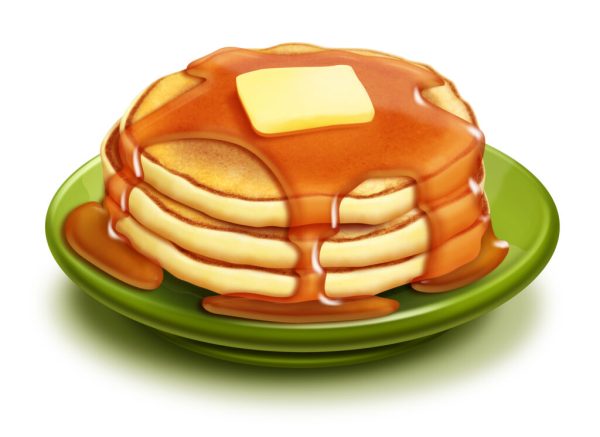
My father loved pancakes. My mother made them often, but he especially loved the pancakes that the women of the United Methodist Church served every Easter morning after sunrise service.
Perhaps the pancakes tasted sweeter when filled with the spirit of revelation. Perhaps he just liked the way the pancakes were uniformly round, thin, and warm, so unlike the ones my mother made. Hers were always misshapen, and by the time they got to his plate, they were routinely cold. I suspect that in his mind, my mother had not mastered the gentle American art of making pancakes, as she had most assuredly not mastered the compleat art of Easter.
Oh, she got the gist. She understood that Easter was, like Passover, a celebration of renewal, of rebirth. I was born in the wake of the Holocaust that drove her to the US, and though she never said as much, I know that the symbolism of Easter and Passover were reminders that she was fortunate to have a life that had transcended the ashes that consumed so many of her loved ones. She abjured the images she admitted to later, images of Easter pogroms in her father’s Polish shtetl. She embraced our celebratory rituals – coloring eggs, making paper flowers, painting murals for the dining room that exploded with the glory of springtime. We lived in several places in the northeast, where winters then were long and bitterly cold. The warmth of spring was a welcome reprieve. But she never made Easter about Christ.
Nor did she make pancakes on Easter Sunday. Easter Sunday was the one Sunday we broke with the weekly tradition of attending church together.
On that morning, because I sang in the choir, Dad woke me early, and we went together to Sunrise Service, after which he stood in line, first for pancakes, then for seconds. He chatted with the parishioners, schmoozed with the minister and the assistant minister, and then he drove back to the house to get the rest of the family. I would watch from the choir loft with a modicum of embarrassment as Dad, Mom, and my six siblings, all dressed in the new Easter finery that Mom herself had sewn, filed in. They were, as always, about ten minutes late, and the congregation seemed amused as they filled a pew at the front of the nave.
After the service, Dad was like a little boy. He could not wait to get us home to our Easter baskets, which he had personally filled with candy and little toys. Then we’d have brunch, which Mom would serve with pride. The other food varied with the years – when we were flush, we had meat and cheeses, and when we were not, we had whatever we could afford – but three critical items never changed. At every Easter brunch, we ate the eggs we had colored the day before and the Passover matzahs she had hungrily opened that morning. We always had chicken soup and matzah balls. Dad made fun of Mom for the matzah. She could have chosen toast, he would chide. Or she could have made pancakes. She would smile and say, “You already had your pancakes, and you don’t like mine nearly as much.”
The year I was about 6, the toys in our basket included tiny taxidermized chicks. My mother was appalled. She said something I didn’t understand about carrying the imagery of Easter too far. When I realized what I had in my hand, I shrieked and ran to the backyard, where I buried the weightless thing in Mom’s tomato garden. Years later, Dad remembered the day more vividly than I did, and I believe he blamed it for a cataclysmic change that came over me when I was twelve.
Until then, I never questioned our tradition of attending church together every Sunday. I was deeply committed to my father’s religion and, from the time I was 5, I sang in the choir, often emotion-laden solos with tears running down my face. Easter was my teariest time – tears of mourning for the crucifixion and tears of joy for the resurrection. My father was intensely proud.
Then, in the middle of my final tween year, I experienced a reversal of faith. I told my father that I respected Christianity deeply, that I believed in its tenets regarding love and forgiveness. But the basic mythology had lost its appeal. I could no longer believe in the stories; they did not ring true. Dad and I fought bitterly over what he considered my blasphemy, but I was obdurate. I would no longer participate in the rituals of the religion, and I would no longer attend church with him. He acquiesced.
My denunciation hurt him deeply. I am not sure he ever truly understood what made me an apostate, but he never blamed me. He never shunned me or made me feel awkward about it. Our fight on the day I announced it to him was the last time he even addressed it. Until the year my first child was born.
Fifteen years after my lapse of faith, my husband and I moved to be near my parents’ home, where we reinstituted our family celebrations. When Easter arrived, I was four months pregnant. We spent the day with my parents, who had prepared Easter baskets for my teenage siblings still at home and another for my unborn child. Mom was in the kitchen putting the last-minute touches on her Easter brunch, and I was pouring water into each of the glasses on the beautifully set table when my father asked me what religion we had chosen for the baby.
“Will you raise your kids as atheists?” He asked.
I laughed. My husband had left Catholicism for many of the same reasons I abandoned Dad’s religion, and we had several times discussed our plan for our family’s religious education. Atheism had never been a consideration.
We wanted our children to have a solid background so that when they reached the age of renouncing traditions, they would have something to reject with authority. No dropping out without a foundation for our offspring. We decided on my mother’s religion, which seemed to us to be both logical and reasonable.
“Besides,” I said to Dad. “There’s no way around it. Mom’s Jewish. That means I am too. And my children are as well.”
“Yes,” he said, nodding thoughtfully. “It’s a sound choice.” Then, with a twinkle in his eye that was tinged with just the slightest hint of accusation, he added, “You do love those matzahs. And with Passover, the only dead chickens will be in your soup.”
Share this and follow me; I'll follow you!

 carlastockton.me