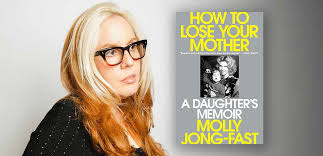
Book Review – How to Lose Your Mother: A Daughter’s Memoir, by Molly Jong-Fast

When Molly Jong Fast’s How to Lose Your Mother: A Daughter’s Memoir (Viking 2025), I resolved to avoid it. I mean, Erica Jong, author of my liberation, facilitator of my most humorous self-deprecation. I didn’t want to know the sad, selfish underbelly of my hero. Then, one day, I listened to an interview with the author, and I thought, “Well, if I can listen to this book in her voice, maybe I’ll learn something.” I did. I found the audio book narrated by the Jong-Fast herself, and, wow, am I glad I did.

Once I relented, I found myself feeling enormously grateful to Molly Jong-Fast for sharing her mother’s missteps, blunders, neglect, and abuse. It made me more aware of my own mistakes and offered me a sense of what my own children might have felt at times in their childhood.

Erica Jong was nothing like me. She was glamorous, well-connected, and a star with a severe drinking problem. I was and had nothing of the kind. But I am a writer, and I know now that too often in my children’s lifetime I felt I had relinquished my Self on their behalf, and I am sure I unwittingly hurt them in some of the ways this mother hurt this daughter. Erica Jong’s dementia and her singular life view prevent her from understanding what happened to her daughter, but with any luck, I still have some time. To make some repairs. Or at least to let my kids know I care. I am sorry.

At base, How to Lose Your Mother: A Daughter’s Memoir, is an everywoman story. When I wrote my memoir, I struggled with how to depict my mother, who suffered multiple traumas too few years before I was born to have sorted them out; she grew to be the mother everyone wished were theirs, but there was always a regret between us for what we could not have. I realized, as I wrote and forgave us both, that the complexities of the mother/daughter conundrum are much the same for even the happiest of pairs. Each mother, each daughter is a reflection of the other. As my mother’s face becomes more clearly the one I see in the mirror every day, I understand more deeply how normal we actually were.

I am grateful to Molly Jong-Fast for the mirror she held unto my nature in much the same way I remain grateful to Erica Jong for Isadora Zelda White Stollerman Wing . . . and later for Serenissima and the sensual dive into Jessica Shylock’s world. . . . as well as so many other pages of entertainment and enlightenment.

How to Lose Your Mother: A Daughter’s Memoir is a lovely — if oftentimes harrowing — read, a book any daughter is liable find herself and her mother in. A terrific experience.

Thanks, Molly!!
Pub Date 2024!!

Hard to believe, I know. But here I am, age 77, and I have FINALLY achieved a solo publication. Writing was my avocation for so much of my life that it is hard to believe I have arrived to a place where it is my vocation!! I am not fond of promoting myself or touting my work, but having written the book, having put it out in the world, I am now in the business of being an author with a book to sell. I will be posting excerpts and insights here on my blog. So stay tuned!!

From Motherless to Motherer

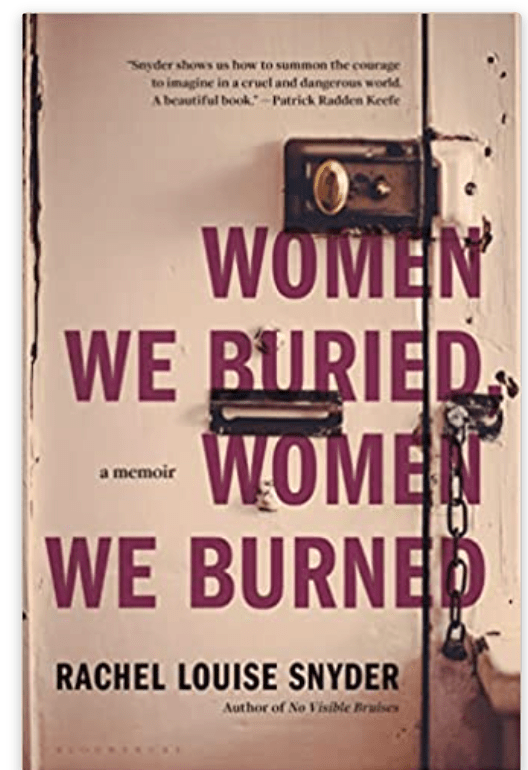
Rachel Louise Snyder’s Women We’ve Buried, Women We’ve Burned

One of my favorite workshops to teach is something I call “Acting for Writers.” It’s a class that investigates how to put ourselves in closer touch with our sense and emotional memory, the way actors do. After all, I explain, actors and writers are artists of the same cloth, who share clear objectives: to tell stories, to entertain, inform, enlighten, even sometimes warn an audience or to unburden themselves of secrets too heavy to hold onto.  In doing so, they seek to be authentic, honest, and believable.

Rachel Louise Snyder could teach my class simply by sharing her work.  What distinguishes that work is the way emotion emerges without being manipulative, the way observations and revelations illustrate how deeply a skilled writer can cut into the very center of human existence and bring it to life on the page.  I never fail to believe Rachel Louise Snyder. I never distrust her.  She is among the most reliable narrators I know. I take in her confidences, and I resolve to keep them in a safe place where they can continue to enlighten me.

So it is with Women We Buried, Women We Burned, Snyder’s soon-to-be-published memoir.  The story of Snyder’s life, beginning with childhood trauma – her mother’s death, her father’s embrace of evangelical fundamentalism – that led to hard-driving self-destructiveness, and then to total self-transformation might seem calculated and farfetched from a less ingenuous writer.  But Snyder’s writing is so stark, so clear, so unfettered by hyperbole of any kind that the saga resonates with irresistible urgency.

Snyder’s narrative journey begins when her mother dies. She hears her mother call out, “I can’t breathe,” and she recognizes even at the tender age of 9 that her mother desperately wants to live but has lost the battle with her disease. Rachel’s father, confused and helpless at the death of his young wife and the responsibility of raising two children nearing their teen years, tells Rachel that her Jewish mother has happily surrendered to death and resides now with Jesus in Heaven. He has almost immediately devolved to a religious self he never was before, and from that moment his young daughter intuits that she cannot trust her father to be the man her mother married, the father she used to know. 

Without warning, Rachel’s father submits himself to unforgiving religion, which he imposes on his family and enforces through the use of corporal punishment.  He loves by force of will and shows affection by exerting dominance. He marries a woman he easily controls, and Rachel’s only defense is willful defiance of everything he stands for. After she is expelled from the Christian school he has forced her into, he turns her out of the family home and refuses to let her back in. 

Endowed of remarkable resilience and empowered by ever-improving survival skills, Rachel wanders through her adolescence and experiences sex, drugs, and rock’n’roll until she finds herself in college, where she gets by, thanks to her superior intelligence and a little help from her friends.  To her surprise, she discovers a love of learning, fascination with history, and, most importantly, commonality with other women – battered and buried women, who have survived or who have been defeated. Then she binds herself to an abiding faith that she can make a difference. 

Ultimately, Rachel Louise Snyder’s story is one of evolving maternalism. The motherless child becomes mother of herself. The self-motherer becomes mother to her stepmother, to her remarkable daughter Jazz, and to the women whose stories without her might never be told.  Her story is a guide for us all.  She models the liberating power of self-acceptance and exemplifies the need for self-love.

I believe her. Every word.