There’s an irony about the way I connected with The History of Sound, the 2025 film by Oliver Hermanus. In other circumstances, regarding other films, I might have avoided watching this one. I am grateful I didn’t. Because the very elements the critics accused of making the film bland are precisely the elements I love.
I heard it said that the film is too sedate, like Brokeback Mountain on Xanax. Brokeback Mountain is among my favorite films, but for me, the critics got it wrong. The History of Sound is tranquil, not sedate. It has a similar, but subtler tone. Both films feature gay male protagonists, and each has an undercurrent of rage and despair, but Jake Twist’s anger and Ennis Del Mar’s longing in Ang Lee’s and Annie Proulx’s story are what Brokeback Mountain is about. The History of Sound is not about its gay men’s love story or the tragedy of being “different” in the 19-aughts, though the men’s love for one another is at the foundation of the tale. The men are connected to one another by their devotion to sound, which in turn connects them to the human race. And the film explores the joy and the sorrow that each derives from both essential bonds.
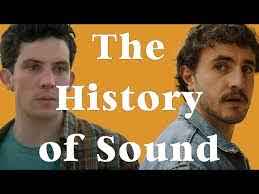
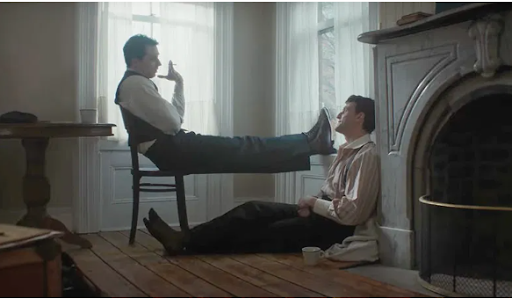
The History of Sound elucidates two men’s common fervor for collecting folk songs, preserving the authentic voice of the American heartland, for chronicling history that would otherwise go unnoticed by future generations. One man is Lionel Worthing (Paul Mescal), a musical prodigy who rises out of his Kentucky poverty by earning a scholarship to a New England music conservatory. The other is David White (Josh O’Connor), born into privilege, orphaned at a young age, a seeker of the truth that is the music. What draws Lionel to David in their initial encounter is David’s extensive knowledge of songs that Lionel thought were merely the sounds of his hillbilly home; their bond forms out of the shared knowledge that folk music is the heartbeat of a culture. That knowledge is a passion that animates their relationship.
Which is a relationship without conventional commitment.
Neither of the men defines himself as a gay man; each expresses interest in marriage, children, and neither pledges forever to the other. In every frame, each of the men exposes his unwillingness to disclose too much of his past or his secret self. David knows that Lionel is a farm boy, and Lionel knows that after David’s parents died, an English uncle took him in; when the uncle died, David self-nurtured in his parents’ Newport estate. When David is drafted and sent into the maws of WWI, he writes letters about the landscapes of Europe, not about his love for Lionel . . . or about what he might be suffering. And when he returns from the war, he controls the inevitable PTSD in such a way that both Lionel and the movie audience feel it vicariously, as a not-quite-palpable volcano in David’s belly.
Such tension in a film is anything but sedate. I was unnerved and riveted to each well-acted, beautifully crafted scene.
Still, I understand others’ complaint that “nothing happens.” Neither man suffers a beating for being a homosexual. In fact, no one so much as casts a negative aspersion their way. No torrid sex scenes take us into their shared bed. When tragedy occurs, it occurs, as it would in the best Greek tragedies, behind the scenes, and there is no over-dramatic display of despair or mourning. This is a movie that invites us to witness the power of both sound and silence to create ties and to dash them to smithereens. The viewer is never expected to be a voyeur.
At the same time, there is plenty happening on the screen. There is not one awkward moment of inept acting; both O’Connor and Mescal are consistently convincing. Director Hermanus has created a very believable world, and Ben Shattuck’s screenplay has some dialogue that is downright poetic. To say that Alexander Dyan’s cinematography is stunning is an understatement. He has captured, with magical lighting, brilliant juxtapositions of forest, sea, sky, fields, nature, the visual glory of American landscapes – the city of Boston, the farmland of Kentucky, the forests of Maine, remarkably recreated in the state of New Jersey. There are also picture window vistas shot in Rome and the glorious UK Lake District.
My personal attachment to the film has another dimension. It took me back to my own youth in a roundabout way.
Until I was 6, I fell asleep every night blanketed by the healing warmth of my mother’s cello. As soon as my brother and I were in bed, she would hasten to its side, caress it for a moment, then begin to play. I lived in a farmhouse not unlike the one in which we first see the child Lionel in this film, and in the smile that transforms his face when his father plays, I recognized the relief I felt the moment Mom’s cello began to hum. I found my mother in that music, and I was drawn to her because of it. I learned to recognize her moods in the sound – joy when she played Bach, despair in Bruch’s Kol Nidrei. I could feel her story long before I knew it. The cello sang for her and to her, and I learned early that music burrows into the soul and fills in the holes wrought by suffering, sorrow, and loneliness.
The folk music in A History of Sound resonates as my mother’s cello did. The film conveys music’s true weight, a weight that cannot be spoken. It must be heard.
In 2016, my friend B treated me to a Southwest adventure. We flew to Phoenix, visited family before we drove to Sedona and on to New Mexico. After seeing friends and family in Albuquerque, we parked ourselves in Santa Fe, where we planned to stay before taking the High Road to Taos winding up with family in Los Alamos. The trip was gorgeous in many ways, but a definite highlight was meeting Rock’n’Rolll legend Lou Christie.
Lou had been on our flight from NY to Albuquerque, and we had noticed him. How could we not? What an icon of pop culture he had been for most of both our lives. Lou Christie wrote and sang the musical score for almost every event of my adolescence. We were impressed, but we didn’t bother him. Until we saw him in Santa Fe.
He walked into the lobby of La Fonda Hotel as we roamed through looking for a public restroom. I could not resist. Neither could B. I don’t remember exactly what we said to him or why he engaged with us, but when we left the hotel, I had his personal phone number and an invitation to call him about an interview for my “get Read” column in the Columbia School of the Arts publication Catch and Release.
Now that Lou is gone, I thought I would re-share that interview. . . .
—————————————————————
If I were a photographer, and the shutter had just closed, I would be confident that I had just grabbed the money shot.
“Lou,” I ask toward the end of our three-hour interview, “what have been the major forks in your life? The professional ones, the places where you could have gone one way, but you chose to go another. . . ?”
“Oh, wow,” he muses. I love that question!”
We’ve been talking long enough for me to truly understand why he likes it so much, why he is so visibly moved. Lou Christie has been doing what he’s doing most of his life, and what he’s been doing is reinventing himself, reconfiguring the formulae that take him and his melodious voice onward and upward.
We were seated among colorful iconography on orange furniture in the cozy, New Mexico-inspired sitting room he has built atop what used to be the roof of a 1940s tenement building in Hell’s Kitchen, in midtown Manhattan, where he has lived since the early 1970s. He bought his apartment when it went coop, and the landlord was selling dirt cheap; knowing exactly what he wanted and being ever in control of his destiny, he simultaneously bought the air rights so that he could add his a second story of his own design, connected to the first by a picturesque spiral staircase, lit by a skylight and a sliding glass door that leads to the patio with a view of lower Manhattan and the Hudson River.
Despite the low price, the decision to purchase the place took some deliberation. Hell’s Kitchen was among the least desirable neighborhoods at the time, a rough area dominated by the Westies, a deadly alliance between the Italian and Irish mobs, and by Puerto Rican and Anglo youth gangs. The ones immortalized in West Side Story. But Lou Christie recognized an opportunity to get in on the first wave of gentrification, and by the 1980s, the Javitz Center was underway, the Westies were disempowered, and the kids were back in school. He had bought himself a haven. Now, he has transformed a perfect example of simple, utilitarian working-class architecture into a Southwestern style country dasha, a brilliant transformation.
And the perfect metaphor for the life and times of Lou Christie.
When Lou moved into Hell’s Kitchen, his star had begun to rise in earnest. Thanks to New York radio stations and American Bandstand, Christie’s had become the voice of its generation. The insistent falsetto, half pleading, half scolding, all simply celebrating the fact that it could get that high, played on all the hit radio stations. WABC’s hitmaker Bruce “Cousin Brucie” Morrow, was a fan, as was WNBC’s gravel-throated Robert Weston “Wolfman Jack” Smith. “If those guys liked you, you were in.”
“I was a fifteen-year-old farm boy from Glenwillard – yes, it’s a real place, less than twenty miles out into the boondocks in the environs of Pittsburgh, PA” – when I realized I wanted to sing, just sing. I wasn’t Lou Christi in those days.”
Lou was born Lugee Giovanni Sacco, a name reconfigured from the longer Sicilian Saccosso at Ellis Island, and he always loved to sing. And to color outside the lines.
“My father, who had been schooled to become a priest or a doctor, was my first role model: he chose a path less traveled and became a steel mill worker. Then he came home every evening to farm our 100-acre property. Both my parents were musicians, and instead of spending evenings watching television together, we usually got together over music-making.
Lou was the second of six children, having trailed his sister Amy into the world by 18 months; when Lou was nearly fourteen, his parents solved a marital crisis by having four more kids: Maree, Marcie, Shauna and Peter. “We all had to chip in then,” he says, smiling slyly.
“We never knew any different; we just took care of one another, helped mom take care of the house and dad take care of the farm. But we were always singing. I don’t remember ever NOT singing.” From the beginning, Lou was the family lead singer, and his sisters and brother naturally provided the backup.
“See? Now, there’s the first fork. I knew I wanted to be a singer. But I had to make some choices. Am I better off going into Classical? My teacher thought I should do that. Or should I find great standards to sing? But wait, should I write my own stuff? I had a great range – I sang the lowest bass in my school choir and the highest tenor with equal ease.”
He also had a counter tenor range, the ability to sing the really high notes.
“SI kept asking myself, what voice should I choose?”
His falsetto won and forged a path to classic rock ‘n’ roll.
“I didn’t want to be a choir boy. My father was a great bread winner, all day long he was a slave in the steel mill, and then he came home and farmed his land. I was a happy kid, but I didn’t want to be like him. Not me. I wanted the levis, the painted jeans, the purple shirts all the way. I just knew this was it, and I knew instinctively how important it was to remain master of my own career.
“I was so focused. You know. I gave up a lot, like my teen years, but I got exactly what I wanted because I went after it. You know that book The Secret? They must have been following my life . . . because that’s what I did. I concentrated my efforts on getting what I wanted, and I made it happen every time.”
Lou got wind that there signed up for lessons with “a guy in Pittsburgh, who recorded local artists.” After a single session, the producer sent Lou home to make a demo tape. “He told me my voice was already good enough.”
“What you really need,” the teacher said, “Is a backup group.”
Lou grins at the memory.
“’Oh,’ I said to him. ‘I got my group.’ We’ve got a sound you’ve probably never heard. Kinda like three mice. Because I sing high, and I have another guy, and he sings up here too, and a girl. . . so then he said, ‘ Okay. Go put something together, make me a demo tape, and let me hear what you got.’ ”
When Lou brought the demo back to the studio, the producer was impressed enough to put Lou’s group on the vocal backgrounds for a song called Ronnie Come Back, by a girl called Marcy Jo, on the Robbie Records label. Everyone loved the sound of the background, and the record was a big hit, climbing the national charts and reaching the top 20. Lou and his mice never got paid.
“Then we did a follow up with Marcy called When Gary Went in the Navy, and four more, and they were all hits though they never paid us. Heck, I was still in school. I couldn’t even drive yet.”
After a few more non-paying hits with Marcy Jo, Lou chose a new path and set his standards by creating Lugee and the Lions. “I was Lugee, and my sisters and the same group of little kids that were always around me sang as the Lions.” Lou’s dad drove the group all over Pittsburgh, where they sang for weddings, mall openings, parades and the like, and eventually the positive attention brought him Twyla Herbert. And thus he reached yet another fork in his road.
“I could see right away. . . that woman was pure genius. When she proposed working together, I still had to question myself. . . .
“There I was at another fork. This woman was special. She was twenty years older than me, had a degree in classical music, was a classical pianist, didn’t know a doo-wop from a dust mop. But she was brilliant. Just brilliant. And I could see we could be good together, really good!”
He chose to give collaboration a go, and together, Christie and Herbert wrote The Gypsy Cried, in the style of Valli’s Sherry – it took them all of fifteen minutes – and, he said the experience was surreal, something like what he imagined it would be like to be on an acid trip though he had no experience with drugs. “There was something about our chord patterns. They were more classical or more international, made the music more interesting instead of the standard 4 chord progressions, the usual wha wha wha. . . “ The song established a musical partnership spanned the next 47 years, until Twyla Herbert’s death in 2009.
“I never wanted to make a record that sounded like anyone else. My voice had this falsetto, these octaves to work with, and I didn’t want to record anything that wasn’t uniquely mine.”
By 1966, when Lou and Twyla wrote Lightning Strikes, which shot almost immediately to #1 on the European and American billboard charts, Lou knew beyond doubting he had made the right choice both in going into the business of creating songs with Twyla Herbert and in sticking to his falsetto. The only choice he didn’t like for a long time, until he got accustomed to it, was the recording company’s choice of his name.
“I just wanted to be Lugee!”
But the bosses dubbed him Lou Christie. And Lou Christie soared to fame and fortune.
He never took his good luck for granted.
Still, the path was never smooth.
“Even good managers can be really dumb. I know because I had one. . . . Bob Marcucci tried to sway me from my path, and I had to fight tooth and nail to stay the course.”
Marcucci told Lou that he would have to grow up, lose the falsetto, sing more standard arrangements of old songs. But Lou tried it Marcucci’s way just once.
“I went to my gig in Framingham, outside Boston, and I sang all the standards, all the classics. ” It was a disaster. Fans hissed and booed, screaming for “Lightening Strikes.”
“It made sense to me. I mean, can you see me doin’ Ol’ Man River? I’m boring myself just thinking about it.”
Lou left the songs in a dumpster and vowed to listen only to his own advice. He toured extensively, singing the hits, getting his audience to its feet in adulation, singing along. He knew what worked. His easy style on stage coupled with his obvious natural delight in being there sold him.
Lou stops and thinks for a moment. When he speaks, he is back in the present.
“Now I’m sayin’ to myself, I’m 72, and I’m sayin’ ‘See? It still works. I’m still here.’”
That was 2016. Lou’s concerts were never less than packed. His life was never perfect. He had married, divorced, raised two children, lost one to a tragic accident, and he had persisted in touring and sharing the joy of his presence with family, friends, and, most of all with fans.
Like his myriad fans, I am left with the memory of a warm, witty man with a singular mission.
“Once upon a time,” Lous said to me just before we ended our interview, “I only wanted to share the good side, the fun side because I don’t believe you can make a career out of talking about all the bad things in life. But maybe it’s time to start mentioning it. Everyone thinks I’ve had a flawless life. Part of the reason is I project that kind of forward thinking, and I’m a peaceful person. I have never wanted to get stuck in my anger or my bitterness.
“But you know, I am still so naïve There are a lot of people out there who live on bitter – more of an addiction than any wine or beer or shot or pill. I don’t want to be one of them.





 carlastockton.me