

There’s an irony about the way I connected with The History of Sound, the 2025 film by Oliver Hermanus. In other circumstances, regarding other films, I might have avoided watching this one. I am grateful I didn’t. Because the very elements the critics accused of making the film bland are precisely the elements I love.
I heard it said that the film is too sedate, like Brokeback Mountain on Xanax. Brokeback Mountain is among my favorite films, but for me, the critics got it wrong. The History of Sound is tranquil, not sedate. It has a similar, but subtler tone. Both films feature gay male protagonists, and each has an undercurrent of rage and despair, but Jake Twist’s anger and Ennis Del Mar’s longing in Ang Lee’s and Annie Proulx’s story are what Brokeback Mountain is about. The History of Sound is not about its gay men’s love story or the tragedy of being “different” in the 19-aughts, though the men’s love for one another is at the foundation of the tale. The men are connected to one another by their devotion to sound, which in turn connects them to the human race. And the film explores the joy and the sorrow that each derives from both essential bonds.
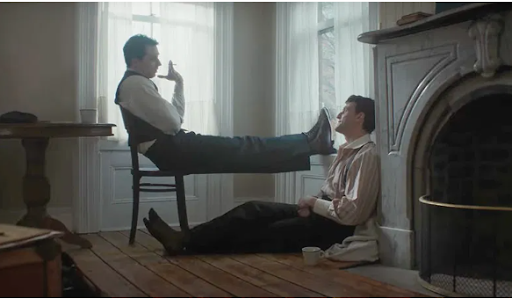
The History of Sound elucidates two men’s common fervor for collecting folk songs, preserving the authentic voice of the American heartland, for chronicling history that would otherwise go unnoticed by future generations. One man is Lionel Worthing (Paul Mescal), a musical prodigy who rises out of his Kentucky poverty by earning a scholarship to a New England music conservatory. The other is David White (Josh O’Connor), born into privilege, orphaned at a young age, a seeker of the truth that is the music. What draws Lionel to David in their initial encounter is David’s extensive knowledge of songs that Lionel thought were merely the sounds of his hillbilly home; their bond forms out of the shared knowledge that folk music is the heartbeat of a culture. That knowledge is a passion that animates their relationship.
Which is a relationship without conventional commitment.
Neither of the men defines himself as a gay man; each expresses interest in marriage, children, and neither pledges forever to the other. In every frame, each of the men exposes his unwillingness to disclose too much of his past or his secret self. David knows that Lionel is a farm boy, and Lionel knows that after David’s parents died, an English uncle took him in; when the uncle died, David self-nurtured in his parents’ Newport estate. When David is drafted and sent into the maws of WWI, he writes letters about the landscapes of Europe, not about his love for Lionel . . . or about what he might be suffering. And when he returns from the war, he controls the inevitable PTSD in such a way that both Lionel and the movie audience feel it vicariously, as a not-quite-palpable volcano in David’s belly.
Such tension in a film is anything but sedate. I was unnerved and riveted to each well-acted, beautifully crafted scene.
Still, I understand others’ complaint that “nothing happens.” Neither man suffers a beating for being a homosexual. In fact, no one so much as casts a negative aspersion their way. No torrid sex scenes take us into their shared bed. When tragedy occurs, it occurs, as it would in the best Greek tragedies, behind the scenes, and there is no over-dramatic display of despair or mourning. This is a movie that invites us to witness the power of both sound and silence to create ties and to dash them to smithereens. The viewer is never expected to be a voyeur.
At the same time, there is plenty happening on the screen. There is not one awkward moment of inept acting; both O’Connor and Mescal are consistently convincing. Director Hermanus has created a very believable world, and Ben Shattuck’s screenplay has some dialogue that is downright poetic. To say that Alexander Dyan’s cinematography is stunning is an understatement. He has captured, with magical lighting, brilliant juxtapositions of forest, sea, sky, fields, nature, the visual glory of American landscapes – the city of Boston, the farmland of Kentucky, the forests of Maine, remarkably recreated in the state of New Jersey. There are also picture window vistas shot in Rome and the glorious UK Lake District.
My personal attachment to the film has another dimension. It took me back to my own youth in a roundabout way.
Until I was 6, I fell asleep every night blanketed by the healing warmth of my mother’s cello. As soon as my brother and I were in bed, she would hasten to its side, caress it for a moment, then begin to play. I lived in a farmhouse not unlike the one in which we first see the child Lionel in this film, and in the smile that transforms his face when his father plays, I recognized the relief I felt the moment Mom’s cello began to hum. I found my mother in that music, and I was drawn to her because of it. I learned to recognize her moods in the sound – joy when she played Bach, despair in Bruch’s Kol Nidrei. I could feel her story long before I knew it. The cello sang for her and to her, and I learned early that music burrows into the soul and fills in the holes wrought by suffering, sorrow, and loneliness.
The folk music in A History of Sound resonates as my mother’s cello did. The film conveys music’s true weight, a weight that cannot be spoken. It must be heard.
 carlastockton.me