Swift River . . . Paddling the Rapids of Raging Adolescence

Essie Thomas' new novel is a perfect summer read

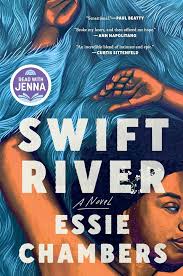
From the moment I dived into Swift River, I was swimming through memory, in sync with Essie Thomas’s captivating heroine Diamond Newberry.  Like Diamond, my 17-year-old self suffered from a sense of dislocation, and I recognized in her a familiar longing to know an origin story. Like me way back then, she found her hope in stories her family members, the ones willing to talk candidly about the past, could share with her.  Like Diamond, I ate my troubles away, wallowed in tuna casseroles and wingdings, but being white,        From the moment I dived into Swift River, I was swimming through memory, in sync with Essie Chambers’s captivating heroine Diamond Newberry.  Like Diamond, my 17-year-old self suffered from a sense of dislocation, and I recognized in her a familiar longing to know an origin story. Like me way back then, she found her hope in stories her family members, the ones willing to talk candidly about the past, could share with her.  Like Diamond, I ate my troubles away, wallowed in tuna casseroles and wingdings, but being white, what young me did not have in common with Diamond was color. 

My confusion and disassociation were just as real, but they were invisible, and I therefore did not suffer the same slings and arrows of outrageous racism that Diamond endures. Yet I easily relate to what she feels, and how she responds because as unique as Diamond is, she is a character who represents the distinctly American experience of growing up in an unkind, duplicitous society whose respect for diversity is superficial at best. 

Diamond is caught in a perfect family-and-society-fueled storm. Her father has disappeared, is perhaps dead, and her mother has become recklessly unbalanced.  Her marriage to Diamond’s father was disastrous, but she does not know how to live without him.  So she drinks.  She makes Diamond responsible for her but is, at the same time, immobilized by the way her community – the town that has been her family home for generations – treats her daughter.  She knew that nothing about their life together would be easy, but she never embraced his brittle fragility.

Already restless and morbidly obese, Diamond finds herself entirely untethered by her fatherlessness.  She wants to stop her mother’s hurt, but she is aware that her mother’s love is genuine but also neurotic and toxic. She longs for her father’s return, as he seems to be the only one who might have the knowledge to explain why the town’s Black population inexplicably left town in the dead of night some years before and what their exodus has to do with her.  He alone might justify his bitterness and the self-destructive recklessness that causes him to act out his angry bouts of frustration.  Diamond has no place to turn for answers until she receives a letter from her father’s cousin-sister, who lives in the Newberry family home in Georgia. 

Letters pass between the girl and her unseen auntie, and Diamond begins to assert her true self.  She secretly signs up for driving lessons and forges a friendship with a girl from her class, who is equally void of ballast, a girl who has learned to sublimate her pain in promiscuity.  Over the course of an illuminating summer, Diamond learns to drive, loses her virginity, and finds her roots.

At the heart of Swift River is the reminder that no matter what ethnicity, what race a teenager is blessed or cursed with, the compulsion to know who we are and where we come from is universal.  Diamond’s plight is overwhelming, but she finds a way to cope just as teenagers have always forced themselves to cope with circumstances they would never choose as the basis of their lives.

Like all the great coming-of-age stories, this one is written by an adult with a mature outlook, told through the eyes of a precocious seventeen-year-old who clearly has the benefit of Chambers’s wisdom.  For that reason, Swift River is a great read for teens and adults.  It is an illuminating journey over the racing rapids of adolescence, a passage that none of us avoids.       

Diamond is caught in a perfect family-and-society-fueled storm. Her father has disappeared, is perhaps dead, and her mother has become recklessly unbalanced.  Her marriage to Diamond’s father was disastrous, but she does not know how to live without him.  So she drinks.  She makes Diamond responsible for her but is, at the same time, immobilized by the way her community – the town that has been her family home for generations – treats her daughter.  She knew that nothing about their life together would be easy, but she never embraced his brittle fragility

Already restless and morbidly obese, Diamond finds herself entirely untethered by her fatherlessness.  She wants to stop her mother’s hurt, but she is aware that her mother’s love is genuine but also neurotic and toxic. She longs for her father’s return, as he seems to be only one who might have the knowledge to explain why the town’s Black population inexplicably left town in the dead of night some years before and what their exodus has to do with her.  He alone might justify his bitterness and the self-destructive recklessness that causes him to act out his angry bouts of frustration.  Diamond has no place to turn for answers until she receives a letter from her father’s cousin-sister, who lives in the Newberry family home in Georgia. 

Letters pass between the girl and her unseen auntie, and Diamond begins to assert her true self.  She secretly signs up for driving lessons and forges a friendship with a girl from her class, who is equally void of ballast, a girl who has learned to sublimate her pain in promiscuity.  Over the course of an illuminating summer, Diamond learns to drive, loses her virginity, and finds her roots.

At the heart of Swift River is the reminder that no matter what ethnicity, what race a teenager is blessed or cursed with, the compulsion to know who we are and where we come from is universal.  Diamond’s plight is overwhelming, but she finds a way to cope just as teenagers have always forced themselves to cope with circumstances they would never choose as the basis of their lives.

Like all the great coming-of-age stories, this one is written by an adult with a mature outlook, told through the eyes of a precocious seventeen-year-old who clearly has the benefit of Essie Chambers’s wisdom.  For that reason, Swift River offers an astute journey through the fraught passage from childhood to adulthood that none of us avoids.                                        

                                                                                                                                                                                                                                                                                                                                                                                                                                                                                                                                                                                                                                                                                                                                                                                                                                                                                                                                                                                                                                                                                                                                                                                                                                                                                                                                                                                                                                                                                                                                                                                                                                                                                                                                                                                                                                                                                                                                                                                                                                                                                                                                                                                                                                                                                                                                                                                                                                                                                                                                                                                                                                                                                                                                                                                                                                                                                                                                                                                                                                                                                                                                                                                                                                                                                                                                                                                                                                                                                                                                                                                                                                                                                                                                                                                

The Enduring Endurance of Charlotte and Her Pig

In November, I shall have been a mother for fifty years.  I never envisioned the possibility that one day my children would be older than I was when both my parents were dead, that I would outlive my younger brother, and that I would be a grandmother older than my own was when this fifty-year-old, her fourth great-grandchild,  was born. . . . The breadth of it all amazes me.

That my children survived my parenting is another source of amazement.  Having grown up the too-often surrogate parent for my many siblings, I thought I would naturally take to it.  I’d have perfect children because I’d be a perfect mom.  Of course, I was wrong.  Dead wrong.  In so many ways.  I was subject to so many ineptitudes.

But one thing I got right was entertainment. 

We did not have a color television until the firstborn reached the age of 11.  It just didn’t seem necessary.  As a result, Saturday morning cartoons were easily abandoned in favor of playing outdoors. At night, no one ever begged to stay up for just one more show or sneaked back into the living room to steal a look at what mommy and daddy were watching. From the time they were tiniest tots, they wanted stories.

Stories were commonplace in our house even before the first of our blessed events.  Stories were a tradition begun during their father‘s and my courtship. In our first conversation, we discussed Mahler’s Kindertotenlieder, based on Friedrich Rückert’s stories of dying and dead children.  We often camped, and we read to one another under the stars . . . works as innocent as Alice in Wonderland as self-conscious as I’m OK You’re OK. One of my motivations to have children was the impetus to continue reading stories aloud, to sharing adventures vicarious and fabulous.

At first I sang the stories.  I’d warble convoluted folksongs with sad or inspirational themes or I’d set the story of our day to some monotonal melody or stitch it into a familiar tune and add the story of a journey we had made.  Then came the infinite rides we took with books.

We traveled with a bear of little brain on honey-seeking safaris, with elephants from the African savannah to Paris, in a car to the Eifel Tower, to a balloon over the ocean, the big, blue ocean, then on to a tropical island and back to Africa.  We laughed at the silliness of an urban monkey whose curiosity continually got him into and out of trouble.  We marveled at the D’Aulaire’s version of Greek mythology, tzikached at Aesop.  The child who is now turning 50 had a penchant for maps and atlases so we read about faraway places and charted journeys they would take as adults.  We soared through those books. 

Even after all were more than competent readers on their own and were devouring books by themselves, we read as a family.  Especially when we traveled. 

Road trips were our vacations of choice, and we drove across the country listening to story cassettes, precursors of Audible recordings.  Heroes travled with us.  Robin Hood and Little John.  A young Fox and a basset hound. Bambi.  Under the stars in our campsites or as we wound down in a small motel room, we read aloud until the reader fell asleep.

A favorite author in the post-picture-book days was E.B. White.  Charlotte’s Web came first, and we read it more than once.  It became our favorite. When the first film version emerged, we saw it together and critiqued it harshly.  We reread the book and saw the newer version, which we judged with the same rigor. We loved that book.

The other White books and the essays were lovely.  But none ever had the pure cachet we afforded Charlotte’s Web.  I hadn’t thought about that in a very long time. After all, a 50-year-old child has been a grown up far longer than they were a child.  Reading to my babies resides among the cherished memories of a time long gone.

But time has been kind, and new book memories have settled in, thanks to grandchildren who have loved stories as much as their predecessors did.  Two have already passed through our read-aloud nights and are firmly ensconced in teen sensibilities. But I still have one little person left with whom to share the stories.

He lives far away, but we Zoom almost every night.  After a little talking, sometimes a game or two, I read him to sleep.  In past months, we’ve coursed through 26 Junie B. Jones books, and twelve books about dogs and pirates and wizards. Most recently, I have wandered back with him to the pleasant joy of Charlotte’s Web

The sheer beauty of the book moves me to tears every single night.

The narrative voice is soothing, even as White describes the prospect of his hero being reduced to bacon and lard, even as he takes us through a mountain of manure into a rat’s nest.  Somehow, no matter how ugly the world is, this author finds the words to reassure us that there is reason to be calm, reason to hope that on the next page there will be something fun and joyful.

When the human child Fern’s mother asks her pediatrician if he understands the writing in Charlotte the Spider’s web, the doctor admits that he doesn’t.  But, he continues, he doesn’t understand how a spider spins a web in the first place.  “When the words appeared, everyone said it was a miracle.  But nobody pointed out that the web itself is a miracle.”

The humblest of realities, a spider’s web.  A miracle.  What a lesson for children.  And expressed in a prose that is smoothly American English at its best.

“Well, who taught a spider?  A young spider knows how to spin a web without any instructions from anybody.  Don’t you regard that as a miracle?” The doctor asks.  The real miracle is the writing.

My children were young in the Arizona desert, and my grandson lives in a country with a Mediterranean climate. Yet all learned what to expect from a New England winter, what makes fall a season of amazement, why spring springs exuberantly from E.B. White.

“The autumn days grew shorter. . . . The maples and birches turned bright colors and the wind shook them so they dropped their leaves on the ground. Under the wild apple trees in the pasture, red little apples lay thick on the ground.”

No Netflix series, no Nickelodeon animals can bring the world to more vibrant life.  Nothing on Youtube compares with the deep satisfaction even an 8-year-old derives from hearing about Charlotte’s affectionate, abiding friendship for a spring pig.  And nothing – not even the most sensitive Disney films like Bambi or Soul will ever demonstrate more positively to a child that life includes death, that happiness includes grief, that joy bursts forth from the meanest of realities.

Prodigious marvels are all around us. Even in in a “warm delicious cellar, with garrulous geese, the changing of seasons, the heat of the sun, the passage of swallows, the nearness of rats, the sameness of sheep, the love of spiders, the smell of manure, the glory of everything.”

When I celebrate this fiftieth anniversary of parenting, I shall light a candle of gratitude to E.B. White and his Charlotte for teaching my progeny I’ll always be with them, and they never need to look far for the joys I’ll have left behind.

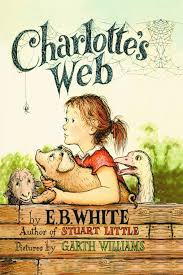
Charlotte's Web
by E.B.White

The Haircut   

I have quirky hair. It is thick and blonde, a gift from my father’s Dutch ancestry. But it’s also unruly and willful, often kinky and frizzy, the bequest of my mother’s Ashkenazi forebears. I like my hair. It’s singularly mine and uniquely beautiful. So says every beautician to whom I have entrusted its care. But it has traditionally been a pain to tame, a challenging for those who seek to cut and style it .

My aunt was a stylist with her own salon. A talented stylist who simply could not be bothered to do battle with my tresses, Aunt Ruth’s approach to cutting my hair was to ignore its idiosyncrasies and clip indiscriminately. I wanted long hair, but until I left home at 17, I had to abide by my mother’s edicts, and she mandated a semi-annual visit to her sister’s shop. Which is why, when I look at photos taken before my liberation, I wonder if Mike Judge saw me somewhere. I could easily have been the model for his Butt-head character.

Over the years, I have invested heavily in what appears to be the right haircut. I live in NYC, where a beauty parlor appointment can be more costly than a hospital visit. Every visit is an exercise in cautious paranoia. Will the operator figure out how to navigate the territory? Will I be a mop-head when they finish?

The stylists share my trepidation. They typically spend the bulk of my time allotment on fussing over where, how, why to layer and then trying to re-assign a part in a head of hair that listens to no one. After the cut, every artiste insists on straightening the hair, forcing it into flat lifelessness. Too often I have emerged from the salon with hair I would not wear to a Halloween party, for which I have paid the equivalent of a year’s salary. I was resigned. This was the way things were.

Until I was in Taiwan two years ago. My hair got long, I shedded profusely, and my hairphobic hostess was frantic. She could not stand the sight of hairs on the couch, the floor, the kitchen counter. I had to get it cut.

Quaking with fear, I chose a place close to the apartment with an American brand name. I had little faith in my choice, but I believed it was my only alternative. Branded or not, could a Taiwanese stylist understand the dangers lurking on my scalp? Would she be able to make my hair presentable?

In the salon, though neither of us spoke the other’s language, she easily grasped what length and shape I was hoping for. She spent no time at all assessing the hair but instead lavished me with a luxurious wash and scalp treatment, a neck and shoulder massage, and a delicious cup of jasmine tea. Then she went to work, studiously snipping a large chunk here, a bit there, another chunk, another bit, and in record time, she was patiently twisting the locks as she assaulted them with the blow-dryer, causing my natural curls to spring gratefully into line. When she was finished, my hair looked better than it has in my adult life. We bowed to one another, and I paid the bill in Chinese NT, an amount which, amazingly enough, amounted to less than a soy caramel macchiato at the local Starbucks. When I offered her a tip; she declined, smiling. Tipping is not the custom, and she was proud of her work.

On two more occasions I found myself in need of a haircut in Taiwan. For various reasons, I wound up in a different salon with a different operator each time. Invariably, I had the same experience: treatment that engendered languid comfort and a respectable haircut for little money.

This past summer, I found myself in Turkey rather than Taiwan. As before, I was there long enough that my hyperactive hair growth and insistent shedding necessitated a cut.

Had I not been schooled in Taiwan, I would have been beset by anxiety. Instead, I confidently walked to a very local spot, a tiny establishment with one chair and one sink. I had a moment of hesitation when I saw that the price of a haircut listed on the board was less than a straight-up cup of black coffee in any NYC diner. I ventured in nonetheless.

This time I was slightly more able to communicate. With roughly 25 words of Turkish at my command, I was able to explain what I was seeking. The receptionist nodded solemnly and motioned me into a chair in front of the single sink on the premises. She simultaneously made a phone call and briskly and brusquely washed my hair. As she threw a towel over my head, a squat, middle-aged man appeared in the entryway. He spat a cigarette from his mouth and smashed it beneath his shoe before walking over to us. He and the woman exchanged a few words – she translated my instructions into proper Turkish. He nodded, took the towel from my head, and went to work. He snipped about, parted and re-parted my locks, brushed the hair forward, cut some more, pushed it back, snipped again, flipped it to one side and then to the other. After about five minutes, he stopped cutting, affixed the diffuser to the blow dryer, puffed air at me for a few more minutes, and grunted that he was done. In the mirror that he held briefly behind my back, I caught a glimpse of the back of my head.

The hair looked great.

This time I paid in Turkish lire, and he accepted a tip. I had to fight the nagging sense that I had stolen the haircut.

Walking back to my apartment, I wondered what it was that I had worried about all these years. What was it that made the process so damned fraught and so incredibly expensive?

American values, of course. Nothing is worthwhile if we don’t pay dearly. No one is worth anything until s/he proves successful in monetary terms. “You get what you pay for, and you pay for what you get.” We measure people by the quality of what they acquire.

The ramifications are myriad.


Lucky’s Not Good Enough

I wanted to love We Were the Lucky Ones, a Hulu original series.  After all, the story resonates with me.  Like my real-life Jewish family, the family in the show is dispersed by the Nazi invasion, set adrift in the world.  It’s a masterful series, well acted, realistically written, and beautifully shot.  Yet, after the second or third episode, I found myself feeling sick, resenting the artistry of it.  The why eluded me at first.

The drama is certainly harrowing.  An embattled family encounters every possible horror that the Holocaust meted. They witness, narrowly escape, suffer aftershocks, and move on. The music is Schindleresque sad, and the scenes of torture and cruelty are horrifying.  But that’s not it. Nothing in this show is any worse than what Keneally or Spielberg depicted or what Primo Levi described.  No loss is any more heartbreaking than those Daniel Mendelsohn memorialized.  There is nothing to see in this series that we haven’t seen in any one of the honorable Holocaust museums across the world.   So why does this show so offend me? 

Over my head, I hear the whirr of helicopters, and I run to the TV to check the local news. On the screen, hate-spewing,  pro-Palestinians rally on my Alma Mater campus, just up the street from my home.  An angry child-woman glares into the camera and shouts, “They are weaponizing the holocaust” while hundreds scream, “From the river to the sea.” 

At another gathering in midtown Manhattan, youngsters in checkered scarves and green, white, black, and red flags scream “Free Palestine.” A middle-aged man proudly waves a Hamas flag.  Online, a headline from the ADL: “Chicago Sees Rise in Antisemitism and Activism Amid Action by Anti-Israel Groups.”

There it is. Now I get it.

Our stories are betraying us.  It’s time to revise.

Real life has become scary, and those of us who inherited our parents’ PTSD, who were born with memories we cannot decipher, are reliving the dreams we cannot comprehend of the terror they fled.  The specters that used to visit only by night are fully animated by day.  Once upon a time, the anticipation of violence was easily quelled by stories that assured us that the world was sufficiently sorry; pogroms were a thing of the past. We believed our parents when they reminded us that this is America, after all, and we could feel safe.  No more.  Those night fears loom omnipresent over my home, my security, my grandchildren.  The stories no longer heal.

The haters are wrong.  It is not that we are weaponizing the Holocaust or antisemitism.  But we are hiding behind it.  We hold up our past like medals won in the Suffering Olympics that proclaim our capable willingness to suffer.  There is no more reassurance in the idea that it can’t happen here because clearly it can.  And it will if we let it. 

Those who wish for our annihilation are fueled by our pain.  Many display their own medals and say we have not suffered nearly enough.  Others are simply irritated by what they perceive as our whining insistence that enough is enough. 

We have to stop thinking that this approach will work. Many in the world deem it passive aggression.  We have to stop apologizing for our coreligionists who are fighting for the survival of Israel.  We have to stop disclaiming our right to fight back.  We have to take control of the rhetoric and paint ourselves as a far more positive, authoritatively powerful people. As Rabbi Diana Fersko recently wrote for Tablet magazine, “We have to stop running defense” (“American Jews Should Become a Little more Israeli” April 1024).  Just because millions of us were killed in the holocaust doesn’t mean we must beg for survival by reminding our foes we don’t deserve to be exterminated.  Would we be any less deserving if we had not suffered the mass murders? 

Art is a wonderful place to find relief and transformation.  Which is what so many writers and filmmakers, artists and curators have done by insisting on telling our truth.  But at this moment, the profusion of new Holocaust reenactments feels like a Hail Mary play that is doomed to failure.  We cannot think that because Hulu shows The Lucky Ones for ten weeks on their streaming app our detractors will suddenly see the folly of their ways and back off.  Will one Jewish family’s miraculous survival of that great apocalypse convince the world to watch any less dispassionately while the Ayatollah rattles Iran’s nuclear sword?   Not a chance.

We should have more films like Munich or Raid on Entebbe or even Exodus. We need to see heroes like Liev Schreiber’s character in “Defiance,” heroes who defied the stereotypes and showed our refusal to let the world beat us up.  There should be more series like Tehran that explore the ways in which Israel and world Jewry are endangered every minute of every day by adversaries who hate us for no reason but that they do. We should have filmmakers creating films like Watching the Moon at Night that expose Hamas leaders’ vitriolic calls for the extermination of all Jews everywhere. We need documentary footage of Jews standing up to the hate, holding their ground. . . winning.

We cannot expect the world to feel sorry for us just because we wear our thorny laurels in public.  People are not moved by pictures of dead Jews.  They take those images for granted.

Of Pasha And Pancakes

My father loved pancakes.  My mother made them often, but he especially loved the pancakes that the women of the United Methodist Church served every Easter morning after sunrise service. 

Perhaps the pancakes tasted sweeter when filled with the spirit of revelation.  Perhaps he just liked the way the pancakes were uniformly round, thin, and warm, so unlike the ones my mother made.  Hers were always misshapen, and by the time they got to his plate, they were routinely cold.  I suspect that in his mind, my mother had not mastered the gentle American art of making pancakes, as she had most assuredly not mastered the compleat art of Easter.

Oh, she got the gist. She understood that Easter was, like Passover, a celebration of renewal, of rebirth.  I was born in the wake of the Holocaust that drove her to the US, and though she never said as much, I know that the symbolism of Easter and Passover were reminders that she was fortunate to have a life that had transcended the ashes that consumed so many of her loved ones. She abjured the images she admitted to later, images of Easter pogroms in her father’s Polish shtetl. She embraced our celebratory rituals – coloring eggs, making paper flowers, painting murals for the dining room that exploded with the glory of springtime.  We lived in several places in the northeast, where winters then were long and bitterly cold.  The warmth of spring was a welcome reprieve.  But she never made Easter about Christ.

Nor did she make pancakes on Easter Sunday.  Easter Sunday was the one Sunday we broke with the weekly tradition of attending church together. 

On that morning, because I sang in the choir, Dad woke me early, and we went together to Sunrise Service, after which he stood in line, first for pancakes, then for seconds.  He chatted with the parishioners, schmoozed with the minister and the assistant minister, and then he drove back to the house to get the rest of the family. I would watch from the choir loft with a modicum of embarrassment as Dad, Mom, and my six siblings, all dressed in the new Easter finery that Mom herself had sewn, filed in.  They were, as always, about ten minutes late, and the congregation seemed amused as they filled a pew at the front of the nave. 

After the service, Dad was like a little boy.  He could not wait to get us home to our Easter baskets, which he had personally filled with candy and little toys.  Then we’d have brunch, which Mom would serve with pride. The other food varied with the years – when we were flush, we had meat and cheeses, and when we were not, we had whatever we could afford – but three critical items never changed.  At every Easter brunch, we ate the eggs we had colored the day before and the Passover matzahs she had hungrily opened that morning.  We always had chicken soup and matzah balls.  Dad made fun of Mom for the matzah.  She could have chosen toast, he would chide.  Or she could have made pancakes.  She would smile and say, “You already had your pancakes, and you don’t like mine nearly as much.” 

The year I was about 6, the toys in our basket included tiny taxidermized chicks.  My mother was appalled.  She said something I didn’t understand about carrying the imagery of Easter too far.  When I realized what I had in my hand, I shrieked and ran to the backyard, where I buried the weightless thing in Mom’s tomato garden. Years later, Dad remembered the day more vividly than I did, and I believe he blamed it for a cataclysmic change that came over me when I was twelve.

Until then, I never questioned our tradition of attending church together every Sunday. I was deeply committed to my father’s religion and, from the time I was 5, I sang in the choir, often emotion-laden solos with tears running down my face.  Easter was my teariest time –  tears of mourning for  the crucifixion and tears of joy for the resurrection.  My father was intensely proud. 

Then, in the middle of my final tween year, I experienced a reversal of faith.  I told my father that I respected Christianity deeply, that I believed in its tenets regarding love and forgiveness. But the basic mythology had lost its appeal. I could no longer believe in the stories; they did not ring true.  Dad and I fought bitterly over what he considered my blasphemy, but I was obdurate.  I would no longer participate in the rituals of the religion, and I would no longer attend church with him. He acquiesced.

My denunciation hurt him deeply.  I am not sure he ever truly understood what made me an apostate, but he never blamed me.  He never shunned me or made me feel awkward about it.  Our fight on the day I announced it to him was the last time he even addressed it. Until the year my first child was born.

Fifteen years after my lapse of faith, my husband and I moved to be near my parents’ home, where we reinstituted our family celebrations.  When Easter arrived, I was four months pregnant.  We spent the day with my parents, who had prepared Easter baskets for my teenage siblings still at home and another for my unborn child.  Mom was in the kitchen putting the last-minute touches on her Easter brunch, and I was pouring water into each of the glasses on the beautifully set table when my father asked me what religion we had chosen for the baby.

“Will you raise your kids as atheists?”  He asked. 

I laughed.  My husband had left Catholicism for many of the same reasons I abandoned Dad’s religion, and we had several times discussed our plan for our family’s religious education. Atheism had never been a consideration.

We wanted our children to have a solid background so that when they reached the age of renouncing traditions, they would have something to reject with authority.  No dropping out without a foundation for our offspring.  We decided on my mother’s religion, which seemed to us to be both logical and reasonable. 

“Besides,” I said to Dad.  “There’s no way around it.  Mom’s Jewish.  That means I am too.  And my children are as well.”

“Yes,” he said, nodding thoughtfully. “It’s a sound choice.”  Then, with a twinkle in his eye that was tinged with just the slightest hint of accusation, he added,   “You do love those matzahs.  And with Passover, the only dead chickens will be in your soup.”