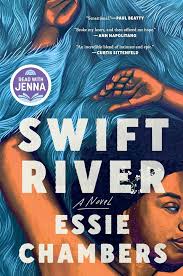
Swift River . . . Paddling the Rapids of Raging Adolescence

Essie Thomas' new novel is a perfect summer read

From the moment I dived into Swift River, I was swimming through memory, in sync with Essie Thomas’s captivating heroine Diamond Newberry.  Like Diamond, my 17-year-old self suffered from a sense of dislocation, and I recognized in her a familiar longing to know an origin story. Like me way back then, she found her hope in stories her family members, the ones willing to talk candidly about the past, could share with her.  Like Diamond, I ate my troubles away, wallowed in tuna casseroles and wingdings, but being white,        From the moment I dived into Swift River, I was swimming through memory, in sync with Essie Chambers’s captivating heroine Diamond Newberry.  Like Diamond, my 17-year-old self suffered from a sense of dislocation, and I recognized in her a familiar longing to know an origin story. Like me way back then, she found her hope in stories her family members, the ones willing to talk candidly about the past, could share with her.  Like Diamond, I ate my troubles away, wallowed in tuna casseroles and wingdings, but being white, what young me did not have in common with Diamond was color. 

My confusion and disassociation were just as real, but they were invisible, and I therefore did not suffer the same slings and arrows of outrageous racism that Diamond endures. Yet I easily relate to what she feels, and how she responds because as unique as Diamond is, she is a character who represents the distinctly American experience of growing up in an unkind, duplicitous society whose respect for diversity is superficial at best. 

Diamond is caught in a perfect family-and-society-fueled storm. Her father has disappeared, is perhaps dead, and her mother has become recklessly unbalanced.  Her marriage to Diamond’s father was disastrous, but she does not know how to live without him.  So she drinks.  She makes Diamond responsible for her but is, at the same time, immobilized by the way her community – the town that has been her family home for generations – treats her daughter.  She knew that nothing about their life together would be easy, but she never embraced his brittle fragility.

Already restless and morbidly obese, Diamond finds herself entirely untethered by her fatherlessness.  She wants to stop her mother’s hurt, but she is aware that her mother’s love is genuine but also neurotic and toxic. She longs for her father’s return, as he seems to be the only one who might have the knowledge to explain why the town’s Black population inexplicably left town in the dead of night some years before and what their exodus has to do with her.  He alone might justify his bitterness and the self-destructive recklessness that causes him to act out his angry bouts of frustration.  Diamond has no place to turn for answers until she receives a letter from her father’s cousin-sister, who lives in the Newberry family home in Georgia. 

Letters pass between the girl and her unseen auntie, and Diamond begins to assert her true self.  She secretly signs up for driving lessons and forges a friendship with a girl from her class, who is equally void of ballast, a girl who has learned to sublimate her pain in promiscuity.  Over the course of an illuminating summer, Diamond learns to drive, loses her virginity, and finds her roots.

At the heart of Swift River is the reminder that no matter what ethnicity, what race a teenager is blessed or cursed with, the compulsion to know who we are and where we come from is universal.  Diamond’s plight is overwhelming, but she finds a way to cope just as teenagers have always forced themselves to cope with circumstances they would never choose as the basis of their lives.

Like all the great coming-of-age stories, this one is written by an adult with a mature outlook, told through the eyes of a precocious seventeen-year-old who clearly has the benefit of Chambers’s wisdom.  For that reason, Swift River is a great read for teens and adults.  It is an illuminating journey over the racing rapids of adolescence, a passage that none of us avoids.       

Diamond is caught in a perfect family-and-society-fueled storm. Her father has disappeared, is perhaps dead, and her mother has become recklessly unbalanced.  Her marriage to Diamond’s father was disastrous, but she does not know how to live without him.  So she drinks.  She makes Diamond responsible for her but is, at the same time, immobilized by the way her community – the town that has been her family home for generations – treats her daughter.  She knew that nothing about their life together would be easy, but she never embraced his brittle fragility

Already restless and morbidly obese, Diamond finds herself entirely untethered by her fatherlessness.  She wants to stop her mother’s hurt, but she is aware that her mother’s love is genuine but also neurotic and toxic. She longs for her father’s return, as he seems to be only one who might have the knowledge to explain why the town’s Black population inexplicably left town in the dead of night some years before and what their exodus has to do with her.  He alone might justify his bitterness and the self-destructive recklessness that causes him to act out his angry bouts of frustration.  Diamond has no place to turn for answers until she receives a letter from her father’s cousin-sister, who lives in the Newberry family home in Georgia. 

Letters pass between the girl and her unseen auntie, and Diamond begins to assert her true self.  She secretly signs up for driving lessons and forges a friendship with a girl from her class, who is equally void of ballast, a girl who has learned to sublimate her pain in promiscuity.  Over the course of an illuminating summer, Diamond learns to drive, loses her virginity, and finds her roots.

At the heart of Swift River is the reminder that no matter what ethnicity, what race a teenager is blessed or cursed with, the compulsion to know who we are and where we come from is universal.  Diamond’s plight is overwhelming, but she finds a way to cope just as teenagers have always forced themselves to cope with circumstances they would never choose as the basis of their lives.

Like all the great coming-of-age stories, this one is written by an adult with a mature outlook, told through the eyes of a precocious seventeen-year-old who clearly has the benefit of Essie Chambers’s wisdom.  For that reason, Swift River offers an astute journey through the fraught passage from childhood to adulthood that none of us avoids.                                        

                                                                                                                                                                                                                                                                                                                                                                                                                                                                                                                                                                                                                                                                                                                                                                                                                                                                                                                                                                                                                                                                                                                                                                                                                                                                                                                                                                                                                                                                                                                                                                                                                                                                                                                                                                                                                                                                                                                                                                                                                                                                                                                                                                                                                                                                                                                                                                                                                                                                                                                                                                                                                                                                                                                                                                                                                                                                                                                                                                                                                                                                                                                                                                                                                                                                                                                                                                                                                                                                                                                                                                                                                                                                                                                                                                                

Pictures on Exhibition at a Class Reunion – Fictionalized Nonfiction in Three Parts: Part I

  1. The Playwright

Chuck Folger sidles up to me, and I recognize him immediately. Bodies shift and reconfigure, features sag, and hair goes to gray or white, but eyes don’t change. His are still the same crystal blue they were in high school, still twinkling brightly like they’re hiding a funny secret or like they’re made of glass and could break if he blinks too hard. We hardly spoke in high school, but I was aware of him, was amused by him, was intrigued that anyone could have such true blue eyes.images

“Do you ever see her?” He asks, as though continuing a conversation we’ve been having all along, despite the fact I haven’t seen him in fifty years.

“See whom, Chuck?”

“Our Laila. The playwright. I saw her in an interview on television,” he says. “I thought of you. You live in New York City. You must see her sometimes.”

“I do,” I say, thinking that my being in touch with this woman is not simply because I am in New York City, where she is, and that we are from the same small town in upstate New York. It’s a complicated story, and I hope he won’t ask.

He doesn’t.

“Yeah, I thought you might. I always liked her. In high school. I thought she was pretty. Did you know her then?”

Chuck’s accent sounds Canadian. I ask him if his folks, like many in the logging town just up the road on Route 3, might be originally from somewhere near Montreal, but he explains that actually it was his mother who gave him the accent. His dad descended from French Canadians, but they’d been local for generations.

Nope. It was his mom. “She was Onondaga, you know, lived on the res up in Hogansburg. The elders taught her French and then sent her to school outside of Montreal, where the sisters taught her English.”

“I wish Laila were here now, were at the reunion. I’d like to tell her I saw her on television. Did you know her back then?”

Before I can reply, Ronnie Himmelstein, says, “Of course she knew her in high school.”

Ron left our town to go to a Division I university and then returned to teach in the local junior college, chimes in. Ron is dapper, commands attention afforded local celebrity. . . he writes a column for the local daily paper. “The four of us founded the literary magazine. We two and Laila and Pierce Bogart.”

No one reacts to the name Pierce Bogart. He’s long since left and been forgotten. Instead, Jake Ferucci looks up from his sixth or eighth beer to say, “I never read the magazine, but I sure did love that Laila. I’d sit in French class and just look at her. . . . “ His voice trails off. Then he adds, dreamily, “You understand why I never learned a word of French? Every French word was lost in the crazy screams in my head.”

“Screams, Jake?” I ask.

“Just fear,” he says. “I wanted to ask her out. But I was afraid. She’d never have gone out with me.

“I bet you’re wrong, John,” sighs Polly Paget, who’s still as lithe and lean as she was on the ski hill in 1965, still as limber as when cheering on the football field. “I would have. You never asked.”

“You mean I missed an opportunity?” Jake whines.

“Big time,” Polly snuffs. “We all wanted you.”

Jake groans and guzzles his beer. The past tense has not eluded him.