A Mother’s Day Gift to My Children – Part IV

American life was strained from the beginning.  Americans in general and Jews in particular were not as welcoming and protective as the family expected them to be; adjusting to life in Accord, NY, and then in Kingston, was a perpetual challenge.  The business Papa’s brother promised to set up took far too long and cut far too deeply into their reserves, and Charlotte couldn’t find a cello teacher who could stay even a step ahead of her.  News began to come from Europe about those who had not survived: slowly, the family learned that three of their mother’s siblings and their father’s favorite sister had perished, and so had Thea Matzner and her entire family.  They slogged on, and Mom even managed to prevail against all odds; she was accepted into a premed program at the University of Vermont, a miraculous achievement considering she had been enrolled in three different high schools in the mere two years she had been in America, and she had had to take SATs a full year earlier!

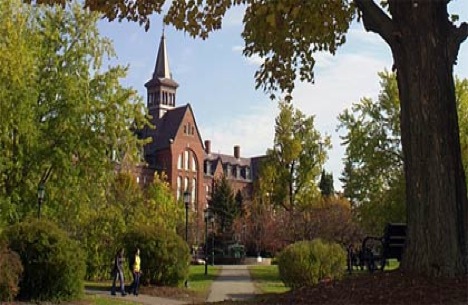
UVM offered unexpected solace and belonging at a critical moment in Mama’s life

Then, in 1943, the long-awaited son, the light that had brought life back to his parents’ eyes, Hannes Edward died in yet another freak accident at the age of 15.  Charlotte once again took on the mantle of blame — she had been away at college and had not been there to do . . . what? . . . anything.

A Mother’s Day Gift to My Children – Part III

As Charlotte, my mother, entered her teens, the person she most admired kept aloof of her.  Eldest sister Herma, five years her senior, was consumed with her social life.  Her best friend, a girl named Thea, daughter of my grandparents’ closest friends the Matzners, would arrange trysts for Herma, standing lookout when she would meet a boy. Herma’s attentions turned to her piano teacher, a Serbian painter named Borislav Bogdanovich, and it was certain her parents would disapprove, so she relied on Thea to provide cover.  But Thea’s own love life intervened, forcing Herma to confide in her younger sister. There began a life-long conspiratorial relationship, a bond neither Charlotte nor Herma ever grew out of, fortified by tragedy.

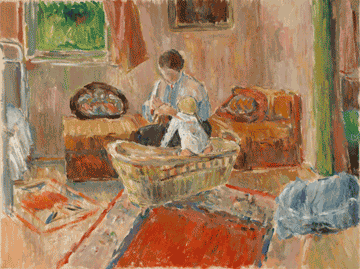
Herma and Tonka, by Borislav Bogdanovich
The Bogdanovich Collection
http://www.bogdanovichcollection.com
annatheab@aol.com

Herma and Borislav were married and had a gorgeous child Anthony (Tonka), in whom the sun rose and set for both of them.  Before he was two, the child died in a freak accident.  In later years, whenever Herma told the story, she told it with Charlotte in the room at the time witnessing her horror; when Charlotte told it, she was nowhere near.  In either case, Herma very nearly succumbed to her loss, and her marriage suffered as well.  But history intervened, and there was no time for self-absorption or meandering through the stages of grief; Hitler necessitated yet another move.

Pregnant with her second child, Herma helped Borislav assist her father in making arrangements to get the family out.  Thanks to a network that depended on Borislav’s Serbian ties and aided by Papa’s French connections and multiple relatives already in America, the family was able to emigrate fairly swiftly, and, in 1939 all but Papa arrived in New York; he went to Cuba, where he stayed until he had transferred his Polish citizenship and could gain entry to the U.S.

A Mother’s Day Gift to My Children – Part II

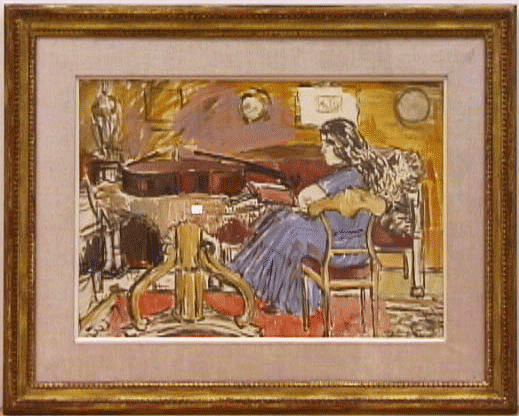
Charlotte, Age 12, With Cello
The Bogdanovich Collection
http://www.bogdanovichcollection.com
annatheab@aol.com

When Charlotte, my mom, was not quite six, the family uprooted and moved to Zagreb.  Though he was a civil engineer with advanced degrees from the University of Vienna, Papa found that his Jewishness impeded employment; he had turned to sales and opened a new territory in Croatia, representing several European textile manufacturers. He subsequently opened a wholesale store and a textile mill, and he began to prosper.  Life seemed good.
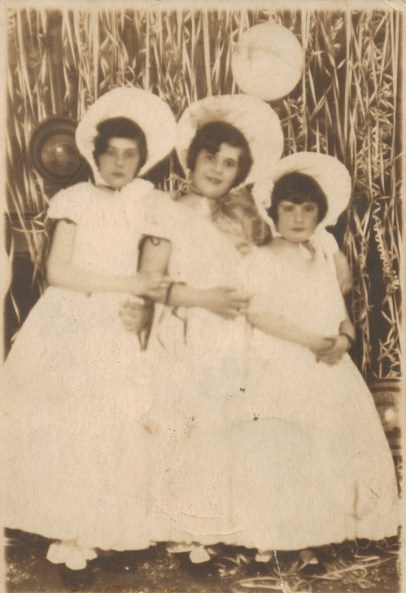
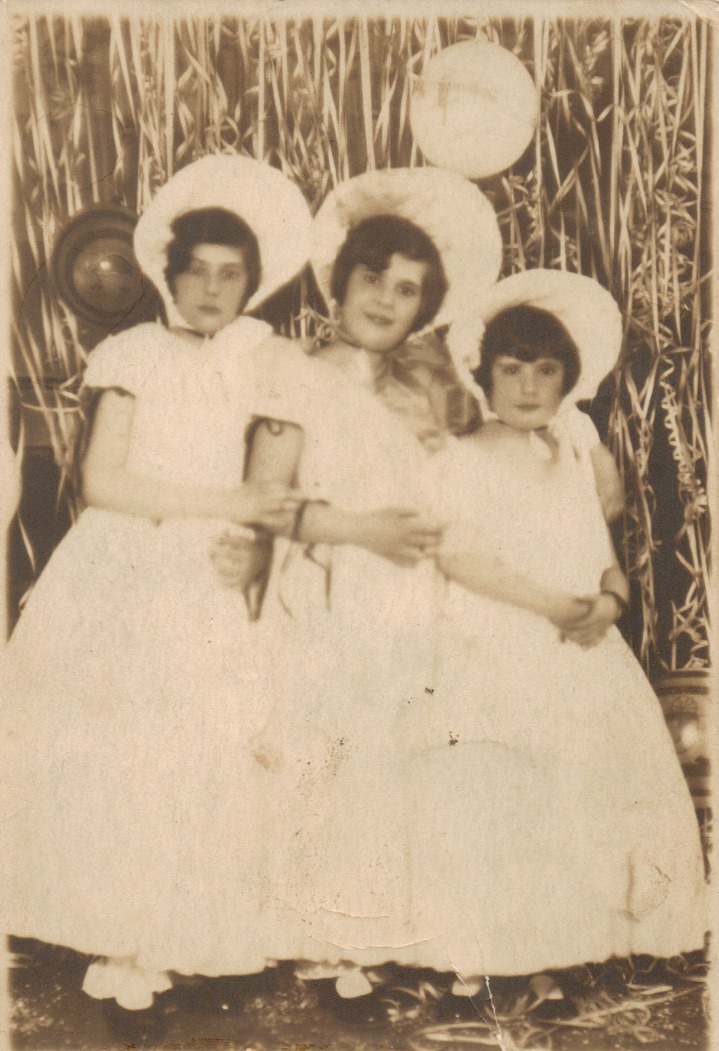
When comparing herself to her sisters, Mama (center) described herself as oversized and clumsy, a boyish blunderer; but none of the photographs from the time attest to that image.

Charlotte considered herself grotesquely large and healthy in contrast to her sisters. Thea had always been wan and delicate, prone to illness; now there was Ruth, two years Mom’s junior, who was so sickly, as an infant she had required a transfusion, which she got directly from their father, who lay on a gurney, connected to her by the tubing that carried his blood the short distance to her little thigh.  Ruth officially took over as Papa’s darling, so Charlotte studied cello and played team sports in order to protect her position as the son her father didn’t have.
In 1927, the family finally did add a son — Hannes Edward — but Charlotte did not denounce her throne; she was the designated “son” and took on all the responsibility attached to the role. “I was the one,” she would whisper, as though her brother might be in the next room listening, “with perpetually scraped knees from climbing trees.  They kept Johnny wrapped in cotton wool, but not me.  You know what I loved to do?  There was a pecan tree in our yard in Zagreb.  I found branches that would hold me just so, and I would sit in that tree for hours reading.  I read all of The Three Musketeers there, then I would climb out of my tree and challenge my dog, King, to a duel.”

The world turned upside down in 1932, and it did not right itself for a very long time.  In January of that year, Thea, just five months shy of her 12th birthday and a ballet prodigy, having only recently recovered from a near fatal bout with scarlet fever, was struck with meningitis and died.  Charlotte, who had prayed for illness, had been profoundly jealous of the attention her sister received, was devastated and blamed herself for the tragedy, convinced that her parents would have been far less afflicted if it had been she and not Thea who had died.  She told me, “I used to go to the cemetery and sit on Thea’s grave for long conversations.  I was only ten.  It was a great weight I carried on my shoulders.”

My grandmother was undone, and her health deteriorated in multiple ways, leading to conditions that eventually addicted her first to morphine and then to alcohol.  “Papa went a little berserk,” Mom would mutter, as though admitting it were tantamount to denunciation.  He became ultra-religious and drove his family to near insanity with his obsessive adherence to details he hardly believed in.  Charlotte became more committed to her cello; though she longed to dance, she couldn’t — it was a realm that belonged to Thea, and besides, she believed that no one would “think of giving a roly-poly girl ballet lessons.”  But she was a talented musician and studied religiously, eventually performing often in concerts and recitals.

A Mother’s Day Gift to My Children: A Remembrance of Charlotte Esther Robinson Swett – Part I

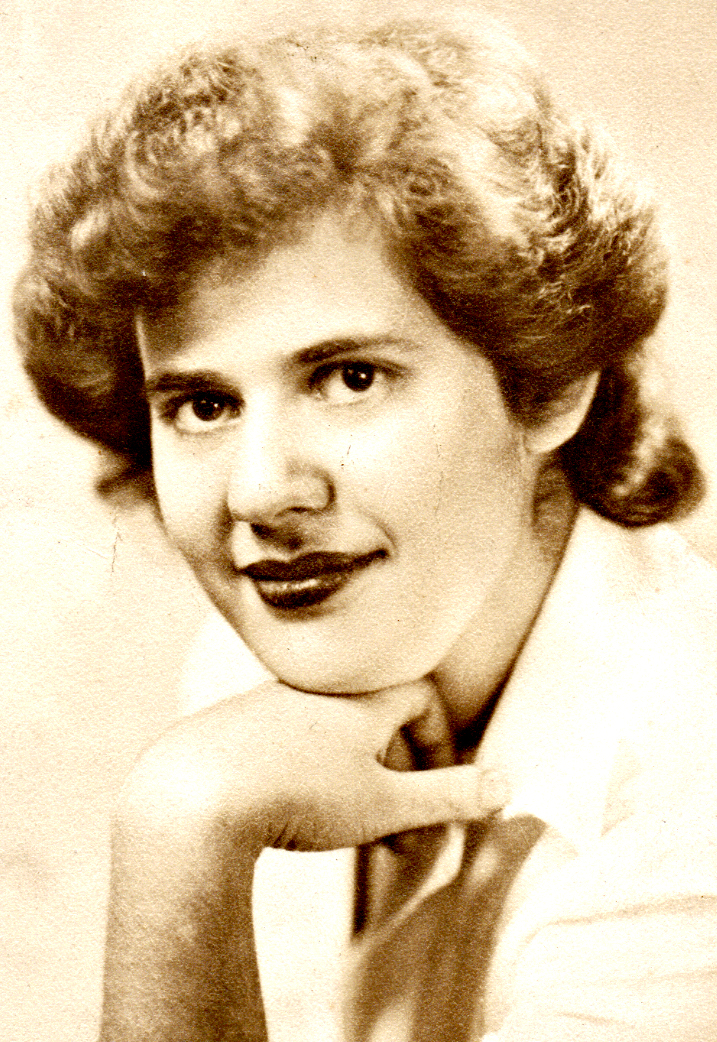
Charlotte Esther Robinson, University of Vermont, Class of ’44

 Charlotte Esther Robinson Swett, my mother, never knew how very much I admired her.  We were, for many years, closer than most mothers and daughters, but she couldn’t know the depth of my esteem for two reasons.  First, this complex woman never quite internalized the breadth of her inestimable value; and second, I never quite understood the scope of my emotions.  So I write this now for my children and grandchildren.  They need to know.

When I was small, my cousins referred to our grandmother as Mama, but I could never muster the word; she wasn’t anything like a Mama to me.  She was harshly critical, emotionally cruel, and I recognized early on that she had not even earned the right to that moniker from the woman I knew was my Mama.  Grandma had suffered terribly in her life, and in her last twenty years, after she found sobriety and a modicum of peace, especially after my grandfather died and liberated her from her subservience, she became a friend and a confidante, but it was clear to me that as a mother, she had provided no model for my mother to emulate, had failed to nurture and protect her daughters, and had damaged them all irreparably.

My mama shared her life with me in timid drabs over late night vigils.  My father was a traveling salesman, and he was often on the road into the wee hours of the night; it was I who kept her company while she waited, always frightened that the worse might have happened.  Fearing the worst was a learned response to a life of worsts, but she found them difficult to tell, difficult to explore, and until I was twelve, all I really knew were the funny stories.  One was the story of her birth, which she told between gales of girlish giggles that invariably made me laugh too . . . until I was old enough to get it.

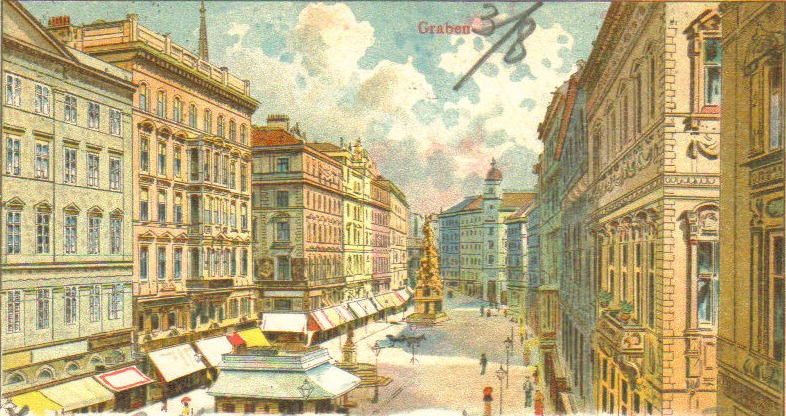
Picture Postcard Vienna, 1918

“I was born on a crystal clear Viennese night in April, 1923,” she would begin; she was only eleven months younger than her sister Thea, born in 1922, who was four years younger than their first sister Herma, born in 1918.  “Mama told me there wasn’t a cloud in the sky outside her window, just a glittering sliver of moon.  But poor Papa was devastated. He was sure this time he would finally have a boy.  He had put his head at Mama’s belly, and he was certain that this time he would be father to a son. He was so excited he could not sit still for most of the 9 months of the pregnancy.  I often imagine my Papa’s reaction when the doctor came out of the delivery room to tell him he had a big, robust, healthy daughter!  He went crazy.  Mama didn’t see him for weeks . . . maybe even months.  The story changed whenever she told me.  But when he did come back, he was determined not to be disappointed, and from then on he encouraged me to be a tomboy, which was just fine by me!

Why I Hated Bridesmaids

I know this is not a popular point of view, but I hated Bridesmaids.  Everyone I know who saw the movie, including people I respect and admire and listen to assiduously, said it was laugh-out-loud funny, poignant, great fun.  I found it tiresome, pedestrian, contemptible.

I think the thing I hated most was the way it depicted the women’s relationships, which rang absolutely true and was entirely unamusing.  I am not entertained anymore by the way we women find it so difficult to support one another, by the way in which we seek to undercut our sisters’ best efforts.  The schadenfreude women have for other women is stultifying, and, in this day of diminishing women’s’ rights, or what Sarah Silverman adroitly (if with somewhat ill-advised timing) calls the Real War on Women, we should be doing all we can to give one another a boost whenever we can.

Or perhaps it hearkens back to an attitude I developed in my youth when I was the oldest of a large family of misbehavers.  We were all wont to fight among ourselves, and we were often hyper critical of one another.  But if anyone on the outside was looking in, we banned together and sang one another’s praises.

Women don’t do that.  They allow politicians to call their co-genderists unthinkable names (Remember how Hillary was treated during the pre-nomination campaign?  Notice how anyone who decries the erosion of our rights is assailed?  Are you hearing the kinds of names Sarah Silverman, Anne Roiphe,  et al., have been labeled with by so-called feminists lately?), and they put up with discrimination at every level of our society.

Back in 1969, a month before Stonewall, my roommate and best friend attempted suicide.  It was a gruesome experience, and I won’t detail it here.  Suffice it to say that when he came out of his stupor and took a look at the world around him, what caught his attention and ultimately made him fight his way back to sanity was the Stonewall Uprising.  I have a vivid mental picture of his telling me, as he lay in his bed in the psychiatric ward at St. Vincent’s, “If the gay community is willing to stand with me, why should I lay down and die?”

Had my friend been female, I believe he would have died.  We women never had a Stonewall.  And more often than not, I feel like my sisters would prefer I lay down and die rather than stand next to them and make them feel diminished by me.  Or threatened or embarrassed by me.

And all the while, the glass ceiling turns acrylic and indestructible and our dominions over our bodies is diminished and our sense of empowerment is undermined.  And we let ourselves be led by people who don’t have our best interests at heart, who want to see us walk down the aisle to self-destruction and live unhappily-ever-after.

It’s not funny.