Memorial Day Musing (from Medium.com)

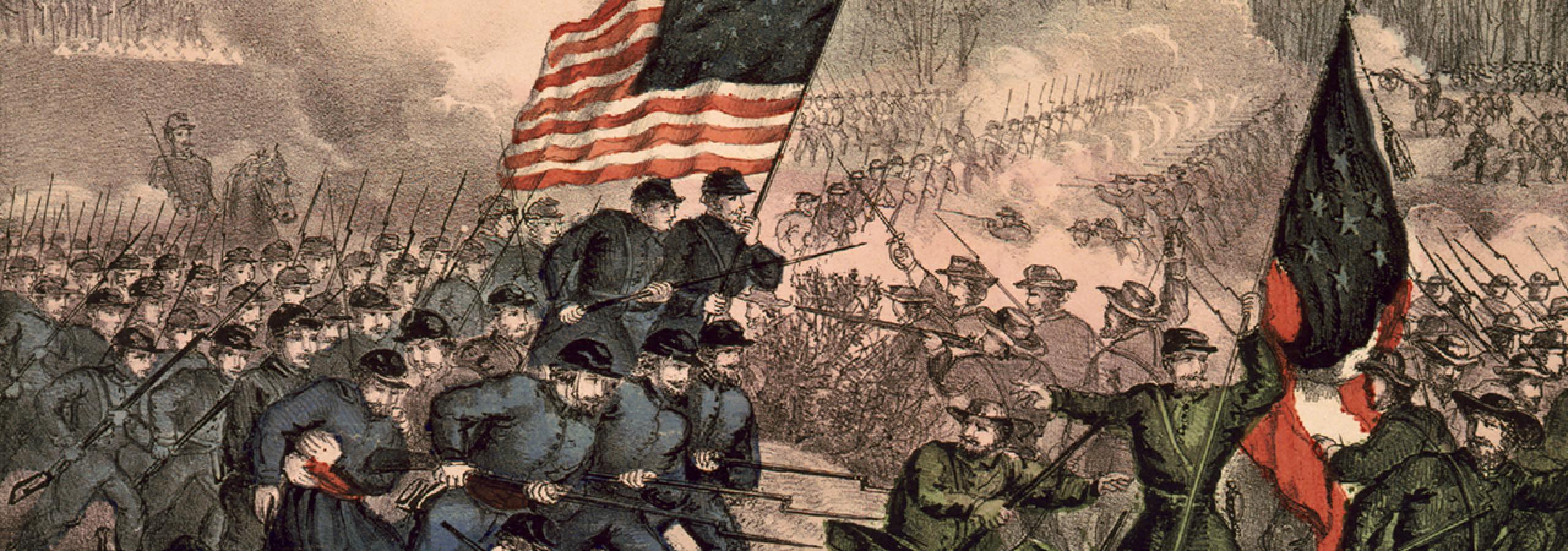
The Second Battle of Bull Run, August 28–30, 1862–15,000 Union troops died in two days, and the Confederacy wond a decisive victory. Hiram Terwilliger fought valiantly and (barely) survived.

Memorial Day Musing

Insomnia plagued my childhood. My mother was a refugee from Nazi Europe, who never spoke outright about what had happened back there. Eavesdropping on the muffled conversations she had in clandestine German with her sisters and parents, however, I felt the anguish wrought by the dismal truths they shared. I inferred that some dark force was out there, still looking for us. When I closed my eyes, I pictured evil monsters, and I could not sleep.

In those days, my father was rarely home. He traveled around the country, representing, depending on the year, surgical supply or pharmaceutical firms. He repaired machinery, consulted with physicians, sold his products, and was often absent for weeks at a time. When he was at home, he was the center of my universe. In his presence, I felt safe. We had animated, prolonged family dinners. There were Sunday afternoon restaurant meals and bedtime stories that extinguished the nightmares.

Mom was not one to wait bedside until I drifted off to sleep, but Dad reveled in the opportunity to display his performance repertoire. It was a rich one that included Biblical episodes delivered with dramatic flourish, Chaucerian tales recited in crisp, Middle High English, a medley of Protestant hymns sung in a sonorous baritone, and, my personal favorite, tales of his grandfather’s Civil War exploits.
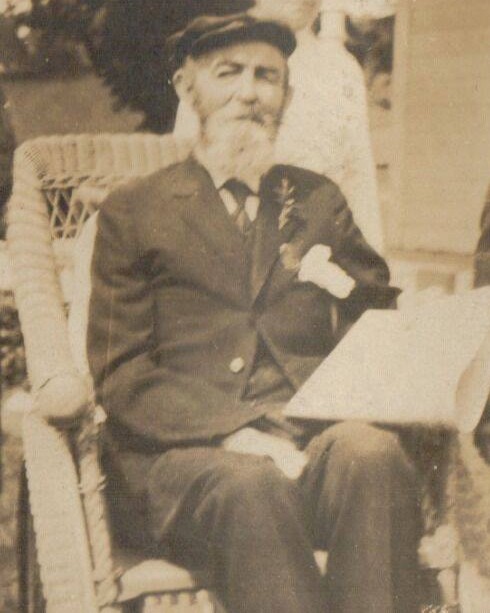
Hiram H. Terwilliger(1838–1935), ca. 1923

Hiram H. Terwilliger was my father’s maternal grandfather and the god of his idolatry. A gentleman farmer in the Catskills, Hiram was descended from a line of Dutchmen who had emigrated from the Netherlands early in the second decade of the 17th Century. By the time of the American Revolution, in which Hiram’s own great-grandfather had distinguished himself as a warrior patriot, they had begun to intermarry with English landowners and had taken their place in the highest echelons of Knickerbocker society. Dad’s narration of this family lore always had a pointed purpose: Terwilligers take heritage seriously. It defines how they are to live their lives..

A lay preacher in the Dutch Reformed Church, my great-grandfather was a rabid abolitionist. He and his sister Sarah were conductors on the Underground Railroad, and the family farm was a relay station. Though passionately pacifist, when the purveyors of human beings refused to end their vile trade, Hiram enlisted in the Union Army, in 1861. He was wounded and sent home mere months after he joined. As soon as he was healthy again, he re-enlisted, this time elevated to the rank of Corporal and subsequently to Sargent.
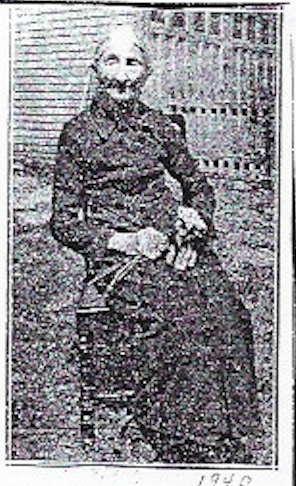
Sarah Elizabeth Terwilliger Warren(1840–1940), ca 1940

In 1862, at the second Battle of Bull Run, Hiram was shot nine times, sustaining at least three wounds that should have killed him. He refused to fall. After retrieving the Union flag from the ambushed color guard, Hiram kept moving, leading his battalion into the fray. I can still hear my father’s tear-stained voice whispering, “He said he would not rest so long as all Americans were not free.”

Recovery from the wounds and from the subsequent surgeries was long and painful. Summoned to the hospital in Fredricksburg, where Hiram had been taken from the field, Sarah, who volunteered with the corps of battlefield nurses, cared for him until he was well enough to travel. She accompanied him back to the family homestead, where she dutifully nursed him for over a year.

Though they both married and lived separate lives, brother and sister remained to committed to the cause that nearly killed him.

Sarah, who lived to age 100, was a popular local heroine, known in Ulster County as Auntie Warren, her married name. She became a suffragette. Hiram marched with her. He preached universal suffrage from his pulpit and took his message to conferences and convocations around New York and New England. Toward the end of his life, Hiram suffered paralysis from his waist down but continued to preach from his wheelchair. Whenever he heard of discriminatory practices enacted against any of his neighbors, Hiram was there to preach equality. He had a special affinity for Native Americans and was a continual thorn in government’s side, writing letters and making sermons admonishing the powerful hypocrites, who betrayed the People with broken promises and violated treaties.

Dad would finish Hiram’s story with a grand flourish as he looked into my sleepy eyes with a singularly intimidating look. “And so,” he would whisper, “now you understand your responsibility.”

“My grandfather nearly died,” Daddy would whisper as he left the room. “So that what happened to Mommy’s family in Europe will never happen to people here”

Since Mommy had clearly suffered from whatever it was that befell her beloved home, I embraced his assertion. She had escaped the Nazis and had come to America because here she could be safe, and her children would be protected from discrimination.

Every year of my growing up brought new awareness of America’s salient truths. People were not safe here. Discrimination was rampant. My father’s best friend was a physician, who was forced to take maintenance jobs in order to feed his family he finally found a hospital willing to grant him admitting privileges. I spent a weekend billeted with a Mohawk family on the St. Regis reservation, and I was appalled to come face to face with what my white forebears had done to this proud, generous people. By the time I graduated from high school, I deeply understood the hypocrisy of the opening words of the Declaration of Independence, grasped the depth of the evil perpetrated on villages in Korea and Viet Nam in the name of American democracy. My great-grandfather’s story became my reassurance, my inspiration.

I attended Malcom X lectures, marched with Martin Luther King, Jr., explored the beliefs of Muslims, Hindus, Buddhists, et al. I studied languages and traveled abroad so that I could obtain a deeper understanding of the world around me I believed that it was possible to be an American, and to uphold the rights of humankind, to extol the virtues of immigration, to embrace multiculturalism. I struggle now — a struggle exacerbated daily by new events, such as this week’s brutal murder of George Floyd and the idiocy of Christian Cooper’s encounter with a white woman’s performative fear in Central Park — to suspend my disbelief.

I miss the days when I bought into the myth of America. Once a year, I force myself to make a valiant effort to retrieve my faith.

Every Memorial Day, I doff my cynicism and think about old Hiram Hauslander Terwilliger and his sister Sarah Elizabeth Warren. While many of the principles they espoused are still unwon, their story reminds me that we can do better. Men and women before and since have given their lives to the belief that we will do better.

The future of this country demands that we must do better.
Corporal Hiramm Hauslander Terwilliger, 1861

Three Dead Men

It’s been a rough month for understanding emotions. In a rush of sudden departures, I have lost three complex men, with whom my relationships were equally complicated. What follows is my initial effort to rummage through the shadows and identify my most honest responses to their deaths. Not a simple task.

All three were remarkable. One narcissist, one divo, and one hero. All brilliant. All loving, hateful, kind, and even abusive. You were right Bobby Burns. 

The Narcissist

Urs in 2008 – He loved this image of himself

The first death notice was for Urs, a former lover and confidant, who died suddenly in Switzerland. After years of dickering about how and if, Urs and his brother were finally renovating the family homestead near Zürich. In typical Urs fashion, he was cavalierly riding atop a trailer loaded with trash. He slid off and fell under a tractor wheel, which instantly crushed him. My first reaction when I heard the news was a simple nod. Every time I walked or biked with Urs in traffic, I would beg him to observe caution, to obey street signs, to listen to oncoming traffic. He laughed. It was, he reminded me, his desire to go suddenly, without pomp. “I wish to be snatched into the void before I have time to think about it or to be a burden to my children,” he declared. Death by garbage truck became him.

A self-proclaimed polymath, Urs was a financial wiz, a legal eagle, a filmmaker, a photographer, a writer, a painter, a collector. He loved art and argument, music and mental mayhem. His self-absorption was peerless. In his mind, everything revolved around him. He imagined every eye was on him from morning till night. He owned enough pairs of glasses – he called them his mood measurers – to open a curiosity shop of eyewear and had closets full of clothing that would make the Kardashian women seem frugal. He cast all rules of engagement, suffered no fools, tolerated no dissension. I knew that if I didn’t agree with him, if I didn’t like what he chose or did or wanted, he was finished with me. That was all. And for reasons I hardly understood, I was okay with that. Perhaps it was because, at the same time, he could surprise me with his generosity. He arranged a career-changing job for me, and that job took me to London, where I was able to live for nearly three months, thanks entirely to his hospitality. He believed in the opportunity, and he believed in me. . . so long as I was in some way an extension of him.

Urs had a rapier wit, a deep appreciation for irony and The Absurd. He was expert at mugging, and his jokes were delightful. I lost myself in him, allowing his intellect to eclipse mine, encouraging him to void my will. He was an anomaly, and I might have fallen in love with but for his abject cruelty.

One day, as we walked in the NY neighborhood where my son and his family lived, we happened to meet up with my daughter-in-law. She was only a few weeks post-partum and was having her nails done in a local salon. Urs greeted her in the European manner, kissing her on each cheek before he announced imperiously for all to hear, “You look terrible. Did you know you’ve become quite saftig?”

That night, as we prepared for bed, I demanded that Urs apologize. Without discussion, he ordered me to leave. “It’s the middle of the night,” I whined. “You’ll have to walk me home or come down and hail me a cab.” Wordlessly, he pointed me to a mattress on the floor in an adjacent room. At first light, I went home. We were done.

Il Divo

No one was as able as The Coach to elicit genuine brilliance from young singers.

Next was “Dr. Coach,” my longtime collaborator and cheerleader.

I can still hear the sonorous voice that greeted me over the phone the first time I encountered him. “Hello,” it crooned. “Carla Stockton, this is __________, Ph.D., and I have heard so very much about you. I am calling to make an offer I know you won’t refuse.” I didn’t. How could I?

The offer was the job of artistic director for an educational summer theater program for which he was musical director. Ours became a fertile partnership. For several years, we created spectacular productions together – putting talented kids to work building sets, creating costumes, stage managing, acting, and singing for works such as Into the Woods, Most Happy Fella, Sweeney Todd, A Chorus Line, Pippin . . . .

People were astounded. The music we chose was challenging – highly operatic, written for seasoned performers – and the kids nailed it every time. That was all Coach. He could have coaxed music from a plank of wood, and his ability to evoke musical perfection from our charges, to motivate them to reach ever loftier goals, was nothing short of magical. I worked with many music directors over my years in educational theater. Never did I encounter anyone as effective a teacher as he was.

But he had a dark side. He was prone to mad bouts of depression during which he became surly, abusive. He berated me for every possible flaw, both real and imagined, I might have. “You spend too much time on the chorus scenes when we should be working the quartet. Let the idiots go, and focus on our stars.” “Your hair is getting too long, and I think you need a new look. Tell that skinflint of a husband of yours to get you a haircut and a new outfit. I’m tired of jeans.” “You’ll never understand this music. I sometimes think you have a tin ear.” He also had some troubling proclivities.

At the time, Coach was a 60-something-year-old man with a yen for school-aged women. Especially for the youngest, prettiest, most voluptuous, most gifted. Over the years I knew him, he never expressed interest in any woman older than 18. Fortunately, however, he was careful and self-aware, and I never worried he would do anything untoward.

During preparations for a show, he would call me after each rehearsal to share with me which girls he was lusting after. I think he did that to shield himself, to hear me say how absurd it was, what a ridiculous fancy. He never touched them, never crossed any lines of impropriety. I listened and chided him without scolding, encouraging him to continue confiding in me and to continue holding himself back. His passion seemed to enable him to be a kind of Pygmalion for the women he craved, breathing splendiferous life into voices they did not realize they had.

Before the first summer theater season began, I called on Coach to collaborate on a project at the high school where I was employed. I had been asked to direct the senior class production of Into the Woods. I knew there was no way I could pull that show off without a superior music director. Despite the fact that he was in the thick of his choir duties at his school, in addition to the performance he and his students were preparing to take to Washington, Coach eagerly added my project. In auditions, we were dumbfounded by the discovery of a young woman with a flawless soprano voice. She had never sung before, she said, but she already commanded a full three-octave range, and her high notes were the purest I had ever heard. Coach was instantly smitten. He threw himself into the task of coaching her to play the very demanding role of the Witch. She, too, immersed herself in the work.

Every night after rehearsal, Coach would call me and pour out his besotted fantasies. Every day we would go back into rehearsals, where he would maintain complete decorum. Their efforts resulted in a wondrous performance. I have never heard “Children Will Listen” sung as well as that child delivered it. The innocence in our witch’s crystalline voice resonated, gave the song added import. Children did listen.

In 1998, at Coach’s insistence, I wrote a successful grant proposal for a conservatory-style summer program that had an afterschool training component in Bel Canto voice and Shakespearean acting. The State of Connecticut gave us an unprecedented amount of money. We hired actors and technicians and instructors, artists to create seminars and field trips. We were able to produce four plays in repertory. We recruited students from all over the state, and we met in a classroom at a local university from September till May. Then, in the summer, we housed our students at the same campus and bused them to our host high school, where they attended classes and seminars, rehearsed the plays they were in, ate the three meals we provided. We were able to hire dorm supervisors and to take elaborate field trips. It was a golden year, and we were the talk of New Haven County. We could have become an institution. Until Coach lost his resolve.

Soon after summer rehearsals began, Coach realized he could not live without one of our stars. She was a delightful young woman, beautiful and innocent, with a glorious voice. At first, Coach kept his feelings to himself, controlled his cravings. But each day brought him new frustration, and by the second week of the three-week rehearsal run, he was telling not just me but anyone who would listen that he could hardly contain himself any longer. He even told his male students. He was in love, he moaned, and he just must, must, must tell her. At this point, my tolerance waned. “You can’t tell her. You have to stop telling your boys. And you cannot touch her. This has to stop NOW.” He curbed his hunger, but we were no longer friends.

I was sad to lose him, but I was diverted by personal concerns and paid no attention to what he was up to. He took advantage of my silence and spread nasty rumors. He told parents of some of our young techies that I had cheated them out of pay. He told the district I had pilfered money intended for buses. He told colleagues in the community that I had subverted the program, and his accusations ensured that our grant was not renewed. I only learned about the tales much later, by which time I had no desire to engage with him on any level. I settled into my life and assumed that we would eventually become acquaintances with memories of a very successful collaboration.

Sometime in 2006, and I saw him examining the produce in a local market. Spreading my arms wide, I declared, ”_____________, Ph.D., I haven’t seen you in forever!” He glowered at me for a millisecond, then turned his back and walked away.

The Hero – DAN ALON, his story follows in the next entry.

A Clockwork Orange . . . Live!

Screen Shot 2017-11-23 at 11.01.56 AM

My first thought when the gaggle of middle school-aged boys boarded my crosstown bus was how lucky that I’d be disembarking soon. They were without adult companions, clearly coming from an after-school activity, exuding the day’s pent-up exuberance. The two years I spent as an 8th-grade classroom teacher and my years in youth drama taught me well to expect noise and boisterous behavior. Nothing prepared me for what they actually brought onto that bus.

Nothing except perhaps Anthony Burgess’s Clockwork Orange dystopia.

There were ten of them. The oldest looked to be a few months shy of his fifteenth birthday. Small, smooth-faced, and wiggly, they seemed adorable – all cherubic faces and cuddly little bodies. Giddy, silly boys volleying jocular epithets in half-changed voices that vacillated from soprano to crackling baritone.

“You call that a jump shot? Dude. He was just standing on tippytoes like he was spitting at the hoop.”

“Truth, man? I don’t give a &*&* about no jump shot. I’m down with the cheerleaders.”

“No shit! I’d be down with them. Literally. Like down in all that . . . .”

I could not believe what I was hearing. Suddenly, without warning, the banter turned brutish.

“You see Lilly this mornin’?”

“She looked hot.”

“Right? That’s some rack she’s carryin’ – and that booty. I just wanna. . . . ”

“I got plans for that one. Oh yeah. You c’n help. One of these days after school, we could drag her into the girls’ room. We cover her mouth so she can’t scream, and we . . . . “

The child went on to describe his plan for the girl in question, a plan that turned darker as his giggles grew more mirthful. In lurid detail, he shared the stages of a rape he had in mind. He and his friends bounced up and down like toddlers on a trampoline. Raucous laughter crescendoed to cheering as his words slithered toward the narrative’s climax. Shrill expletives pierced the bus walls with vile, violent language.

My fellow passengers and I sat stock still, afraid to look at the boys, afraid to change expressions. No one moved, no one spoke. Our heads down, we all struggled to conceal our collective grimace.

I escaped at the fifth stop. And as I caught my breath, my guilt set in.

I should have spoken up. I teach older students, and I have never been afraid of confrontation. Why was it that I was so intimidated, that we all were so intimidated by this group of changelings?

For one thing, the boys’ behavior was all too familiar. We see it on Youtube, on Facebook, in the news, in our midsts. Youthful aggressors testing their limits by whatever displays of disrespect they can muster. They carry amplifying devices in the streets and on public transportation, blasting their angry music in all directions. They push old people out of their way to take seats when the vehicles are crowded, and they lash out at anyone who gets to a seat ahead of them. A very fat girl pushed me aside so she could occupy three spaces on a crowded D-train one day, and when I scowled, she stomped on my foot to make sure I knew my place. We are unprepared for this madness, and so we are silent. These kids are empowered by forces we strain to understand.

In NY, quality of life laws have been thrown to the wayside, and the police are powerless to silence the noise or search for guns. It’s clear to those of us who live among the toughest ones that they are packing. We can see the firearms that are only perfunctorily concealed beneath hoodies and oversized sweatpants. But we can do nothing.

Who in their right mind would speak up? There are myriad stories circulating about the danger of dissent. So little as a disapproving face can incite an assault.

The country is led by a moronic bully, whose mentality is exactly like these boys’. He brags about his exploits, disrespects just about everybody, throws his considerable weight around without concern for anyone but himself, and he publicly uses language that makes him sound tough to adolescents. Our so-called president is an overgrown middle-schooler with no self-constraint, and he licenses our children to feel impervious. We can’t touch them. They are in control.

images-1

From a parody by Hugh Atkins

These kids are even less sophisticated than Burgess’ droogs.* They navigate a real-life Orwellian Airstrip, speak mindless newspeak, and eschew reason. To them war is peace, hate is love, and respect is folly. They need fear no one. There is no consequence anyone dares dole that impresses them.

And therein lies my great despair. And guilt. How do we stand up to it all? To the evil empire that has the country in its grip? To the oppressiveness of racism and classism that holds us all down? To the bonds of overzealous liberalism that makes it impossible to protect a city from itself? To the mob mentality that has put us where we are and to the other one that holds us prisoners to political correctness?

There must be a way to drive America sane.

I just wish I knew what that way is.

images


*members of street gangs


ME TOO

The “Me too” posts on social media have me feeling ill at ease. I recognize the courage of those speaking up. In the not so distant past, we were ashamed to admit aloud that we had been violated. As victims, we bore the blame and thus were silenced. This new openness is potentially promising. I want to believe that the phrase might become the refrain of a liberation anthem. But I remain skeptical.

Forgive me for this, my sisters, but “Me too” feels too pat. It seems like another in a series of earnest empty slogans. I fear we are too easily lulled into the hope that our words will ignite sudden revelation among those people – both male and female – who have long perpetuated the abusively misogynist old boys’ club that runs most of the institutions in this country. But I have a strong sense that once the system has slapped a few wrists, has made a great show of punishing a few Weinsteins, has vented astonishment, everything will simply revert to the way it was before. No consciousness will be permanently raised. No significant change will be affected.

Of course, I, too, have been assaulted, molested, discriminated against. So have my daughters and my sisters and my cousins and most of the women I love. Most of the women I know. Like them, I’ve passed up opportunities that were offered in the trade of self. I’ve been disrespected and denigrated, and I have been relegated to the status of chattel. Most recently, as an older woman, I have witnessed the same humiliation wearing a new mantle. Suddenly, my many talents and considerable intellect are deemed as unworthy as my body. Since I am no longer able to procreate, my ability to write, to think, to speak, to teach is no longer desirable. I see the hatred for my womanhood all around me. In the sneering faces of men who shove me aside on the subway or the angry stares shot at me when I raise my voice to dissent. I am blanketed in wrath and menace.

But I am a lucky one. I have never been beaten to within an inch of my life. Nor have I been raped in a way that left me consigned to a lifetime of PTSD. There are those who have. And my saying “Me too” implies that the ways in which I was trespassed against are equal to the more lethal ravishments suffered by my cohorts. In my mind, that homogenization of the brutality dilutes the urgency, belittles their misery. And belies the desperateness of the situation. Change needs to happen. Now. There is no excuse for the perpetuation of this hideous status quo.

Chanting “Me too,” we are a choir of outliers. We seek safety in the company of our peers, but who else is listening? Do the others – the guys in charge, the ones with the power to alter the circumstances – really hear? Our “Me too” seems to lack gravitas with them.In my mind is a pervasive image: We girls are gathered on one side of a great hall, the boys on the other. They are snickering.  They are pointing, saying, “There they go again, those girls. They think they’re making sense, but we know they only make whatever sense we say they make. Let’s wink at them, laugh, wave, nod, tell them they’re terrific. They’ll see we think they’re cute, and they’ll go back to doing their nails or whatever it is they were doing before this silly idea popped into their heads.”

I want more than a slogan, more than a chant, more than a refrain.  I want to see a true movement of women. One wherein women stop trying to undercut one another, stop vying for men’s attention, stop trying to trip their sisters as the sisters climb up the various ladders of achievement. I want a movement of women that offers true support to those who need the assistance of the sisterhood. A movement that empowers women and disempowers the male-dominated offices that disable us daily. A movement that stands up to the assaulters and the abusers and the disrespecters and makes it clear that we are not going to take it anymore. A women’s movement that is all-inclusive, that does not bar participation by ANY human being who identifies as a woman. Politics have no business in this movement. We need to form a circle and link arms and fend off the forces that would relegate us to a weaker sex, imprison us in our imposed inferiority.

Women need to see that there will continue to be “me too” generations till the end of time until and unless we women put a stop to it. By standing together, we could take over the system. We could do more than right the wrongs aimed at us. Our power could enact safer gun controls, create affordable universal health care,  reduce our collective carbon footprints, viably reform public education, etc. We could make life less terrifying for all.

With something like true unity, we could conceivably change the world.

That’s when I’ll pipe up with a “Me too.”


Green Curry for Christmas (reprinted from Medium.com)

I’m Christmas-ing in Thailand this year, and it’s a relief to be away from what Americans call holiday cheer. At the risk of being accused of crusading against Christmas, I find the holiday, as it has evolved in the US, to be gruesome and overbearing. The real celebration for me is being removed from the ubiquity of obnoxiously perseverating Christmas song in every public space, omnipresent guilt-mongering in the guise of advertising, oppressive overlays of faux cheer, and incessant arguing over how to greet one another.

No one has stopped me in the street to say, “Merry, er, happy, er . . .” Few even know that there’s a holiday going on out there. In Bangkok, except for the occasional paean to the Capitalist Christmas in the form of a display of goods for sale and a few saliently out-of-place reminders, there are few Christmas accouterments at all. It’s like Calvin Trillin’s observation that Christmas in Tibet would be a “place where folks cannot remember/That there is something special in December”(“Christmas in Qatar,” The New Yorker, 19 December,1994).

Absent is the apparent outpouring of hyperbolic Christmas spirit. Even though this is a cosmopolitan city, with strong ties to the West, a large Christian presence, and a decidedly multi-cultural persona, including a huge contingent of expatriated Americans, Germans, Belgians, Russians, et al, one is hard pressed to find reminders that joy has suddenly descended on an otherwise morose world.

img_3169

Christmas Eve, Lumpini Park, and not a Santa Claus or Christmas elf in sight (Photo by Stockton)

Some might attribute the absence of Christmas to the fact that Bangkok is 2,000 miles closer to the equator than is New York City, and December is a very hot month. Every time I emerge from an air-conditioned space, I feel like Tom Hanks’ character in Volunteers, descending from his plane into this country. “My God,” he moans. “We must be about a mile from the sun!”

But having lived in the Arizona desert for many years and having spent a few holiday seasons in Florida, I know it’s not the climate that’s to blame. People dwelling in warm climes might pay some lip service to the fact that they can’t get into the Christmas spirit without snow, sultry wintry wind, and delectable fires burning in their family rooms’ fireplaces. But they’ve adapted. No matter what the climate, people who want to decorate for Christmas will find ever more elaborate ways to deck their cacti – or palm trees, boats or sand castles – with boughs of holly and whatever else they can think of to connote the season. In Thailand, however, the landscape is bereft of palm trees disguised as Tannenbaums, of neon MERRY CHRISTMAS signs twinkling out of store windows.

imgres-1

Amazing. Not a single Monitor Lizard wearing antlers! (Stock photo)

While there is no outpouring of zealotry for the trappings of Christmas, people here are eager to honor one another’s traditions. Among those people educated in the ways of The Other, there is a genuine attempt to honor the fact that some do celebrate a very important holiday on December 25.

In the lobby of my hotel the proprietors have chosen an mp3 loop to play endless celebrity covers of every Christmas song imaginable, and on the screen, a slide show of snow-covered New England and old England scenes that seem odd, out of context, dislocated. But the intent is sweet. Every staff member greets every western looking guest with a heart-felt “Merry Christmas.” But they don’t worry about offending me for not saying Happy Chanukah; they really are unaware that there is such a thing, and I would not expect it. I am touched that they wish me happy anything.

hideous-christmas-dec

Luckily, there are not a lot of Christmas displays in Bangkok, but they are not entirely absent. Photo by Stockton.

I doubt they’ll wish anyone a happy Kwanza, and certainly not because they are anti-Kwanza. There simply are no African-Americans staying here. Yet, I am sure that if there were or if a major Muslim holiday happened concurrently, they would be offering their best wishes with some customary acknowledgment, the equivalent of Merry Christmas. And when the time is right, they probably greet celebrants of Vesak or Diwali with appropriate greetings. There is no reluctance to call the day what it is, no fear of offending.

images

The Chinese Pavilion in Lumpini Park, Bangkok, like the other temples and memorials, are devoid of Christmas accoutrements.

On Christmas Eve, in that same lobby, I returned from an outing to find banana muffins laid out on a table in front of a sign scrawled in a childlike cursive that said, “Free. Merry Christmas.” I smiled at the desk clerk and bowed with my hands together to show my gratitude in the Thai way. She grinned back at me, bowing and likewise holding her hands together, saying, “Christmas cake. Very good.”

I asked the clerk if she celebrates Christmas. “Oh, no,” she said. “New Year only.”

I have never been a fan of the flap over what to say in the holiday season. It’s absurd, at least. Christmas is a specific day, and on that day to say Merry Christmas seems totally appropriate, especially in our country, which has designated Christmas a national holiday. To wish Happy Holidays on that day, seems as absurd as wishing someone a Merry Christmas the day after Thanksgiving, when many holidays approach.

We could take a lesson from my hosts here in Bangkok. If we embrace each day and call it what it is, if we honor our collectivity by understanding that Happy Holidays is all-inclusive, we show our respect for one another, for the individual attributes that make each of us a person. We acknowledge our differences while accentuating our common humanness.

What can be bad about that?