A Trifle of a Trip

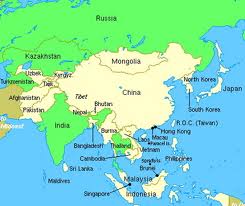
I am about to embark on an adventure.  Thanks to thoughtful planning and uncommon generosity on the part of my youngest child, I will soon fly to Thailand by way of Tokyo and then home by way of Seoul three weeks later.  Each way I’ll be in transit for over 24 hours, and I will cover nearly 9,000 miles. I’ve never been to Asia before, but I have been on an air trip that took nearly that long, and I realized as I awoke this morning that I feel something like the same sense of awkward anticipation, nervous tension and absolute thrill of adventure I felt in that long-ago moment, as I was about to embark on that first trek.

It was 1957, and I was a miserable child, more than generous with my pain. My mother hoped that spending the summer away from home might make me lose some weight and gain an appreciation for my parents.  Since my half-sister, who lived in Los Alamos,  was expecting her fourth child — her oldest was just 4 — and since I was already a skilled mother’s helper, being the first of (so far) five, Mom decided that the perfect solution for everyone’s ills was for me to travel to New Mexico and spend the summer there.

You don’t think about it nowadays.  Flying cross-country is so matter-of-fact and takes so little time. But I am talking about an era when air travel was still a novelty, and my sister’s home seemed like a very long way away from mine.  We had driven there a few times in my life, and I remembered the long days in the car, the endless sky and cloud formations, the bottomless font of hymns my father could sing to keep us from going absolutely stir crazy.  It took five days to get there .  And now they were telling me I would reach my destination in only one!

My mother bought me a brand new, pink dress from JC Penney, a matching pink sweater, pink socks and white patent-leather shoes and for my flight.  I felt downright regal when I tried it all on, though my bright red glasses kept sliding down my nose.

We drove to my grandmother’s in Queens, an 8-hour journey that was rendered delicious by my father’s recent discovery that the best way to travel by car with children was to do so at night, so we dreamed soundly all the way in the moving vehicle and arrived in the morning, giving me plenty of time and vigor with which to engage with my cousins, who were veteran flyers, having been already to Europe.  They filled me with stories about the terrible things that could happen, and I felt a growing dread that only made my excitement more thrilling.

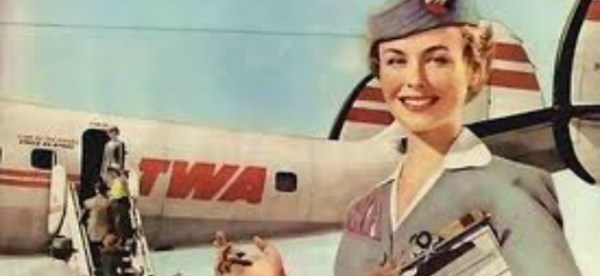
Since they lived in Bayside, LaGuardia was near by.  The airline of choice — we didn’t have a lot of them — was TWA, whose hub was there.  We parked right by the airfield and went into a small waiting room, which was on ground level and had a wall of window that looked out onto the landing field.   When the plane was ready to board, the stewardess — sorry, that’s what we called them then — came into the room and took me by the hand.  “Are you ready to fly with me?” She fairly sang, as I put my gloved hand into hers.

My mother took a photograph of me walking out to the airplane, and I remember seeing it years later, long after I’d made transatlantic flights and become something of a seasoned flyer.  The plane looked so small, so fragile, and I looked so relieved to be climbing aboard; I do remember feeling like I had to duck to avoid hitting my head on the wing as we approached.  I also remember my heart was thumping, and I was wondering what I would possibly do with myself for 21 hours while we flew.  I had two books to read and stationery on which to write my thoughts for reporting back to Mommy, but 21 hours just seemed such a long time to just sit.

I needn’t have worried.  The flight crew was aware of me, and they entertained me lavishly.  There was the obligatory visit to the cockpit, I got to “help” with the food and beverage, which meant that I served the boxed lunches to each passenger, and I visited the lav pretty frequently.  At one point, like a scene out of Volunteers, one of the Stewards pulled out a guitar and began to sing folk songs to the section of the aircraft where I was seated; in those days, passengers sat facing one another like they might on a train today.

Besides, the flying time was not all that protracted.  We stopped in Chicago, Kansas, St. Louis, Oklahoma City and Amarillo, sitting on the ground long enough to refuel, load in more box lunches and board new passengers, before we got to Albuquerque.

I was sleepy but unable to sleep, and when we reached Amarillo, I thought I heard the pilot tell us we were in Albuquerque, so I deplaned. For a terrible few minutes, I was horrified to see no familiar faces in the assembled greeters at the runway.  Expecting, at very least, the tall, looming presence of my sister’s husband, I was dissolved to tears when no one in sight looked remotely related. But before I could lose myself in despair, my guardian angel stewardess had grabbed my shoulders and was steering me back on board. We landed in Albuquerque a very short time later, and all the family members were there to meet me.

It was an elegant beginning to a glorious summer.  My sister, resplendent with the empathy of young motherhood and free of the burden of shaping my womanhood, encouraged me to play.  So I did, cavorting gleefully with my niece and nephews.  She sent me to a summer program where, as happens in a summer camp setting, I made brief but brilliant friendships.  I ate ice cream without remorse, and I did lose some weight.  I read, I wrote, I even watched some television.  And when I returned home, I was no longer miserable.  I felt soothed, renewed.

What a lovely memory to find as I prepare for my Journey to the East.  No misery to lose, no pounds to shed, I am ready, simply,  to be filled with the wonder of it all.
Daddy

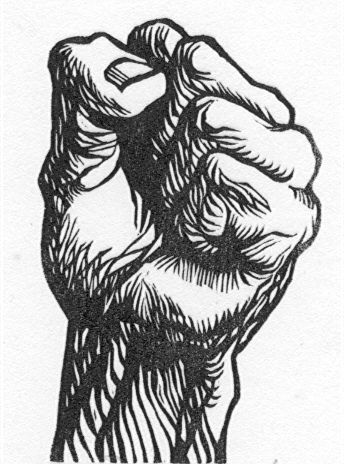
My most salient memory is of his knuckles.

Suspended above my head, poised to strike me, they belied the generations of Yankee prosperity, the privilege of his youth.  They were the joints of a laboring man, gnarled, swollen, yellowed with age, frostbite and continual paper cuts.  The hands were enormous, muscular, striated with bulging veins.  Ominous.

“Do you dare say that again?”  he thundered.

Knowing full well that my words were a declaration of war, I replied, “I am never going to church again.”

His hand did not change position.  It trembled, aching to complete its mission, but it remained in midair, creating a comical, cartoonish image of frustration.

I didn’t laugh.

“Daddy. . . ” My voice broke.  How could I make him understand? I hoped he’d drop his arm to embrace me, to encourage my preteen independence.  “I-I just don’t believe in it anymore.  It stopped making sense.”

He dropped his arm and clenched his fist, pushing the veins to greater prominence,  and bit down hard on his back jaw. His rain watery eyes clouded over.  The concept was beyond his ken.  Never in his fifty years, despite his self-imposed life of hardship, had he ever considered the absence of “sense” in his religion.  How could this child, this female child, question his truth?  He shook his head.  The light from the rising sun streaming in through the picture window caught his baldness and cast a halo over him.

I gasped.

“This is not an issue to be discussed,” he barked.  “You have no choice.  I say you will get dressed, and you will come with us to church as you always have.”

“Why?”

“Because I said so.  I tell you what to do, not vice-versa.”

“I should be allowed to choose.  You cannot legislate belief, Daddy.  I don’t believe.”

“Nonsense. Of course you believe.  What is not to believe? The Lord our God is omnipotent, and He is Everywhere.  He is love.  God is Love.  Someday you will see him, and all will be proven.  You believe because it is true.”

I knew argument was pointless.  Half a century before, his grandfather had whispered Dutch Reformed rhetoric into his ear at birth, and his infant brain had embraced the dogma.

God had presented Himself to my father first in his twelfth year, making His presence known by robbing him of his father.  Daddy knew he deserved this show of divine wrath because he had taken the Lord’s name in vain the day before.

Then again, at seventeen, when he had prayed that his eighteen-year-old wife be spared to care for the infant daughter he had bred out of wedlock, he had accepted unquestioningly God’s decision to take the young woman into Heaven along with the son she was attempting to bear him.  Not long after, as a medical student in New York, he again trusted God’s wisdom in punishing him for performing an abortion on his partner’s girlfriend; he was dismissed from Columbia without appeal. He had willingly attached himself to the wheel of retribution and had paid for his sins ever after by refusing to allow himself to experience any joy.

His arm, still fisted and poised to strike, must have tired because he stretched and reached over his head, resting the hand on the bony top of his head, forming, with his huge mitt, a skullcap of sorts.  So priestly did he look that I averted my eyes.  I knew I should feel shame, but I hated his joyless God, and I wanted to prove to him that his was not the only righteousness.

“Daddy, I don’t understand why you care.  Why does it matter to you if I go to church?”

“You will do as I say.”

“I will not.”  I said it quietly, hoping that the hush in my voice would still the turmoil in his soul.

“How dare you defy me?  Go get dressed.  We leave in twenty minutes.”

The veins in his hands pulsed in rhythm with the pounding of my heart.

“No.” I whispered.

“What?” he screamed.

“I won’t,” I answered.  I was calm now.  Nothing would move me.  I was not willing to carry his cross anymore, to seek the salvation he was so sure he had thrown away.

His whole body quaked now as he held himself back.  I think he wanted to kill me.  I was the incarnation of all his failures.  His failure to fulfill his father’s dream of a medical career, his failure to appease his mother’s disappointment at his wrong-side-of-the-tracks, shotgun teenage marriage, his failure to be a real father to my half-sister, his failure to impose his fundamentalism on my mother.  I saw my weapon then, and I grabbed for it.  At any moment he might lunge at me, attempt to crush me with his hands.  I had to defend myself.

“Daddy, you know Mommy doesn’t believe in it.  You can make her go to church, but you can’t make her believe what you believe.”

“Nonsense.  Your mother shares my beliefs.”

“She does not.”

“Charlotte!”  He screeched toward the kitchen where she was hiding behind breakfast preparation.  “How dare you confuse this child?”

“Leave her out of this, Daddy.  She didn’t do anything.”

“She is poisoning your mind with doubt.”

“No.  Mommy would never contradict you, she’d never admit you’re wrong in front of me.  These are my feelings, my thoughts, my doubts.”

His face was bluish as the veins in his temples struggled to carry the oxygen to his brain.  I feared — and hoped — he’d drop dead right there, right then, a victim of his apoplectic obsession with a God I detested.  He rubbed the back of his hand across his forehead, and the veins glistened with the moisture they collected.

“I just know my mother,” I continued.  “And she could not possibly embrace your idiocy. She is, always has been, always will be a Jew.”

There.  I had said it.  I waited for him to fall, to convulse with pain and then to disintegrate into a crumbled heap.  Surely this knowledge, my giving words to the unspeakable truth, should be as terrible and as swift as the sword of Christianity he held dangerously over my head.

We had never admitted to one another that our life in the church was a lie.  That those late Sunday arrivals, our oversized family marching in to fill a pew at the center of the nave, were mere display.  My mother, the beloved of his life these past sixteen years, the mother of his seven recent progeny, was a Jewess.  Marrying this man in 1945 must have been a comfortable safety from her nightmare-ridden childhood, from the terrifying memory of the friends and family would could not, as she had, escape the cry of Juden Heraus.  Her children were safe from the freight train, but she could not deny her self.  She would accompany him to his church, sing songs of praise to his Jesus and sacrifice her children to his fanaticism, but she would not convert.  No holy water would ever wash away the receded passion for her heritage.

I watched his hands as my words penetrated the wall of his illusions, and I was sure their invasive nature would strike him dead . . . or that his tense and throbbing hands would execute me.  Either way, I expected justice would be served.

Instead, a great calm descended on him.  The sun was higher now and bathed him in its full light.  He unclenched his fists and closed his eyes in a moment of silent prayer Then he opened them, smiled beatifically and said simply, “Breakfast is probably waiting.  You know how much your mother hates that.  We should go eat.”

Dog Days

A few years ago, my colleagues Daniel Fine, Dana Keeton, Ed Ludvigsen and I collaborated on a little film that poked fun at animal owners.  That was before Madhu entered my life.  Now I have a more  personally seasoned and emotionally tuned view of pet parenting, and I’d like to share both our silly little film and my story of Madhu.

Please note that the chihuahua in the video is NO RELATION to Madhu, who is pictured in the piece!

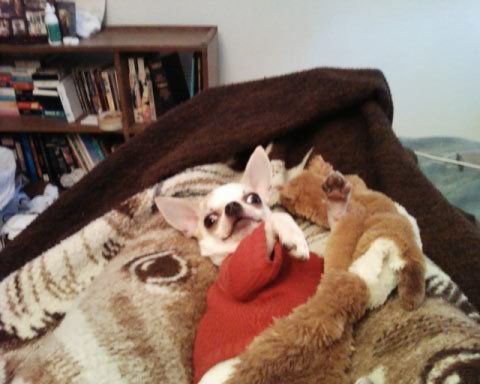
MADHU

Two years ago, my daughter, who was living in Taiwan at the time, asked if I would house her Chihuahua for a couple months.  She was about to do some traveling and did not want the little guy to undergo recurring bouts of quarantine; she sought to place him with someone she could trust would recognize that he was her baby.  Who better to ask than Grandma?  How could I not comply?

Mommy went to great expense and trouble to ensure the pup would fly safely.  She bought him an indestructible but well-breathing enclosure, chose calming toys into which she rubbed her scent; she equipped the crate with plenty of drinking water and trusted he’d be protected by the gentle handlers who accompanied him to the plane.   Then she held him close to her heart until the very last minute when he would have missed his flight had she not closed him inside and said a tearful goodbye.

As I drove to the airport to fetch my new charge on that crisp March morning, I got a text from my son: my daughter-in-law was in the hospital, and the birth of my first granddaughter was imminent.  There is something powerfully karmic about the fact that I became a grandmother twice that day.  Minutes after I brought my daughter’s bundle home, I was at the hospital holding my son’s miracle in my arms.

That was three years ago.  Mahdu — his name is Hindi for Sweet, Honey — never returned to Asia.  My daughter moved around, and she wound up in Thailand, where he would have had to be detained for weeks in quarantine should he join her there; she relinquished his company rather than put him through that pain, and he has turned out to be a kind of miracle in his own right.

Fetching him from animal control at JFK was not easy or uncomplicated.  It took an exceedingly long time, making me worry that this little dog — whose breed is not known for its patience or its calm — would be wound up and agitated by the time I reached him.  Luckily for me, and I suppose for him as well, he was nothing of the sort.  There he sat in his enclosure, his large, deeply brown eyes bulging out of his face, taking everything in, calmly accepting that he was where he should be until such time as he was released, and he was fine with that.  He was happy to see me, but he wasn’t hyper-active; he allowed himself to be picked up, stroked, reassured, and then he nestled his nose into my winter coat and drifted off to sleep.

I have another daughter, who has adopted Mahdu and with whom he has formed a new attachment, and Mahdu has been her salvation. There is something incredibly zen about this animal.  He never barks, he never cries, he simply trusts that all will be well.  He loves to cuddle, prefers to sleep buried in the warm curvature of flesh between his human’s face and clavicle, and he greets strangers with joy and exuberance that encourages even the brawniest of men to crave his merest affection.

Last summer my Asian-dwelling daughter was here for a visit.  Mahdu became transfixed the moment he beheld her, burrowed into the space between her arm and her chest and refused to move until he needed to emerge to lick her face again and again.  He didn’t cry when she left him to visit others, and he didn’t flag in his affection for his surrogate mother. But it was clear that he had missed her, would miss her again, that his love for her is boundless.

A person could do worse than have a Taiwanese Chihuahua for a grandson.