
Back to the Future with Jenna Rose

Back to the Future with Jenna Rose

American adolescence is hard. At times brutal.  Especially for girls. So many lessons need to be learned.  So many Rubicons need crossing.  It’s something most not-yet-women suffer through universally.  Adolescence is at the root of Joni Iraci’s swiftly-moving novel Reinventing Jenna Rose.

Iraci’s novel drew me in and sucked me back to my own youth.

I was 18 when I became a self-sustaining New Yorker.  I suppose I should have been frightened, but I had a grandmother who gave me a place to live, who trusted me to be on my own.  I had all the freedom I could handle to seek myself out.  That was a long time ago, and today, in the world of over-protected teens, it is hard to imagine a 15-year-old whose parents have left her to her own devices.  Which is the case with Jenna Rose, the intrepid heroine of the circuitous story  Iraci weaves.

At open, Jenna Rose’s Dad has disappeared, and Mom, self-consumed and bitter, is AWOL.  Jenna Rose has been ordered to stay where she is, alone in her California house, with all the trappings of wealth but no comfort.  She is the victim of benign neglect, a prisoner of meaningless abundance.  Worst of all, the girl has no idea who she is or what her roots might possibly be. She desperately needs to throw caution to the wind, to take off, to liberate herself and find a life.

Enter a long-lost grandmother in New York City, the ghosted mother of Jenna Rose’s mom.  Jenna Rose decides that the only way to liberate herself, to reconcile the many questions that muddy her past, to forge any kind of a future, she must find the old woman.  Which is how she lands in New York, fabled source of self-identification, in the early days of the 21st Century.   

The vagaries of adolescence are universally resonant, and Reinventing Jenna Rose reverberates with the elements that make Catcher in the Rye, The Goldfinch, and others timeless.  Jenna Rose faces obstacles no less haunting than Holden Caulfield’s and no less daunting than Theo Decker’s.  Yet her journey is entirely her own, unique picaresque adventure. 

The presence of Jenna Rose’s grandmother and a quirkily empathetic neighbor her own age plus a devoted white German Shepherd bolster Jenna Rose’s quest for Self-Actualization.  With some help from a friendly therapist and reinforcement from her new-found community, she faces and resolves long-buried personal trauma, travels to obscured corners of her own and her family’s pasts, plumbs the depths of her pain, and eventually emerges as a truly three-dimensional woman.

Groping through the multiple shadows cast in Reinventing Jenna Rose, I found myself once again grateful for my grandmother’s indulgences.  Like Jenna Rose’s grandmother, mine never told me what to do or think or feel. She shared wisdom, and I was astute enough to take it.  Most of it. 

The grandmother’s wisdom gives the book another dimension. This is not just another young adult novel. This is a book is that that can be appreciated by people of all ages.  Now that I am older than my grandmother was when I moved to New York, I see myself in the old woman, and I hope that some day my granddaughters will likewise avail themselves of my love and experience.  I want them to appreciate the rich layers of pain, sorrow, joy and peace that make a well-crafted life, a life that might fit into a well-crafted novel like Reinventing Jenna Rose.
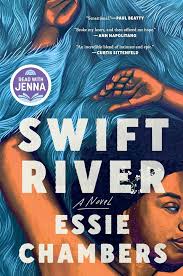

Swift River . . . Paddling the Rapids of Raging Adolescence

Essie Thomas' new novel is a perfect summer read

From the moment I dived into Swift River, I was swimming through memory, in sync with Essie Thomas’s captivating heroine Diamond Newberry.  Like Diamond, my 17-year-old self suffered from a sense of dislocation, and I recognized in her a familiar longing to know an origin story. Like me way back then, she found her hope in stories her family members, the ones willing to talk candidly about the past, could share with her.  Like Diamond, I ate my troubles away, wallowed in tuna casseroles and wingdings, but being white,        From the moment I dived into Swift River, I was swimming through memory, in sync with Essie Chambers’s captivating heroine Diamond Newberry.  Like Diamond, my 17-year-old self suffered from a sense of dislocation, and I recognized in her a familiar longing to know an origin story. Like me way back then, she found her hope in stories her family members, the ones willing to talk candidly about the past, could share with her.  Like Diamond, I ate my troubles away, wallowed in tuna casseroles and wingdings, but being white, what young me did not have in common with Diamond was color. 

My confusion and disassociation were just as real, but they were invisible, and I therefore did not suffer the same slings and arrows of outrageous racism that Diamond endures. Yet I easily relate to what she feels, and how she responds because as unique as Diamond is, she is a character who represents the distinctly American experience of growing up in an unkind, duplicitous society whose respect for diversity is superficial at best. 

Diamond is caught in a perfect family-and-society-fueled storm. Her father has disappeared, is perhaps dead, and her mother has become recklessly unbalanced.  Her marriage to Diamond’s father was disastrous, but she does not know how to live without him.  So she drinks.  She makes Diamond responsible for her but is, at the same time, immobilized by the way her community – the town that has been her family home for generations – treats her daughter.  She knew that nothing about their life together would be easy, but she never embraced his brittle fragility.

Already restless and morbidly obese, Diamond finds herself entirely untethered by her fatherlessness.  She wants to stop her mother’s hurt, but she is aware that her mother’s love is genuine but also neurotic and toxic. She longs for her father’s return, as he seems to be the only one who might have the knowledge to explain why the town’s Black population inexplicably left town in the dead of night some years before and what their exodus has to do with her.  He alone might justify his bitterness and the self-destructive recklessness that causes him to act out his angry bouts of frustration.  Diamond has no place to turn for answers until she receives a letter from her father’s cousin-sister, who lives in the Newberry family home in Georgia. 

Letters pass between the girl and her unseen auntie, and Diamond begins to assert her true self.  She secretly signs up for driving lessons and forges a friendship with a girl from her class, who is equally void of ballast, a girl who has learned to sublimate her pain in promiscuity.  Over the course of an illuminating summer, Diamond learns to drive, loses her virginity, and finds her roots.

At the heart of Swift River is the reminder that no matter what ethnicity, what race a teenager is blessed or cursed with, the compulsion to know who we are and where we come from is universal.  Diamond’s plight is overwhelming, but she finds a way to cope just as teenagers have always forced themselves to cope with circumstances they would never choose as the basis of their lives.

Like all the great coming-of-age stories, this one is written by an adult with a mature outlook, told through the eyes of a precocious seventeen-year-old who clearly has the benefit of Chambers’s wisdom.  For that reason, Swift River is a great read for teens and adults.  It is an illuminating journey over the racing rapids of adolescence, a passage that none of us avoids.       

Diamond is caught in a perfect family-and-society-fueled storm. Her father has disappeared, is perhaps dead, and her mother has become recklessly unbalanced.  Her marriage to Diamond’s father was disastrous, but she does not know how to live without him.  So she drinks.  She makes Diamond responsible for her but is, at the same time, immobilized by the way her community – the town that has been her family home for generations – treats her daughter.  She knew that nothing about their life together would be easy, but she never embraced his brittle fragility

Already restless and morbidly obese, Diamond finds herself entirely untethered by her fatherlessness.  She wants to stop her mother’s hurt, but she is aware that her mother’s love is genuine but also neurotic and toxic. She longs for her father’s return, as he seems to be only one who might have the knowledge to explain why the town’s Black population inexplicably left town in the dead of night some years before and what their exodus has to do with her.  He alone might justify his bitterness and the self-destructive recklessness that causes him to act out his angry bouts of frustration.  Diamond has no place to turn for answers until she receives a letter from her father’s cousin-sister, who lives in the Newberry family home in Georgia. 

Letters pass between the girl and her unseen auntie, and Diamond begins to assert her true self.  She secretly signs up for driving lessons and forges a friendship with a girl from her class, who is equally void of ballast, a girl who has learned to sublimate her pain in promiscuity.  Over the course of an illuminating summer, Diamond learns to drive, loses her virginity, and finds her roots.

At the heart of Swift River is the reminder that no matter what ethnicity, what race a teenager is blessed or cursed with, the compulsion to know who we are and where we come from is universal.  Diamond’s plight is overwhelming, but she finds a way to cope just as teenagers have always forced themselves to cope with circumstances they would never choose as the basis of their lives.

Like all the great coming-of-age stories, this one is written by an adult with a mature outlook, told through the eyes of a precocious seventeen-year-old who clearly has the benefit of Essie Chambers’s wisdom.  For that reason, Swift River offers an astute journey through the fraught passage from childhood to adulthood that none of us avoids.                                        


A Clockwork Orange . . . Live!

Screen Shot 2017-11-23 at 11.01.56 AM

My first thought when the gaggle of middle school-aged boys boarded my crosstown bus was how lucky that I’d be disembarking soon. They were without adult companions, clearly coming from an after-school activity, exuding the day’s pent-up exuberance. The two years I spent as an 8th-grade classroom teacher and my years in youth drama taught me well to expect noise and boisterous behavior. Nothing prepared me for what they actually brought onto that bus.

Nothing except perhaps Anthony Burgess’s Clockwork Orange dystopia.

There were ten of them. The oldest looked to be a few months shy of his fifteenth birthday. Small, smooth-faced, and wiggly, they seemed adorable – all cherubic faces and cuddly little bodies. Giddy, silly boys volleying jocular epithets in half-changed voices that vacillated from soprano to crackling baritone.

“You call that a jump shot? Dude. He was just standing on tippytoes like he was spitting at the hoop.”

“Truth, man? I don’t give a &*&* about no jump shot. I’m down with the cheerleaders.”

“No shit! I’d be down with them. Literally. Like down in all that . . . .”

I could not believe what I was hearing. Suddenly, without warning, the banter turned brutish.

“You see Lilly this mornin’?”

“She looked hot.”

“Right? That’s some rack she’s carryin’ – and that booty. I just wanna. . . . ”

“I got plans for that one. Oh yeah. You c’n help. One of these days after school, we could drag her into the girls’ room. We cover her mouth so she can’t scream, and we . . . . “

The child went on to describe his plan for the girl in question, a plan that turned darker as his giggles grew more mirthful. In lurid detail, he shared the stages of a rape he had in mind. He and his friends bounced up and down like toddlers on a trampoline. Raucous laughter crescendoed to cheering as his words slithered toward the narrative’s climax. Shrill expletives pierced the bus walls with vile, violent language.

My fellow passengers and I sat stock still, afraid to look at the boys, afraid to change expressions. No one moved, no one spoke. Our heads down, we all struggled to conceal our collective grimace.

I escaped at the fifth stop. And as I caught my breath, my guilt set in.

I should have spoken up. I teach older students, and I have never been afraid of confrontation. Why was it that I was so intimidated, that we all were so intimidated by this group of changelings?

For one thing, the boys’ behavior was all too familiar. We see it on Youtube, on Facebook, in the news, in our midsts. Youthful aggressors testing their limits by whatever displays of disrespect they can muster. They carry amplifying devices in the streets and on public transportation, blasting their angry music in all directions. They push old people out of their way to take seats when the vehicles are crowded, and they lash out at anyone who gets to a seat ahead of them. A very fat girl pushed me aside so she could occupy three spaces on a crowded D-train one day, and when I scowled, she stomped on my foot to make sure I knew my place. We are unprepared for this madness, and so we are silent. These kids are empowered by forces we strain to understand.

In NY, quality of life laws have been thrown to the wayside, and the police are powerless to silence the noise or search for guns. It’s clear to those of us who live among the toughest ones that they are packing. We can see the firearms that are only perfunctorily concealed beneath hoodies and oversized sweatpants. But we can do nothing.

Who in their right mind would speak up? There are myriad stories circulating about the danger of dissent. So little as a disapproving face can incite an assault.

The country is led by a moronic bully, whose mentality is exactly like these boys’. He brags about his exploits, disrespects just about everybody, throws his considerable weight around without concern for anyone but himself, and he publicly uses language that makes him sound tough to adolescents. Our so-called president is an overgrown middle-schooler with no self-constraint, and he licenses our children to feel impervious. We can’t touch them. They are in control.

images-1

From a parody by Hugh Atkins

These kids are even less sophisticated than Burgess’ droogs.* They navigate a real-life Orwellian Airstrip, speak mindless newspeak, and eschew reason. To them war is peace, hate is love, and respect is folly. They need fear no one. There is no consequence anyone dares dole that impresses them.

And therein lies my great despair. And guilt. How do we stand up to it all? To the evil empire that has the country in its grip? To the oppressiveness of racism and classism that holds us all down? To the bonds of overzealous liberalism that makes it impossible to protect a city from itself? To the mob mentality that has put us where we are and to the other one that holds us prisoners to political correctness?

There must be a way to drive America sane.

I just wish I knew what that way is.

images


*members of street gangs