Gender Confusion

Ever wonder why Baby Boomer women are not all hip to gender dysphoria and its complex new requirements? Most of us have had our own bouts of confusion. Being female had so many pitfalls. What Freud called Penis Envy came from varied experiences, most of which proved that we would never be equal to the men who orchestrated our worlds. . . .

There we were, stuffed into Mark’s MGB – Mark in the driver’s seat, Michael in the passenger’s, and I curled onto the shelf in front of the back windshield – headed east across Route 40.

Somewhere between Albuquerque, New Mexico, and Iowa City, Iowa, I got my period. . . . and my first glimpse of what might have been a moment of mild gender dysphoria.

It was April 1966; I was nearly 18.  My boyfriend Mark and I were on our way to celebrate in NYC.  Our plan was to drive to the city, spend a day, and drive back to Albuquerque in time for the last months of our second semester at the University of New Mexico. 

In many ways, the trip was more like an acid trip than real life.

It came about late one Friday night. We were at Mark’s with another friend, a guy named Michael, who had a mad crush on Mark.  I was just beginning to catch onto the vibe that Mark was actually more interested in Michael than in me, but I was still a virgin in every possible sense of the word, and while the information processing through me induced anxiety, I didn’t acknowledge its significance.

Mark and Michael were probably stoned, definitely mellow, They had either eaten small portions of shrooms or drunk large draughts of Romilar CF.  As one who hated feeling high, I was the designated straight man, so to speak, listening to a staticky jazz station on a transistor radio.  A woman’s voice covering Sinatra’s New York anthem caught my ear, and I dissolved into homesickness tears.

Mark and Michael stopped ogling each other to ask why I was crying, and the next thing I knew, we were stuffed into Mark’s MGB – Mark in the driver’s seat, Michael in the passenger’s, and I curled onto the shelf in front of the back windshield – headed east across Route 40.

“ First stop: Iowa City,” Mark announced. “Robin’ll be happy to see us.”

Robin, my counterpart in Iowa City,  had been Mark’s girlfriend when he was a freshman at the University of Iowa before his mother tugged him back to UNM, where, thanks to his Zuni ancestry, tuition was free.

A small fact that Mark failed to disclose was that his little car wasn’t actually his.  It was registered in both his and his twin brother Kent’s names.  He hadn’t told Kent what we were planning, so technically we were committing Grand Theft Auto. But had that occurred to any of us that night, we would not have cared.  We were on our way to New York City.

I desperately needed to get away. Spring Break gave me extreme agita, too much time to think. I didn’t know what to do with my growing awareness that Mark was not just a polite young man who respected me too much to ask for you know what.  I had no idea what my feelings were and no clue what I should do if I figured them out.  

If only, I thought, I were a boy.  Or better yet, a man.

I had often felt that I’d have been better off as a guy. I was a big girl – 5’7  “, 185 pounds. When I did dress up, my friends called me a beautiful drag queen, and I took that as a compliment, but I usually dressed as androgynously as my size and shape would allow. For this trip, I had brought my manliest outfits – baggy khakis, oversized sweatshirts, a huge trench coat borrowed from a friend.  I could have been my own brother, a linebacker or a shot putter out of uniform.

So there I was in Kansas – or some proximity thereto – without anything feminine.  I had entered a time in my life when denial was the only state I could bear to be in, so I was able to disavow any connection to womanhood.  How I could have ignored the fact that I’d eventually need feminine napkins and tampons eludes me now, but I was shocked when we made a pit stop, and the mess in my drawers reminded me I actually had an assigned gender. 

“I need to get to a drug store.  Pronto,” I told the boys as I climbed back onto my perch. 

Mark winced.  He was inordinately close to his mom and recognized the urgency in my tone. 

“Fuck,” he whined.  “We’ll. Have to detour off the highway.”

I felt the same rush of humiliation I’d been feeling since my cycles began when I was 9.  I muttered an apology before I closed my eyes and wished fervently for a Deus ex machina to swoop in and free me from the bonds of female fecundity.  Being a woman was embarrassing.  Nothing but trouble.  Worst of all, already undesirable to the boy I loved, I had become downright repugnant.

Had I ever liked being a girl?  Probably not.  My parents punished me for everything my brother got away with. I hated dolls and wanted to be a race car driver.  All the male cousins in our family made my mother and her sisters smile; when the boys were around, the tone in my grandmother’s voice turned dulcet.  When they left, she reverted to her shrewish self.  I was not pretty or delicate, and I could not relate to flirting.  No. I hated being a girl.

We stopped at the drugstore in some small hamlet near the highway. 

“Get me a pack of smokes while you’re in there,” Mark ordered.  “Montclairs.”

“Yeah,” barked Mike.  “And a Snickers bar for me.”

I roamed the store for a few minutes before I found what I needed.  Then, at the checkout, I pointed to the cigarettes, grabbed the chocolate bar. 

“Anything else?” the clerk asked me.

I shook my head.

“That’ll be $5 even.”

I put the money on the counter and, as I turned to leave, I heard him say without any irony in his voice, “Thank you, sir.  Come again.”

Every prickle in my uneasy personality stood up in my craw.  It startled me that I was angry.  How dare he?  Didn’t he get . . . .

I opened the door and turned around.

“Thanks, ma’am,” I said in my softest, most feminine purr.  “See ya.”

Sixteen hours after we left Albuquerque, we arrived at sweet Robin’s, where she gave us blankets and pillows so we could sack out on the floor of her living room.  In the morning, she let Mark use the phone to call his mom long distance. 

“Make it short though,” she pleaded.  “My parents’ll have a cow if the bill’s too big.”

Mark went into her bedroom to use the baby blue princess phone on the floor next to her mattress.  He closed the door behind him, hoping for some privacy.

A female voice shrieking epithets crossed all state lines and burst through the phone into the living room.  Then we heard Mark sobbing.

“He is such a little girl,” Michael sneered.  “He should ’a’ let you make that call.”

When Mark joined us, he said, “She told me if I’m not back by day after tomorrow, she’ll put out an APB.  She already told the tribal cops. She’s not kidding.  We gotta go back.”

Michael snorted.  “You are such a little girl.  What could the cops do anyhow?”

“Arrest us.  For stealing the car.  You know.  Kent can file a complaint. It’s as much his as it is mine.”

“Screw it then,” I said.  “Let’s go back.”

We folded ourselves back into the little toy vehicle and buzzed on over to Route I-80. 

“No stops except for gas, water, pee,” Mark proclaimed. Everything else would have to wait till we got to Albuquerque. 

Only we never did.

Michael was driving.  It was well past midnight, and we were a few miles out of Fort Morgan, Colorado on a deserted stretch of highway.  It was Mark’s turn to sleep on the ledge, and I was soundly snoring in the passenger seat when a deafening clunk, followed by a throbbing grind woke us up.  The car shimmied, then convulsed.  Michael pulled over as smoke began to pour out of the engine. 

“We gotta get outta this thing,” Mchael screamed, and we all jumped out and pulled as far away from the snorting machine as we could. 

“Shit,” Mark said, laying his head on my shoulder. “My mother’s gonna kill me.  And she’ll blame you.”

“Me? Why me?”

“You’re a girl.”

He was right.  Our escapade ended that night.  Mark called his brother.

“You asshole,” Kent said. “Just leave the car where it is. Greg ‘n’ I’ll drive over ‘n’ get it.”

Kent was a certified mechanic.  He’d know what to do with it.

Mark, Michael and I hitched a ride into town and found a room that Mark’s mother paid for, and we slept till it was time to catch the morning’s first Trailways back to Albuquerque. 

Mark’s mother never invited me back to their ranch.  She never spoke to me again.

“That’s what you get,” she told Mark, “for loving a girl.”
I See Old People!

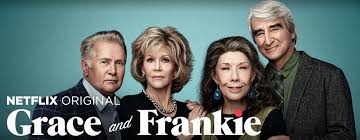
Grace and Frankie, a Netflix Original Series, Starring Martin Sheen, Jane Fonda, Lily Tomlin and Sam Waterston.

Grace and Frankie, a Netflix Original Series, Starring Martin Sheen, Jane Fonda, Lily Tomlin and Sam Waterston. (Netflix photo)

Sometimes the things that frighten us most when we are young turn out to be the very things that save us when we are old.

I know this because when I was newly married, I was terrified that I would wake up one morning and realize that oh shit my husband didn’t really love me. I used to have nightmares where he would come to where I was eating a salad or shaving my legs, and he would say, “You know I don’t love you. I never did.” And I would wake up screaming, “Please no. Don’t say that. Noooo.”

But by the time I had been married for twenty-five or so years, I began to see that I could do very well without him, that my fear had set me up to allow myself to be taken for granted, and worse, to be emotionally and verbally abused.

In the end, I was the one who left.

Looking back, realizing that my fears were, in fact, grounded, that we really didn’t love each other enough, that he failed to love me in the way I deserved to be loved, fueled my decision to move out. Ten years later, I have to say, I want to call him up and thank him for all the times he called me names or refused to buy something I needed or threw something at me in a rage. If he had been more loving, I might still be with him, and all my energy would be suffocated out of me instead of channeled into rebuilding my Self. I’m better off.

My experience was not unique. Many women, especially in our blooming boomer days, when being married, being loved were a woman’s salvation, when her route to a credit card or even a bank account was closed off unless she had a man or was fabulously well off, accepted – settled for – less than we actually wanted because we believed we had no choice. Most of us stayed put, and many of those who left were pushed out by that long-feared, oft-dreaded blow. “I just don’t love you anymore.”

Which is the premise on which Grace and Frankie, the Netflix original series, starring Jane Fonda as Grace and Lily Tomlin as Frankie, is based. They are jilted wives set adrift by their husbands Robert (Martin Sheen) and Sol (Sam Waterston), only to discover that being discarded is the greatest gift either husband ever gave them.

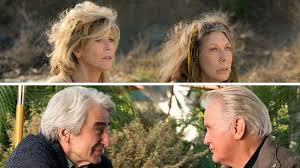
Grace and Frankie: the great divide. (photo from Netflix)

Grace and Frankie: the great divide. (Netflix photo)”The men are never demonized, are heroic in their way.”

At the beginning of Season One, Robert and Sol disclose to Grace and Frankie, women who’ve entered their 70s believing they were in rock-solid marriages, that both marriages are over. For twenty of the forty years they have been together, both men, who shared a law practice and were apparently devoted to their wives and families, have been carrying on a secret love affair. It’s time, they tell the women, that they came out once and for all; they are getting married, and nothing the women can say or do will change their minds.

The women are devastated. How will they ever live without these men, who have been the center of their lives for most of their adulthood? Over the course of the initial thirteen episodes, however, they learn to adjust; in the end both realize from individual epiphanies that they were never fully themselves as married women, that each has compromised herself and has lost sight of who she was to begin with.

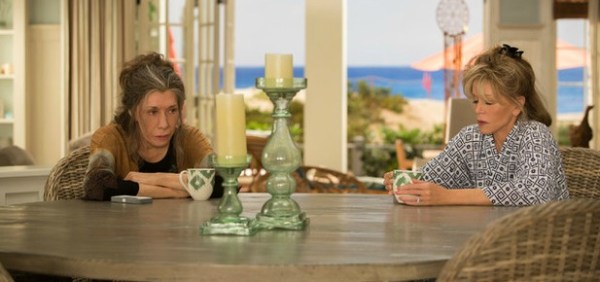
perfect and hippie

Too perfect, too hippiedippiedoo (Netflix)

In Season Two, Grace and Frankie have accepted the rearrangement of their lives. They have learned to like each other enough to actually enjoy sharing the beach house to which they have been summarily exiled by their ex-husbands; it is a house the men jointly bought for the two families, and in the past, the women had gone out of their way to avoid getting to know one another intimately. Grace is too body-obsessed, too protocol-conscious, too money-hungry for Frankie’s taste, and as far as Grace is concerned, Frankie is too weird, too hippiedippiedoo, too 60s-leaning addled.But lo and behold, they find that the women buried in the personae they’ve become have more in common than they ever imagined, and together they set about figuring out who they might be under the camouflage.

I do not mean to suggest that Grace and Frankie represent the majority of my sisters. Nor have I stopped believing in happy marriages; I know that those do exist, and Grace and Frankie are by no means the “normal,” which I believe there is such a thing. But I identify with them. They resonate for me in ways female characters of my own generation rarely do. They are fleshy women who transcend the caricatures of older women we are usually presented with: dotty bats or bitchy, lonely success icons. Except that they are too rich and live a life too rife with options, they are real. . . and flawed.

Grace and Frankie are damaged goods. Grace can’t get through a day without excessive amounts of alcohol, and she rarely eats, slavishly catering to her nearly anorexic body, protecting the copious dollars she has expended in preserving her looks. Frankie needs mind alteration and seeks it out in peyote, in ganja, in muscle relaxers; she calls herself an artist but has been unfaithful to her art and has hidden herself in new age homilies and soporifics. Each of them experiences a crisis that leads to a shared epiphany: Frankie’s religious beliefs and spirituality are tested by the dying wish of an old friend, and Grace’s are challenged by the booze and a near affair with an old, still-married flame (Sam Eliot).

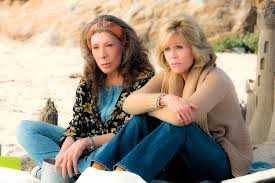
Grace and Frankie at the beach

Grace and Frankie at the beach (Netflix)

At the end of the second season, both women are forced to come to terms with the need to take hold of their lives, when Robert and Sol present yet another fâit-accomplit – they have put the house they have been living in on the market and are planning to move out. The house, which was where Robert and Grace raised their daughters, went to Robert in the divorce settlement, but the announcement that the men are divesting themselves of this vestige of their old lives sets off a firestorm of revelations.

Sol, seeking to clear his tortured conscience before he moves into the next phase of his new life, tells Frankie he fabricated a story of how, when they were very young, he had sold a piece of her art work off the wall of his law office to a famous client. The story has been Frankie’s life raft of self-confidence. She is devastated, protesting, “It’s the one thing that proved to me that I was really an artist!”

A few moments later, Robert gives Grace a carton filled with “thoughtfully” prepared gift boxes, each containing a pre-wrapped item of jewelry, pre-staged with an anticipatory card attached.

There’s a gold necklace: “Sorry you had a bad day.”

And a diamond bracelet: “To Grace. Thinking of you with love. Robert”

An emerald ring. “Happy anniversary to Grace from Robert with love.”

Another and another, each signed “Love, Robert.”

“Seriously?” Grace bellows. “They’re not personal. . . . It’s like a jar of treats for a dog. . . . . “ She stops, lost for words.

“I used to think,” she goes on, fighting the tears, “how nice! Robert went out and got me something because he knew I was sad. Or . . . Robert got me something special because he knew I was right, and he was wrong. But that wasn’t it at all. It wasn’t for me at all. It was for you, so you wouldn’t have to deal with me. So you didn’t even have to think about me. . . . We’d have a fight, and you’d give me a gift from your stash. I used to think you gave me gifts because, I don’t know, you weren’t a talker. But it was to keep me quiet, hunh? To manage me. To handle me. Never, not once was it because you loved me.

“I never understood our marriage until right now.”

All at once, with just the subtlest shift of her body and a gentle sigh, Grace is grateful that her marriage is over. To learn, a year after the divorce, that your husband never really loved you is the worst lie to own up to because it’s a lie you had to be telling yourself or it never would have flown.

Frankie, too, must come to terms with the great lie between her and Sol. She has built her trust on Sol, based on his assertion that he sold her painting so easily because he and the client were so impressed with the art. He thinks he did her a favor.

“I believed in you and wanted you to believe in you too,” he says. He’s sincere. Which makes it all the worse.

Because it is so entirely dismissive. He has robbed her of respect, has failed to trust that she could own her own need to develop her art; he perceived her to be such a child that he needed to candy coat a truth that might have engendered her professional growth.

Grace agrees and accuses Sol of belittling Frankie.

“I was not belittling her,” Sol declares. “I was not dismissing her. . . .”

“Oh really,” Frankie rejoins, “Because ‘her’ is still in the room, and it feels a little dismissive to ‘her’.”

Too pervasively, we women – especially women of the baby boom generation – are programmed to accept men’s condescension, to feel flattered when they humor us, when they patronize us, when they throw us bones. We all have learned to call ourselves happy when our men acquiesce to allowing us to live, even as we stifled our own breath.

Grace and Frankie cogently captures that dynamic, the underlying and agitating essence of what taints too many marriages. It makes the show a continual revelation, a source of satisfying binge watching for this older woman, who hardly expected to see herself represented on the small screen.

Grace and Frankie is not perfect. Although I’m grateful that the show doesn’t pander to the view of older women as finished products, I wish there were less emphasis on the women’s quest to find the right man. They are so much more complete when they don’t kowtow to the opposite sex. But the men they are interested in are far more interesting than the men who have thrown them to the curb, so there is a relief in that.

I also wish that the women’s substance abuse were a subject for more serious investigation. Perhaps it will be in Season 3, when they embark on their next adventure together. I don’t want to see them continue to get in their own way, to stifle their own ability to make themselves happy.

But it is refreshing that neither woman is willing to put up with the stream of put-downs we usually hear in sitcoms; nor is either reduced to silly one-liners that put their men in their places. This is no Everybody Loves Raymond battle of the sexes. It’s rich, convoluted, frustrating, confusing, terrifying, exhilarating real life.

And the men are never demonized. They are easily loveable, even heroic in their own way – after all they have come out to family, friends, colleagues, the world, and have married after 70. That’s courageous. Both former couples are fully fleshed characters, and the actors play them with remarkable aplomb. In a way, because they have clearly found a perfect niche, Sam Waterston steals the show from Sheen, as Jane Fonda does from Tomlin. Still, Tomlin and Sheen are wonderful; this is a full complement of entirely credible actors deftly playing deeply human roles.

I called this a sitcom. That’s not accurate. I guess one would call it a dramedy. I warn you, I cry at least twice in each episode. The stories cut close to the soul, and they can wring emotion I forgot I felt.

I do laugh. But mostly when it hurts.G & Frankie like each other