

“The way it actually was. The endless ocean. The infinite specks of coral we called islands. Coconut palms nodding gracefully toward the ocean. Reefs upon which waves broke into spray, and inner lagoons, lovely beyond description.”
Tales of the South Pacific, by James Michener
How can I possibly be in the South Pacific and not think of James Michener?
I first read his Tales as a freshman in high school, and when Hawaii came out that year, my mother was called into the principal’s office for allowing me to read such racy literature. Michener remains with me, especially when I travel (he’s written about so many of my favorite places), but here in Bali, an island that is still confused for the island paradise immortalized by Bloody Mary’s nearly eponymous song in the Rogers and Hammerstein adaptation of Michener’s work, he looms.
Obviously, my expectations were high as we flew from Don Muang Airport in Bangkok to Bali’s Ngurah Rai. Which is to say that there is no way I would not be disappointed.
Even the physical image of my imaginary Bali, reinforced by the film version of Eat, Pray, Love, which featured gentle marketplaces, smiling people with no desire to rush anyone and a pristine, sparsely populated seaside, was immediately tainted. There was, from day one, nothing Edenic about what I found there.
I won’t claim to be an expert on anything Balinese. I was there for five days, a prisoner of my own inadequacies. To begin with, I was impaired my choice of reading companionship.
 For some reason I am unable to decipher as yet, I chose, as my airplane entertainment, 1493, by Charles C. Mann. It’s a great book; don’t get me wrong. But it’s very affecting. As I deplaned at the Bali airport, I had only just read about the spread of Malaria, one of the many results of the Columbian Exchange.
Apparently, and this is a truly reduced explanation, because of the voyages of Cristobal Colon, which created a network of trade routes around the globe, all sorts of agriculture and its concomitant insects, germs and diseases, were able to migrate easily worldwide, and one of the most adaptable migrators is the mosquito with its uncanny ability to infuse malaria into the blood of its host.
Mann’s writing is most engaging, and his descriptions leave little to the imagination, including his descriptions of the way the disease infiltrates the body, what it does to the blood, how it spreads from one host to another and how it creates epidemics that make the flu pandemic of 1918 look downright contained.
So there I was, arriving in Bali, armed with just enough knowledge about malaria to know I didn’t want to get it and knowing that I had ignored CDC recommendations. Anti-malarial shots can be pretty invasive and destructive, so, since there has been no major outbreak in the Bali city areas, the CDC doctor in NY suggested I just plan to “Use Deet; sleep in Deet, cover yourself in Deet.” I figured that if it were that important, Deet would have to be readily available in Bali, and, not wanting to carry any more liquid than I had to, I planned to buy it there.
Well, I was wrong. No Deet presented itself in any form in any of the multi-varied stores we found once we got settled. But far more worrisome was that in the book, Mann had clearly said that malaria outbreaks are worst in areas such as rice paddies, which are notorious for their standing water, especially when the rice paddies are in areas of extreme moisture and even more so in areas where the rice paddies were not native but had been transported to that region in the Columbian Exchange.
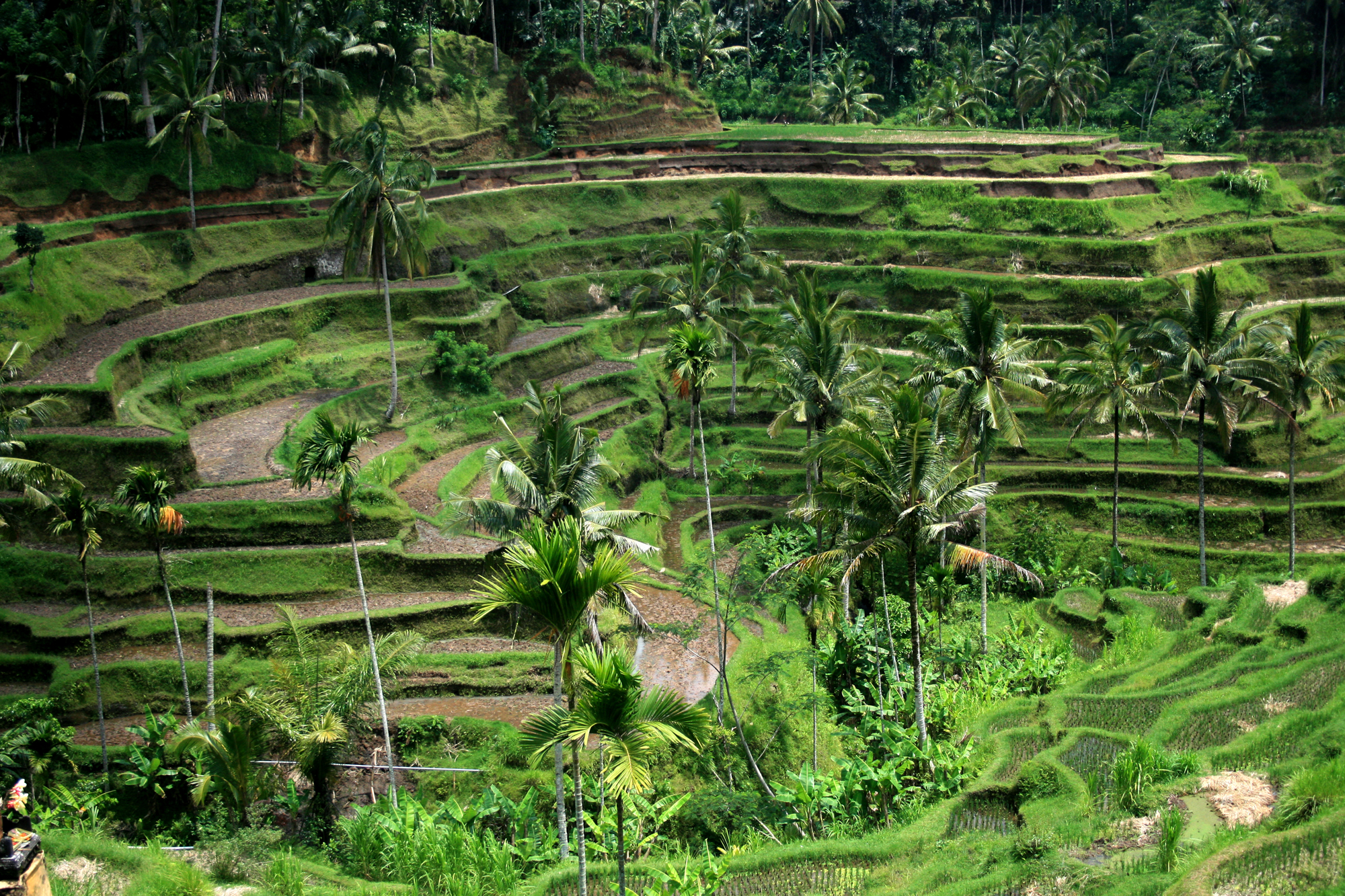
You guessed it. Bali’s rice was introduced by visitors — Bali is situated, after all, right along the main trade route, whose center was just up the ocean at Manila –after the 16th Century. And the rice paddies, built into the sides of the sloping jungle, are awash with tourist resorts for every breed of mosquito. When we’d found our way to our accommodations, I asked our host about malaria, and he said, “No worry. Only in rainy season.” When is rainy season, I wondered and looked it up: all year.
So I began with ill ease, and then communication difficulties intensified discomfiture.
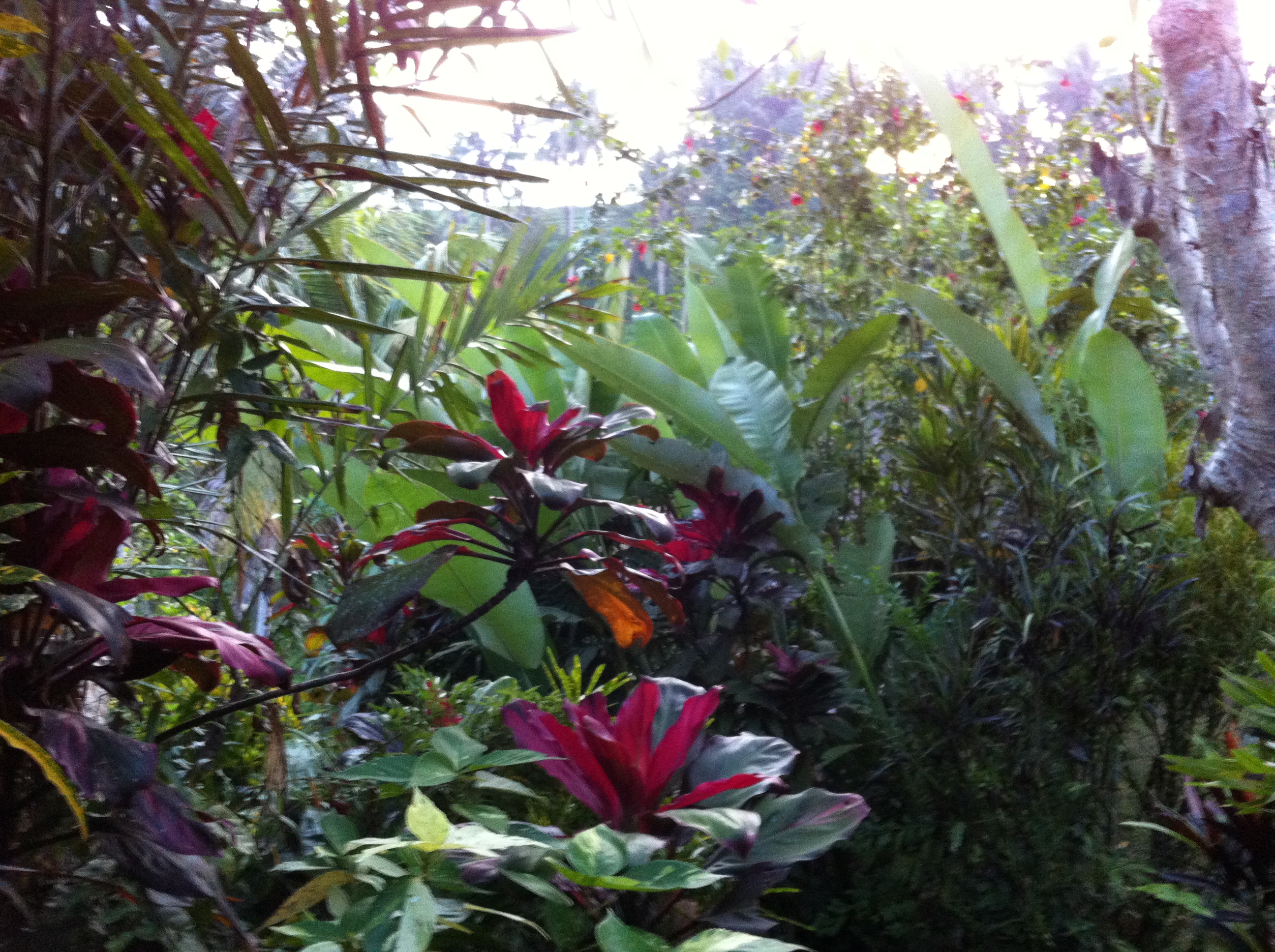
We had planned to stay for the entire five days of our visit in a house that, according to the pictures we had seen online, was a clean, quaint, lovely house, perfect for quiet meditation, in the area known as Ubud. We expected a few days of retreat, time to read and write and cogitate and perhaps explore the charmingly offbeat town and its environs. The owner of the house had honestly disclaimed, “If you are looking for five-star accommodations, this is not your place, but it is infinitely comfortable and immaculately clean.” An unfortunate miscommunication.
The house, first of all, is two hours from the airport. I knew I was in trouble about ten minutes into our trip out there, when I saw a billboard that said, “Visit Ubud. Enjoy the beauty of the rice paddies in the splendor of the jungle.”
That sign preceded two hours of standstill or crawling traffic. 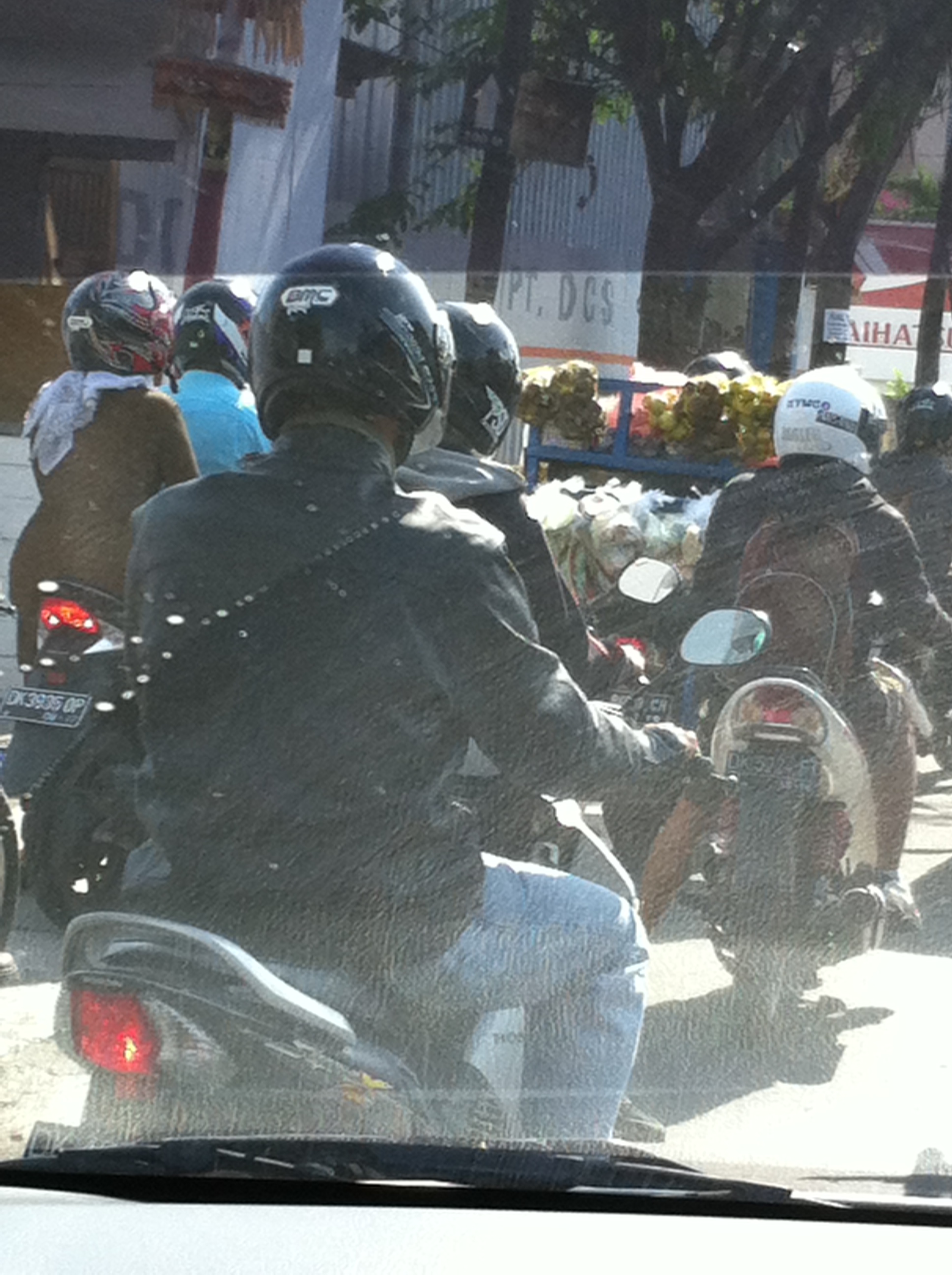 Nothing moves easily in the congestion of trucks and motorbikes, and we were later informed that this is a condition that is Bali-wide. Nothing controls the traffic here — like much of Asia, Bali lacks streetlights, street signs, traffic police, speed limits, pedestrian crossings, road regulation of any kind. When we arrived at our destination, the driver stopped at the top of a hill, and he indicated that we should walk down.
He took one of our bags, and we handled the rest, descending a very steep hill, on an alleyway sidewalk barely wide enough for one average-sized person. An overweight ten-year-old would be challenged trying to navigate the walkway. On our way down, we were surprised — more like mortified, shocked, amazed, terrified — by an oncoming motorbike. It sped up the hill, assuming we would find a way to stand aside, and as the menacing bug whizzed by, I felt his tire slide over my toe (luckily, this was before I became a converted flip-flops wearer, so I was still sporting my Nikes) and his handlebar graze my arm.
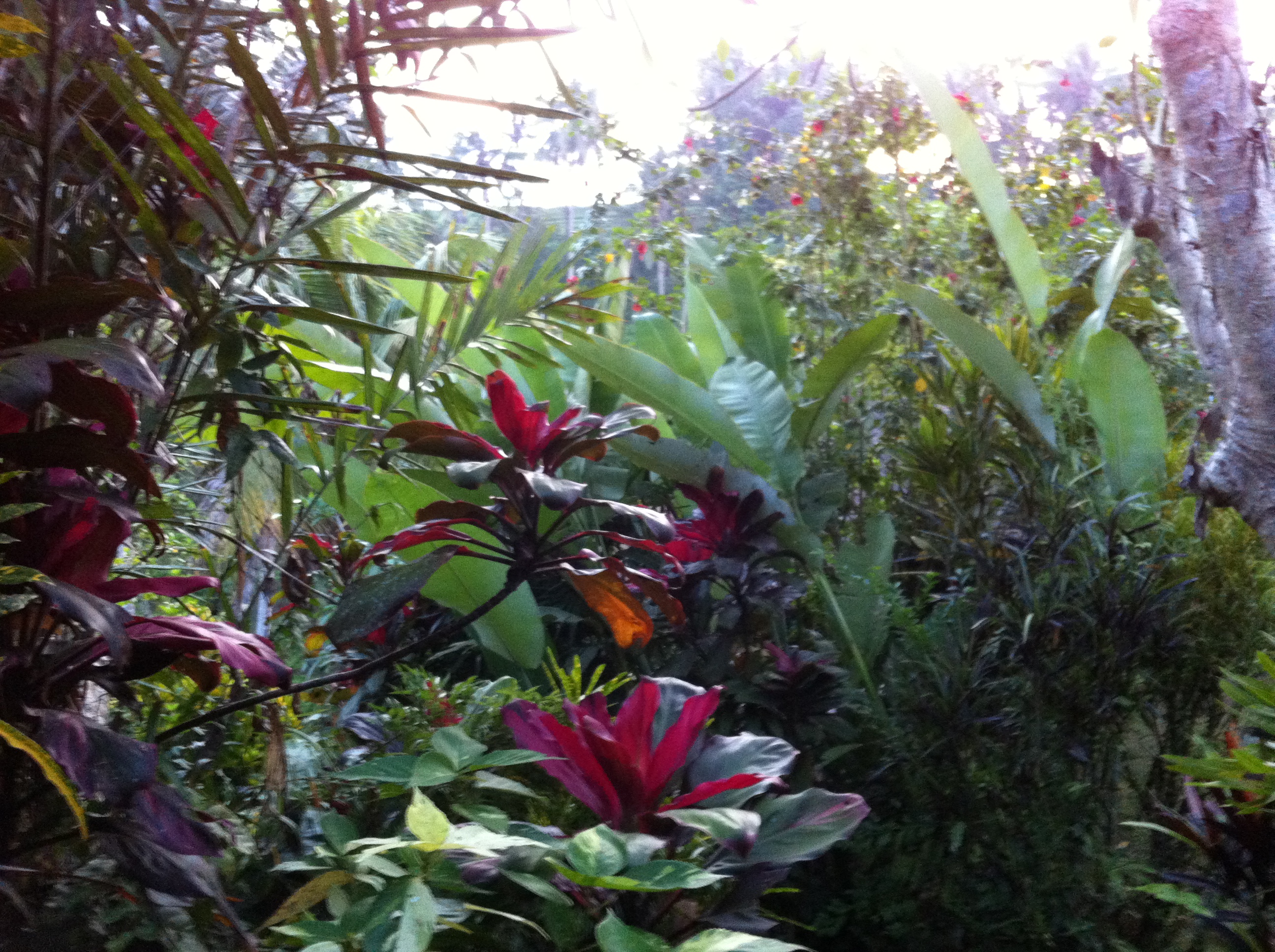 The house is cradled in the spectacle of a greenness I could never have imagined. Numerous waterfalls drop off the sides of the rice terraces, and the giant palms rustle gently, sparkling in the brilliant sunshine. A choir of floral hues echo from every bush, every clump of glass. Where the airport area had been unbearably hot, here on our mountain, it was considerably cooler, and, as the sun began to set it got downright comfortable. I even considered donning a sweater.
So much for the positives. The house was dirty. Not in a neglected or abused kind of way, but in a way that figures you won’t find sleeping on others’ sheets, using others’ towels, walking on wet floors objectionable. I might have found a way to deal with that, despite the high price (yes, the price per night was verging on 5 star cost) of the accommodation, but there were worse aspects.
For one thing, there was no mosquito netting. And the local store had no Deet. But worse than that, the bedrooms — more like monks’ cells, actually — were on opposite sides of the house, with no way to navigate one from another without walking thru the darkness of the jungle. Is my western-ness showing? I cannot deny it! In any case, these little rooms were in a state of perpetual air-conditioning, but they were not screened, so doors had to be firmly shut, yet the bathrooms, which are outside the bedrooms, accessed through unscreened doors, are the domain of marauding hordes of ants and spiders. Of course, the sound of mosquito song fills the air, even drowning out the shrill calls of the jungle nightlife. Going to the bathroom allows the little visitors in and invites them to hitch a ride atop one’s skin. We had no control of the a/c, and we had no blankets, which made for a cold night, but it didn’t deter our blood-sucking intruders from feasting on us.
While the open, airy kitchen area was esthetically pleasing by day, at night it became nightmarish. All kinds of creatures shared the space, including, of course, those mosquitos. There was a kind of sitting room on the second story, very quaint and something I’d probably love in an upstate NY summertime (after black fly season), but kind of formidable in its dirty unprotectedness.
The grounds were pristine, thanks to the next-door neighbor, who tended them. The pool, however, clearly presented him a challenge, and there were innumerable dead things both botanical and zoological floating in it. Not inviting.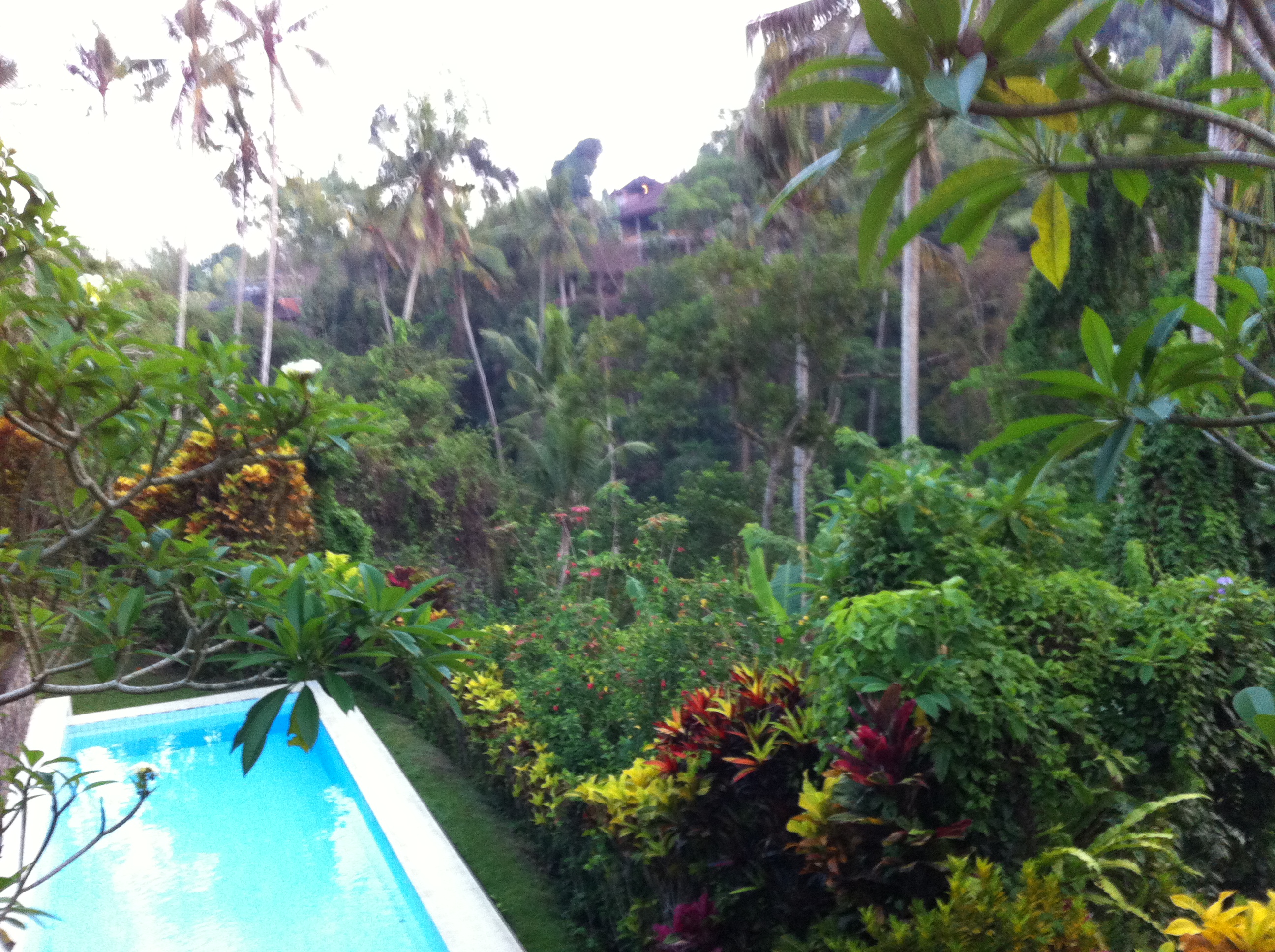
But the worst part about the house was something we came to realize is implicit in the Bali tourism trade: the ubiquitous, over-fussy, cloyingly attentive staff employed to meet our needs.
I feel terrible sharing this observation because, especially in the case of the team that cared for this house, the people can be really sweet and genuinely concerned. But you can’t sit without someone grabbing the chair. You can’t get yourself a glass of water or personally open a mangosteen; they will wrest whatever you are holding from your hand and do it for you, whether you like it or not. Our caretaker made himself responsible for everything from carrying our luggage to hiring a car (his relative) to trying to accompany us wherever we might want to go. And his wife did everything else. When I awoke at 5 a.m. and stumbled in the half-light to the kitchen, she was standing there, in the eerie jungle crepuscule, (I had to wonder how she knew I was up – she and her husband live next door, up a hill), armed and ready with her pancake makings, which I had to ask her — and this seemed to offend her — not to employ.
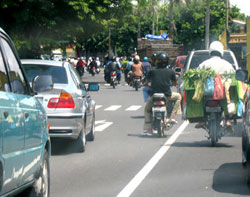 Ubud is congested. In the evening, dreading the presence of our serving staff, we emphatically declined the escort service and walked to the village. Well, walked is a misnomer. We crept along the sides of the road. There are no pedestrian spaces, so we basically stuck to the gullies, kind of clinging to the vegetation to keep from falling down. Nonetheless, we did manage to get a feel for the lay and texture of the town: very late ’60’s atmosphere, hippies in abundance from all over the world (those we talked to were mostly from Australia and Europe, but there were plenty of Americans around too) with backpacks and naked children and presumably nothing to do but hang out in the local vegetarian restaurants by day and then in the abundant bars by night. By the time we had spent one night in Ubud, we knew we HAD to leave. So we did.
But before we left, we were really interested in seeing the area; it had been raved about in every publication we had perused. So we asked our grounds man to engage his cousin-the-driver to take us on a tour and then to deliver us to another section of Bali, where we had booked a hotel room. Cousin brought the car around, and we were off.
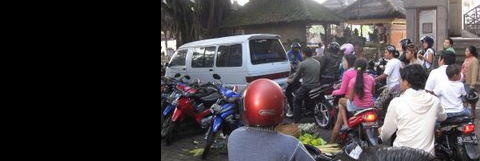 We stopped in Ubud for lunch in a hippie restaurant — I saw some people I know from New York, which didn’t wholly surprise me, as there are scores of what some might call “yoga tourists” milling about– and walked around the shops for an hour, and then the driver hunted us down to ask imploringly if we were ready to go to the hotel. He seemed anxious to get us there. “We asked for a day,” I said incredulously. He didn’t understand me and answered me something I couldn’t make out except that I got the word “far,” so I knew he was speaking a kind of pidgin. I asked him to show us what he loves in the area. He didn’t understand. He asked if we wanted to go to the Monkey preserve? No, thanks. The zoo? Absolutely not. Finally, he had a stroke of genius and wordlessly took us to a coffee plantation.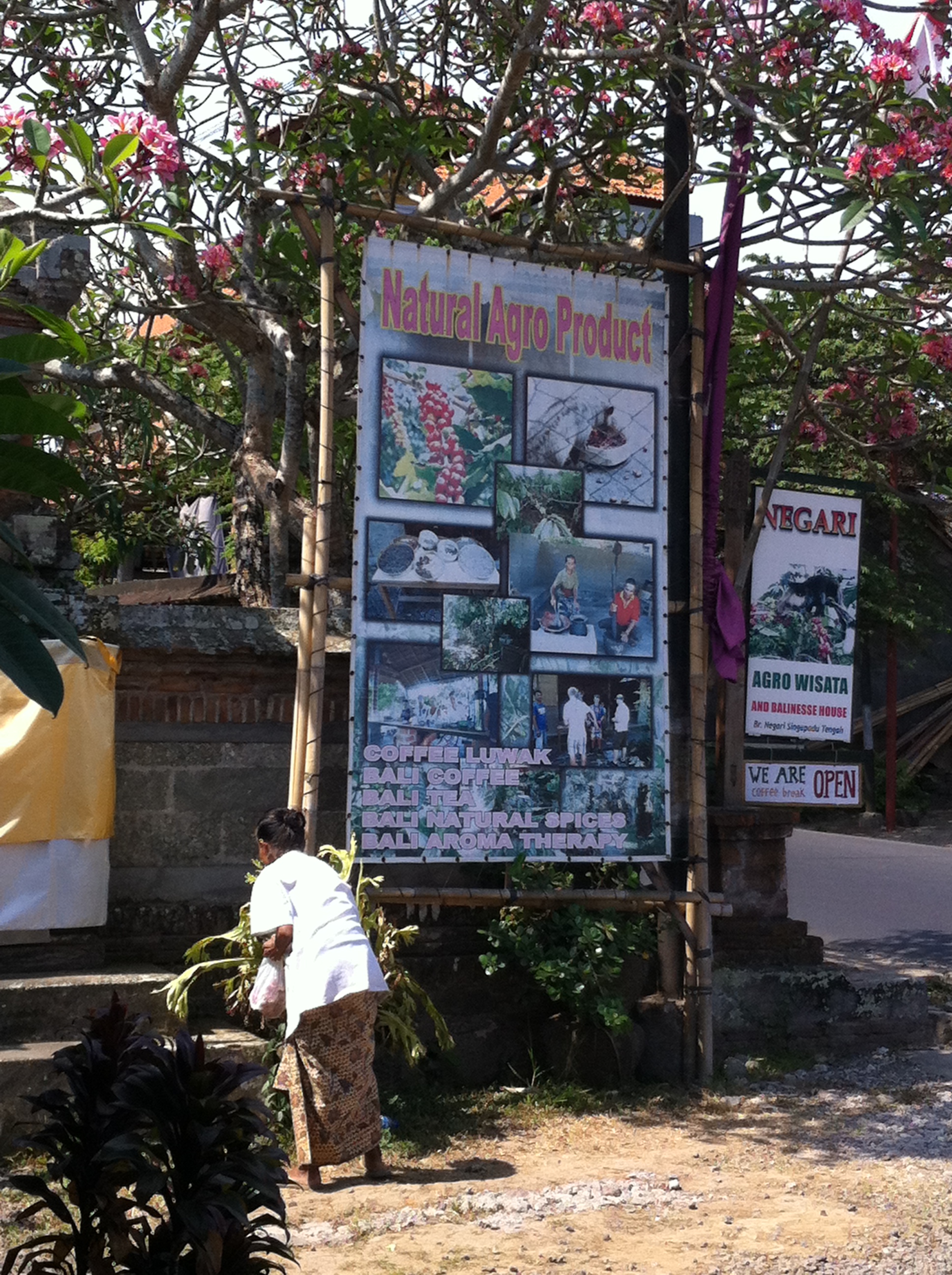
The coffee “plantation” was small, just a little farm, really, where the family raises luwaks (weasel-ish animals, civets — and the coffee raised with their assistance is called luwak coffee, or luwak kopi, every expensive) and monkeys and other animals with rich detritus.  They harvest their captives’ feces for fertilizer, and plant their coffee in its warmth. In the case of the luwaks, they feed the beans to the animals; it is defecated and harvested. Then members of the family process the locally refined strain of coffee.
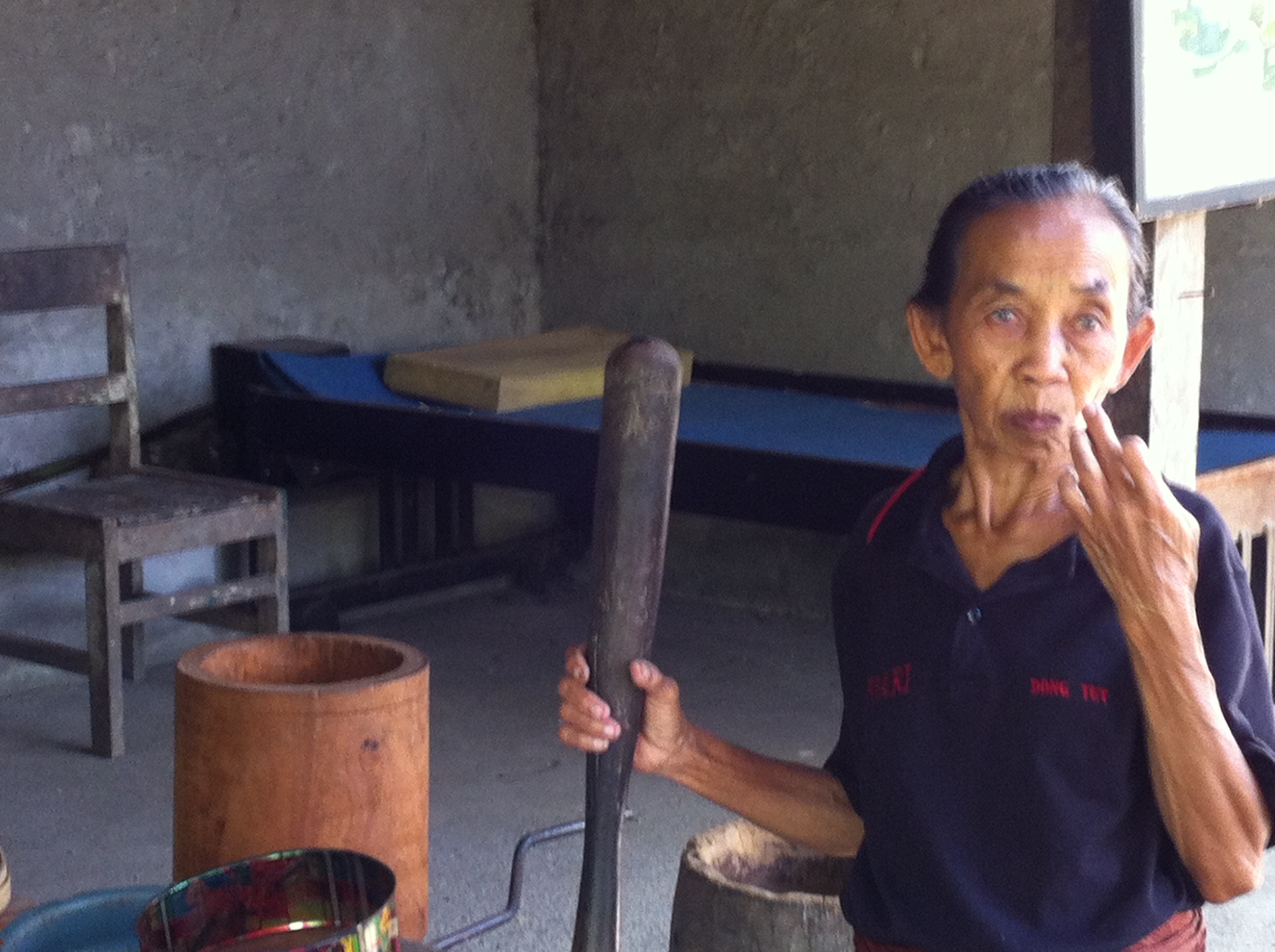 As we toured the farm, the owner/workers seemed to be on a break, congregating wherever we were, under no pressure to perform any pressing tasks. After they ascertained that we were English-speaking, they summoned a young woman, who later explained that she knows “some little” English because she is in her third year of a course to become an English instructor at the local university.
Her father — that’s who he appeared to be — had lived, he said, in Los Angeles; his English was much better. And when he joined us, we actually had a lively conversation and got the lowdown on how the beans are sterilized, roasted, peeled, prepared for consumption; and I was convinced to spend $30 on a very small bag of coffee, one of the some thirteen varieties we had been encouraged to sample, and which I found delicious.
There were a few men around, who seemed to be hired help. Absent any cognates, I could not identify any languages except that the one the father spoke was laced with Dutch sounding words. I did clearly observe that when he talked to these guys, who appeared to be locals, he had to repeat himself. Curious about this, I later looked up the language of Bali and learned that there are many.
Bali, it turns out, not unlike NY, was colonized by the Dutch, who encouraged immigration from all over. Indigenous people from nearby islands, as well as people from the Philippines, China and Malaya, moved in. There is no island that has a single language because even those people who are native to an island speak a variety of tribal tongues; there are actually 637 known languages spoken in Bali. Communication is difficult at best. Bahasa Indonesia, the official language of Indonesia, was chosen rather arbitrarily to represent all the people of Indonesia in the 1960’s, when the myriad islands of the area were incorporated to form the country. So the majority of Balinese learn one language at home and then have to learn another to communicate with compatriots and still another to navigate the tourism world that dominates their economics.
And to reconnect to James Michener, I also learned that Indonesia, Polynesia, Micronesia — the many little island nations created out of disparate tribal nations — are all related in that their people have been often irrationally nationalized and come from similarly diversified roots.
No wonder we were unable to have a fruitful conversation with anyone except Dad of the Coffee Farm.











 carlastockton.me