Thankful for Home. . . .

One of Mayor-elect Mamdani’s promises is that he will rout out the evil landlords from NYC, and that worries me.  By whose estimation are landlords deemed as such?  To what measure do we hold them?  And who decides which landlords deserve to be punished?

In my building in Harlem, for example, there is much discussion about how we are neglected. There have been some dire problems, and we are without a full-time superintendent, without a maintenance man, without real support.  As frustrating as that is for us tenants, it is too easy to blame the landlords, too facile to call them negligent.

Running a building is an expensive, difficult operation.  Especially in a building that tries to accommodate those of us who truly NEED to be paying rents that are realistically affordable. Affordability is a word that has no real meaning in most of the city these days — directly across the street from my building is one that the NYC lottery has offered as “affordable,” a word defined by starting prices of $4400/month for a studio apartment. For whom is such a sum affordable? Not for most of us in my building.

Ours is a rent-stabilized building that houses 130 units, some of whose tenants are living on Section-8 vouchers and some who are unable to meet their monthly obligations, for which the landlords are merciful.  We have had our share of sink and tub drainage problems, and it is absolutely clear that the plumbing and disposal systems, built in 1984, might need replacing; but, for the most part, even without the full-time help, things usually right themselves in due time.  People complain there is no heat, but the city regulates landlords, and while I would prefer there were NO HEAT at night and a little more heat by day, I am sure our landlord is meeting their obligations. Occasionally, we face other problems endemic to the city, but within a reasonable amount of time, they are usually dispatched. If we are not treated like guests in a 5-star hotel, well, we’re not guests in a 5-star hotel. We are working folk who come home to a stable building protected by a security guard and maintained with enough care that we certainly never suffer the slings and arrows of the sort Mr. Mamdani refers to as evil landlording.

I would never want the responsibility of providing housing to so a disparate group as the group housed in our building comprises.  We come from all walks of life, all kinds of culture, and we can be a demanding lot, who, overall, get whatever we need.  The landlords have an incessantly huge task.  One I do not envy.

On this Thanksgiving, I am grateful for the roof over my head.  And for the management that keeps my building functioning. 

Thank you, Park Management. 

Lia and Izaak in New Amsterdam: A Writer’s Journey Begins

 Too Much of Nothing: Notes on Feminism, Identity, and Womanhood (Mountain Ash Press, October 2024) was not the book I expected my first solo book would be. I had spent two years compiling stories about my mother’s immigrant family, my father’s eccentric past. They comprised the MFA thesis that I planned to publish.  My readers disagreed.

“Make this your second book,” they said.  “What’s most interesting in this work is the story you tell with you as the central character.  Write about you first.  Then write them.”

I revamped, reassuring myself that my next book would be the tribute to my family I felt compelled to write.  Once I got past Book #1, I would return to the compendium of family stories, the histories of my displaced and troubled forebears, to honor their memory with my carefully chosen words.

Once Too Much of Nothing was launched,  I moved into the process of preparing the next book by focusing on my immigrant mother’s trauma and her family’s survival and planning for the research that would delve more deeply into Dad’s ancestry. I began preparing to depict the layered amalgam of culture and sorrow my parents’ union created.

The journey has been fascinating . . . .   Their background is rife with drama. The forces that drove mom’s clan out of Europe in 1939, coupled with the tales of my father’s Dutch family, provide a rich tapestry of escape, survival, and the power of love. Best of all for me as a true New Yorker, their stories converge in the Catskill mountains and coalesce into one truly American chronicle.

When I read Russell Shorto’s Taking Manhattan: The Extraordinary Events that Created New York and Shaped America, I realized again how important the story I plan to tell really is. 

I’ve been a Shorto fan since, as a New York sightseeing guide, I read his Island in the Middle of the World, his history of New York City, which argued that everything we identify as American comes from the cultural stew that simmered in New Amsterdam/New York.  That stew, according to Shorto, contained generous portions of the Dutch, English, and Jewish traditions that bubbled in my identity. Shorto’s newer book re-examines the history even more sharply, and he plumbs the depths of tropes that any child who attended Junior High in New York State was fed as the history of our state. 

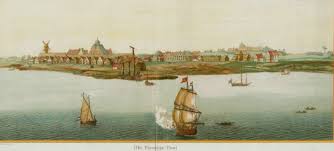
We all knew that the Dutch established a community here and called it New Netherland, that New Amsterdam, their city at the tip of the Manahatta Island, was its capital.  Then, in 1664, the English arrived on the banks of the Hudson River, seized New Netherland, and renamed it New York. Then, the Dutch slinked away to the corners of history. 

Not exactly the truth, Shorto proves.

According to documents that have only recently been translated, there is much more to the story that we did not know.  The Dutch West India Company, acting not as agents of the monarch but as agents of the world’s second international trade union (the first being the Dutch East India Company) stole New York – and what are now Delaware, New Jersey, much of western Massachusetts, and Rhode Island – from the natives and built a society that encouraged diversity.  They were not inherently more tolerant than the English or the Spanish, but they found that a multicultural world was conducive to profitable business. And business was what they were all about. They were willing to accept anyone and everyone from anywhere at all, so long as there was money to be made. What the Dutch West India Company did not do was to protect its people from the reprisals by the understandably angry natives, and they failed to create a workable government.

The British Civil War had just ended, reestablishing the English crown. King Charles II realized that his ravaged country needed to curry influence in the new world in order to replenish his coffers.  He put his brother James in charge of asserting their presence, and James sent emissary Richard Nichols to take possession of land that now constitutes most of the Northeastern United States seaboard.

After spending some time in the Massachusetts Bay Colony negotiating peace between royalists and Puritans, Nichols, well-educated and conversant with Dutch success, sailed down coast and up the Hudson River to negotiate with Peter Stuyvesant for a transfer of power.  No shots were fired; no animosity resulted. As soon as his signature was affixed to the document, Stuyvesant made a brief visit to his European homeland before returning to Manhattan and settling down on his large farm at the south end of the island. He died a very wealthy, satisfied New Yorker.  

Nichols knew that a system that worked needed no reworking, and the Dutch system worked.  He brought in military forces to protect the citizenry, to maintain loyalty to the King, and to uphold the law.  But the Dutch remained in positions of political and social prominence. The array of religions and nationalities that had thrived under the Dutch retained their status as well. 

In the story Shorto tells of my city, I see my mother and my father as central characters. My father’s paternal English roots English planted themselves in Massachusetts, Maine, New Hampshire in the 1620s when they fled the Church of England,  around the same time as his maternal folks were landing in New Netherland. Members of the Dutch Reformed Church, Dad’s second and third great-grandparents likely originated as Walloons, Calvinists who wandered away from the perils of Catholic Belgium and France into New Amsterdam by way of Holland.

 Likewise, my mother’s people had spent generations seeking a safe homeland.  Out of the Russian Pale of Settlement, into Poland/Ukraine, to Zagreb by way of Vienna, and eventually to Kingston, NY, once a Dutch enclave called Wiltwyck.

I will write about my parents.  But I will write about them as fictional characters in a time when unions like theirs were the stuff that fueled the sensibility that built the United States.

My parents’ fictional personae will inhabit 17th-century New Netherlands.  He as the son of parents who arrived in 1624, for the purpose of establishing a future in nieuwe wereld. She as the child of a Lisbon-born Jew, whose family, dispersed by the Inquisition, had found refuge in Dutch Recife, Brazil, until the same Inquisition sent them scrambling to New Amsterdam.

My protagonists are Lia and Izaak.  Neither’s story is unique, but each has a singular voice and a profoundly individual presence.  Theirs is a timeless story shared by millions, but their details are theirs alone.

A Very Human Condition

When I moved to New York City in 2003, it took me some time before I eventually found work as a New York City Sightseeing Guide.  For the first year, I felt ridiculously fortunate to be able to share NYC with tourists who rode with me on the top of a double-decker bus and to get paid for the pleasure.  That wore off eventually, but in the meantime, I got to know Mandy. 

Mandy, still generally called by what would become her dead name, Stephen, was my favorite coworker. A brilliant guide and former attorney, she was saving up for gender reassignment surgery.

Divorce from a greedy wife, mental illness in a daughter whom Mandy would never abandon, and frequent mandate transgressions had led to her being fired from her high-powered law firm, which left Mandy with no money for the ultra-expensive procedures. In the interim, Mandy made concessions of powerful self-assertion by wearing, in all weather, Bermuda shorts fashioned in bright orange sweatshirt fabric, frowzy blouses and tops that plunged below her prominent and rapidly graying chest hair, and neon-colored sneakers. Her hair and mouth were a whirling forest of bright tangerine curls and a soft, pillowy hot pink glossy triangle.

“I’m a lesbian,” Mandy explained to me the first time she asked me out to dinner.

I was flattered. I had never met anyone smarter or funnier than this person, qualities I have always found irresistible in a man. But I had no interest in being romantically involved with a woman, even a woman who was, anatomically at least, still a man. Of course, I didn’t want to hurt Mandy’s feelings, and though I turned down the invitations to dinner, to movies, to theater, we often sat together as we waited between buses.  

I never tired of listening to the stories she told. The personal stories were harrowing, beginning with a Lower East Side childhood, and the professional stories were infuriating. This person had tolerated more than anyone’s fair share of abuse by the system over the years. If I had been differently wired, if I were capable of loving Mandy as she deserved to be loved, I would have spent all kinds of days and nights with this remarkable human being.

Those first months working on the bus were magical.  What a privilege it seemed to explore New York from an ostensible eagle’s view. As a history and culture buff, I was learning in a way no book or school had ever taught me. Mandy’s wide knowledge of the city enriched each day and broadened my tour repertoire.  Having studied architecture, Mandy was conversant with the eclectic nuances of building styles that comprised our city’s makeup. As an astute political observer, she understood the underpinnings of Tammany, why Robert Moses was more tyrant than savior. She explained to me why the Breslin-Mailer campaign to create the great city-state, a movement I enthusiastically worked for in my youth, was basically moronic.  Having studied labor law, her expertise guided our labor disputes. When the company abused us, Mandy spoke eloquently with great erudition. She knew the score.  She understood what we were entitled to and what was being kept from us with malicious, greedy fury.

Winter descended as I rounded the end of my first year on the bus, and with it came the end of the idyll. Cold weather and heartless employers extinguished the joy.

Eventually, Mandy ended too.

Our company, a startup in every sense of the word, provided no bathroom for our relief.  For a while, we were allowed to use the restrooms in the Hilton Garden Inn, which was less than a block from our launch site, and the management there even encouraged us to buy goods in their gift store and food mart by giving us a generous discount. 

Then one day Mandy farted and sighed loudly in a stall in the women’s room, and a tourist seated next to her, the woman in the next stall, securely separated by a metal wall and a locked door, freaked out at the sound of a male voice sighing on the tail of a roaring fart. She complained to the Hilton management. After that, all guides were banned from the place. No more comfy lounge seats, no more cheap candy bars. No more toilet. I saw no solution to the problem and opted to take a break.

I left the buses to edit a book for the friend of a friend. The book was set in NYC, but the London-based author knew little about our city and wrote locations that were amiss and an Iowa-bred protagonist, who was more accurately an Englishman in New York.  To complete the project, I went to the UK for a few months, and when I returned, Mandy was gone. 

Conditions Mandy had fought to improve had killed her.

Mandy was our advocate, the voice that argued for improvement in conditions atop the buses that were unfit for guides.  We had no place to sit.  We were required at times to perform chores – like helping the elderly up the stairs or carrying baby paraphernalia or lugging luggage up the stairs – that put undue strain on all our muscle groups.  We stood for long periods of time, jostled mercilessly about. We had no place to go to get warm, no relief from the harsh winter exacerbated by the harsh wind generated by the moving bus.

Mandy’s back and health could not take it. She suffered pneumonia and bronchitis and then was injured and re-injured until she finally had no choice but to undergo back surgery.  Like many spinal surgery patients, Mandy did not survive. The company management, who never appreciated what an asset they had in Mandy, was relieved. Tethered by Mandy’s knowledge of the law, they had felt forced to retain her. Her illnesses and back troubles cost them money by way of pay they were impelled to dole out and by insurance rate hikes her claims inflicted. The bloodsuckers were free at last. 

We who loved Mandy, lost a precious friend.  I lost a valuable mentor.

I find myself wishing for her presence lately.  She’d tell me why the current state of affairs for Trans people cannot hold.  She’d tell me to keep the faith.

“Don’t give the bastards any power,’ she’d laugh.  “They’ll turn to dust just like the rest of us.”

So Long, Frank Gehry

When I was young, Reader’s Digest, a subscription to which my 9th Grade English teacher included in her yearly syllabus, ran a feature called “My Most Unforgettable Character.”  It was the monthly’s most popular feature, and I wrote a few character sketches and thought one day I would submit one to the magazine.  I never did.   Truth be told, I don’t think I ever really met my MOST unforgettable character until 2005, when I took a job as a guide on a New York City tour bus.

In that job, every day was a new adventure.  I was lucky.  Everyone I met was reasonably personable. Well, almost everyone. One time a pair of gang kids tried to hijack the bus I was on, but finding a police person was easy back in the days when crime was still against the law.  In a trice, the cops took the interlopers into custody, and our tour commenced without further incident.  The event stands out in memory because it was unique.  I came to hate the working conditions and the attitudes of the owners, my bosses, but the people I worked with, like the people I entertained, were, for the most part, people I enjoyed being around.  Some were, of course, more colorful than others, and none was as remarkable as Sarabeth.    

Sarahbeth was my favorite person in the bus world. She was saving up for gender reassignment – her birth name was Stanley — but divorce from a greedy wife, mental illness in a daughter whom neither Stanley nor Sarabeth would ever abandon, and frequent gender transgressions that led to Stanley’s being fired, which left Sarabeth with no money for the surgeries.

Instead,  Sarahbeth made powerful self-assertions by wearing, in all weather, Bermuda shorts fashioned in bright orange sweatshirt fabric, frowzy blouses and tops that plunged below the prominent and rapidly graying chest hairline, and neon-colored sneakers.  Her hair and mouth were a whirling forest of bright tangerine curls and a soft, pillowy hot pink triangle.

“I’m a lesbian,” Sarahbeth explained to me the first time she asked me out to dinner. I was flattered.  No one I had ever met was smarter or funnier than this person, both qualities I have always found irresistible in a man.  I had no interest in being romantically involved with a woman, even a woman who was, anatomically at least, still a man.  I didn’t want to hurt Sarahbeth’s feelings, and though I turned down the invitations to dinner, to movies, to theater, we often sat together as we waited between buses, and I never tired of listening to the stories she told. 

The personal stories were harrowing, beginning with a lower East Side childhood, and the professional stories were infuriating.  This person had tolerated more than anyone’s fair share of abuse by the system over the years, and if I had had more imagination or a better apartment, I would have invited her over for sleepovers. 

My touring repertoire grew astronomically, thanks to Sarabeth’s knowledge of the city.  Having studied architecture, she was conversant with the nuances of styles of the eclectic buildings of the city. As an astute political observer,  she understood underpinnings of Tammany, why Robert Moses was more tyrant than savior.  She explained to me why the Breslin-Mailer campaign to create the great city-state, a movement I enthusiastically worked for, was basically moronic.  Having studied labor law, leaned heavily on her when we had labor disputes. When the company abused us, it was Sarabeth who spoke most eloquently and with the most erudition. She knew the score.  She understood what we were entitled to and what was being kept from us with malicious, greedy fury.

There was no bathroom for our relief.  For a while we were allowed to use the rest rooms in the Hilton Garden Inn, which was less than a block from our post, and the management there even encouraged us to buy goods in their gift store and food mart by giving us a twenty percent discount. 

One day Sarabeth farted and sighed loudly in a stall in the women’s room at the Hilton, and a tourist seated next to her, the woman in the next stall, securely separated by a metal wall and a locked door, freaked out at the sound of a male voice sighing on the tail of a roaring fart. She complained to the Hilton management.  After that, all guides were banned from the place.  No more comfy lounge seats, no more cheap candy bars, no more toilet. 

I left the buses to edit a book for the friend of a friend. The book was set in our City, but the author knew little about NY and wrote locations that were amiss, and a protagonist, who was supposed to be from Iowa but was more accurately an Englishman in New York.  To do the work, I went to London for a few months, and when I returned, Sarabeth was gone. 

Consistently, Sarabeth had argued that the conditions atop the buses were unfit for guides.  We had no place to sit.  We were required at times to perform chores – like helping the elderly up the stairs or carrying baby paraphernalia or lugging luggage up the stairs – that put undue strain on all our muscle groups.  We stood for long periods of time, jostled mercilessly about.

Sarabeth’s back and health could not take it.  She suffered pneumonia and bronchitis and then was injured and re-injured until she finally had no choice but to undergo surgery.  Like many back surgery patients, Sarabeth did not survive. The company, which never appreciated what an asset Sarabeth was, was relieved. Tethered by Sarabeth’s knowledge of the law, they had felt forced to retain her. Further, her illnesses and back troubles cost them money by way of pay they were impelled to dole out and by insurance rate hikes her claims inflicted.   The blood suckers were free at last. 

We tour guides, who loved Sarabeth, lost a precious friend.  New York City lost a champion.

At Best A Tepid Tempest in the Park (Reprinted by permission of Catch & Release, the Columbia Journal Online

It is downright unpatriotic to be a New Yorker and walk out on a performance at Central Park’s Delacorte Theater in the middle of A Shakespeare in the Park production. But that’s just what I did. After I stood in the sun for two hours waiting to be handed two free tickets, I looked the city’s gift horse in the mouth by throwing my hands at mid-show and walking – no, running – away. It felt blasphemous. It felt treacherous. It felt good.

The air was cold, the seats were hard, the show stank, and after forty years of attending what Shakespeare in the Park I was lucky enough to get tickets for, I felt like I had earned the right to stalk away in an exasperated huff. Especially since the Public apparently feels like it has earned the right to present so unimpressive a production as this one.

The critics have been generous with the show.  While they have found some fault, overall, they are loathe to come down hard on it, and this perplexes me. Having spent much of my life studying theater and acting, directing student productions, reading copious amounts of criticism and history, taking a dramaturgy practicum at Columbia, I know that even if some people disagree with my assessment, I cannot possibly be alone. If any other production with such a high profile failed so miserably as this one, the critics would be screaming their displeasure at the city. But The Public Theater’s annual Delacorte starfest is a sacred institution, dependent on donations and sponsorships, and no one wants to be the little boy pointing brazenly at the emperor’s nudity.

Which is too bad. Because good criticism should make the program grow stronger; in a perfect world, sponsors and patrons would want to invest more money in the idea that making really good theater requires making some really terrible mistakes. That to suggest that something is not as good as it should be is to encourage it to reach its own potential.

Why, then,  does my feeling of treachery persist when I say that the production was flat, that it created no magic and no island, that it had no sorcerer of any kind performing miracles in a play that, at its best, is one miracle after another?

There was a time when I attended the shows at the Delacorte knowing that I would see great acting, thoughtful design, coherent directing. In this production of The Tempest, the directing is unfocused, and the actors get away with blunders that would not be tolerated in the remotest hinterland productions. Once upon a time, actors donated their time and in return found grateful fans, who followed their careers. This show featured an actor who was cast despite the fact that he is absolutely wrong for the part simply because he is a beloved New York icon.

Audiences come to the shows to see faces they recognize from elsewhere. The star-studded Shakespeare in the Park productions have turned into the kind of stuff tourists’ dreams are made on, just like the mini Chocolate theme park called the M & M experience that draws out-of-towners off the tour buses at midtown. So casting is not always as thoughtfully executed as it should be.

I knew better from the start.  I should have eschewed this production of The Tempest altogether.  I was aware of this beforehand and was reminded while waiting on the line at the designated 135th Street spot for ticket distribution when one of the Public Theater pages came out to tout the show. He announced with great pride that Prospero would be “played by Sam Waterston, whom you all know from his amazing work as Jack McCoy on Law and Order.” I groaned. I did not want to see Jack McCoy as Prospero.
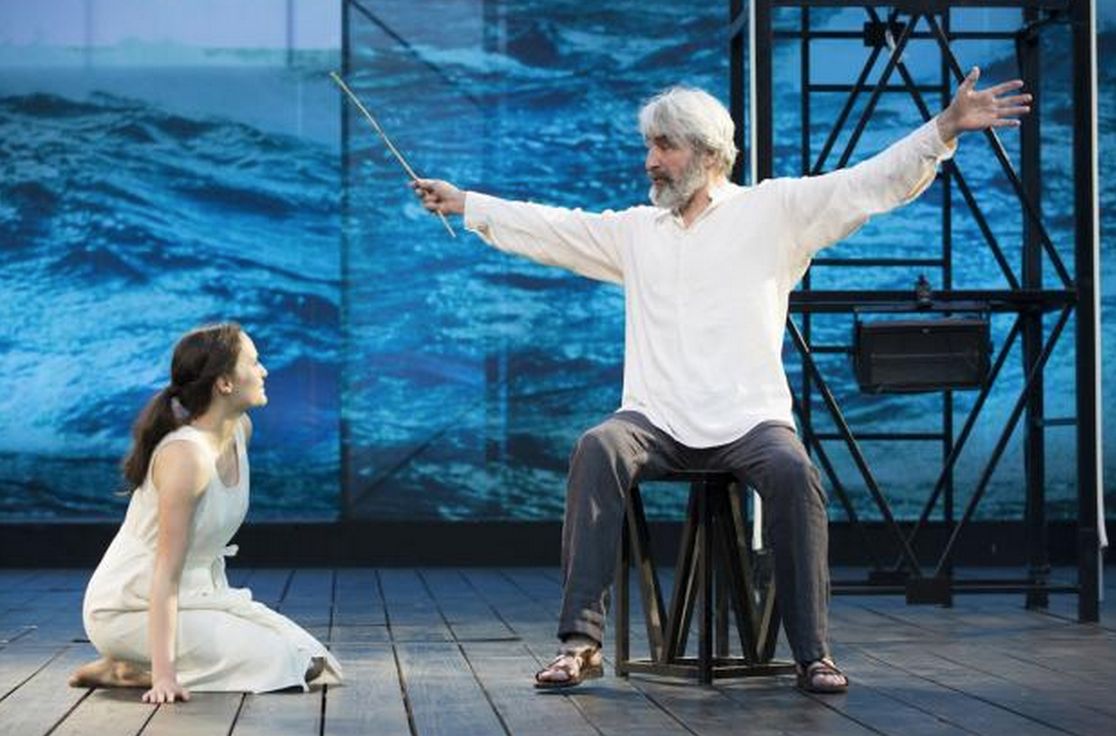
Screen Shot 2015-06-28 at 2.25.39 PM

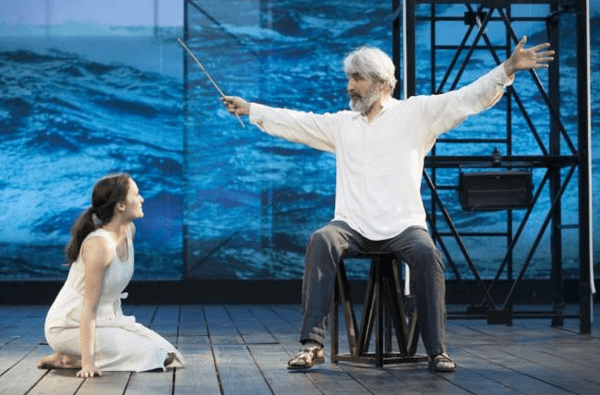
Sam Waterston, as Prospero, and Francesca Carpanini, as Miranda, in The Public Theater’s Shakespeare in the Park production of The Tempest. (photo ©Joan Marcus, NY Daily News)

Let me digress here and say that I admire Sam Waterston’s work enormously. In Grace and Frankie, where his conflicted, ambivalent Saul is the soul of the ensemble, he is the reason I watched every episode despite the fact that the other cast members failed to convince me they were who or what they purported to be. I was enthralled by his work in The Killing Fields and always wanted more from him when I watched Law and Order. But when I traveled to New Haven to see Stoppard’s Travesties, which featured Waterston, I was sorely disappointed. Waterston’s mumbly, hesitant speech patterns didn’t capture the rhythm of Stoppard’s writing. The play was uneven, and the speeches tended to be long and ponderous, even for Stoppard, and Waterston was not nailing them. Spoken with aplomb, Stoppard’s speeches, even at their wordiest, are melodious and lyrical, downright Shakespearean. Waterston’s delivery made them seem clunky, pretentious, pseudo-intellectual. So why did I even bother to get tickets for a Shakespeare play in which he would play a character with some of the longest, most ponderous speeches in the canon?

Two reasons. Because I could. And because I should. Who would turn down an opportunity see a free production of one of Shakespeare’s best plays, directed by Michael Greif, a Tony winner, one of Broadway’s best directors? Who would not want to witness a spectacle produced by a Broadway-caliber production team? Well, I was wrong in thinking I did.

Mediocrity is, apparently, the measure of excellence in a Delacorte show.
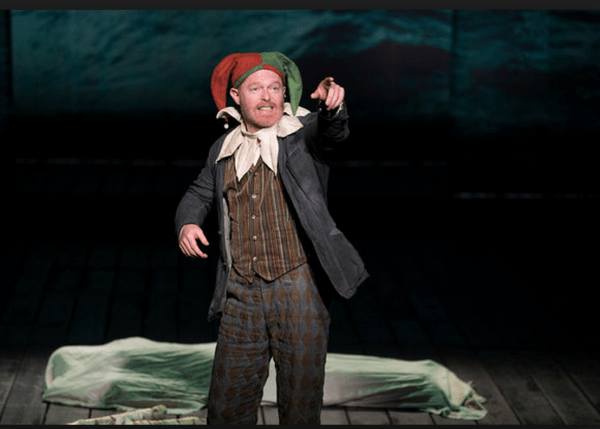
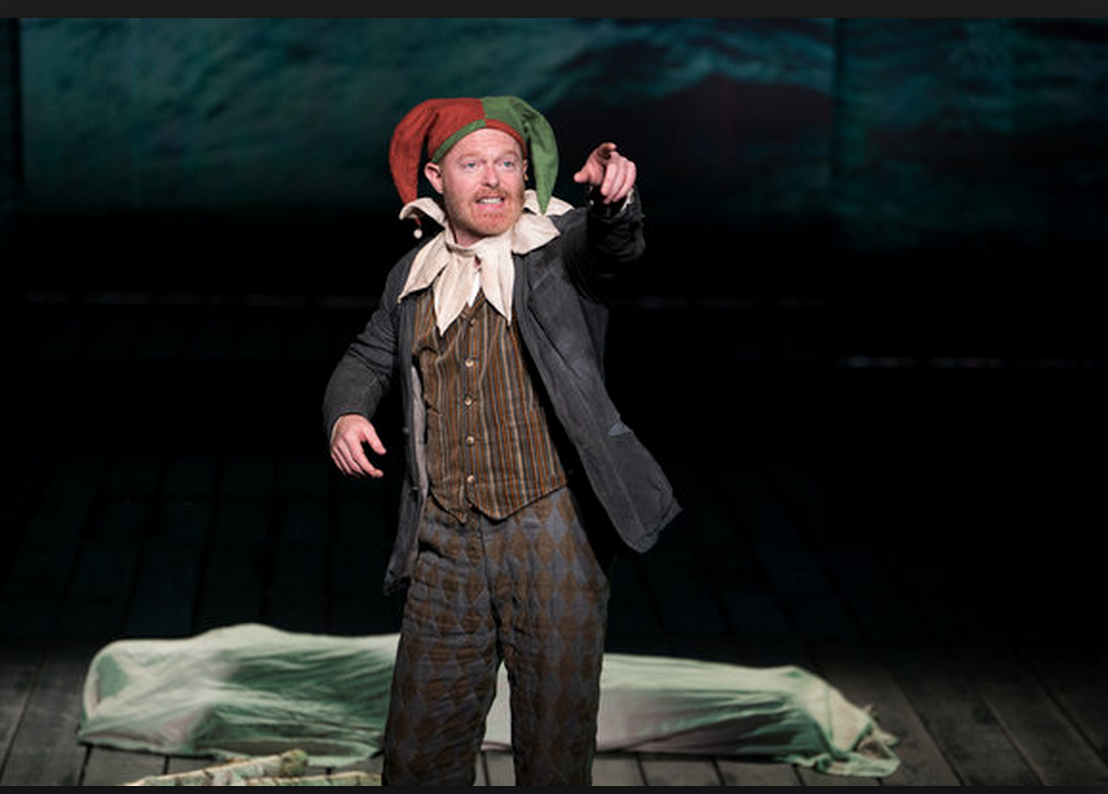
Screen Shot 2015-06-28 at 2.20.53 PM

Jesse Tyler Ferguson as Trinculo in The Tempest, by William Shakespeare, now playing at the Delacorte Theater (photo © Sara Krulwich, NY Times)

The highlight of the evening at my Delacorte was Jesse Tyler Ferguson’s Trinculo scene opposite Danny Mastrogorgio as Stephano and Louis Cancelmi as Caliban. Ferguson was good. He played Trinculo exactly as he plays his character on Modern Family, vascillating between over-the-top-reactions to things and understated asides. Stephano was okay. At least he was almost understandable. But Caliban seemed confused by the character he was playing, could not choose which of several accents to rely on, had no inkling as to how his body should move, and it was nearly impossible to catch his words, which were not falling trippingly from his tongue. The scene is pure Commedia fun as written; there is little any production could do to ruin it, but if the words were more critical, even that scene would have been lost.

No one in the cast, with the exception of Cotter Smith in the part of Prospero’s brother Antonio, was able to speak the speech. Waterston spoke as though he had pebbles on his tongue, and half his mouth was sewn together. Ariel might have been articulating just fine, but since he was whispering much of the time, nothing was reaching my ears. Miranda shouted everything. There were no nuances of emotions from her, just ebullient shouting to accompany her juvenile physicality. She seemed more like an over-excited six-year-old than a young woman encountering sexual awakening, and watching her I was reminded of a classmate of my daughter’s in her performing arts magnet high school, who had been Annie on Broadway and played every part, even scenes of quiet contemplation, with the same musical comedy hugeness.  As a high school theater director, I held my neophyte teenage actors in our several productions of plays by the Bard to a far higher standard than any of these credentialed professionals seemed to reach for.

It is worthless to go on about the acting. It was just the tip of the iceberg. The opening scene, the tempest itself, was lovely. I am a great fan of theatrical minimalism, of letting the actors carry the “sell” of a set, and in the opening, it all worked well. But as soon as the initial storm died, so did the success of the staging, the appropriateness of the design, the creation of the world. There was nothing to make me believe that I was encountering characters cast adrift on a seemingly hostile, enchanted island; they were simply pretenders stomping through roles on a stagnant playground in the center of a stage at the Delacorte Theatre.

Given how lacking I found the show, I can’t help wondering why I am already planning to seek tickets to Cymbelline, a play that is rarely done well?   The answer is plain, really. Because I’m New Yorker. It’s my patriotic duty.