Sliding Back to America from the Marmara Sea

Last week, at a playground on the banks of the Marmara Sea, I stood with a stranger and watched his daughter and my grandson chase one another up and down the slide. They were laughing, enjoying the game. We were encouraged by their easy palship to attempt a conversation.

“Where you are from?” the man asked me. I faltered a moment, embarrassed.

“From the U.S., “ I finally replied.

“Ah. I am from Syria. I came here five years ago.”

Unsure what to say next, I stammered, “You are kind to speak English with me.”

“Oh,” he laughed. “I am a teacher of English. I love to have the opportunity to speak!”

“Ah.” I could have been quiet. A socially adept person might have stood there simply enjoying the mirth of our children and the sparkle of the sea. Instead, I pressed on.

“It must be difficult to be from Syria. What’s happening in your homeland must be painful for you.”

He nodded solemnly for a moment then looked me in the eye. “Well,” he ventured, with a new twinkle of mirth emerging from his own, “No more painful than being from America, I’ll bet.”

Déjà-vu.

In 1970, when I first ventured to Europe, a sweet Italian boy asked me if I were an Ugly American. I spent the next 9 weeks of my trek across the continent proving in every way could that I was not. My encounter with the Syrian English teacher was not the first time I realized I was experiencing a resurgence of what I felt about my country in my profligate youth.

“Speak to me in German,” I begged an Iranian neighbor in the courtyard of the apartment complex where I was staying one morning. I couldn’t bear to hear American English coming from my mouth as I spoke to her.

Being an American, especially being an American abroad, is indeed excruciating. Every day of the two months I stayed in Turkey I faced news from my beloved country that made me shudder. Child abuse by US officials. Refugee incarcerations. Racist slurs against respected politicians. Rallies inciting brainwashed multitudes to chant hateful slogans. Ostensible newscasters spewing toxic lies to widen the chasms that divide citizens. Threats of war both civil and foreign.

Early in the morning three days before my flight home to the States, I received an email from my airline instructing me that because of heightened security in the US, all passengers leaving high-risk areas must undergo extreme scrutiny by security personnel. I was therefore instructed to be at Istanbul Airport at least three hours prior to flight time.

I closed the email, shuddering at the thought of having to leave the apartment at 2 AM for a 6 AM flight. Shivering with resentment that my prosthetic hip would set off the metal sensors and force me to endure inevitable pat-down humiliation.

Before I could shut down my email server and go brew a cup of coffee, my news feed blasted pictures from El Paso. Twenty people killed less than a week after the Gilroy Garlic Festival massacre. I sat and wept. Before my tears abated, news of Dayton. I remain inconsolable.

I am hyper-aware of irony. It underscores the absurdity of life around me and ordinarily gives me a healthy perspective on what I observe in the world. While irony often makes me laugh, it is equally capable of reducing my soul to painful shards that impair my vision, alter my hearing, infuse me with the bitter taste of helplessness.

By the time I read those three notices, my toddler grandson and I had spent 60 days frolicking in various playgrounds in our Istanbul suburb, interacting with people from all over the Middle East. I didn’t like everyone, and I am sure there were those who disliked me. Human interaction is like that. I’m not historically ignorant, and I know there have been times when I would have had a very different experience in Turkey. But this time, now, there was no threat inherent in not being friends with everyone. I never felt unsafe. No one ever threatened me with a gun. No one shouted at me that I must conform to any single notion of right/wrong. Not one person posed any kind of a threat to me or my family.

So sad. My misinformed, misguided, brain-washed fellow Americans believe that the people outside our country threaten us with terrorism. When I said I was traveling to a country that is 97% Muslim, I was overwhelmingly warned, even by my more enlightened acquaintances, to “Be careful.” It should have been I issuing the warnings. The real threat to all of us comes from our fellow Americans.

Mass shootings continue to increase. Congress continues to allow the money-wielding gun lobby to control them. The so-called president continues to sow seeds of fear and resentment that foster bigotry and violence. Politicians and our so-called liberal leadership continue to insist on radical stances instead of seeking ways to re-group and ameliorate. The mainstream press continues to whitewash the awful truth about the evil in our midst.

And we continue to allow ourselves to be bamboozled.

You are right, my Syrian acquaintance. What’s happening in America is painful.
 

A Thorn By Any Other Name . . . .

The nightmare never changed. It recurred as a terror that began just after I began Kindergarten, at age four. In each bad dream, the ominous wailing of European sirens would wake me from a sound sleep in my grandmother’s Bayside, Queens attic. As the sound of metal soles and heels marching on the suburban pavement reverberated around me, I would scream for my sisters and brothers and cousins to follow me. In German, a voice shouted from the street below. “You cannot escape a second time. We have found you. You will come with us to the camp.” I would wrest myself sweating and crying from the torture of sleep just as the uniformed robots were about to grab my youngest brother and throw him into the tank that followed their march.

Every detail of the dream was the figment of my imagination or of some phantom reminiscence. We had no television, and the only films my parents took me to see were Disney films. I search my memory for some clue as to how the sound of the jackboots and police cars found their way to my subconscious, and I find none. I do know why I was afraid of the camps.

I was born two years after WWII ended. Members of my mother’s large extended family, dispersed across the world, were just beginning to find one another. We received intermittent letters from sources I could not identify that provided cryptic updates. The word “camps” was omnipresent. So much so that when my parents sent me to Girl Scout Camp at age seven, I was sure they were sending me away forever.

The soto voce conversations about the correspondences were always dire. Like the members of my mother’s nuclear family, most of the mispacha had barely escaped. A few to the US, others to Brazil, Israel, Australia, Argentina, the UK. The displaced were the lucky ones. There were telegrams and official notifications bearing the saddest news – two uncles and an aunt gassed in a death camp with a garbled name. What a relief to learn that another aunt and uncle never suffered the same fate but were shot defending their clinic in the Stanislaw ghetto uprising. My mother would huddle with her sisters and parents in secluded corners of our communal home to read each missive aloud. I was not invited to hear, but I was an expert eavesdropper, and while I could not have told you what or who or why, I felt the effect of the camps that my mother and her sisters had narrowly avoided. Even the bits and pieces I surmised were enough to convince me I would never want to go to that place where the evil whose name was Nazi lived.

The pain, the fear, the agony of the camps bored a hole in my consciousness. As did the guilt my mother and her sisters, who never forgave themselves for running away, brought to America. I grew up wondering, as they did every day, if I might have made a difference if I had only been there.

Of course, the notion is absurd. Still, though they said – and genuinely believed – that no such horror could happen in America, they passed to me a sacred responsibility. Never again. Make sure. Never again. Be on your guard. Tolerate no persecutions.

That was the banner I carried in my heart when my cousin and I joined the marchers on the Brooklyn Bridge, when I sang my freedom songs in coffee shops, when I advocated for the end of the War in Viet Nam. Reading history made me cry. How could we enemies of oppression have perpetrated annihilation of the Natives, perpetuated slavery? The more I learned about how this country came to be, the more my inner voice chanted “Never again.”

No one in my circle of intimates ever suggested that there might be anything like comparative suffering. The internment camps that held native Americans all over the Southwest were no less horrific than those that held Japanese Americans during WWII. Inhumanity is inhumanity, Suffering is not a competition sport.

Genocide is genocide.

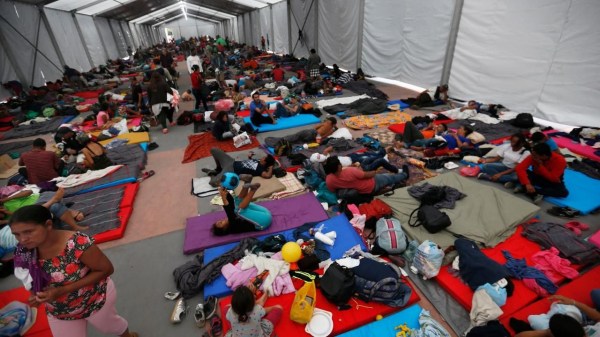
It follows then that a concentration camp is a concentration camp. Just because there are no gas chambers does not give a vile detention area, where children are tortured, a right to be called anything less brutal. Though the inmates of these camps are not in imminent jeopardy of extermination, ten children have died of their maltreatment.

How many deaths does it take to constitute a death camp?

Children forced to sleep on floors, left unclean, given no soap or water, encouraged to drink from toilets. Worst, children growing every day with no affection, no comfort, ripped from their parents’ love. . . .


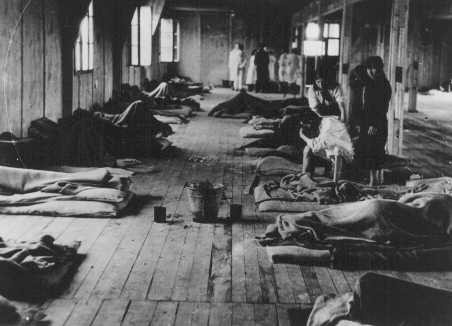
Theresienstadt was a concentration camp. It was a showplace – a beard intended to prove to the Red Cross that the Nazis were humane. Here, like in the border camps, children died. Maltreatment, malnutrition, squalor are killers as lethal as gas and guns.


My people suffered great losses, yes. But we have no right to be precious about our pain. To be honest, I abhor the fact that we refer to our destruction as The Holocaust. There have been so many holocausts, murder and mayhem inflicted on human beings by fellow humans. Our losses are of no more significance than the losses incurred by our contemporary refugee counterparts.

We don’t own the torment. But we do own the imperative to fight to end our government’s insistence on perpetrating more of it. We will carry the sad karma wrought by the deplorable savagery being enacted under our flag. We must somehow take action, real action, to send this siege of evil.

The great challenge here is to stop the bickering among the converted. We must put our level heads together to figure out what that action is. We must have a unified plan, and we must cry out in a single voice.

Never Again.


Back on the Road With Grandma – Part II – View from the Courtyard. . . It Seems So Simple Really

From my window, I have a world view I wish I could share with my fellow Americans.

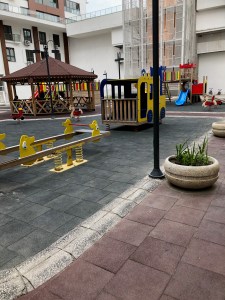
I am currently in an apartment complex in Istanbul. On the European side. Four separate entrances to four connected but independent buildings comprise the 12-story structure that wraps itself around a large courtyard, a recreational close.

In the center of the courtyard is a very large gazebo.

With ample seating for at least 20 adults and floor space for at least as many children. Much of the day, it is occupied by mothers and a few fathers, who chat amongst themselves while their many children run exuberantly about. They are often there until well after 10 PM.

No one in any of the flats that face the courtyard fears missing the opportunity to be part of the communal scene. Each apartment faces the square, and curtains on the sliding doors leading to a small balcony are invariably open. By placing a couch set at the sliding door, inhabitants extend the indoor living space out into the world of the square. Sound carries easily. From the comfort of home, they intermittently call to one another, supervise unruly children, and engage with the flow of life below.

I imagine our neighbors wonder what is wrong with us that we are so anti-social as to keep our windows covered, our doors closed.

Solitude, then, is not the ideal here. Personal space is meant to be shared. It extends beyond our courtyard into the activity that bustles about us. On the street, in stores, at the local market one is likely to feel crowded even when there are no more than a few people nearby. Walking close to one another seems a requirement on the walkways. Driving far too close is common practice on the roads.

Life here is on a clock set for summer hours. Revels extend late into the night, and nearly nothing stirs before 9 AM, even on workdays. This is lucky for me. My need for alone time, for the wide berth of privacy, is satisfied by my early-morning sessions in the exercise room or by eschewing the sun-drenched outdoor pool in favor of the dimly lit indoor equivalent.

I adjust to what might feel like perpetual invasiveness, even when people are staring at me with great curiosity. The ultra-communal atmosphere fascinates me. It instructs me about the world to which I will soon return.

In my neighborhood in Harlem, apartments are built to ensure the most privacy one can hope for in a crowded city. They are built with an American sense of individuality. Bolted doors, barred windows help to reinforce the notion that boundaries matter.

It is a notion that is just as foreign to many of my neighbors in Harlem as it is to those here in Istanbul. Like my neighbors in this courtyard world, my fellow Manhattanville residents are from places where the house is the place to sleep. In the warm climes – in places like this part of Turkey, the Caribbean Islands, large sections of Africa, Asia, South America, and the Asian subcontinent — the cultures encourage and even require communalism. Folks often and comfortably congregate in courtyards, on the beaches, in the marketplace. In Harlem, they replace the familiar sharing places with city sidewalks, local parks, even the local grocery stores.

I have been known to grouse about the way the habits of the collective affect me, interfere with my limits. Though I crave diversity and delight in the culinary benefits these strangers have brought to my city, I also complain about the things that niggle.

Watching the courtyard below me in this very foreign place is a kind of revelation, a reminder of how fortunate I am to experience this perspective changer.

I pledge to remind myself often — at night, when I wish the noise on the street would just stop, on my block, when I am having trouble walking quickly because of the lawn chairs and hibachis blocking my way, in Whole Foods when another shopper’s cart refuses to move more than an inch from me, on my way to work when the tourists walking four abreast slow my progress from point A to B, in my own apartment building, when it is abuzz with folks iding together – that my way of living is not universally the best. Awareness and perhaps a set of earplugs should enable me to adjust my point of view.

We white Americans have made a history of co-opting, usurping, and/or obliterating all traces of Others’ cultures. Our national beginnings are fraught with murder, enslavement, criminalization of anything un-white. We have stolen food, customs, traditions, language, and culture and have forcibly replaced what belongs to others, requiring that they embrace what is ours. We have taken this imperialistic attitude to the world, earning us the moniker of Ugly Americans. And in the time of Trump, we are doubling down on our insistence that the Other be like us or get out.

I don’t like what we’ve become, we white Americans. We are a fearful, suspicious, hateful lot with little understanding of these others settling on our shores. They are not here to take anything away from us. Yet we treat them as though it is a bad thing that their difference threatens our blandness. Every American should spend a week looking out of my Istanbul window and see that there is no harm in retaining individuality if that is what we want. We might be irritated by a handful of inconveniences, but in the end, our lives are enriched by allowing ourselves to observe and grin.

Perhaps a week at my window would engender a sorely-needed American attitude adjustment. Liberals need to see that while the people of the heartland have lacked exposure, they can watch, smile and accept with the rest of us. And so-called Conservatives need to shut up and listen, taste, touch the joy that happens in this courtyard. We can all adjust.

It’s so simple. Really. You may love your hamburgers, sandwiches, and wraps, but once you’ve tasted kofta or börek, you’ll know something more delicious. Preserving tradition is fine and dandy, but it’s always a sure bet that adding something new can give your life a whole new dimension.

Back on the Road With Grandma

This summer, it’s Istanbul, Turkey. I’ve never been here before.

Once upon a time I dreamed of seeing Istanbul-not-Constantinople and taking in Ephensus, the Topkapi Museum, et al. My imagination conjured encounters with all manner of exotic people, places, ideas. Even in my old age, I fantasized about meeting interesting people, perhaps a man? Preparing for my trip, I made a hypothetical list: The Blue Mosque, the Haga Sophia, a ride atop a double-decker tour of the city and the ancient ruins of Iconium, a cruise down the Bosphorus alongside the remains of the wall that protected Turchia. I figured that since I’d be in the city for three months, I’d have ample opportunity to learn some of the local language, soak up the essence of the culture.

Now entering my third week, I have adjusted my expectations. Mine is not the sojourn of a freewheeling youngster or a liberated retiree. I am here in the official capacity of Toddler’s Grandmother. Consequently, though I have happily partaken of the pide bread and acquired a craving for muhammara salad and vegan boreks, I remain more familiar with home-heated frozen French fries and chicken nuggets. While I’ve managed to board the ferry and visit the Isle of Heybellada, My experiences are filtered through a skewed lens with minimal focus. I see the world through the eyes of a two-and-a-half-year-old, who is fixated on construction vehicles with three doors that open and shut or on dogs sleeping in the shade or birds resting on low-hanging branches. Nothing else in Turkey matters nearly as much. A museum would be excruciating, and the Blue Mosque might shudder at the thought of my grand child running through.

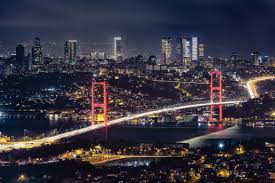
I have yet to see the city by night. Bedtime is early in the world of a toddler.

None of this is in any way disappointing. I believe I will love the memory of this Turkish sojourn all the more for having shared it with my little miracle boy. A walk on the Bosphorus is as satisfying as any cruise when you’re throwing rocks to watch the ripples disrupt the calm and laughing at the boats seeming to race with one another, singing about wheels going ‘round and ‘round as a big green bus zooms behind.

Back in New York, I’ll hear in my dreams the five calls to prayer outside our window, but I will remember a sleeping boy rather than the responses of the faithful. Here I’ll content myself with vicarious visits to storied places. The beauty of Haga Sophia and Rumeli Castle resonates adequately from the page, and neither will age any less sublimely for want of my presence.

Much to my amazement, I have no need to further enrich my senses. Things that once seemed intensely important have lost their luster. The glories of the past are singularly unenticing because the future is in my arms.

My future has become irrelevant. Who knows what time I have left? Nothing is promised,. I have had already a long life that has given me much to be grateful for. I gladly turn my attention to what I will leave behind. Memories matter.

No matter what time is left, I will be a presence in this boy’s heart, even if only as half-seen a shadow casting stones on the water of the Bosphorus.

——————

Next up: How America looks from here . . . . Spoiler alert. It’s not pretty.


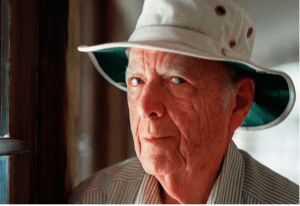
SAILOR AND FIDDLER: REFLECTIONS OF A 100-YEAR-OLD AUTHOR BY HERMAN WOUK

Reprinted from Bookslut, March 2016

I always thought of Herman Wouk as my own personal Virgil, and as much as I like to think my relationship was special, I suspect there are many of me out there, wayfarers who have depended on Mr. Wouk to show the way. Those of us born to families devastated by the tragedies of the Second World War, whose parents chose not to talk about their experiences, who felt the force of their survivor guilt without knowing from whence it came found succor in Wouk’s work.

He welcomed us with abiding love, guided us down to the darkest circles of the hell they’d escaped, showed us the purgatory of their immigrant experience, and then he illustrated their view of heaven for us. For me, because my mother, like many survivors of the horrors left behind in Europe, hid her Jewishness, which disappeared into my father’s very American blue-blood WASP persona, Wouk was an essential source. He led me to my deepest roots and taught me how to love them.

I learned about the tenets of Judaism and prepared myself to study more formally by reading This is My God, a straightforward, unembellished explanation of the beliefs, rites, holidays, festivals, law, and the many variations of the religion. From Inside, Outside, I learned that many of the idiosyncrasies I thought were unique to our family were, in fact, universal to the experience of first generation Americans. In Winds of War and War and Remembrance, I got close to characters who had suffered the fear, loss, separations and dislocations my mother and her loved ones endured, and I found a way to be more empathetic to and less judgmental of that same mother.

What Herman Wouk’s books also offer is insight into the nearly 101 years he has lived on this planet. His fictional characters, only minimally masked and altered, are the people he has loved, hated, known, observed, dreamed about, and the events he has chosen for set the action of his novels against are mostly events he lived through or had some relationship to. In a way, the body of his work is his autobiography, his memoir in fiction.

Which is essentially what he tells the reader in Sailor and Fiddler: Reflections of a 100-year-Old Author, his rumination on the sixty-four years of his career as a bestselling author. Sailor and Fiddler is not so much a memoir as a remembrance of things past, a paean to the good fortune that has accompanied his professional life and a nod at the tragedy he prefers not to talk about. He identifies himself as a sailor, having spent World War II in the Navy, and a fiddler, a character from the Sholem Alecheim stories his father read to his children in Yiddish, stories that fueled Wouk’s desire to write.

Wouk chooses to minimize the memoir. He says his beloved wife, to whom he refers as “Betty Sarah Wouk, the beautiful love of my life,” discouraged his writing any memoir, saying that a writer’s life is not all that interesting. He agrees, and so instead, he zips his reader past his journey from working class Brooklyn to fame and fortune in mainstream American culture. He sketches out some of the milestones of his life, glosses quickly past the mention — the first, he says, in anything he has written — of his first son’s death by drowning, concentrating on his the frequent reiteration of the amazing charm his life has seemed to have.

From the moment he was accepted to Columbia College’s Class of 1934, every project Wouk took on succeeded beyond his own expectations. He worked as a gag writer for the giant star of radio Fred Allen, went to Hollywood to write screenplays and, by the way, wrote a hit play, published a series of bestselling novels beginning with his first, Aurora Dawn, which he says was actually enabled by his Navy salary. He credits his gag writing with keeping his novels snappy, funny, and easy to read, even when the material was dense and meandering, and he credits his Judaism with keeping him focused, earthbound.

Whether living in Hollywood or sequestered on an island in the Caribbean, Wouk remained tenaciously religious. He refused to eat non-kosher food, and he never missed a Shabbat service. Thanks to his religion, he was able to anchor himself in his family and remain circumspect, diligent, and, most importantly, grateful for his great good fortune.

For readers who haven’t met Wouk in his novels, this minimal volume will perhaps provide an incentive to explore the literature that consistently remains on bestseller lists of all kinds. But it will not enlighten those who seek to learn about the private Wouk, the personal encounters. What it will do is provide a key to how Wouk relates to his work, how he came to write what he wrote, what some of his influences were. It will introduce the reader to the novelist’s relationship with his creations, what he especially likes and what he dismisses, what he is most proud of, and what he discounts. Imbedded in the book is a glimpse into the times and events that shaped Wouk’s sensibilities — his birth into a family of Eastern European Jewish immigrants, the post-WWI years in Brooklyn, the cataclysms of WWII, the McCarthy era, to mention a few. But everything that the book mentions is examined perfunctorily; Wouk writes neither for therapy nor to provide himself and his readers with profound revelations. The book is merely an old man’s musing on a long and prosperous career amid world and life events that the author assumes his reader knows plenty about.

What he hopes is that the “gentle readers” of this little book have already read and/or will soon read his work, and thereby know everything there is to know about him. He has recorded in his books all that seemed important to him, all that shaped his personal and professional life, and he wants to be known through those books.

As he says at the end of his discussion on writing The Hope and The Glory: “I told Ben Bradford I wanted to write two books before I died, one on Israel, one on my life’s story. By God’s grace, I have done both. And in this reminiscent glance, I have sketched how I did them.”

Sailor and Fiddler: Reflections of a 100-Year-Old Author by Herman Wouk
Simon & Schuster
ISBN: 978-1501128547
160 pages