It Hath Made Me Mad

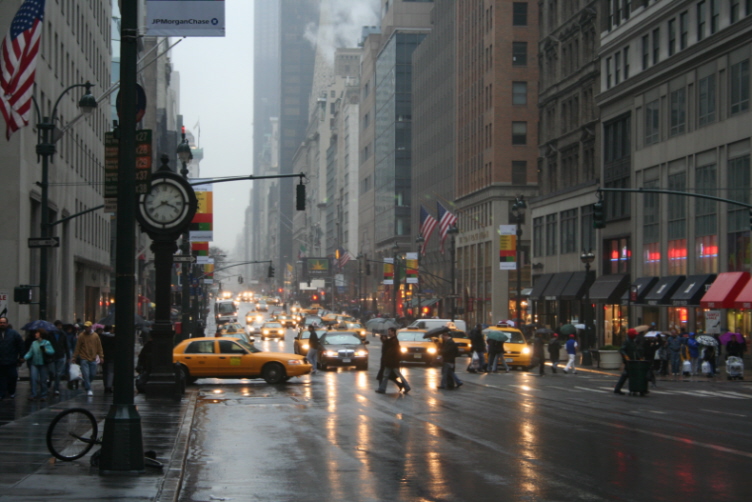
Cold, sharp rain enveloped my city on the February morning when I returned to the neighborhood Loew’s to see Silver Linings Playbook for the second time.
urlI love attending the first show of the day.  Now that I’m a senior, I no longer need the price break; there’s something about the people, whose sparse presence affords me a sense of community while I luxuriate in the near isolation of a private screening.  The audience seems to be there to see the film, seriously, not to make out or have a conversation; people turn their cellphones off before they are instructed to do so, and they eat their popcorn quietly, sipping their water thoughtfully so as not to obstruct their own ability to follow what’s going on on screen.

This day, however, perhaps owing to the nasty weather outside, things began uneasily.  Sitting behind me was a young woman, clearly out of her comfort zone; she was wet, squirmy, audibly unhappy.  Waiting for the previews to finish and the feature to begin, she complained to her companion, “Why is the sound up so loud?  I don’t think I can stand it if they don’t turn it down.  I came here to see a film, not to have my eardrums punctured.” I wondered why the sound bothered her too much.   I read somewhere that hyper-sensitivity to sound is a sign of mental illness.  I tried not to turn around to look at her.

When the film began, I heard the girl sigh mournfully, her breath heavy with equal portions of aggravation and passion. “I thought this was going to be funny,” she complained.  “When will it get funny?”
imgres-4

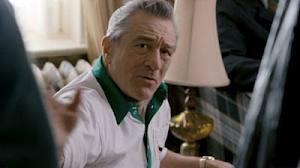
Then, during most excruciating moment of the film, when Patrick Solitano (Bradley Cooper) accidently slugs his mother (Jackie Weaver) and is attacked by his protective father (Robert DeNiro), the voice from behind me wailed softly, “I need to leave.  This is too painful to watch.”

I no longer thought the speaker aberrant and began to wonder how many others in the theater were experiencing the same level of discomfort.  Promoted as a comedy in the vein of a slightly more mature Judd Apatow kind of project, the film must shock people who settle into their seats and find themselves bombarded with the painful realities of familial dysfunction.  Most of us are at least a little put off.  Who among us has not lived through moments like the most disturbing ones in the film?

The Cooper character is identified as insane.  He has bipolar disorder, and others treat him as though he were contagious, distrusting his pronouncements, which, to be sure, are proclaimed, as he admits, “without a filter.”  They constantly instruct him to take his meds, meds he detests because they make him lose focus.  But look around him.  Is he honestly the craziest person in the group?  Ever?

When I was a kid, I had a relative who was hospitalized for depression.  She underwent shock treatments, was sequestered for months at a time in various institutions; then she was treated like a looney, derided and mistrusted by her nearest and dearest.  She had children, and it was particularly difficult for them, as they were left alone in a gossipy world without her protection.

I often wondered what she could possibly have done that got her put away.  Was it any less “normal” than the fights my father and I would have — physical fights, I’ll have you know — over whether I would go to church or what I would teach my sisters about sex?  Like Cooper, my relative was surrounded by a tribe of entirely unhinged personalities, yet she was the one who wore the scarlet I on her forehead.

When my relation was finally released from her incarceration, she was expected to take all manner of drugs, mostly the kind that made her drool and babble inchoate thoughts.  It was 1968, and the world was turning upside down, yet when she lost herself to uncontrollable weeping over the death of Bobby Kennedy, her doctors upped the dosage on her soporifics.  As if she were out of whack in a sensible world.  Meanwhile, I was running amuck pretending to myself that I was gainfully engaged in a (choose one) protest movement when all I was doing was drowning my fear in sex and cigarettes.  Who among us was sane?

What is the nature of sanity?  What constitutes successful coping?  In Silver Linings Playbook, the “sick” one tries to resolve the conflicts around him, to soothe the raging beasts who founder without ballast.  He counsels his best friend (John Ortiz) to fix his marriage and lose his destructive anger; he responds to his brother’s condescending attempt to make conversation by offering an embrace and saying, “I have nothing but love for you.”  He makes a futile effort to stop the tailgating frenzy that erupts when some of his theoretically rational compadres can’t control their urge to drink, fight and spew racial epithets.  All the while they are calling him the cuckoo, the wacko, the non compis mentis.imgres-3

His fellow nut case Tiffany (Jennifer Lawrence), whose embarrassed family attempts to keep her hidden from the rest of the world, solves the worst crises as they arise and puts broken Pat back together again while her entirely conventional sister is coming apart at every seam.

On the way out of the theater, I strained to hear what my neighbor would have to say.  I wondered, since she had entirely quieted down and had seemed to be engaged in the film, what she would think.

“I hated the first part of it,” she was saying as I slowly pulled my coat on and feigned looking for lost items of clothing.  “He just made me feel so empty.  I’m like that.”

The woman she was with muttered something I couldn’t hear, and they walked backward out of the theater, watching the credits, as I always do.  “I feel insane because I want to do and say what’s right, and it just gets so mixed up so much of the time.  And the world is so distorted.  How can anyone be sane?”

Just like the rest of us, I thought as I turned to take my place at the back of the rest room line.  The assembled women were quiet.  I wished I knew how many of them felt what that young woman had articulated.

I feel it every day.  Never more so than when I try to make sense of the news.

Two months ago, a young man named Adam Lanza took a bushmaster, an AR-15 automatic rifle and enough rounds to eliminate a large platoon of combatants into an elementary school.  There he gunned down twenty-six peaceful, harmless innocents.  The papers said he was insane, that he was being treated for emotional and mental disorders.  Yet it was his mother who owned the weaponry, stockpiled the armory in her home and then left it entirely accessible to her son.  Was she sane? Really?

Ultimately, Pat Solitano was lucky.  He was sent to the hospital by the law as a punishment for beating up his (theoretically reasonable) wife’s lover after he discovered them together in his home shower.  He got good care, found a very helpful doctor (Anupam Kher), and he learned strategies and skills with which to cope.  Most of us have to pay for our treatment, and it’s very expensive.imgres-2
That Adam Lanza’s mother, I, the young woman behind me, so many others probably need the kind of firm and gentle guidance Solitano gets from his Dr. Patel is a given.  But most of us cannot afford it, and health insurances are loathe to provide the needed coverage.  Besides, a good doctor is often very hard to find.

Which means that the vast majority of us are out there, swiping at stationary windmills, shouting at the moon, jostling one another with angry stares in subways and grocery stores, groping for inner peace.  It’s a problem.  A real problem.  One that needs to be dealt with in a big way.

There is nothing cute or dismiss-able about David O. Russell’s  brilliant Silver Linings Playbook.  It is a very real statement on how we view our fellow human beings, how we treat one another, how we drive one another crazy.

And it’s been effective.  Even Joe Biden and Barak Obama are initiating dialogue by citing the film.  But that’s only a start.  We all should be doing more than talking about it. We should be studying it, and we should be discussing what we can do to fix what is shattered and yet preserve what ain’t broke.  We should be insisting that the Nancy Lanzas get help right alongside their messed up kids.  We should be fighting for improved mental health care coverage and non-drug interventions.  Instead of stigmatizing people with emotional and mental disease and disorders, we should be standing with them, insisting they are more like us than different.  We need to recognize that it’s a crazy world we inhabit; loving one another is our best defense.

We must find ways to eliminate the desire to act out our anger, to employ guns to murder and create.  There are alternatives.  We will support them.

The last thing I heard my young neighbor say as she grabbed onto the revolving door to leave the theater and braced herself to meet the pelting sleet was, “It’s growing on me now.  I’m really glad I saw this movie.  You know?  It was really good, really true.  Don’t you think?  She pulled her hood up over her ears.  “It’s nice to know it’s not just me.”
Impossibly Impossible

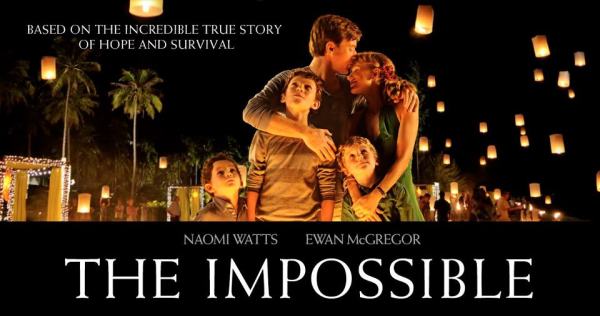
No doubt about it, The Impossible is a well crafted film.  The Tsunami is impeccably recreated, the acting is superb, and the script orchestrates intermittent tears with the deftness of a klezmer clarinet.  I hated it.
09TSUNAMI1_SPAN-articleLarge

Don’t get me wrong.  I admire the filmmaking.  Director Juan Antonio Bayona (The Orphanage) has crafted a remarkably terrifying horror film out of a natural disaster, and he has captured the aftermath with paralyzing clarity and alarming accuracy of detail.  He has harnessed a physical violence no Freddy Kruger film could possibly find.  And that is just what troubles me.

What is the point?  That we should respect and fear Nature?  Okay, I agree.  That tourists should stay away from Thai beach resorts?  What other recourse if you want to avoid the risk of being swept up in this kind of maelstrom?

I wonder if Bayona might have made that point more effectively if he had written more about the aftermath of the ordeal, more about the emotional violence every one of those survivors must surely have suffered in the months, now years, since the tragedy.

This is no Titanic or Ship of Fools with disparate characters thrown together and forced to recognize one another as fellow passengers on a death-bound express.  And therein lies, for me, the rub.

This is one family’s terrifying wrestling match with Fate.  We know precious little about them, and that’s all we need to know. Mom Maria (Naomi Watts)is a non-practicing doctor and Dad Henry(Ewan Macgregor) has a job in Tokyo; she has a hankering to go back to England, and he is ambivalent.  Their three boys Lucas, Simon and Thomas (Tom Holland, Samuel Joslin, and Oaklee Pendergast) are pretty typical — entitled, smart, cute.  They make a perfect group to illustrate the blindness of fate; why does this family survive when so many others were so less fortunate?

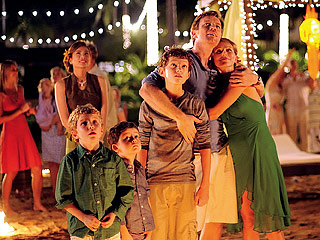
In perfect horror film cadences, Bayonna lulls his audience into the family’s idyll — not just their vacation in this perceived Phuket paradise but, moreover, the fairy-tale perfect family they embody.  fmp-the-impossibleMaria is beautiful, bright, calm and loving; she soothes her husband’s worry when he gets a text that implies he might fact difficulty at work.  Henry is handsome, intelligent, affectionate; he spends most of the time before the storm playing with and hugging his boys.  Then, knowing the viewers are securely tucked into the family’s Christmas paradise, he dashes them against the  harrowing flying debris — cars, trees, homes, animals, mud — and bloodiness of the tsunami.  The audience reels in the center of the mayhem along with the family as they are torn asunder, roiled in the brine, dashed back to land, remaining on the brink of disaster every minute of the film and until they are, miraculously, reunited and sent flying off to Singapore to begin their happy-ever-aftering.

Which, from where I stand, is where the real struggle will begin.

More than the moment-to-moment endeavor to keep breathing, the life they all move onto will most certainly be fraught with strife that few films, few novels thoroughly investigate: the real struggle for survival, the one that starts after calm returns to the world.  One of the trailers boasts that nothing is more powerful than the human spirit, but in the awful 72-hour wake of the immediate tidal wave, we only see the beginning of the test.

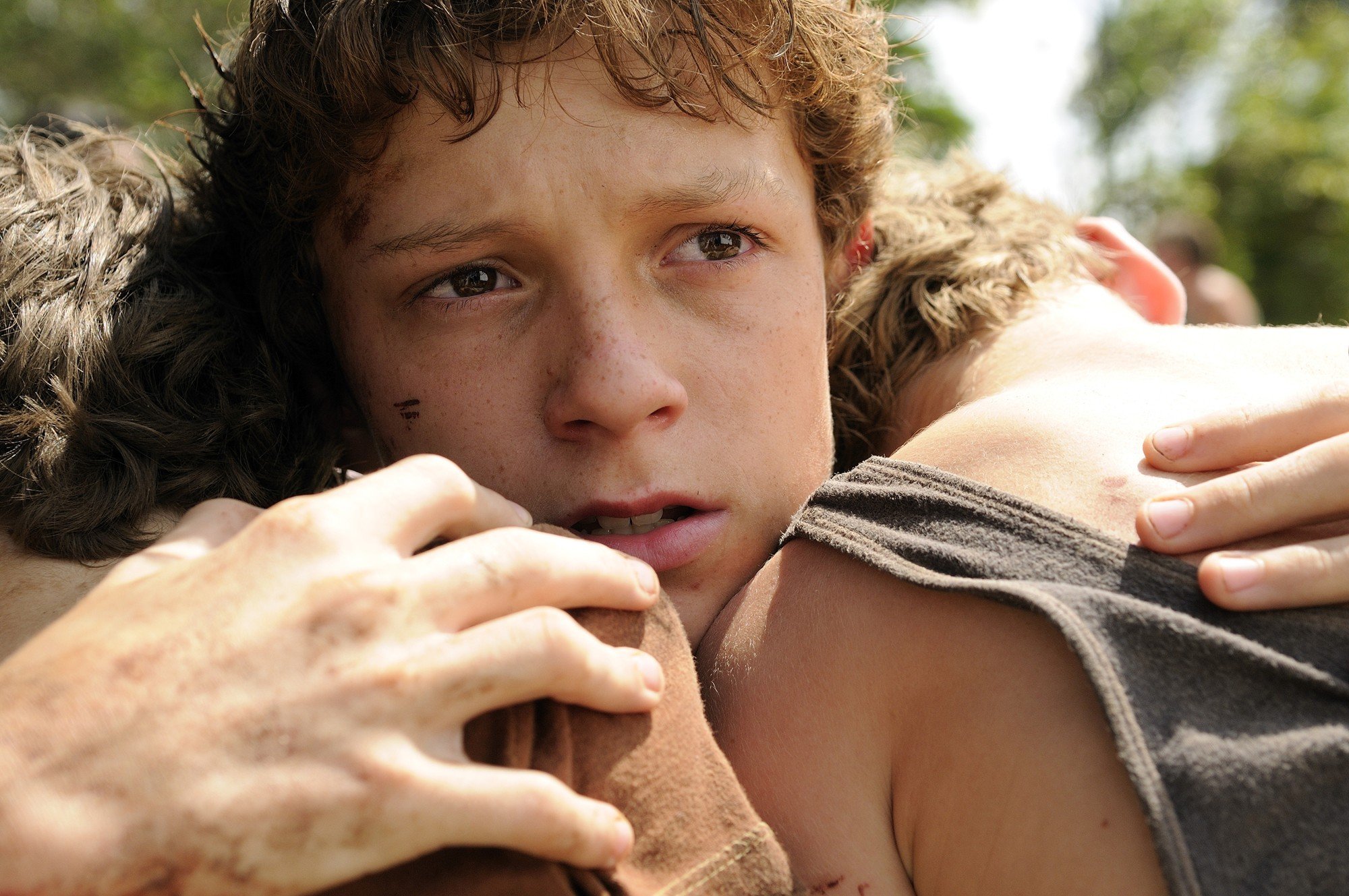
Several times in the course of the film, Bayona’s camera confides the horrors the family witnesses on the way out of mayhem.  We watch, rapt with fear and dread, as Maria comes up from the brown abyss, gasping and moaning.  She sees Lucas, still a self-absorbed child, clinging to flotsam, whining, “Make it stop, Mommy.  I don’t want to be here.”  Then, despite all indications to the contrary, the two manage to connect, and so Lucas begins his fast-forwarded transformation into manhood, while Maria learns to allow herself to be parented by her child.  No doubt about it, the human spirit is boundless, and these two are riveting in their courage.the-impossible06

But then the movie turns quite ordinary, sluggish, boring.  It begins to rely on tear-wrenching moments of great pain and emotion-numbing relief as the rest of the family is recalled to life.  There are some lovely bits — Lucas learns to find solace from his suffering by relieving others’, an old woman (Geraldine Chaplin) bonds with Simon under the stars — but we know how it’s going to end, and after a while we just want them to get on with it already.

The interesting stuff awaits them.  How completely must the nightmare in the water murder all their sleep from now on?  How entirely will the PTSD interfere with their interpersonal relationships?  How will the acrid smell and the visual obscenity of all those rotting dead cast along the shore, the road, the ditches on every inch of each one of their journeys to find one another?  How will their survivor guilt manifest?

Some fine acting has been captured in this movie.  Neither Watts nor Macgregor, who are usually fine, has ever shown more polished chops, and the boys are natural, believable, delightful.  Tom Holland emerges as the real find of the movie — his performance is subtle, nuanced, mature way beyond the actor’s sixteen years.

But how much more could this director have wrung from all that talent if they had had some human opponents to battle.  If, for example, they returned to England and found that no one remembered what they’d been through and just assumed that because they’ve lived, they should be nothing but grateful.  Or if Mom becomes a workaholic because she can’t shake the feeling that if she hadn’t been on so decadent a vacation, one of this would have happened.  If, after the idyll was dispelled, he had taken them back to — horror of horrors! – – real life.

My Personal Silver Linings Playbook

What was your favorite film this year, Carla?”

All over Facebook, my friends are pontificating about and citing personal nominations for this year’s best films. They’re not particularly judicious about it. “You should go back and see that film again,” one told me when I disagreed about a favorite film. “You clearly didn’t get it the first time.” Another, posting ebullient praise for a film that left me speechless with disappointment, concluded, “And if you don’t agree with me, you might as well unfriend me right now because I’m going to have to let you go because you are too unintelligent to be my friend!”

oscars_lead

So  I am here to respond in an equally patronizingly dismissive way, and I hereby declare myself a nominating committee of ONE.

My first action will be to remove most of the awards for anything or anyone involved with the making of Lincoln, with the exception of Tommy Lee Jones for his portrayal of Secretary Seward; I offer neither sycophantic praise for Anne Hathaway as Fantine nor demeaning slurs for Russell Crowe’s Javert in Les Mis; I’d prefer to extinct the film altogether. I would proclaim recognition for elements of Looper, a film I expected to hate but absolutely admired; and I’d add a few superlative categories for Skyfall, since its best elements don’t really fit in any of those that now exist.

In fact, in choosing the Best Film, I’d throw every 2012 movie off the list except for Argo and Silver Linings Playbook. These two pictures could duke it out for ALL the awards; they deserve to be nominated in every existing category and to have new ones invented so more of the work could be honored. These are two pictures that exist in a class by themselves in my personal playbook. But to answer the overwhelming question, “What was your favorite?” No hesitation: Silver Linings Playbook, my candidate for Best Film of 2012.

I am thoroughly prepared to be unfriended by the many zealots who preferred other films; but I was deeply moved by Silver Linings Playbook, and in the end, choosing a front-runner is a subjective, emotionally-driven pursuit.

In a year when there was enough real-life horror and violence to satisfy the most voracious blood lust, SLP offers none, and I admit I am swayed here by my gratitude. Even the fighting, replete with bloodied nose, was understated. This is a film that isn’t concerned with horrifying the audience; it’s there to entertain, and while it entertains, it teaches a bit as well. What a relief.

Never preachy, never sanctimonious, Silver Linings Playbook is that mirror unto nature perfectly positioned so that we behold the human condition. This is a well-told tale about characters who may seem, from time to time, to be strutting and fretting about their stage but who, in fact, are groping along in an earnest quest for happiness. They hurt each other along the way, and they lose themselves in self-centeredness, but these are characters who, despite all the baggage and the damage they’ve incurred from their various pasts, honestly live to love and be happy. They have learned to function in a dysfunctional world and have become, as a result, paragons of dysfunction. And yet they are at heart rational beings who learn what they already intuited, that the only panacea for any of our pain is commitment to one another.

There is no villain in Silver Linings Playbook. When people get hurt, when people violate one another, they do so out of an inability to live up to expectations — their own and others’ — and they fall prey to their own lack of patience. There is no conniving, no evil plotting; and the only weapons they wield are verbal affronts and over-zealous fists. Since there is no villain, there is no hero, not even an anti-hero.

Lawrence-Cooper

The protagonist in SLP is neither abundantly good nor adorably bad. He is Pat – Patty to his parents, with whom he lives — Solitano, Jr. (Bradley Cooper), released, at open, from institutionalization for beating up the man he caught naked in the shower with his beloved wife; he is bipolar, a creative thinker fighting his demons every minute of his every day and has no illusions about the effect of drugs and booze in his life. He would be very grateful if he could just remain sober and prove that he is sane and lovable enough to make his estranged wife return to him. Well, that’s what he thinks he wants for most of the film, and what makes the whole thing so very satisfying is the complexity and completeness of his arc, a very palatable arc. When Patty has his epiphany, it happens in a quiet, subtle moment that demonstrates Bradley Cooper’s real chops as an actor and David O. Russell’s ability to find them. Which is something Russell does really well — remember the acting in The Fighter? — for Anupam Kher, Jennifer Lawrence, Julia Stiles,Chris Tucker, Jackie Weaver, and the entire Linings cast.weaver-robert-deniro

But nothing he elicits from the other actors comes close to what he gets out of Robert DeNiro, who has, of late, seemed to be trying so hard to make acting a struggle to be way over the top that he’s been making my teeth ache. Here DeNiro is as natural and as believable as he was in Deerhunter. He’s superb in SLP, inhabiting the confused but steadfast Pat Sr., who wants to be paternal but isn’t exactly sure what’s needed from him, what’s expected, even what’s acceptable. He’s funny without reaching for the joke, and he’s poignant without manipulating us toward tears.Deniro

The Solitanos are a troubled family, who succumb to forces we rarely talk about anymore. This is a family that lives in our real world, which wants everyone to act alike, think alike, respond to stimuli in a prescribed manner, and where drugs are omnipresent, revered as magic potions that can erase every little aberration. Patty is constantly being reminded to take his meds, but he hates them, and he has become an inmate in his own private Cuckoo’s Nest, plagued mercilessly by unlikely, unwitting familial Big Nurses. He meets Tiffany, also afflicted with some mental health issues,  who, too, has chosen to eschew the soporific effects of her medications. In one brilliant exchange, the two run through a litany of the drugs they know and despise and the failure of each to be even marginally appeasing. No filmmaker since Gus Van Sant (Drugstore Cowboy) has been so lucid in examining the state of the true American drug war, in capturing how the magic pills that promise to make things perfect only succeed in shifting things out of focus.Russell 2

SLP strikes a deeply resonant chord because so many of us, afflicted with social ineptitudes, with anger issues, etc., understand too well the fine line between agitation and insanity, and it elucidates the many ways that parents are disempowered by their grown children while at the same time they are stripping those same kids of their ability to thrive.

In the end, the film is most affecting in that it affirms that the only drug that fixes anything or anyone is love.

That’s a lot to pack into a funny, well-acted, plaintive, beautifully orchestrated, carefully directed film. What an achievement.

The Silver Linings Featurette

It Tolls for Thee

Redux . . . http://abcnews.go.com/US/oregon-school-shooter-15-heavily-armed/story?id=24093516

Too many martyrs and too many dead
Too many lies, too many empty words were said
Too many times for too many angry men
Oh, let it never be again.
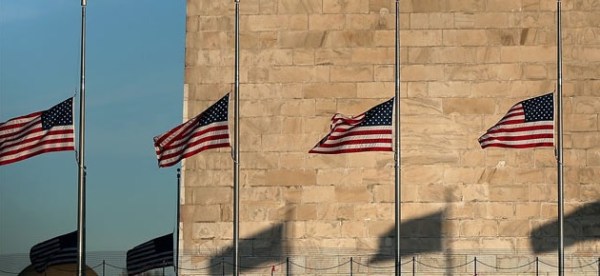
Phil OchsA U.S. flag flies at half staff in front of the Reed Intermediate School in Newtown, Connecticut, following a shooting nearby at Sandy Hook Elementary School

I was in my classroom when the call came.

The school was brand new, a vast industrial, accidentally brutalist building, with long, silent corridors, poorly lit because bulbs were forever burning out.  Video monitors in every hallway streamed endless loops of Channel 1 News, but except at passing time, the halls were empty.  No one monitored the comings and goings at the multiple entrances and exits, and no stood watch to ask if a newcomer belonged there.

The day of our incident, just before the holiday, I remember many of my own students being absent.  The four or five present members of my drama class and I were watching a film, whiling away the countdown to early dismissal.  And then my phone rang.

“This is Principal M____.” My usually friendly boss spoke from what sounded like a great distance,  in a manner that was forced, cold.  She was actually talking to every classroom at once, trying to be quiet so that she stirred no reprisal, caused no reactions.  “You are to lock your door from the inside, sit with your students on the floor, and stay put until further notice.”  She paused.  “There is a gunman in the building.  No shots have been fired, but we are working to apprehend him without incident.”

As is my wont in crises, I did not feel any specific emotion right away.  I made light of the situation, sat with my kids playing a game.  I was distracted by the niggling, infuriating awareness of the myriad inconveniences this could portend.  My children required transportation to and from their destinations, my husband’s dinner needed preparing, and I had no way to let anyone know what was going on.  All the mundane chores of the day loomed ahead, and I chafed at being delayed while I fretted that the kids might hear reports of the disturbance and worry for my safety.  Only then did I even begin to think about the gunman roaming the halls.

A shot rang out.  Well, we assumed it was a shot fired. Through the institutional walls, the sound could have come just as well from outside and been a car backfiring, but we knew it was a gun.  The kids huddled close to one another and trembled.  Some of the girls were sobbing.  The two boys in the class were tapping their feet, drumming, flicking lighters imbedded in their pockets.  I was impatient, thinking about catching up with my life.

The end result was an anticlimax.  Altogether, we heard three shots fired, none aimed at human beings, and then no sounds at all.  After a couple hours, the person was apprehended, and we were released.  Physically released anyway.

Columbine had happened only a few months before, and as the realities sank in, the images of that day began to play over and over in every level of my consciousness.  By the time I got home, I found myself shaking.  I was furious, disempowered, terrified.  That night brought the first of many nightmare-disrupted sleeps, my dreams perverted by the many possible consequences my waking brain refused to acknowledge.

I left teaching soon thereafter, and I am sure that the afternoon of the gun propelled my premature exit from the profession; I couldn’t continue to face the terrible vulnerability that visited me in those horrific nightmares.   My then husband scoffed at my dread, reminded me endlessly that nothing had happened.  And that was how I knew I couldn’t live with him anymore.

My memory of that trauma haunts me still, and I am willing to bet that it haunts every person who was there that day.  Looking into the eye of violence is unforgettably agonizing.

I cannot imagine what it feels like to have survived in Newtown today.  I would be willing to bet that there is no one in that town or its environs who will go about his/her life unscathed.   The events in that elementary school, where a troubled young man killed the hopes and dreams of twenty-nine families in less than ten minutes are senseless, infuriating, immobilizing.  No words adequately describe any of it, though newspeople, texters, im-ers, FB subscribers, bloggers will keep trying to find some. Because to capture this giant poison and get it into a verbal jar helps us sort through, seek the peace we will probably never find.

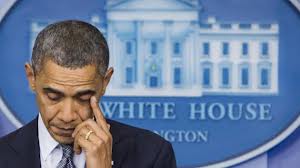
What makes it hardest of all is that the solutions are not clear.  President Obama is criticized for giving lip service to the horror, but the truth is that that is all we have. imgres-1

The knee-jerk reaction of the liberals among us was to scream for gun control, to decry the hold the NRA has on the nation.  I’m one of those hippies who wouldn’t give my children toy guns; no one is more anti-gun than I am.  But the sad truth is that gun control would not have prevented Newtown.  The guns were duly registered in the name of the gunman’s mother, who was legally entitled to own the gun that killed her.

The second reaction among us was to blame the health care system.  A friend of mine, who is a health care professional with a family history of mental illness, sobbed, “The system puts these kids out of treatment, out of physicians’ watchful eyes as soon as they are 18, turning them into health care orphans.”  She is right.  Our health care system is terrible, but, again, in this case, the shooter was not without support and care.

The problem is deeply ensconced somewhere in our American psyche, perhaps in the cowboy/mafia/noir fetishes we have nurtured in ourselves, perhaps in our collective isolation from the civilizations across the waters.  I don’t know where it is or what causes it, but I do know that in other countries where citizens own guns, crimes like Newtown, like the Oregon mall, like Aurora are far less frequent, and the threat of violence is far less omnipresent.   I spent a month in Thailand, and at no time when I was walking did anyone point his car at me and threaten to kill me as a man did here in New York the other day.  There is an anger, a seething ire that bubbles forth in unthinkable ways.  And it explodes, kills our children and grandparents and uncles and friends not only with guns but with vehicles driven drunkenly, with fists wielded in stadium fights, with cruel words that drive the fragile to suicide.

What can we do to stop the violence when we hardly understand it and have no remedies at hand?

For one thing, we can admit that we are all in this struggle together and cling to one another in more loving, positive ways.  What happened in Newtown was not perpetrated by an “other” out there threatening us; the devastation was wrought from within our own ranks, and we need to look within ourselves for ways to create a more loving environment with less alienation.  I realize I sound like a character in Volunteers, and I should be singing “We shall overcome,” but shouldn’t we at least begin here?

Then, too, we can reach out to the people of Newtown and let them know that we acknowledge that every one among them is a victim.  Every one of them has been traumatized and forced to carry a burden no one deserves.  Every man, woman and child in that community has been scarred for life.  Because there is no way to quantify grief, it is not for any of us who were spared to judge whose grief is heavier.  The people whose families are in tact tonight can be in as much pain as those who must bury theirs.  Acknowledging all the sufferers, validating the throbbing ache each will endure from now on must contribute to their healing.  Everyone touched by today’s horror needs to be heard, needs to be comforted, needs to be reassured that they will face no malice, no recrimination for having lived.

Of course, we must begin to seek ways to heal the ills that afflict the misguided, violently solipsistic people who solve their malaise by pointing guns.  If they are ill, their illnesses need to be recognized and dealt with before they explode; if they are simply grotesquely entitled, they need to be educated in how to become citizens.

Further, it is vital that we point our attention to a system that gives money and time to gun lobbyists but takes money and time away from education. Many an alienated soul has been saved by an arts education program, has discovered therein a way to express the need to murder and create without bloodshed.

This is not going away.  The people of Newtown, the people of Connecticut, the people of the East Coast and by tomorrow, the people of the entire country will live in the shadow of this day forever.

Question is, how can we protect the other Newtowns to come?  It’s already too late to begin, but better late than never. . . .

Ill Will Hunting

Someone tried to kill me today.

Did I incite the near violence?  Perhaps.  But I certainly meant my would-be murderer no harm.
0

Turning onto Broadway from 125th Street, clearly in a hurry, a young man behind the wheel of a white van failed to slow down for his turn and entered the crosswalk. I happen to know that it is illegal for a vehicle to enter a crosswalk when the walking icon is white, so I pointed to the traffic light in an effort to raise the driver’s awareness.    Then, in my best Dustin Hoffman voice, I admonished, “I’m walkin’ here,” and I smiled.  The driver was not impressed. In reply, he gunned his motor, pointed his vehicle right at me, and accelerated.

I managed to jump out of the way, and my daughter’s Chihuahua, toddling beside me, managed to evade the oncoming wheel, but it was close.  We did not survive because the driver meant to let us go.  He would have relished the kill.

I staggered to the curb and I caught my breath before I looked up to see if I could ID him, but he was already cresting the hill, about to be out of sight.  There was no license plate on the back of his van, so I had no choice but to watch him disappear into the ebbing traffic.

Witnesses abounded, but except for a young woman crossing near enough to us to have been concurrently endangered, no one so much as tsikached in disgust.  The co-walker blanched and shook her head over and over but said nothing to me.

I’ll be seeing that man’s face as I attempt to sleep tonight and for many nights to come.  As I nearly froze in the headlights of the man’s stare, glowing with delighted anticipation, I was aware of some prophets’ omens written on the subway walls.
IMG_9689

First, this guy is not the first nor will he be the last to have a death wish for me.  We have never met, and I don’t know him personally, but I am sure he was thrilled at the notion of eliminating an old white woman.  I have lived in Harlem for a number of years, and I am aware that despite the fact that I am not in any way superior to my neighbors in income or quality of life, I look like I am, and I am often the object of their contempt.  It’s the inevitable result of the extraordinary disparity between the haves and have-nots, more salient here than anywhere in the country.  Resentment flourishes, and misunderstandings abound.  11_kensinger_west_harlem_pier_DSC_5936

Columbia University, viewed by the locals as the bastion of the high and the mighty, is spreading through the area, encroaching on any territory their eminent domain allows them.  Rents are rising just as quickly as affordable housing is disappearing.  We are approaching something called a fiscal cliff, which few understand but everyone fears.  People are desperate; unemployment is high, and there is little incentive to curb the natural impulse to take risks, to defy the law, to push the envelope to its tearing point because there is little to nothing to lose.  I often feel like an interloper.

Second, the incident was undoubtedly seen and ignored by the police.  There is never a dearth of officers on 125th Street, but the police simply do not patrol these streets for dangerous traffic violations.  Harlem roadways, especially 125th Street, Broadway, and Amsterdam Avenue are more like freeways than local streets.  Cars and trucks soar at high speeds, and police rarely give chase except after cars driven by the elderly and otherwise slow-moving operators, whom they get for expensive but nonthreatening infractions.  The big things, like speeding or wielding the car as a loaded weapon go unchecked.  Trucks and vans especially burn their rubber with abandon, heedless of posted limits, potholes, foot-draggin children and aged, or any other impediment to excessive speed.

Police are underpaid, overworked and apathetic.  Citizens are harried, worried, pressured by financial insecurities and faced with staggering unemployment. There’s a fiscal cliff that few understand but everyone fears. It’s a scary world out there.

And someone tried to kill me today.