Catch a Flying Star.

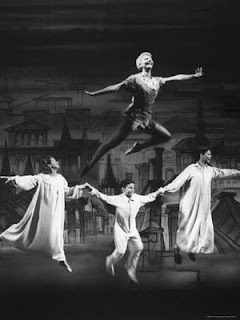
Mary Martin as Peter Pan with Wendy (Kathleen Nolan), Michael (Joseph Stafford) and John (Robert Harrington), 1954

I was 7 when my mother took me to a friend’s house to watch the first telecast of Peter Pan starring Mary Martin.  While I loved Peter, I saw myself in Wendy(Kathleen Nolan), my more accomplished self, stuck in responsibilities, too pragmatic and obedient to just crow.  Jumping up and down with excitement, I watched her take off on her first flight, and I think that was the first time I remember crying for joy.  Wendy was saved.  No matter what, she’d never again be trapped in that holding pattern where a young lady is not allowed to be a child but isn’t yet respected as an adult.  From now on, when adults yelled at her, Wendy could escape, return to the joyous memory of flying.

Which made me wonder about Wendy’s mother.  Would she, like my mother, be impatient with the frivolity of childhood?  When Wendy was in her room writing about Peter, would her mother shame her into emerging from her cocoon to look after siblings?  Would Wendy’s mother be angry when Wendy slept too late after a night of fantasy-induced insomnia?  I concluded that Wendy’s mother must be far too enlightened for any of that.  No doubt, Wendy’s mom had had a spectacular childhood, and, as a result, took pleasure from her daughter’s fancies.  In short, Wendy’s mother was my ideal mom.  Every year, I’d watch Mary Martin fly away, leaving Wendy and Nana, and I wasn’t the least bit sad.  Because I just knew that Wendy was happily where she belonged.

How gratifying that Rick Elice has envisioned the perfect childhood for my imaginary mother.  His Molly (Celia Keenan-Bolger), the heroine of Peter and the Star Catcher, who will be Wendy’s mother someday, is strong and brave and smart and competitive and obnoxiously self-assured; she leads the boys into their life of perpetual childhood, a life she has even designed for them.  She facilitates Peter’s epiphany that allows him to meet himself and laughs in the face of Captain Black Stache (Christian Borle) as she thwarts his evil and sets him up as the favorite prey for the omnipresent croc.  In short, Wendy’s mother Molly is exactly the kind of girl I wanted to believe my mother should have been because she was who I wished I were.
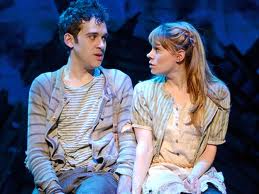
Boy (Adam Chanler-Berat) and Molly (Celia Keenan-Bolger)

Wendy isn’t the kind of girl who’ll grow up to be a man-hating feminist.  Nor will she ever want to be one of the guys.  She is proud of her femininity and then reveals that she is also unafraid to be soft and vulnerable. Celia Keenan-Bolger captures her brilliantly, her perfect voice and demeanor cloaking the girl (or is she really older than we think?) in vari-colored nuances that make her starkly real while still a figment of our collective imagination.
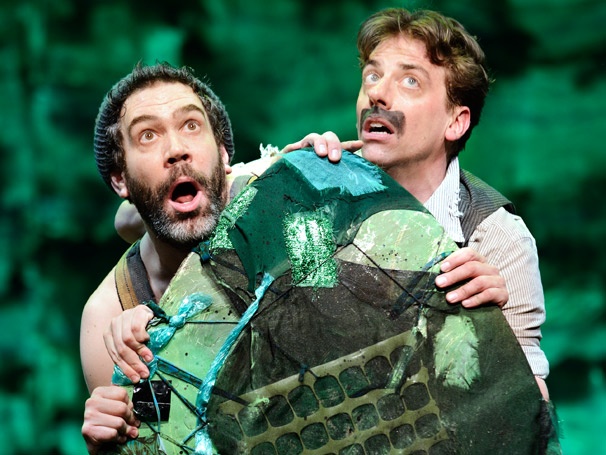
Smee (Kevin Del Aguila) and Stache (Christian Borle)

 Wendy is not alone onstage.  She is surrounded by a brilliant company, swinging from role to role never dropping even a shadow of the thread.  Christian Borle could not be more enchanting as the company man and the dastardly Captain Stache. He chews up the scenery in a frolicking frenzy of masterful comic acting and then, to prove his true command of the craft, he revels in a line that pokes fun at himself for doing so — vowing that no croc is going to devour scenery while he’s onstage!
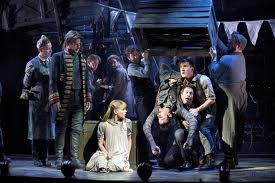
Peter and the Star Catcher Company

There’s no one who’s not terrific here.  Adam Chanler-Berat as Boy, Arnie Burton as Mrs. Bumbrake, and  Kevin Del Aguila as Smee may seem salient, but the whole ensemble deserves equal credit for bringing this romp to full-boar life.

 Peter and the Star Catcher misses not one single beat in this production, now playing at the Brooks Atkinson Theater (http://peterandthestarcatcher.com).  Directors Roger Rees and Alex Timbers have found just the right pace, exactly the best staging, have chosen precisely the best creative team, and there isn’t so much as a single hiccup of error.
Which brings it all back to Rick Elice.  The best character in this play is The Play itself.  Pure theatrics at their most basically theatrical.  No pyrotechnics, no high gloss effects, jut flawless actors capable of endowing pieces of string with more life than a wilderness of monkeys.  Peppered with allusions to everything you’ve ever seen (or read) and loved before but rife with originality, this is a play that asks the audience to play along, to suspend disbelief in the suspension of disbelief and then gently forces us to believe long before Peter asks us to clap and prove it.

In the end, empowered by our own delight, we leave theater knowing that the vagaries of our lives and its multiple responsibilities will hereafter be mitigated by this memory of flying.


The Sisters Over Sixty Series – Part I: Anna Thea Bogdanovich

My mother and her sisters, having lived in the shadow of their brother — and then their brother’s death — all their lives should have known better.  Shaped by the attitudes and norms with which they were raised, they doted on their sons; while they loved and even (perhaps secretly) admired their daughters, they did not reveal to their girls the kind of support and encouragement they lavished on their sons.  My female cousins, my sisters and I, especially those of us who followed creative paths, were left to grope our way to self-actualization, which is not a bad thing.  We turned out to be resilient, strong and iconoclastic.  We became, in the aggregate, very like our mothers, only more so.  The kind of women I want my daughters and granddaughters to become at heart.

By the time my cousin Anna Thea Bogdanovich was born, her now-famous brother Peter was thirteen and only a few years short of establishing himself in his career in the dramatic arts, the family’s resources having already been allocated to his professional training. He had himself been born on the heels of tragedy and loss, and he was for his parents and grandparents the beacon that recalled them to life.

Peter is an amazing talent who cast a giant shadow, but Anna Thea has found her own well self-illuminated niche as a singer-songwriter and crafter of screenplays.  She curates The Bogdanovich Collection, her father’s vast legacy of paintings, sketches, drawings — the art that dominated his life — and works as a script consultant at Colleen Camp Productions in Hollywood.

Anna Thea Bogdanovich has had a varied career.  She had a long stint as Development Consultant at TMC Entertainment, and her musical documentary Earth Tribe LA was nominated for an Emmy Award.  But Anna’s proudest achievement is a project she embarked on only recently, one that continues to evolve and to take on a life of its own.  

Anna Thea Bogdanovich conceived, founded and directs World Beat Media to produce “film, music and multimedia projects that inspire good will and understanding across cultures.” She has dedicated her work to the goal of” achieving a global epiphany of our shared humanity and interconnectedness with all life.”

One of Anna’s first productions with World Beat Media was Freedom’s Land, a music video that celebrates, in singer Willie Nelson’s words, “the everyday rituals and practices of peaceful people” and is featured on the singer’s Peace Research website (http://bit.ly/KAfyE4) with words of high praise. 

World Beat Media is in preproduction on the new Earth Tribe LA 2012, which will feature multicultural singers and musicians of all ages in a pop/worldbeat song and music video. The World Beat Media website (www.worldbeatmedia.com) is under re-construction, and Anna is in the process of developing a YouTube channel, which she hopes to launch in 2013, and which will be “dedicated to individual and collective peace, healing and transformation through the arts and new media, and will include original cross-collaborative multimedia projects using media technology.” The channel will also be used to generate programs that will raise money for various children’s charities.www.youtube.com/user/WorldBeatMediaCom

Anna Thea Bogdanovich is a woman who has forged her own path.  It’s not been paved, and navigating will take some effort, but she will prevail.  After all, Anna Thea Bogdanovich is her own bright torch!

To preview and buy Freedom’s Land song or music video on iTunes

A Mother’s Day Gift to My Children – Part X

Mom and I had grown apart as I aged.  While she adored my three kids and was thrilled that we had chosen to bring them up Jewish, she was as deeply engrossed in her career as I was in mothering.  My family and I had moved to Arizona in 1972 to be close to her, but when I moved back to my beloved East in 1987, I felt a kind of relief.  I would no longer have to face the daily disappointment, recognizing that the expected connection we had always had no longer seemed to be there.  We spoke on the phone several times a week, and we visited as often as we could, but for better and worse, it was never the same.

Just before she died in 1999, Mom asked me if she had done enough.

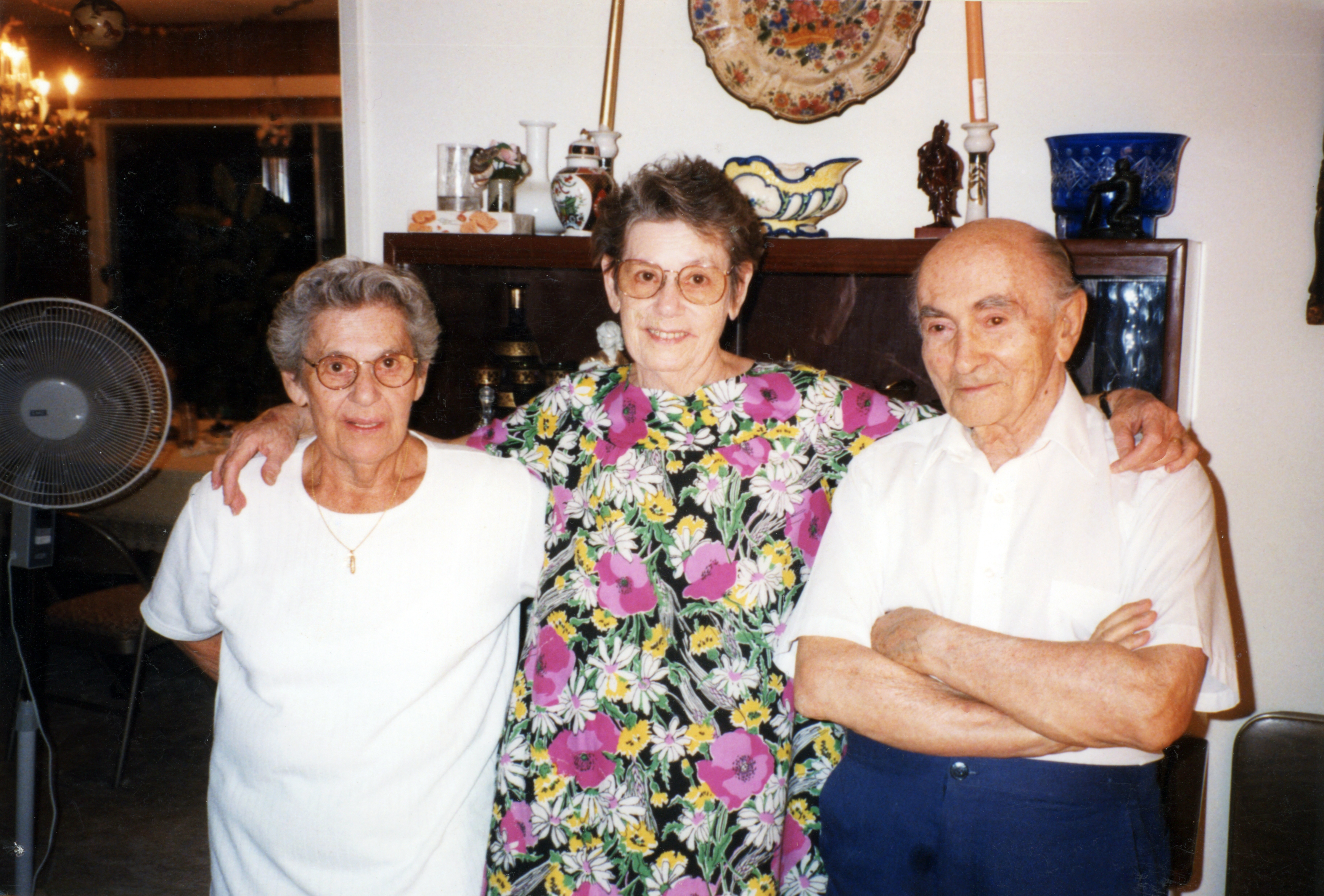
Charlotte with her younger sister Ruth (center) and Ruth’s husband Uncle Fred. The three were constant companions, especially after Herma’s death, and when Charlotte died suddenly in 1999, the loss was devastating to the last remaining sister.

She wasn’t ready to go — she shouldn’t have been; she was only 76, was still tutoring and teaching every day, still contributing to the world in her varied ways.  She had volunteered in Israel, the culmination of a childhood dream, and had traveled back to Zagreb among other places in Europe to revisit both halcyon and heinous days of her youth; she was an active participant in a life broadly lived.  All five of her grandchildren and six step-grands adored her, and her still-growing legions of former students continued to call and visit her regularly.  There was so much left to live for.  What else could I do but nod vigorously and reassure her, “You have, mom.  You’ve done plenty.”

No one could have done more.

A Mother’s Day Gift to My Children – Part IX

In 1970, another tragedy fueled another uprooting.

Only four years after relocating to Scottsdale, AZ, and finding a sudden surge of interest in his art, Herma’s husband died suddenly the day after Thanksgiving.  “It’s time,” Mama declared, “for a rapprochement! ”  She bullied Alfred into moving them across the country, to a house less than a five-minute walk from Herma’s.  Four of the kids were still in school — the youngest, in fact –was still in middle school, but she was undeterred.  Once she had moved, her mother and father followed, and soon thereafter her younger sister Ruth with husband Fred as well.  The family reunited and began life anew.  Yet again.

If Charlotte and her sisters had been paid by the Arizona Chamber of Commerce, they could not have been more effervescent spokeswomen for the state. None of them had any desire ever to return to the gentle greenness of the east coast; they were delighted with the dry warm winters, the fragrant springs, even the blistering summers.  Visiting Connecticut in the ’90’s, Mom declared, “I feel so closed in.  I can’t see the sky.  Too many trees!”  Arizona suited her. “When Hitler threatened us, I begged my father to let me go to Israel with B’Nai B’rith, but he insisted I come to America with the rest of them.  This is my consolation prize,” she would exclaim, reveling in an Arizona sunset.  “This is Heaven!”

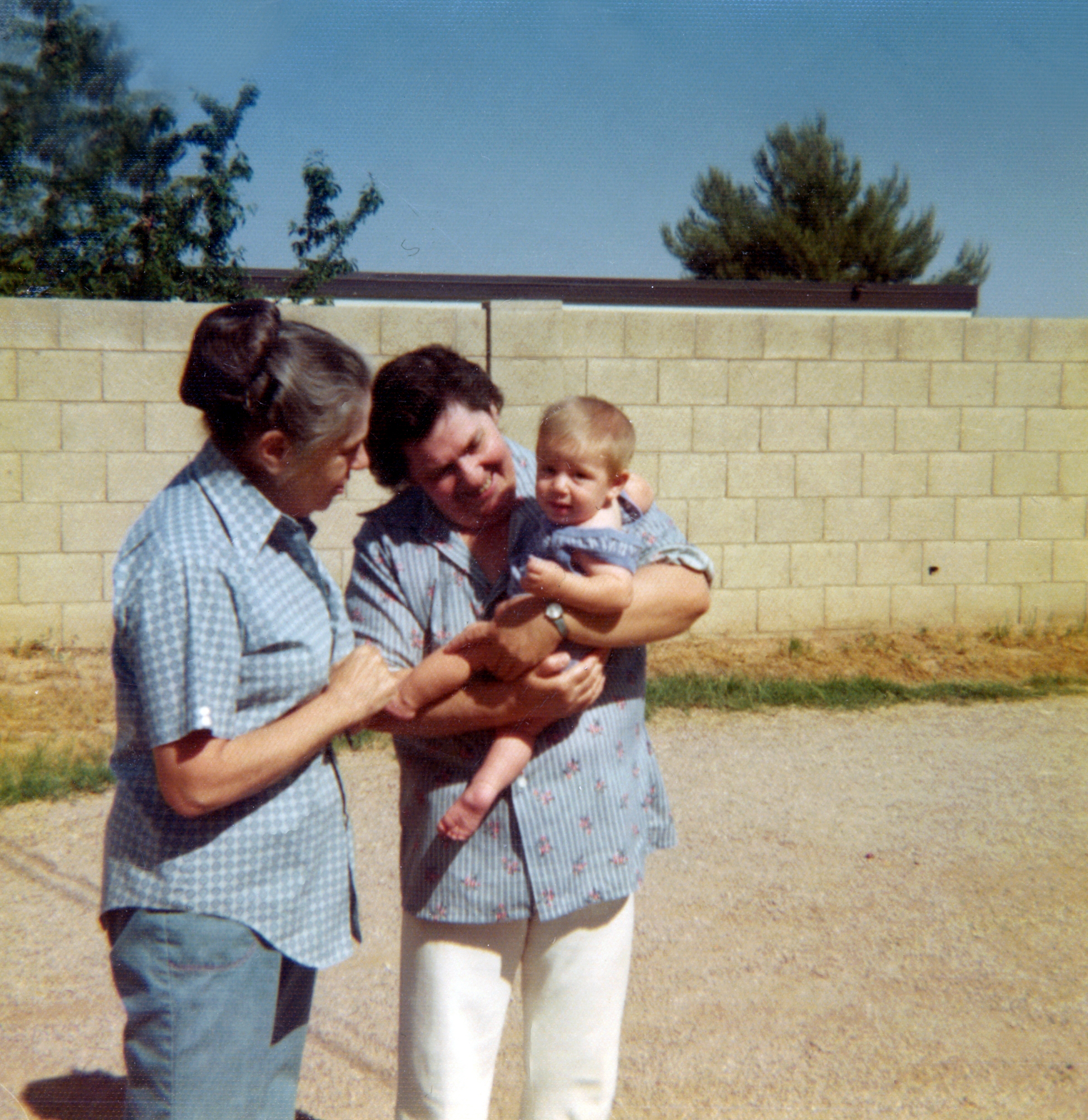
Herma, right, and Charlotte in 1975 with my firstborn – Both adored their grandchildren.

Then, in 1974, her world threatened to unravel once more.  Both Ruth and Herma were diagnosed with cancer, and Herma died in 1979.  This time Charlotte had polished her armor.  After her beloved Herma left her, she very quickly absorbed the loss and buried herself in her professional development.

After a rough start — in a middle school where the principal was put off by her accent — Charlotte found work in Scottsdale and taught not only Biology but Special Education as well, for the next 25 years; after she died in 1999, the school auditorium was full to bursting with students, teachers, alums, who came to say farewell to a most beloved, greatly revered teacher and friend.

A Mother’s Day Gift to My Children, Part VIII

When my youngest brother, nearly 14 years my junior, started first grade in the late ’60’s, against my father’s wishes, Mama went back to school.  She wasn’t sure the purpose yet — she was only sure that it was way too late to consider med school — but she wanted to further her studies in biology.  She loved the science, loved academics, loved the intercourse with teachers and fellow students she’d excelled at at UVM.

For the next two years, she managed her wifely chores, drove children where they needed to be, battened all hatches, and then traveled — in wind, rain, snow, sleet or dripping humidity — the fifty miles from her home to the State University of NY at Plattsburgh, where she would attend her classes only to drive home to do her homework, conduct research, do whatever was necessary in order to finish the degree while she cooked and cleaned and tutored her children through their homework.  She was almost intolerably proud of herself when she finished.  I didn’t appreciate the feat then, but I do now, and more with each passing year.

Armed with her new degree, she decided to go back to work.  Doing what?  She had come to realize she was a gifted teacher, and she loved teenagers; she decided she would be a science teacher, and in no time she secured a job at Lake Placid High School.

But Alfred was unhappy about that.  Miserable in fact.  By applying pressure, by being petulant, by punishing her in myriad little ways, he got her to quit.  In the middle of a semester.  Any aspirations of pedagogy in the Northeast were dashed.