Back on the Road With Grandma – Part II – View from the Courtyard. . . It Seems So Simple Really

From my window, I have a world view I wish I could share with my fellow Americans.

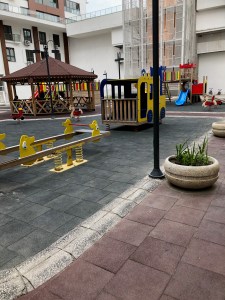
I am currently in an apartment complex in Istanbul. On the European side. Four separate entrances to four connected but independent buildings comprise the 12-story structure that wraps itself around a large courtyard, a recreational close.

In the center of the courtyard is a very large gazebo.

With ample seating for at least 20 adults and floor space for at least as many children. Much of the day, it is occupied by mothers and a few fathers, who chat amongst themselves while their many children run exuberantly about. They are often there until well after 10 PM.

No one in any of the flats that face the courtyard fears missing the opportunity to be part of the communal scene. Each apartment faces the square, and curtains on the sliding doors leading to a small balcony are invariably open. By placing a couch set at the sliding door, inhabitants extend the indoor living space out into the world of the square. Sound carries easily. From the comfort of home, they intermittently call to one another, supervise unruly children, and engage with the flow of life below.

I imagine our neighbors wonder what is wrong with us that we are so anti-social as to keep our windows covered, our doors closed.

Solitude, then, is not the ideal here. Personal space is meant to be shared. It extends beyond our courtyard into the activity that bustles about us. On the street, in stores, at the local market one is likely to feel crowded even when there are no more than a few people nearby. Walking close to one another seems a requirement on the walkways. Driving far too close is common practice on the roads.

Life here is on a clock set for summer hours. Revels extend late into the night, and nearly nothing stirs before 9 AM, even on workdays. This is lucky for me. My need for alone time, for the wide berth of privacy, is satisfied by my early-morning sessions in the exercise room or by eschewing the sun-drenched outdoor pool in favor of the dimly lit indoor equivalent.

I adjust to what might feel like perpetual invasiveness, even when people are staring at me with great curiosity. The ultra-communal atmosphere fascinates me. It instructs me about the world to which I will soon return.

In my neighborhood in Harlem, apartments are built to ensure the most privacy one can hope for in a crowded city. They are built with an American sense of individuality. Bolted doors, barred windows help to reinforce the notion that boundaries matter.

It is a notion that is just as foreign to many of my neighbors in Harlem as it is to those here in Istanbul. Like my neighbors in this courtyard world, my fellow Manhattanville residents are from places where the house is the place to sleep. In the warm climes – in places like this part of Turkey, the Caribbean Islands, large sections of Africa, Asia, South America, and the Asian subcontinent — the cultures encourage and even require communalism. Folks often and comfortably congregate in courtyards, on the beaches, in the marketplace. In Harlem, they replace the familiar sharing places with city sidewalks, local parks, even the local grocery stores.

I have been known to grouse about the way the habits of the collective affect me, interfere with my limits. Though I crave diversity and delight in the culinary benefits these strangers have brought to my city, I also complain about the things that niggle.

Watching the courtyard below me in this very foreign place is a kind of revelation, a reminder of how fortunate I am to experience this perspective changer.

I pledge to remind myself often — at night, when I wish the noise on the street would just stop, on my block, when I am having trouble walking quickly because of the lawn chairs and hibachis blocking my way, in Whole Foods when another shopper’s cart refuses to move more than an inch from me, on my way to work when the tourists walking four abreast slow my progress from point A to B, in my own apartment building, when it is abuzz with folks iding together – that my way of living is not universally the best. Awareness and perhaps a set of earplugs should enable me to adjust my point of view.

We white Americans have made a history of co-opting, usurping, and/or obliterating all traces of Others’ cultures. Our national beginnings are fraught with murder, enslavement, criminalization of anything un-white. We have stolen food, customs, traditions, language, and culture and have forcibly replaced what belongs to others, requiring that they embrace what is ours. We have taken this imperialistic attitude to the world, earning us the moniker of Ugly Americans. And in the time of Trump, we are doubling down on our insistence that the Other be like us or get out.

I don’t like what we’ve become, we white Americans. We are a fearful, suspicious, hateful lot with little understanding of these others settling on our shores. They are not here to take anything away from us. Yet we treat them as though it is a bad thing that their difference threatens our blandness. Every American should spend a week looking out of my Istanbul window and see that there is no harm in retaining individuality if that is what we want. We might be irritated by a handful of inconveniences, but in the end, our lives are enriched by allowing ourselves to observe and grin.

Perhaps a week at my window would engender a sorely-needed American attitude adjustment. Liberals need to see that while the people of the heartland have lacked exposure, they can watch, smile and accept with the rest of us. And so-called Conservatives need to shut up and listen, taste, touch the joy that happens in this courtyard. We can all adjust.

It’s so simple. Really. You may love your hamburgers, sandwiches, and wraps, but once you’ve tasted kofta or börek, you’ll know something more delicious. Preserving tradition is fine and dandy, but it’s always a sure bet that adding something new can give your life a whole new dimension.

Judgment Call

Once upon a time, I chose to be confirmed in the First United Methodist Church. I was twelve years old and a singular outlier in a closed society. I joined, hoping that membership would foster a kind of belonging I hungered for. I needed to feel embraced and protected by a great, all-encompassing love. The Methodist Church promised me that all were welcome there. I believed.

It is clear now that my iconoclastic half-  Jewish self would not even be invited to join the United Methodist Church today. Having recently announced their decision to allow ministers and administrators to ostracize members of the LGBTQ communities, the church has tacitly granted their congregations a license to shun anyone with traits the church finds offensive. There is no way they would welcome me.

I stopped attending church and identifying as a Methodist some sixty years ago. But until the announcement, however, I harbored a feeling of warmth for what I believed were its precepts. Those I learned from my father, perhaps the noblest Methodist of them all, and they are rooted in a memory I have of a time he acted in a way that demonstrated what I still believe Christianity is basically all about. Long after leaving his church, I attributed his accepting nature to the education it had given him.

In the 1970s, my brother was about to come out to my parents. I worried at first that my father might be less than sympathetic.  

Daddy, a conservative, Iowa-born Republican, belonged to the First United Methodist Church in my small Upstate New York home town. He was known there for the dour parables around which his lay sermons were constructed and by the incongruently kindly manner with which he delivered his fire and brimstone messages to the seventh graders he taught in Sunday School. Though he treated all people with compassion and consideration, his attitude could be harshly judgmental toward people with ethical or moral standards that were not his.

From early childhood, Daddy had been taught that liquor, gambling, card playing, and dancing were sins, as was pre- or extra-marital sex. His sense of humor was corny, old-fashioned, chaste.  He allowed no swearing of any kind in his presence. I was reprimanded when I said, “Oh, gosh,” or “Jesumcrow,” the faux curses that punctuated our Adirondack lingo. In our home, there were no alcoholic beverages, no playing cards, no off-color books or art house nudes. All were banned, I assumed, because my father’s faith required that he disdain them. He seemed to have been indoctrinated by a kind of paradoxical orthodoxy. It was hard to predict how he would react to being the father of a homosexual.

In the first place, the news did not surprise him. And in the second, it did not faze him. “You are my son, and I love you,” he said to my brother. “Nothing could change that.” Not long afterward, my brother, newly mustered out of the Air Force and figuring out what to do next, moved in with my parents. The man who was his first serious partner moved in with him.

I needn’t have worried.

One evening, I arrived at my parents’ house to find my brother and his boyfriend intertwined and making out on the couch in the middle of the family room at the center of the house. More surprising than their unabashed PDAs was the fact that my father sat in the easy chair next to them watching television and eating watermelon. “This doesn’t bother you, Daddy?” I asked pointing to the lovers, who were oblivious to my arrival.

“Should it?” Daddy replied.

“No. Not at all,” I stammered. “But your religion. . . “

“My religion is Jesus Christ,” he said. “Jesus said, ‘Judge not lest ye be judged.’ Shall I be less open than Jesus, whose teachings define my life?”

“But the church, Daddy, won’t the church. . . .”

“The church would never defy our Lord’s teachings.” He stopped. His eyes were distant. He lifted his arms. He was in preacher mode. “The Church welcomes all.”

I accepted him at his word. And I trusted that his beliefs emanated from the doctrine espoused by the religion to which he had unfaltering allegiance. He never missed a Sunday service, never failed to participate in church programs, never refused to teach or to counsel or to take to the pulpit. He was a true believer. So I presumed – hoped – that this church, in which he had raised his seven children, was as accepting as he was.

Hence my shock and confusion when I read the church’s announcement. Traditions I was not aware of had superseded those I had inferred. Traditions of barring homosexuals from ordination, of refusing to sanction same sex marriage, of enforcing strict penalties against clerics who broke the rules and accepted the “gay life style” as a viable human alternative.

Luckily, the declaration is no more than an abstract annoyance for me. And an affirmation of my choice to leave the church all those many years ago. But what of the people – there must be many – like my father. . . the true believers, the ones who honestly see their church as the messenger of their Christ? Does this feel like a betrayal to them? Their church has rejected the notions of inclusion, of loving one’s neighbor as oneself, of refraining from a judgment that Jesus demonstrated by washing Mary Magdalene’s feet, by breaking bread with sinners, by feeding and healing the lepers.

Surely Jesus would be disappointed in this Methodist manifesto. I know Daddy would be.


Notes From a Temporary (we hope) Curmudgeon – Day 1

From the week before Christmas till the penultimate week of January, I was in Asia. For some of the time, I was in Taoyuan, Taiwan then moved for the last two weeks to Bangkok, Thailand. I was immersed in the world of the two-year-old grandson, who was my constant companion.

That meant that, for the most part, I was absorbed intellectually and emotionally by the mercurial disposition of the little boy. But when he descended into the quiet of sleep, I found brief opportunities for critical thought, just before the curtain of fatigue closed over my brain. The internet was unstable, but I was able to search intermittently for both news of home and moments of entertainment. Thus, in the narrow alleyways of my own mind as it intersected with the limited scope of the available worldwide web, I found enough material to support a series of rants.

I was unusually cranky. It was hot in Asia. I am no fan of high temperatures. The hot weather exacerbated the extreme anxiety wrought of my distanced observation of the travesty that has become my beloved country.

From over there, it was difficult to assess the degree to which my homeland’s future was tenuous, but it wasn’t hard to picture the Orange Imposter standing on the steps of the Capitol Building grinning while Washington burned. A hideous manifestation of

Theater of the Absurd — an ersatz president strutting and fretting his too long hour upon the stage, pizzicato-ing across the instrument of our American government, threatening to pop the strings and break the neck. My reaction to things was probably more negative than it might have been had I stayed home.

I declaim my rants. I realize I am a victim of my own White Privilege, preyed upon by my sensitivity to an unstable internet connection and an Asian climate.

I acknowledge here that I am an outlier. My opinions and reactions reflect (nearly) none of my confederates’, my cohorts’, my co-anyones’. I react on my own, according to my own lens.

Thus beginneth the venting of my steam. . . Over the next few days, one rant a day. . .

1. The journey across the world.

I usually fly Taiwan’s own EVA Air. The service is terrific, the bathrooms are immaculate, the 777s offer sufficient leg room for my aching knee. Best of all, the company offers slippers that make it easy to shed shoes and still wander the ample aisle space and ward off PAD (peripheral Arterial disease). Unfortunately, I was traveling at exactly the same time as the myriad Asian kids leaving their American schools to spend the holidays at home, and EVA was booked solid.

I resorted to Qatar.

The flight over was miserable. Puddles in the bathrooms threatened dropped clothing, and in the absence of complimentary slippers, stocking feet. The

Airbus E350 has aisles too narrow for easy navigation. The endless sitting made my inner thighs ache. Seats are configured such that I was unable to sit up straight, and the strain on my back worsened as each of the 13 hours it took to get to the first stop (Doha) dragged on. No inflight entertainment soothed the soul either. Every film on the agenda was an action or horror film. I’m too old for those. Instead, I watched the Netflix shows I had downloaded, which meant that I used up the shows I was saving for later.

Truth is, I was already predisposed to be disgruntled. Unlike most airlines, Qatar’s policy is to charge a customer $350 when s/he makes a reservation and changes within 24 hours. The website promised a 72-hour grace period, but it turned out that was only for tickets purchased online.The website was inaccessible on the evening I wanted to book. The price they advertised was expiring that night so I phoned Qatar Air and booked with the company. It turned out that I had chosen the incorrect date and had to cancel. only two hours after booking. Hence, I was obliged to forfeit the $350.

I hope I will never have to fly Qatar again. (NB: There is an addendum to this entry at the end of the book of rants.)


A Cousin is a Cousin for A’ That. . . .

Cousins!

“Someone had best pinch me,” Lesley said dreamily. “Never mind. I’ll pinch myself. This is all so unreal.”

I nodded. It’s the kind of statement I might otherwise have thought hyperbolic. Silly even. But at that moment I found it utterly appropriate.

Lesley is my second cousin. We had just met for the very first time at the home of our mutual (also second) cousin Nancy, in Columbus, Ohio. Until only recently, none of us was aware of the others’ existence. Nancy and I were lucky. We knew what had been lost. We had expected to find family members waiting to be discovered. Lesley, on the other hand, had no idea. Having grown up without an extended family, she had no inkling there were relatives of any kind anywhere. Pinching was definitely prescribed.

The preparations for our meeting actually began two years ago. Out of the blue, I heard from Nancy, a shadow from a part of my past I only vaguely remembered. We had a shared history, but it was fleeting, and I had to squint through my memory to recall her.

A month apart in age, Nancy and I played together as small children. We share great-grandparents by way of our mothers, the first cousins. Nancy’s grandfather Joseph was second and my grandmother Rudolfine the last of the ten children born to Chane and Hermann Zwilling between 1883 and 1899. In our early youth, our mothers were in close touch, but over time, distances grew between them, and Nancy and I grew up far apart from one another. Now, as age would have it, our heritage demanded that we reconnect and explore our common roots.

Chane and Hermann Zwilling were a storybook couple.

Chane & Hermann Zwilling, circa 1907

They were born, met and married in Ukraine during the penultimate decade of the nineteenth century. Unique among their peers, they lived happily ever after. Following the birth of their first child, they moved to Warsaw and from there to Vienna, all the while managing to escape or survive multiple tragedies, the tropes of Jewish History. Each of their ten children slipped past disease and hunger, infection and violence, through infancy into adulthood. All were gifted musicians, artists, thinkers, and their weekly reunions were effervescent celebrations of being alive.

Luckiest of all was that by the time of the Anschluss Österreichs, Chane and Hermann Zwilling had long since begun whiling away eternity in Vienna’s Zentral Friedhof, its largest cemetery. They never had reason to suspect the marauding madness of Nazism.

Their offspring, however, were endangered. All but Nancy’s grandfather, that is.

Joseph had left Vienna in 1910. His adamant support of Socialism and his refusal to serve as a soldier in the Hapsburg army led to a quarrel with Hermann. “The Hapsburgs do nothing but breed like rabbits,” he exclaimed, and with that, he entered self-imposed exile. In New York City.

By 1928, the rest of the tribe had begun gathering the resources needed to get out. Out of Vienna, out of Austria, out of Europe if possible.

My own grandparents actively began their process in 1929 when they moved to Zagreb, then Yugoslavia. Anti-Semitism was still more subtle there, and a Jewish man could earn a decent wage, save and prepare to get his large extended family to safety.

In 1939, a year after the Anschluß, Nancy’s grandfather and grandmother met my grandmother and her family at the docks in New York. It was Joseph who secured the Harlem apartment that was my mother’s first American home. Together, our grandparents continued to work toward helping the rest of the Zwillings to flee as well.

They scattered. Sisters Milka, Ella, and Cilli escaped to Palestine; from there, two traveled to Australia and the other to Canada. Brother Heinrich found a circuitous route to Sao Paolo, Brazil, and Adolph took his family to Genoa, Italy.

There would be no more family reunions.

Oldest brother Max and two more brothers Ferdinand and Franz were stranded in Vienna. Franz, who had embraced Catholicism to marry his Slovenian sweetheart Elsa years before, realized conversion was not enough to save them. By 1939, all three brothers knew their prospects were slim. But at least they knew that the children were safe.

By 1940, thanks to my grandfather’s insistence and some financial assistance, the cousins were safely out of Austria.

Max and his wife Paula had two teenage daughters, and Franz and Elsa had one son. All three were among the 100,000 youngsters who wound up in the UK through the Kindertransport, an organized rescue effort facilitated by the British government. The girls enrolled in a nurses training program in the west of England, and Franz’s son Herman went to a pig farm outside of London.

Franz and his wife had reason to hope they would be safe. However, Max and Paula were artists and intellectuals with few prospects for escape. Ferdinand, a bookbinder and a musician by trade, a small homosexual man with a seriously deformed back, was doomed.

Ferdinand’s passport was confiscated immediately after the Nazis took over. They refused to allow him to travel until February 1941, when they deported him to Mali Trostinec, a death camp outside Minsk. There is no date of death listed on Ferdinand’s transportation records. In all likelihood, as soon as the train reached the Mali Trostinec station, Ferdinand was summarily shot.

In May of the following year, Max and Paula were also sent to Mali Trostinec. Max was gassed on the first of June, and Paula followed him twenty-six days later.

Franz and Elsa seemed to have scored a better outcome. In 1940, they were granted permission to depart, and they arranged to reunite with their son. Despite the obvious dangers of the raging war, they set sail for England.

Once in London, the couple settled into a hotel to await their son’s arrival the next day. Overnight, the heater malfunctioned. When Elsa awoke coughing and choking, she found Franz dead beside her. He had been gassed. Carbon monoxide.

After the war, through the 1950s and into the 60s, the surviving Zwilling siblings reached out and let one another know where they had gone. By 1963, my grandmother had managed to visit Adolph in Genoa and Ella in Canada. Letters traveled back and forth for years between New York and Australia. She never knew what had happened to Franz or the precise fate of Max, Paula, and Ferdinand. She found comfort in knowing most of her nephews and nieces had escaped.

Except for one who died flying for the RAF, the next generation of Zwilling progeny were safe. They, too, all members of the same close-knit family that gathered so frequently to make music together, sought one another out. Max’s daughters immigrated to the US, and the younger of the two was married in my grandmother’s backyard in Bayside, Queens. But not all were able to reconnect.

The cousins in Brazil and Europe remained out of reach. As far as my mother knew, Franz’s wife Elsa and his son Herman had vanished. It was Nancy who discovered that the information was incorrect.

Nancy is an only child, whose mother was an only child. Since Joe and his wife had left all their effects to Nancy’s mother, it was Nancy who ultimately inherited the task of sorting through all her family papers and memorabilia. A child psychologist who has written two impressive books on the acquisition of language and numbers, Nancy is a brilliant researcher with a highly disciplined, organized mind and methodology. The first thing she did when she began the mission was to catalog her parents’ miscellany.

In the dizzying piles of paper and photographs, she found letters to her father from a Harry Willing. Who was this Harry Willing? And how did he know her father?

In 2015, when Nancy contacted me, she had just begun the massive task of clarifying the family history.

“Come to Columbus and help me with this thing,” she invited me. “I’ll share the cost of the travel because I could really use some assistance.”

I was intrigued.

“Really,” Nancy insisted in her most erudite academic voice. “I’ve hired a genealogist, a genealogical detective,” Nancy explained. “He’s searching in the ruins for all of them.”

Among the detective’s impressive discoveries was that this Harry Willing was the name Franz’s son Herman Zwilling took when he was confirmed into the Church of England. The letters to Nancy’s father began to make sense. Among them were photos of Franz and Elsa before Franz’s death and photos of Elsa and Harry thereafter. There were also photos of Harry’s family – he had a daughter Lesley and a son Martin. Both still live in London.

“Let’s see if we can make contact,” Nancy enthused, and she immediately wrote to the addresses her sleuth had given her. She was not able to find Martin, but Lesley was well within reach and thrilled to be contacted.

Last May, Nancy and her husband visited Lesley and hers in the UK. There is no way to capture the emotional impact that reunion had on all of us. For Lesley, it was most profound.

“I thought my father was alone in the world,” she told Nancy at that first meeting. “I never dreamed I had any kind of family but the one I’ve made.”

Lesley and I began corresponding. “I feel like I have to meet you,” she said soon after her day with Nancy. “I need more time with Nancy, and I need to see you.”

She was hesitant at first to venture over to the US. Though she and her husband are inveterate travelers, Lesley had never gone off on her own.

Luckily for all of us, however, Lesley was driven by her curiosity.

We converged on Nancy’s home and spent three days talking incessantly. We were awake each night well past our bedtimes, and for Lesley that meant staying up past a bedtime that was five hours earlier than Nancy’s and mine. We shared pictures, stories, observations. We crowed about our children, grandchildren, Lesley’s one great-grandchild. We compared medical histories, and we examined the emotional vacuums of our parents’ collective memories.

We are all nearly the same age, and we all grew up with parents who didn’t know how to convey the emotional depths to which their losses had taken them. They were unable to talk about where they’d been, what they’d suffered. I first unearthed the basic truths about the family’s ordeals when I was eleven and had read a novel set in and after the Holocaust. Animating the stories became my passion. Even so, there were things no one disclosed. As my mother’s older sister was wont to say, “There are things we just don’t talk about.”

For Nancy, the discovery came a bit later. She began to ferret out information when she was in college and later turned to a more methodical approach to learning about them. She could not ask her parents. She could only intuit how their lives fit into those she read about in the literature.

For Lesley, the past was a void. She told us she always felt there was something huge missing from her life, but she had no idea what it might be.

Franz Zwilling, ca. 1935

What she did know was that Franz’s death left a hole in her soul. Had he lived, she surmised, her life would have been far different from the one she knew. Harry and his wife were not warm, nurturing people, and Lesley was left on her own much of the time. There was among them little physical contact at all, no expressions of affection. As a shield, she held fast to the image of the distinguished, beautiful man depicted in the single photograph she had of her grandparents, and, “Somehow I knew that if he were alive, he would have loved me the way I deserved to be loved.”


When the weekend was over, Lesley, Nancy and I had bonded like sisters. Cousins. It felt as though we had begun to heal the great gash that persists in our family narrative. Someday perhaps we’ll have this encounter with the other second cousins scattered about the world, and we’ll close the circle.

In the meantime, our Ohio weekend was transformative.

“You’ve filled my heart,” Leslie sobbed as we tearfully hugged goodbye at the airport. “There was always a piece of myself I knew was not there. But I had no idea where to look for it. You’ve given it back. I feel complete.”

The Zwilling Tribe,1900. When their youngest child (on Chane’s lap) was born in 1899, she was named Rudolfine. “But, declared old Hermann, “we shall call her Fini. She is the last of my issue. With this one I am fini.” Behind the three,(l-r) are Ella, Joseph, Max, Milka. to Hermann’s right is Ferdinand; at Chane’s right is Cillia, and to her left is Franz. Seated in the front are Adolph and Heinrich.

Im Not Getting Better . . . I’m Getting Older

Horsey: T S A ©2010 Hearst Newspapers

There are so many slings and arrows we become inured to as we age. Being shoved aside by youngsters bent on getting a subway seat. Receiving condescending rejection letters from potential employers under forty. Being addressed, like a hard-of-hearing toddler, in loud monosyllabic words. It sucks to grow old. But because the alternative is far worse, we simply tolerate the little insults and abuses.

Most of them.

I still get flustered when a TSA agent tells me, “I’ll have to pat you down.”

A pat-down is unnatural. Disconcerting. I try to make light – the way I do when the dentist is extracting yet another of my teeth – but a typical TSA agent has less sense of humor than any dentist. To make fun could land me in jail because to a TSA agent, I am a threat to national security.

All because of my titanium hip. Which I chose to have placed in me.

One bitterly cold February morning in 2006, I was out for a run in Fort Tryon Park. Looking upward, dazzled by the brilliantly cerulean sky, I failed to see the sharply pointed rock jutting out if the earth just in front of my toe. I tripped and flew a bit upward before falling down. My right hip landed squarely on that rock.

“It’s definitely fractured,” my surgeon affirmed, looking at my x-rays. “You must have fallen just right.”

“I know,” I sighed. “I was running faster than I’d run in weeks. I just got over bronchitis and. . . “

“You’ve got options,” he mumbled impatiently. “I could fix it. But you’ll have pain, and you’ll limp. Or I can replace it. Then it won’t bother you at all. Except when you fly.”

He was half right. It only presents a problem when I fly out of an American city. I’ve flown out of cities in Israel, Taiwan, Thailand, Italy, UK, Hong Kong, Turks & Caicos, among others, and I have never been subjected to so much as a second look. In fact, in most places, because of my age, I don’t have to wait on lines, and people go out of their way to be helpful. A body scanner readily picks up the hot spot near my groin, and other countries’ agents recognize the piece of metal that is my bionic hip. No problem. Off I go. But in the US, I’m treated with the care and respect reserved for foreign terrorists.

To be fair, some TSA agents are nicer about it than others. Some are even downright kind. At LaGuardia last month, the woman who responded to the request for a “Female Assist” was personable, friendly. She apologized and did her business quickly. It’s never fun, but in that case, the experience was not humiliating. I flew to Chicago without a single case of the willies.

The agent in Chicago at my return flight made up for the deficit by providing me with a full dose of creepiness.

It began with a bit of drama back at my hotel.

My room’s safe, where I had put my wallet for security’s sake while I attended a wedding on the South Side the night before, was so secure that it refused to open for me. The hotel had only one person with the key to open it, and he did not arrive to liberate my valuables until ten minutes after I should have headed to the airport. By the time I reached the airport, it was nearly time to board. Flights to NY that day were overbooked, and I wanted to get home. I knew, however, that if I gave the TSA people any inkling that I was in a hurry, I would irritate them.

“I need the body scanner – prosthetic hip,” I announced in the practiced, sing-song voice I’ve developed for the statement.

“Female Assist,” the cry went up.

A formidable woman appeared from somewhere else. Imposingly muscular, at least three inches taller than I, she sauntered toward me in her best John Wayne posture and looked down at me with disdain. I’ve come to the conclusion that the TSA HR looks for candidates with resting bitch faces and eyes that shout “NOTERRORISTWILLFOOLME.”

“Feet on the yellow,” she growled. “I said ON the yellow. Hands up. Higher. Hold still. Stand still.”

I emerged from the cell and waited. It took her at least a minute to get back to me. The picture in the scanner was exactly as I expected. Even though I was wearing no jewelry, no braces, no underwear, there was a dark spot on my collarbone and a large one in my hip and groin area. I have no idea what that is at my collarbone. It’s always there. The hip is self-explanatory.

“You’ll have to be patted down,” she growled again. This time she was clearly annoyed. It was my fault.

“I’m gonna have to pat you down on your breasts, your buttocks, your waist, your groin, your . . . “

“Could you just do it please?”

“Not till I’ve said what I need to say.” She started over, droning on about where she would be putting her hands. I think I groaned. She stopped and stared at me with an unmistakable death threat. “I can have you taken into a private room for this if you don’t like it here.”

“It’s okay,” I shuddered. “I was just thinking my plane is going to leave without me.

“We gotta do our job.”

“I understand.” She stood staring at me. I must have sounded sarcastic. No wonder. I should have just held my breath. Instead I said, “I never have this trouble anywhere but in America. Everywhere else, they. . . “

“Well maybe you should ’a’ stayed somewhere else then. You put our country in danger, we don’t want you here.”

I shut up.

She patted me down not once but twice in each of the specified areas. The second time she even pushed her gloved hand roughly down my pants. I closed my eyes so I could not see the other passengers, hurrying by on their way to their flights, stop to stare at the menacing old woman being detained at the TSA station.

When she was finally done, the agent made me endure a hand check. More waiting. Finally, she scowled at me and said, “You can go now. But next time? Maybe you should just stay home.”