ME TOO

The “Me too” posts on social media have me feeling ill at ease. I recognize the courage of those speaking up. In the not so distant past, we were ashamed to admit aloud that we had been violated. As victims, we bore the blame and thus were silenced. This new openness is potentially promising. I want to believe that the phrase might become the refrain of a liberation anthem. But I remain skeptical.

Forgive me for this, my sisters, but “Me too” feels too pat. It seems like another in a series of earnest empty slogans. I fear we are too easily lulled into the hope that our words will ignite sudden revelation among those people – both male and female – who have long perpetuated the abusively misogynist old boys’ club that runs most of the institutions in this country. But I have a strong sense that once the system has slapped a few wrists, has made a great show of punishing a few Weinsteins, has vented astonishment, everything will simply revert to the way it was before. No consciousness will be permanently raised. No significant change will be affected.

Of course, I, too, have been assaulted, molested, discriminated against. So have my daughters and my sisters and my cousins and most of the women I love. Most of the women I know. Like them, I’ve passed up opportunities that were offered in the trade of self. I’ve been disrespected and denigrated, and I have been relegated to the status of chattel. Most recently, as an older woman, I have witnessed the same humiliation wearing a new mantle. Suddenly, my many talents and considerable intellect are deemed as unworthy as my body. Since I am no longer able to procreate, my ability to write, to think, to speak, to teach is no longer desirable. I see the hatred for my womanhood all around me. In the sneering faces of men who shove me aside on the subway or the angry stares shot at me when I raise my voice to dissent. I am blanketed in wrath and menace.

But I am a lucky one. I have never been beaten to within an inch of my life. Nor have I been raped in a way that left me consigned to a lifetime of PTSD. There are those who have. And my saying “Me too” implies that the ways in which I was trespassed against are equal to the more lethal ravishments suffered by my cohorts. In my mind, that homogenization of the brutality dilutes the urgency, belittles their misery. And belies the desperateness of the situation. Change needs to happen. Now. There is no excuse for the perpetuation of this hideous status quo.

Chanting “Me too,” we are a choir of outliers. We seek safety in the company of our peers, but who else is listening? Do the others – the guys in charge, the ones with the power to alter the circumstances – really hear? Our “Me too” seems to lack gravitas with them.In my mind is a pervasive image: We girls are gathered on one side of a great hall, the boys on the other. They are snickering.  They are pointing, saying, “There they go again, those girls. They think they’re making sense, but we know they only make whatever sense we say they make. Let’s wink at them, laugh, wave, nod, tell them they’re terrific. They’ll see we think they’re cute, and they’ll go back to doing their nails or whatever it is they were doing before this silly idea popped into their heads.”

I want more than a slogan, more than a chant, more than a refrain.  I want to see a true movement of women. One wherein women stop trying to undercut one another, stop vying for men’s attention, stop trying to trip their sisters as the sisters climb up the various ladders of achievement. I want a movement of women that offers true support to those who need the assistance of the sisterhood. A movement that empowers women and disempowers the male-dominated offices that disable us daily. A movement that stands up to the assaulters and the abusers and the disrespecters and makes it clear that we are not going to take it anymore. A women’s movement that is all-inclusive, that does not bar participation by ANY human being who identifies as a woman. Politics have no business in this movement. We need to form a circle and link arms and fend off the forces that would relegate us to a weaker sex, imprison us in our imposed inferiority.

Women need to see that there will continue to be “me too” generations till the end of time until and unless we women put a stop to it. By standing together, we could take over the system. We could do more than right the wrongs aimed at us. Our power could enact safer gun controls, create affordable universal health care,  reduce our collective carbon footprints, viably reform public education, etc. We could make life less terrifying for all.

With something like true unity, we could conceivably change the world.
That’s when I’ll pipe up with a “Me too.”



Julius, O Julius, Wherefore Art Thou Julius?

Shakespeare in the Park is irresistible because. . . Central Park (photo by Joan Marcus).

The main problem with the Public Theatre’s production of William Shakespeare’s Julius Caesar, now playing at the Delacorte Theatre in Central Park, is that its frame is warped. Director Oskar Eustis has set the tale first in New York City then in Washington, D.C., in the time of our current great distress. He has dressed his Julius Caesar as a lean and hungry Trump, who struts and frets his overlong hour upon the stage as a great buffoon. This Caesar plunges stupidly into the senators’ trap, dying ignominiously in a moment closer to commedia dell’arte than tragic drama. His death is a relief to us all. The mayhem that ensues seems unmotivated.

It’s a silly notion from the get-go likening the Carrot-in-Chief to the second noblest Roman of them all. It is akin to Dan Quayle’s self-comparison to JFK. We’ve studied Caesar in history, in literature. Anyone who took Latin read of Caesar’s exploits in his own words. We know Julius Caesar. That guy in the White House is no Julius Caesar.

The fault is not in the stars but in our President. The players have a firm grasp on their characters, but #45 is anything but the brilliant tactician, valiant soldier, and learned scholar Julius Caesar was. In his will, the real Caesar named the people of Rome among his heirs, and much of his property was turned over to the city. He was, in theory at least, a proponent of human rights. In Shakespeare’s version of the tale, he is a true patriot, whose vaulting ambition undermines his love of country. As trusted as a politician might be, that Caesar is an upholder of the Republic, a servant of the people.

The current American POTUS believes in nothing and in no one but himself. His ambition may sometimes pose as patriotism, but he abhors the body politic and disdains his fellow citizens. He is a narcissist, a pompous blowhard, whose rise to power is entirely the folly of the rabble that Marullus addresses at the top of the play as, “You blocks, you stones, you worse than senseless things!” These modern day “hard hearts of Rome” have raised up a feeble prince as their savior, and it is his inadequacy that destroys the current production at its core.

Theoretically, this play is an apt mirror unto our times. It’s about the corruption of power, about the way in which the fickle masses aggrandize false prophets, the way we easily relinquish our power to undeserving leaders. And what is art if not the means by which we see ourselves? As Brutus tells Cassius, “ . . . the eye sees not itself/ But by reflection.” If the play were the thing wherein to catch the conscience of a despot, then the slings and arrows of post-Pompey Rome should be the perfect foil for our present morass.

But Shakespeare’s play is lost in a jumble of ill-fitting implications. Having chosen to contemporize the play, Eustis could have preserved it and made it work in the way that some of our best popular entertainment works. Julius Caesar is as much Frank Underwood (House of Cards) or Don Draper (Mad Men) as he is the self-proclaimed Roman god. If Eustis had cast a Trump-ish leader without the multiple specifics that make this one exclusively Donald Trump, the play might have prevailed. It might have been set anywhere in the US, the title character played as any generic American politician. The satire would be obvious. The audience would extrapolate the underlying meaning without graphic detail. The writing is strong enough to work without the cartoonishly overblown visual references this director supplies. But Eustis doesn’t trust us.

His Julius Caesar is more about itself than it is about anything verging on what Shakespeare created. This JC strides the earth like a Donald-cloned Colossus, replete with the long red tie and the bright yellow pompadour. His Calpurnia (Tina Benko) walks with a sneer and speaks with an exaggerated Slovenian accent. There is no doubt who these two are. Eustis is so afraid we won’t get it, he even adds words to Caesar’s opening statements, having him directly address the good people of New York, telling them he is the greatest, that he will please them bigly. Then, just to be sure we haven’t missed it, he sets the scene preceding the murder in a bathtub full of steaming water. Calpurnia, rolling all her Rs and jumbling her sentence structure, almost succeeds in seducing him into staying at home on this dangerous Ides of March. But when the conspirators arrive and convince him he must to the Senate and receive his just rewards, this Orange Julius stands so that everyone can see his shriveled little appendage. Thanks, Mr. Eustis.

Calpurnia (Tina Benko) uses body language to dissuade her Caesar (Gregg Henry) from leaving his home on his fateful day. (Photo by Joan Marcus)

The production definitely improved after Caesar’s death. But even then, it reminded me more of a high school theater’s attempt at satire. The addition of crowds chanting “We rise” and “Resist” and other all-too-recognizable standards was cheap, amateurish. The hand was so overplayed that the overall experience was numbing.

Which was too bad on many levels.

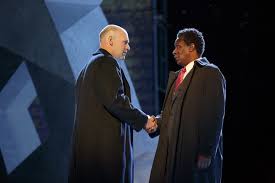
Brutus (Corey Stoll) and Cassius (John Douglas Thompson) seal their deal. (Photo by Joan Marcus)

Some wonderful acting got lost in the melee. Corey Stoll’s brooding Brutus is a thoughtful intellectual. But played in the light of the stunningly farcical Caesar, he seems more like the supercilious guy from the SNL “Deep Thoughts” routine of years ago. John Douglas Thompson is a powerful Cassius, whose ardor and sincerity work well when he is in scenes with Stoll’s Brutus but look ridiculous when he’s anywhere near the other characters and the absurdity of the staging. Stoll and Thompson are in a play of their own. Whenever they must interact with the rest of the company, they are like characters from a Pirandello scenario experimenting with interpretations. Especially when they are playing scenes opposite this feeble Julius Caesar. Or Marc Anthony.

Elizabeth Marvel’s Anthony, with an on-again-off-again Southern accent, is as much a cartoon as the slain hero she mourns. She reminded me more of the television version of Wonder Woman than of anyone cunning enough to have led the retaliation forces that shape the play’s action. I love that a woman is entrusted with this role. I wish the actor, who has played so many powerful, strong-willed, charismatic leaders in her past, had had license to embody a soldier I might have believed.

Nor is Gregg Henry culpable. He plays Julius Caesar exactly as the production demands. Which makes for an overlong SNL skit – where he’d give Alex Baldwin some real competition – rather than anything close to real dramatic art. If this were a sketch by the Uptown Citizens’ Brigade, I’d give him a standing ovation. Alas, it’s Shakespeare in the Park.

And something I’m a bit unclear about here. When Julius Caesar is assassinated, there is no question that the man with the tight suit and the impervious swagger is the present POTUS. Which means that in essence, it is #45 who is stabbed in effigy. How is that not treason? How does this not cross the line? And when the line is crossed, how is the satirist any less officious and self-important than his subject?

It’s all well and good to time bend, gender bend, and story bend in Shakespeare. Two Verona gentlemen dancing blithely in ‘70s hip-hop psychedilia, a midsummer night’s dream transpiring in a floating phantasm of umbrellas, and Coriolanus as a Nazi general are easily acceptable. Each is a fitting transformation. Shakespeare wrote characters and stories that breathe universally over time and across any era. But in order for the re-juxtaposing to work, the basic assumption must be appropriate.

In the end, Julius Caesar is not a comedy of errors, and it doesn’t play well as one.


How Can We Not Resist? (reprinted from Medium.com)

Photo by Aylan Kurdi

Photo by Aylan Kurdi

That photo. The Syrian baby lying face down in the water.

I can’t bear to look at it, yet I cannot look away. That beautiful child, so like children I have loved, so very like my own grandchild now living in a faraway land, who will never feel welcome in her parent’s homeland.

As the child of immigrants, who would not exist had my family not figured out how to circumvent the ban on refugees in 1939 that deemed Poles too dark, too swarthy to be admitted, especially if they were Jews, how can I not abhor the implications of that photo? How can I not scream murder, now that the Predator-in-Chief has exercised his Executive Privilege and has broken the law by banning refugees from seven countries, including Syria, whose people are being massacred and cannot stay where they are.

In school, the lessons we learned in Civics classes taught us that America was not only the land of the free and home of the brave but also the land of Checks and Balances. We have three branches of government so that no one branch becomes too powerful. Why is the judiciary allowing this flagrant law breaking to happen? Why is the Legislature not standing up for the laws they have enacted?

It is clear that it is up to us, The People to demand that our Union be treated with respect. We cannot accept the abuse, cannot allow the current state of affairs to become normalized. We must defy this executive order that, like the other 44 that have been ramrodded through in the past ten days, defies understanding. And this executive order is the one that is the most indefensible thus far.

Because this order sets a precedent. It paves the way for more heinous implications. It puts every one of us in jeopardy though it is being advertised as a measure to protect us from interlopers. In truth, it is a measure to divide us, to terrify us, to make us look for bogeymen in our closets, under our beds, next door, in our communities.

And in time, it will allow each of us to be banned in our turn.

The bare truth is that not one American has ever been killed by anyone from any of the seven banned countries. Even 9/11, which was one of the few acts of violence enacted on American soil by outsiders, was not perpetrated by anyone from any country on the banned list. It was orchestrated almost openly, defiantly, by Jihadists in Saudi Arabia, a country with whom the Bushes were accused of colluding, a country with whom the Trump Koch oligarchs who want to strangle America have deep financial ties, a country saliently not included on the ignominious list. The countries listed are homes to some of the poorest, neediest, most endangered souls on this earth.

There is a pattern here, part of the pattern being woven domestically. The Oligarchy is moving toward hording all our resources. It will eliminate the poor and the working poor and the middle class by putting health care and assistance and ample education out of our reach. And it will circle the wagons to keep the poor out and let only the wealthy in

Yet Americans buy the Kool-Aid, drink it willingly, feel grateful that they are being protected from some encroaching danger that is aiming its slings and arrows at the core of our existences. It’s easy to stick the Muslims out. So many of us don’t comprehend who they are, what they represent, what they believe. Propoganda is powerfully effective, the sugar that sweetens our sadder realities.

Terrorism by Muslims makes up less than one-third of one percent of all murders in this country. A far greater percentage are the result of domestic violence, violence that this administration would like to decriminalize.

This same administration will make it increasingly impossible for gun safety laws to be enacted. Your neighbor’s middle-aged aunt in Somalia who needs a heart transplant may be blocked from entry to our country, but guns being transported from illegal points of distribution worldwide are under no such scrutiny. Any angry husband almost anywhere in America can find a way to get a gun to kill his family.

The current nominee for Secretary of Education suggests we need guns in schools to protect our children from grizzly bears though she cannot have possibly missed the fact that not one single child has been massacred in a grizzly bear attack. Many have, however, been cut down in far more grizzly attacks by disgruntled white teenagers or white supremacists or locally disenfranchised misfits, for whom assault weapons are easier to obtain than Twizzlers.

No single school at any level in any community of any part of this country has been attacked by terrorists from anywhere abroad. But since a heavily armed, sociopathic teen gunned down twenty six- and seven-year-olds plus six of their care givers and teachers, gun violence in schools continues its steady rise.

Somehow, it has become okay for white psychopaths to terrorize our families, but it’s not okay for the huddled masses to seek refuge in the arms of Lady Liberty.

Most shocking to me is that there is a faction of pseudo-religious zealots, who call themselves pro-lifers cheering for these Draconian measures, trumpeting their approval, insisting that our resistance should be put down. They claim to advocate for the unborn children who deserve to live.

How can this photo not move them to rise up against such blatant hypocrisy?

screen-shot-2017-01-29-at-12-06-44-pm

photo by Aylan Kurdi


Green Curry for Christmas (reprinted from Medium.com)

I’m Christmas-ing in Thailand this year, and it’s a relief to be away from what Americans call holiday cheer. At the risk of being accused of crusading against Christmas, I find the holiday, as it has evolved in the US, to be gruesome and overbearing. The real celebration for me is being removed from the ubiquity of obnoxiously perseverating Christmas song in every public space, omnipresent guilt-mongering in the guise of advertising, oppressive overlays of faux cheer, and incessant arguing over how to greet one another.

No one has stopped me in the street to say, “Merry, er, happy, er . . .” Few even know that there’s a holiday going on out there. In Bangkok, except for the occasional paean to the Capitalist Christmas in the form of a display of goods for sale and a few saliently out-of-place reminders, there are few Christmas accouterments at all. It’s like Calvin Trillin’s observation that Christmas in Tibet would be a “place where folks cannot remember/That there is something special in December”(“Christmas in Qatar,” The New Yorker, 19 December,1994).

Absent is the apparent outpouring of hyperbolic Christmas spirit. Even though this is a cosmopolitan city, with strong ties to the West, a large Christian presence, and a decidedly multi-cultural persona, including a huge contingent of expatriated Americans, Germans, Belgians, Russians, et al, one is hard pressed to find reminders that joy has suddenly descended on an otherwise morose world.

img_3169

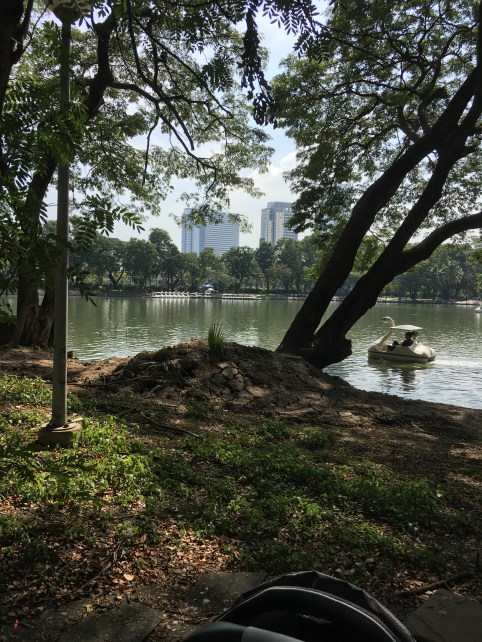
Christmas Eve, Lumpini Park, and not a Santa Claus or Christmas elf in sight (Photo by Stockton)

Some might attribute the absence of Christmas to the fact that Bangkok is 2,000 miles closer to the equator than is New York City, and December is a very hot month. Every time I emerge from an air-conditioned space, I feel like Tom Hanks’ character in Volunteers, descending from his plane into this country. “My God,” he moans. “We must be about a mile from the sun!”

But having lived in the Arizona desert for many years and having spent a few holiday seasons in Florida, I know it’s not the climate that’s to blame. People dwelling in warm climes might pay some lip service to the fact that they can’t get into the Christmas spirit without snow, sultry wintry wind, and delectable fires burning in their family rooms’ fireplaces. But they’ve adapted. No matter what the climate, people who want to decorate for Christmas will find ever more elaborate ways to deck their cacti – or palm trees, boats or sand castles – with boughs of holly and whatever else they can think of to connote the season. In Thailand, however, the landscape is bereft of palm trees disguised as Tannenbaums, of neon MERRY CHRISTMAS signs twinkling out of store windows.

imgres-1

Amazing. Not a single Monitor Lizard wearing antlers! (Stock photo)

While there is no outpouring of zealotry for the trappings of Christmas, people here are eager to honor one another’s traditions. Among those people educated in the ways of The Other, there is a genuine attempt to honor the fact that some do celebrate a very important holiday on December 25.

In the lobby of my hotel the proprietors have chosen an mp3 loop to play endless celebrity covers of every Christmas song imaginable, and on the screen, a slide show of snow-covered New England and old England scenes that seem odd, out of context, dislocated. But the intent is sweet. Every staff member greets every western looking guest with a heart-felt “Merry Christmas.” But they don’t worry about offending me for not saying Happy Chanukah; they really are unaware that there is such a thing, and I would not expect it. I am touched that they wish me happy anything.

hideous-christmas-dec

Luckily, there are not a lot of Christmas displays in Bangkok, but they are not entirely absent. Photo by Stockton.

I doubt they’ll wish anyone a happy Kwanza, and certainly not because they are anti-Kwanza. There simply are no African-Americans staying here. Yet, I am sure that if there were or if a major Muslim holiday happened concurrently, they would be offering their best wishes with some customary acknowledgment, the equivalent of Merry Christmas. And when the time is right, they probably greet celebrants of Vesak or Diwali with appropriate greetings. There is no reluctance to call the day what it is, no fear of offending.

images

The Chinese Pavilion in Lumpini Park, Bangkok, like the other temples and memorials, are devoid of Christmas accoutrements.

On Christmas Eve, in that same lobby, I returned from an outing to find banana muffins laid out on a table in front of a sign scrawled in a childlike cursive that said, “Free. Merry Christmas.” I smiled at the desk clerk and bowed with my hands together to show my gratitude in the Thai way. She grinned back at me, bowing and likewise holding her hands together, saying, “Christmas cake. Very good.”

I asked the clerk if she celebrates Christmas. “Oh, no,” she said. “New Year only.”

I have never been a fan of the flap over what to say in the holiday season. It’s absurd, at least. Christmas is a specific day, and on that day to say Merry Christmas seems totally appropriate, especially in our country, which has designated Christmas a national holiday. To wish Happy Holidays on that day, seems as absurd as wishing someone a Merry Christmas the day after Thanksgiving, when many holidays approach.

We could take a lesson from my hosts here in Bangkok. If we embrace each day and call it what it is, if we honor our collectivity by understanding that Happy Holidays is all-inclusive, we show our respect for one another, for the individual attributes that make each of us a person. We acknowledge our differences while accentuating our common humanness.

What can be bad about that?

See Me, Brother*

adam-clayton-powell-monument-dr-martin-luther-king-jr-boulevard-harlem-cw14nn

A brother stopped me on the street Saturday.

I was headed east, across 125th Street, toward the Metro-North station, waiting at the light on Adam Clayton Powell Jr Blvd, when the man gently grabbed my arm and pointed me toward the group of Black Israelites handing out leaflets. On a milk crate, in the center of the group, a muscular young man dressed in a flamboyant imitation of the Biblical coat of many colors, shouted angrily into his amped-up mic.

“You really need to hear this,” my would-be Virgil whispered harshly without letting go of my arm.

It sounded like a threat. But I listened anyway. For as long as I could stand it.

“ Look around you, white man. See what you have done, you bitches and whores. These people are the sons and daughters of the slaves you persecuted. . . . you should feel ashamed. You should be consumed with guilt.”

Virgil stared at me and tightened his grip as I grunted and attempted to walk away.

“There is much to learn here, “ he insisted.

I nodded, and just as gently as he had grasped me, I pried his fingers off my arm and went on my way, shaking my head.

He was right. There was much to learn here, for all of us. But the lessons should not be about guilt. I could recite a litany of the myriad ways guilt has plagued me all my life, but guilt is irrelevant here. Except that I have learned all too well that guilt is destructive, and promoting guilt will do nothing to close the chasm that divides our union. To heal our country’s cancerous racism, we need to stand together, to learn to know one another, and guilt will only drive us further apart.

Besides, I am not guilty. I am responsible, yes. But my responsibility is to build cohesion, to encourage unity. I am not responsible for the actions of those who came long before me, reprehensible as they were. I am responsible to teach my students, to lead my grandchildren, to show my compatriots what I know about communion and cooperation. I eschew the condescension of tolerance, model equanimity. I care deeply that we humans treat one another with respect, kindness, empathy. But I am not to blame for those invading, marauding Europeans, who raped and ravaged Native and African Americans.

Since, to my knowledge, I wasn’t around in the bad old days of colonization, I hope that if some other iteration of myself was, she would have stood up against the forces of evil, would have argued for peaceful coexistence with the indigenous people, would have shared rather than stolen the land. And I hope that that earlier entity would have fought to abolish slavery, resisted the lynch mobs, fought for human rights, argued for true equality, made art or some contribution toward the effort to humanize — a notion nowhere near the same as to civilize — this country.

I am proud to say that my great-grandfather Hiram H. Terwilliger eagerly enlisted in the Union Army in 1861, long before the draft was imposed in 1863. He was already 27 by then, old enough to let younger men go ahead of him, and he was a Knickerbocker, a privileged member of the landed gentry with plenty of resources to buy a surrogate to serve for him. But he believed in the cause, abhorred slavery, had no patience for the abomination of white supremacy. He reenlisted after his first term and fought valiantly at the Second Battle of Bull Run, only allowing himself to be mustered out of service after he nearly died. In fact, old Hiram made medical history because of his foolhardy bravery. A minié ball split the bone of his left leg before it lodged itself on the outer side, and he kept fighting until, according to the surgeons who attended him, he was “struck again by a round bullet on the left side of his chest.” That bullet passed through him, grazing his lungs and liver, and left him miraculously in tact. Twice he was placed on the pile of corpses and would have been burned had he not groaned; he somehow managed to beat the odds by surviving yellow fever, sepsis and several surgeries without benefit of anesthesia, and then he returned to Ellenville, where, as a lay minister in his Dutch Reformed community, he preached for peaceful reconstruction and for universal voting rights till he died in 1920, at age 87.

While great Grandfather Terwilliger was fighting with Johnny Reb, my mother’s grandfathers, living in opposite corners of the Ukraine, were staving off Cossacks, defending their young sons from mandatory conscription and their daughters from molestation. To escape pogroms, both families migrated East to Poland’s Pale of Settlement. One of my great grandfathers was a rabbi, who stayed in Poland but sent both his male and female children to the university in Austria, and the other was an inn keeper, who dodged the Russians, rested in Warsaw, and eventually ran a hotel in Vienna. Surely neither of them or any of their forebears contributed to the travesty of early America.

I blanche whenever I hear myself called out for being White. I am no more responsible for the unfortunate accident of my color than is my black sister. I understand my privilege — though as a single woman nearing 70, who must work to survive, I have lost much of it — but am not ashamed. If anything, my color has made me more aware of what I can do, must do to eradicate intolerance. The color of my skin impels me to speak out, to rebuke hatred, to defend the rights of all. But it does not make me hang my head in embarrassment.

A student asked me last month if there could be such a thing as racism against whites. “If you hate me for the color of my skin,” I replied, “you are as racist as if I hate you for the color of yours. It’s that simple. Does that answer your question?”

How dare you, young man, make an assumption about me just because I am white? Would you not take offense were I to make an assumption about you just because you are dark? And what do you know about me? How do you presume to know my history? When I shake your hand, I have no preconceived notions. Why do you insist on harboring them as you refuse to shake mine?

We can work together to make police brutality go away, to promote equal rights and achieve the understanding that will stop the madness around us. But we can’t if you insist on labeling me and rejecting my sisterhood.

Truth is, you need me as much as I need you.

Those haters you think I’m one of? They have as much disdain for me as they do for you, and we can only beat them if we join hands and do it together.

*Reprinted from Medium.com