Pride

  In the third week of my second year of college, I decided I had to drop out. I told the registrar at the University of New Mexico I was pregnant so I could collect my tuition money and run away to New York with my boyfriend.  We were both gold-green and scared. I was 18, still living in books, and he was 20, just a kid from the rez near Santa Fe.  We’d heard that even in New York there were laws against illegal cohabitation, and we were worried we’d be arrested if we tried to shack up.  Where would we live?

Mid-flight, halfway across the country, I remembered that my grandmother had a cozy little apartment in her Queens home basement that we might rent if we were married.  So, soon after we landed, we wed.

Grandma’s and my relationship was historically fraught.  Her life had tortured her, and even I understood that that gave her license to torture me.  Before her whole family was forced out of Vienna, the city she loved, before the Nazis murdered her two most beloved brothers and a revered sister, before my grandfather’s illness took all that was left of her endurance, she had buried her favorite daughter, her much-adored first grandson, and even her long-awaited, highly prized son to freakish illnesses and accidents. She took solace in the Cutty Sark and beer she kept close to her in ample supply. As she drank, she descended into dark, evil moods that riveted her to her couch in an unlit corner of her living room. 

In those days, Grandma was a big woman, and her presence was terrifying. She would sit on her couch by herself, sullenly knitting or crocheting, a bloated, glowering Mme. Defarge, muttering her complaints mostly about me, her third surviving grandchild and a massive disappointment.  She smoked a pack of unfiltered camels a day, so her litany of my shortcomings – too fat, too lazy, too blonde, too stupid to be 6 or 7 or 8, 9, 10—was punctuated by the rasp of expectorating sputum. My only defense? I called her Grandma, which she hated, instead of Mamma, as my cousins did.

By the time I needed her apartment, however, she and I had forged a truce.  I was, after all, a married lady, and I worked hard to maintain my professional demeanor, never missed work, cared for my new husband with all the deference and respect expected of a proper 60s wife.

But not for long.  Mickey and I said “I do” in October.   He nearly died of hepatitis in December, and I finally understood why we hadn’t yet conjoined.   Turned out he’d been living la gay vida loca all over NYC.  Yes, I had had a clue.  I just didn’t know what I was supposed to do with the information.  Besides, I loved him, loved his company.  His friendship was the most precious relationship I had ever had, and I never wanted to lose it.  The illness forced him to leave.  He was miserable in New York and wanted to be near his mother. He moved to Santa Fe in January, and I remained in Bayside, terrified to share the explanation with my grandmother. I didn’t want her to stop loving him.  But mostly I feared her derision.

One night I got home late from work in Manhattan, and I was lounging in bed, watching the Million Dollar Movie, when I heard a knock at my door.  I opened it to find my grandmother bent over in the cold, holding a batch of cookies she had baked earlier.  I was surprised to see her and just as surprised by the cookies – she rarely baked, and she never allowed me to eat bread in her presence, let alone cookies.  But I smiled and thanked her.

She coughed for a full minute and a half before she collapsed into a chair at my kitchen table.  I brought her a glass of water, and she nodded. 

“My brother was a faygele,” she said apropos of nothing.

“Hunh?” I wasn’t sure I had heard what I thought I heard.

“Like your Mickey.  He liked boys.  That’s why they took him first.  The Nazis.  To the death camp.”

I sat next to her, and she told me about my great Uncle Ferdinand, a gifted musician, a small hump-backed man, who painted and made his living as a bookbinder.  The Nazis relocated him to the popup ghetto along with his professional musicians brother and sister-in-law with whom he boarded. Then, the three were sent to Mali Trosinac. 

“The Nazis hated the homosexuals.  And anyone who tried to protect them. The brightest and the best they took from me.  Ferdinand, Max, and Paula.” She sighed, and her head dropped to her chest.  I thought she would fall asleep.  Then her emphysema cough startled her upright. She lit a cigarette and talked on into the night. The more she talked, in German and in English, the more elegant her prose became. What a facility she had for narration.  I was spellbound.

“Listen,” she said as she neared the end of her story.  “I know what it was like for you with all your brothers and sisters. You the oldest, you in charge of so many personalities. For me, it was not so different. Everywhere we went when I was a child, we, too, stuck out like a seamstress’s thumbs swollen with pinpricks. “

“You, Mamma?”

“Well, you know. I was the youngest.  Of ten.  Whether you’re six or eight or ten, you’re too many.  You’re always special.  Like my Ferdinand. And your Mickey.”

It’s Still Tolling

. . . any man’s death diminishes me,
Because I am involved in mankind.
And therefore, send not to know
For whom the bell tolls,
It tolls for thee.
John Donne 1624

Back in December, 2014, the day after the Newtown Massacre, I wrote about my own experience with a shooter in the building and the trauma I experienced from the anticlimactic event (“It Tolls For Thee,”). At the end of the piece, I lamented, “”This is not going away.  The people of Newtown, the people of Connecticut, the people of the East Coast, and by tomorrow, the people of the entire country will live in the shadow of this day forever. Question is, how can we protect the other Newtowns to come?  It’s already too late to begin, but better late than never. . . ”

Since then, there have been 201 more shootings in this country. When do we say E N O U G H??

Evangelicals, anti- or pseudo-intellectuals on left and right, special interest groups of all kinds, and untold millions of influencers put pressure on our legislators to ban books and art, outlaw drag shows, curb women’s rights, thwart equality for LGBTQ, legislate the teaching of science and history as myth and fairy tale. They succeed. All across America, poor Atlas is having a really hard time keeping the world balanced on his back as it threatens to topple over.

What feels like the final blow, what seems to be the thing that could push Atlas and his precious cargo right into the abyss forever is the problem of guns in our midst. All the marching for lives that matter, all the canceling of professorial opinion, all the revisionist rhetoric on both sides have ignored a REAL problem we ALL face. The one thing that should bind us together: finding a way to end the oppressive hold guns have on all our lives.

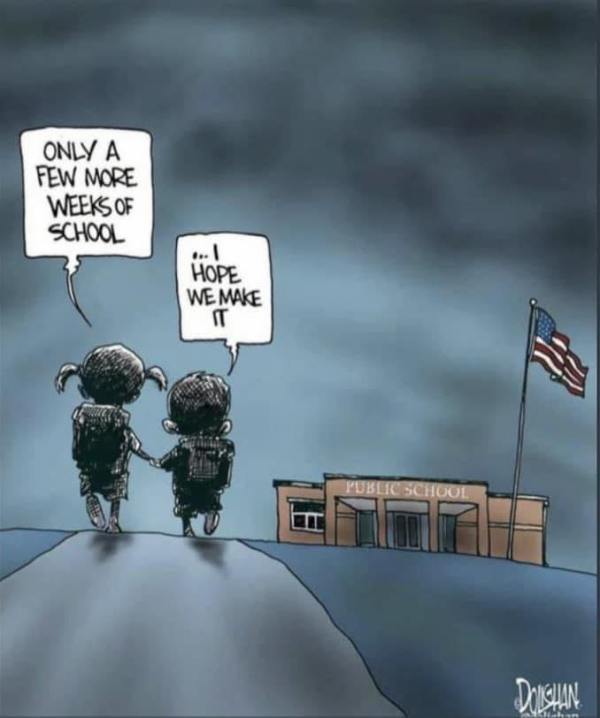
Every day parents send their children to school with no guarantee they’ll return. Every day children are forced to rehearse for the possibility that they will be targeted by an angry someone with no better outlet for their anger than kids in a school. Every day we throw up our hands and say, “What can we do?” And we blame the lawmakers and the NRA and the gun-toter machismo that seems to have a stranglehold on our collective sanity.

We can point fingers all we want. We all know who is really to blame. We are. We throw up our hands and sigh, we write thoughts and prayers and Imsosad on social media, we shake our heads and tzikkash, and we even send money to the coalitions of survivors’ parents who are out there trying to make it stop. But we don’t do enough.

We need to follow the example the French and Israelis have set this month. They shut down their countries to make their wishes known, and they are succeeding. Why? Because a country without services is a country at a standstill. A country at a standstill needs to appease those who are shutting it down in order to get it back up and running.

We need to shut this country down. To show our government — from the top down — that we really are at a point where we just can’t take it anymore. If every service provider said simply, I am not going to work until the government finds a way to rein in the violence, to control these weapons of mass destruction, to make our children safe not just from the bullets themselves but also from the anxiety of expecting to be hit and the trauma of the aftermath.

If we could the people could set aside our differences for just a few days and figure out a way to get the whole country on board to stop the trains, block the runways, brake the buses, close the schools, refuse to open clinics for well visits, how long do you think it would take before legislation would be in place to protect our kids?

I know. Dream on. I have to. The nightmare wants to consume me.

I have a grandchild who lives overseas. Whenever I go to visit him, people shake their heads and say, “Aren’t you scared for your kids there?” The State Department issues warnings about the country where he lives, suggesting that it’s not safe to go there. Yet the only people who carry guns there are the military, who stand guard at schools, airports, bus stations, et al., to ensure that no reign of terror succeeds in taking hold. No child is forced to spend valuable educational time practicing ways to avoid being shot by a maniacal interloper.

Every year I beg my kid to come back, to be near enough so my hugs don’t have to rely on Zoom for most of the year. The answer is always the same. “Not until I can feel safe sending them to school. . . . “

Can’t we make that happen?

Were that it Were

As a fan of the New York Times “Modern Love” feature, I eagerly binged through the eponymous new series on Amazon Prime. I wish I could say my fandom has extended itself. I cannot. Turns out to be just one more proof of how willingly pop culture aggrandizes schmaltz.

Schmaltz , in the colorful, metaphor-laden Yiddish language, means poultry fat and also hyper-emotion. Bathos.

I imagine the proliferation of melodramatic sentimentality is a reaction to the seething anger that surrounds us. Ugly racism on the Alt-Right and pandering on the Alt-Left leave no one safe from vitriolic accusations and slurs, physical jostling, social discomfiture out in the world. Whoever we are, wherever we go, we are assaulted in one way or another. Soppy, mindless nostalgia is a reasonable soporific. I wish it helped me. I guess I’m too cynical.

I’ve never been good at soporifics. They trigger anxiety. For me, hyper-emotional dramas are like post-op pain pills. They briefly soothe the symptoms, but when they wear off, everything hurts more than before the medication. Escapist entertainment reminds me how much work life requires, how much more pain there is when you expect none. Then too, it comes dangerously close to inspiring resentment.  Why can’t I find what these phenomenally lucky folks have found? What a colossal loser I must be.

I don’t enjoy being jaded. I am by nature an optimistic pragmatist. When at first I don’t succeed, I plod on. I want to believe I’ll discover gold in one of the veins I’m exploring, but if I don’t, well, the work’s its own reward.  That’s a lot harder to pull off when prevailing media offerings constantly suggest that everyone else can easily find what remains for me elusive.

Every episode of Modern Love tantalizes with elements of truth. The actors in the series are wonderful – not a bad one in the bunch – but the writing is shallow. Okay, the stories are based on essays that are 1500 words or less. But a screenwriter should be able to create fleshy characters, who talk like people talk. And am I the only one who notices that there is not one episode that follows someone who lives in a middle- or working-class world? That poverty is nonexistent here? Every one of the lovers here has a fabulous apartment that is fabulously decorated. They all have amazing jobs and work among titans. More reasons I should feel unworthy.

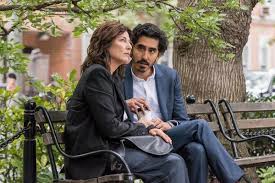
In the episode entitled “When Cupid is a Prying Journalist,” Katherine Keener plays an almost-believable character . . . an older woman giving advice to a thoroughly make-believe young genius (Dev Patel) millionaire (of course) about the pursuit of happiness. The characters in “At the Hospital” are so hopelessly hip their love seems fake and contrived. The heroine of “So He Looked Just Like Dad, etc . . . “ is boringly stupid. Is any young woman working in NYC (and living in such upscale digs) really naïve enough to think a leering, sex-starved older man would moon so unabashedly over a girl for whom he has only paternal affection?

Jane Alexander, an actor I deeply admire, plays a character who serves cheap baloney in “The Race Grows Sweeter Near Its Final Lap.” Up to a point, women might possibly imagine that being over 70 is romantic in some way, but we who have passed that Rubicon know better. And the actual probability of finding the kind of love Alexander’s character discovers is as likely as finding a clean spot on the subway floor.

Or is this just one more way of telling me how inadequate I am?

Older men who seek older women invariably look for someone to mother them, someone to listen to their monologues, someone to call 911. I would love to believe there is a man like James Saito’s character for each of us out there, a gentle man who listens enthusiastically, who shares interests but revels in each of the couple’s individualities. Forgive me if my experience makes me skeptical.

My most recent disappointment happened last month. I met a man who enticed me with what seemed to be a real interest in me and in my work. But the moment I ventured to get to know him – first by electronic messaging, then telephone, and finally on an actual date with him – he became a lecturer. He took to telling me what I like, what I look for, what I am. Assuming I knew nothing, he regaled me endlessly with his erudition. He asked me what I’m writing about, and before I got to sentence number two about the project I am struggling with, he was off on a tale of how he saved a woman writer he had been hired to edit.

On our date, when the monologue turned personal, and he was discussing his marriages or children or something, I made a comment about the complexities of motherhood, how women are easily eclipsed by childbirth and child-rearing. He interrupted with a story about how lucky his first wife was to have had him in the delivery room because he was able to relieve all her pain because he knew the right place to touch. That was immediately followed – without so much as a breath – by the story of how he sailed up the coast of Spain to save a woman who would have bled to death had he not liberated her and applied his EMT skills.

I took the advice of the Madagascar penguin. “Smile and wave, boys. Smile and wave.” I smiled – and nodded – and waved goodbye.

Every day for the following week, I received endless incoherent soliloquies or solipsistic PM messages on Facebook. Each time I replied and asked questions, he rejoined with yet another harangue. None of my questions or comments was acknowledged. I finally asked him point-blank if he had any interest in me. If so, I said, please demonstrate it. Call me, write me a question you allow me to answer, engage with me. Interact. I haven’t heard a word from him since I made that request.

If I were to judge myself by Modern Love standards, I would have to assume I am a ragtag reject.

If only life were so winnable as it is in the series. Would that playing tennis might have volleyed my marriage back to life as it did for Tina Fey and John Slattery’s characters in “Rallying to Keep the Game Alive,” written by Dennis Leary’s real-life wife Ann. Would that any one of the few boyfriends I have had since I divorced twelve years ago had been so quick to acknowledge their role in our absence of communication. At least this episode was honest in its depiction of the separate worlds we build when we are supposedly fused to one another. That was something.

The one episode I really liked was the one I expected to hate. I am not an Ann Hathaway fan, and I was put off at first by the specter of Hollywood glitz. But in “Take Me as I Am, Whoever I am,”  I was won over by the sensitive, detailed glimpse into the bi-polar world it provides. Hathaway, with no little assistance from the script, nailed both the manic hyper-high and the paralyzing despondency, the need for a truly accepting ear, the struggle to maintain the most basic of human relationships. Let alone love. Finally, a protagonist who doesn’t miraculously get everything she ever wished for in 50 minutes flat. Finally, an episode that ends realistically.  Hathaway’s character vows to stay on her meds and talk often to her physician. That is all. She is content.

And that is the best kind of happily ever after I can imagine.


A Thorn By Any Other Name . . . .

The nightmare never changed. It recurred as a terror that began just after I began Kindergarten, at age four. In each bad dream, the ominous wailing of European sirens would wake me from a sound sleep in my grandmother’s Bayside, Queens attic. As the sound of metal soles and heels marching on the suburban pavement reverberated around me, I would scream for my sisters and brothers and cousins to follow me. In German, a voice shouted from the street below. “You cannot escape a second time. We have found you. You will come with us to the camp.” I would wrest myself sweating and crying from the torture of sleep just as the uniformed robots were about to grab my youngest brother and throw him into the tank that followed their march.

Every detail of the dream was the figment of my imagination or of some phantom reminiscence. We had no television, and the only films my parents took me to see were Disney films. I search my memory for some clue as to how the sound of the jackboots and police cars found their way to my subconscious, and I find none. I do know why I was afraid of the camps.

I was born two years after WWII ended. Members of my mother’s large extended family, dispersed across the world, were just beginning to find one another. We received intermittent letters from sources I could not identify that provided cryptic updates. The word “camps” was omnipresent. So much so that when my parents sent me to Girl Scout Camp at age seven, I was sure they were sending me away forever.

The soto voce conversations about the correspondences were always dire. Like the members of my mother’s nuclear family, most of the mispacha had barely escaped. A few to the US, others to Brazil, Israel, Australia, Argentina, the UK. The displaced were the lucky ones. There were telegrams and official notifications bearing the saddest news – two uncles and an aunt gassed in a death camp with a garbled name. What a relief to learn that another aunt and uncle never suffered the same fate but were shot defending their clinic in the Stanislaw ghetto uprising. My mother would huddle with her sisters and parents in secluded corners of our communal home to read each missive aloud. I was not invited to hear, but I was an expert eavesdropper, and while I could not have told you what or who or why, I felt the effect of the camps that my mother and her sisters had narrowly avoided. Even the bits and pieces I surmised were enough to convince me I would never want to go to that place where the evil whose name was Nazi lived.

The pain, the fear, the agony of the camps bored a hole in my consciousness. As did the guilt my mother and her sisters, who never forgave themselves for running away, brought to America. I grew up wondering, as they did every day, if I might have made a difference if I had only been there.

Of course, the notion is absurd. Still, though they said – and genuinely believed – that no such horror could happen in America, they passed to me a sacred responsibility. Never again. Make sure. Never again. Be on your guard. Tolerate no persecutions.

That was the banner I carried in my heart when my cousin and I joined the marchers on the Brooklyn Bridge, when I sang my freedom songs in coffee shops, when I advocated for the end of the War in Viet Nam. Reading history made me cry. How could we enemies of oppression have perpetrated annihilation of the Natives, perpetuated slavery? The more I learned about how this country came to be, the more my inner voice chanted “Never again.”

No one in my circle of intimates ever suggested that there might be anything like comparative suffering. The internment camps that held native Americans all over the Southwest were no less horrific than those that held Japanese Americans during WWII. Inhumanity is inhumanity, Suffering is not a competition sport.

Genocide is genocide.

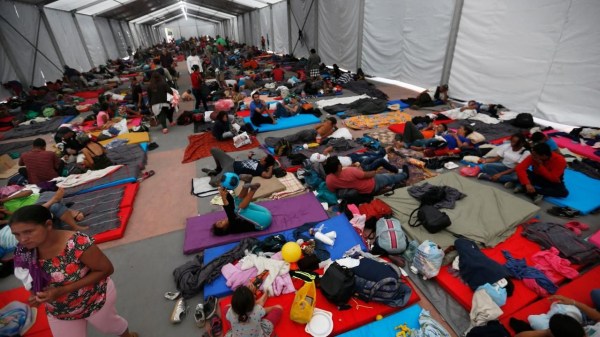
It follows then that a concentration camp is a concentration camp. Just because there are no gas chambers does not give a vile detention area, where children are tortured, a right to be called anything less brutal. Though the inmates of these camps are not in imminent jeopardy of extermination, ten children have died of their maltreatment.

How many deaths does it take to constitute a death camp?

Children forced to sleep on floors, left unclean, given no soap or water, encouraged to drink from toilets. Worst, children growing every day with no affection, no comfort, ripped from their parents’ love. . . .


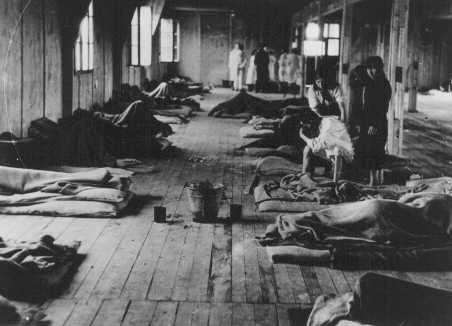
Theresienstadt was a concentration camp. It was a showplace – a beard intended to prove to the Red Cross that the Nazis were humane. Here, like in the border camps, children died. Maltreatment, malnutrition, squalor are killers as lethal as gas and guns.


My people suffered great losses, yes. But we have no right to be precious about our pain. To be honest, I abhor the fact that we refer to our destruction as The Holocaust. There have been so many holocausts, murder and mayhem inflicted on human beings by fellow humans. Our losses are of no more significance than the losses incurred by our contemporary refugee counterparts.

We don’t own the torment. But we do own the imperative to fight to end our government’s insistence on perpetrating more of it. We will carry the sad karma wrought by the deplorable savagery being enacted under our flag. We must somehow take action, real action, to send this siege of evil.

The great challenge here is to stop the bickering among the converted. We must put our level heads together to figure out what that action is. We must have a unified plan, and we must cry out in a single voice.

Never Again.


Judgment Call

Once upon a time, I chose to be confirmed in the First United Methodist Church. I was twelve years old and a singular outlier in a closed society. I joined, hoping that membership would foster a kind of belonging I hungered for. I needed to feel embraced and protected by a great, all-encompassing love. The Methodist Church promised me that all were welcome there. I believed.

It is clear now that my iconoclastic half-  Jewish self would not even be invited to join the United Methodist Church today. Having recently announced their decision to allow ministers and administrators to ostracize members of the LGBTQ communities, the church has tacitly granted their congregations a license to shun anyone with traits the church finds offensive. There is no way they would welcome me.

I stopped attending church and identifying as a Methodist some sixty years ago. But until the announcement, however, I harbored a feeling of warmth for what I believed were its precepts. Those I learned from my father, perhaps the noblest Methodist of them all, and they are rooted in a memory I have of a time he acted in a way that demonstrated what I still believe Christianity is basically all about. Long after leaving his church, I attributed his accepting nature to the education it had given him.

In the 1970s, my brother was about to come out to my parents. I worried at first that my father might be less than sympathetic.  

Daddy, a conservative, Iowa-born Republican, belonged to the First United Methodist Church in my small Upstate New York home town. He was known there for the dour parables around which his lay sermons were constructed and by the incongruently kindly manner with which he delivered his fire and brimstone messages to the seventh graders he taught in Sunday School. Though he treated all people with compassion and consideration, his attitude could be harshly judgmental toward people with ethical or moral standards that were not his.

From early childhood, Daddy had been taught that liquor, gambling, card playing, and dancing were sins, as was pre- or extra-marital sex. His sense of humor was corny, old-fashioned, chaste.  He allowed no swearing of any kind in his presence. I was reprimanded when I said, “Oh, gosh,” or “Jesumcrow,” the faux curses that punctuated our Adirondack lingo. In our home, there were no alcoholic beverages, no playing cards, no off-color books or art house nudes. All were banned, I assumed, because my father’s faith required that he disdain them. He seemed to have been indoctrinated by a kind of paradoxical orthodoxy. It was hard to predict how he would react to being the father of a homosexual.

In the first place, the news did not surprise him. And in the second, it did not faze him. “You are my son, and I love you,” he said to my brother. “Nothing could change that.” Not long afterward, my brother, newly mustered out of the Air Force and figuring out what to do next, moved in with my parents. The man who was his first serious partner moved in with him.

I needn’t have worried.

One evening, I arrived at my parents’ house to find my brother and his boyfriend intertwined and making out on the couch in the middle of the family room at the center of the house. More surprising than their unabashed PDAs was the fact that my father sat in the easy chair next to them watching television and eating watermelon. “This doesn’t bother you, Daddy?” I asked pointing to the lovers, who were oblivious to my arrival.

“Should it?” Daddy replied.

“No. Not at all,” I stammered. “But your religion. . . “

“My religion is Jesus Christ,” he said. “Jesus said, ‘Judge not lest ye be judged.’ Shall I be less open than Jesus, whose teachings define my life?”

“But the church, Daddy, won’t the church. . . .”

“The church would never defy our Lord’s teachings.” He stopped. His eyes were distant. He lifted his arms. He was in preacher mode. “The Church welcomes all.”

I accepted him at his word. And I trusted that his beliefs emanated from the doctrine espoused by the religion to which he had unfaltering allegiance. He never missed a Sunday service, never failed to participate in church programs, never refused to teach or to counsel or to take to the pulpit. He was a true believer. So I presumed – hoped – that this church, in which he had raised his seven children, was as accepting as he was.

Hence my shock and confusion when I read the church’s announcement. Traditions I was not aware of had superseded those I had inferred. Traditions of barring homosexuals from ordination, of refusing to sanction same sex marriage, of enforcing strict penalties against clerics who broke the rules and accepted the “gay life style” as a viable human alternative.

Luckily, the declaration is no more than an abstract annoyance for me. And an affirmation of my choice to leave the church all those many years ago. But what of the people – there must be many – like my father. . . the true believers, the ones who honestly see their church as the messenger of their Christ? Does this feel like a betrayal to them? Their church has rejected the notions of inclusion, of loving one’s neighbor as oneself, of refraining from a judgment that Jesus demonstrated by washing Mary Magdalene’s feet, by breaking bread with sinners, by feeding and healing the lepers.

Surely Jesus would be disappointed in this Methodist manifesto. I know Daddy would be.