
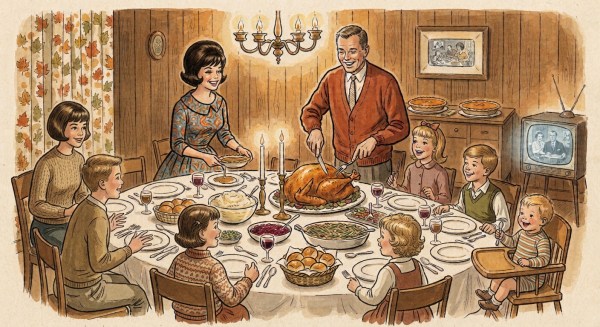
a few beloved memories of an American holiday. . .
I. Daddy’s Day
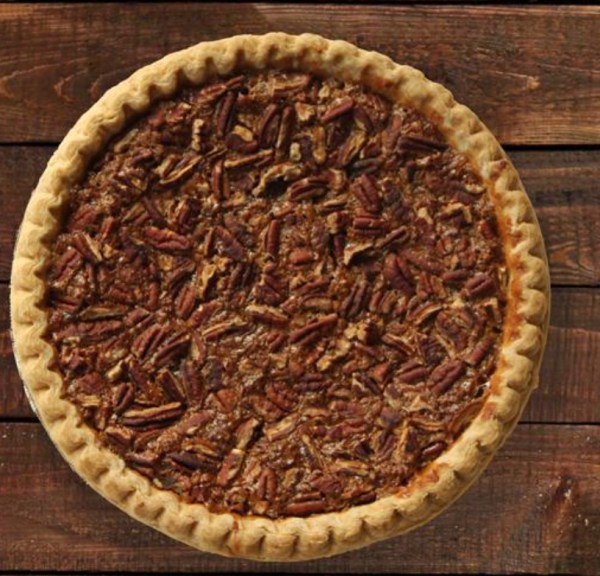
Thanksgiving was my father’s favorite holiday. He could relax, eat his fill, burp, fart to his stomach’s delight, and eat some more. There was no after-holiday over-spending remorse, no compulsion to go to church or visit with clients. Thanksgiving was a day for his family and pecan pie.
Dad hated turkey, the effect of a post traumatic stress suffered after he was forced by foxes and disease to mass execute a frenzied brood of hens when I was 6. No one thought of the bird as the highlight of the meal, though everyone else ate bird, sides, and gravy with great gusto. The real center of attention was always the pecan pie. Dad could eat the whole thing in one go, but he’d make sure there was at least a bit left for the next day.
He loved the sweet gooey confection, smacked his lips after each bite, and when he was through, he always told the story of his Uncle Alfred.
“My Uncle Alfred,” he’d begin.“ The man I’m named for. That man loved Thanksgiving. And most of all he loved his pecan pie!! Every year, he’d eat his meal, turn down seconds of this or that, saying, ‘I’m saving myself for the pie!’ Then the pie would come to the table, and he’d cut an extra large slice and slurp it down with much muttering of ‘mmmm’ and ‘oh my what a pie’ and ‘this is so good;’ then he’d have a second helping just as large, after which he’d announce, ‘Well, I’m off to take my nap. I’ll be back for another slice just as soon as I’ve slept these here slices.”He’d slap his belly and then he’d shout, ‘Be sure to save me some!’
“Every year, the same routine. And every year, my dear old jovial uncle would sleep for an hour or so before he returned to the kitchen, cut himself another generous piece of that pie, and he’d sit among us savoring that last chunk of his beloved treat.
“Well, one year, as usual, at the end of the meal, we laughed when Uncle Al said, ‘Don’t forget to save me that chunk of the pie. . . See you soon!’
“Two hours later, Uncle Alfred was still in his bed. Aunt Jemimah – yes I had a real Aunt Jemimah – went to wake him and found him dead cold with a wide grin across his face. He’d fallen asleep with the taste of pecan pie on his palate and a grin in his heart that showed up all across his face.”
Dad would stop to consider the story; he took a deep breath. We’d all sigh. The story was so familiar, we understood why dad cherished it. And we knew what was coming next.
“That’s what I wish for myself, my children. A death without the long embarrassment of dying. Give me an extra helping of pecan pie and let me go to sleep, never wake up, and take that joy all the way to Heaven.”
I think about that story every year at this time. Dad didn’t get his wish. Exactly.
On a nearly summer morning, my mother called from her hospital bed. She had had knee surgery, and he was due to visit her, was usually by her side before the sun was fully up. That morning he had not arrived. She had a bad feeling and asked that my husband Richard go to check up on him. Sure enough, Richard found him stiff and stuck in the shower, still holding the soap he was using for his morning wash.
It was a shock. But there was kindness in his sudden departure. No one was left with guilt over what we could or should have done for him while he faded into death. In the end, we all accepted that he’d gone as he would have preferred.
But I know that every one of us wished we’d given him a generous helping of pecan pie for breakfast that morning.
2. Thanksgiving among the Natives
When I was 17, I enrolled as a drama major at the University of New Mexico in Albuquerque. I was 2200 miles from my home. When I insisted on going to UNM, my father warned me I would not be home for any holidays. It’s okay, I told him, I’ll go to Dorothy’s.
My older sister Dorothy lived in Los Alamos, and I did spend a few weekends, including the long ones, with her an her family. She had six children, all nearly the same ages as the six siblings I’d run away to New Mexico to get away from. Dorothy didn’t expect me to take care of her kids as my mother did, and I was actually quite close to her older sons, but I was a teenager. A teenager newly sprung from the repression of home life. I couldn’t stay in Los Alamos.
As luck would have it, I was engaged in my very first relationship with a boy. The boy was actually a young man. His name was Mark, a few years older than I, the son of a tribal elder of the Pojoaque pueblo south of Los Alamos, in Santa Fe County, on the Tesuque Creek. His mom was single; his dad had remarried and was living somewhere in Texas with his second family. Mark’s twin brother Kent, their mother Caroline, and I made plans to celebrate with another feast on Friday after Thanksgiving.
I was a neophyte and didn’t recognize any of the delicious foods Mark and Caroline prepared. I recognized that we were eating roasted blue corn, two kinds of squash, and some kind of small bird – I could not tell whether it was a squab or Cornish hen? – all complimented by the famous green chile of the Tewa Valley. We corralled her peacocks and settled down to drink some Oaxacan rum and local tequila; we built a fire and sat around listening as Caroline told stories of how the original Pojoaque people. “Pojoaque is a mother village, she is the ancestral home of so many of our people who have settled all over the Four Corners Region, including Mesa Verde in Colorado and Montezuma Valley in Arizona.”
I felt connected to Thanksgiving in a new way. I knew all the myths of the peaceful intentions of the first Thanksgiving, and I was painfully aware of the broken treaties, the lies told by my ancestors – Dutch warring with the Esopus in New Netherlands, English exploiting the Wampanoag in Massachusetts — of the slaughter that preceded and followed that day of gratitude. I understood that my people were Europeans settlers encroaching on land not their own struggling to survive, allowing murder and mayhem to become their tactics of choice.
Caroline added a layer, a broader perspective.
She held up her glass. “Here’s to the first Thanksgiving, e’nu. Let’s be grateful that we are here together, enjoying this night like the intelligent, civilized folk we are. People talk about us natives like we were hicks” Taking a sip of the sweet margherita Mark had just mixed, she laughed. “Yup, we were nothing but wild babes in the prairie. . . riding our horses across the plains, growing corn, and chasing buffalo. People actually believe that!!! It’s so easy to believe a stereotype. So difficult to question. . . but we Tewa people were way ahead of our time. . . true agrarians. We irrigated this land with sophisticated systems that brought water to each of our farms from the Rio Grande. We grew beans and cotton (cotton!) and squash and corn, and we raised livestock, even pigs who came to us with the Conquistadors. Tewa people were only one ethnic group. There were hundreds. . . .
“Natives were – are — many people, with many interests, many stories, long histories. We have always spoken many languages, and we often went to war against one another. When the white man came, yes, they were cruel, but so were we. . . . I like to believe we were better than they were. But . . . .
“Anyway, I wish we had been able to work together with one another and with the Whites to make the world right. They’re still not right. Maybe never will be. But we don’t deserve to be pitied or denigrated. We are so much more than victims. We are fierce. We are strong. We endure.
“We are here, and we are not going anywhere.”

