Why I Stand With Planned Parenthood

While I refuse to qualify the bizarre allegations levied by misogynistic fear mongerers against Planned Parenthood, I feel a need to make a small statement of support for an institution that I believe in, an institution our society cannot afford to lose.

First of all, I would like to go on record by saying that there is no reason for apologia where abortion services are concerned.  Abortion is legal in this country, and women have the legal right to choose whether their bodies may be receptacles of new life.  I don’t know anyone who is pro-abortion; I am not.  But I am pro-choice, including the difficult choice to terminate a pregnancy.  Choice deserves and requires protection.

What the critics chronically forget to mention is that Planned Parenthood does so much more than counsel women regarding their unwanted pregnancies.  They saves the lives of mothers and children.    Planned Parenthood is a safe haven the community cannot do without.

I don’t know anyone who loves going to the doctor for gynecological examinations, but all women need to do so in order to protect themselves against illnesses that attack the female organs. And having access to affordable care and to prevention and cure of feminine illnesses also deserves and requires protection.

Planned Parenthood provides choices, care and prevention that no other institution offers, preserving women’s lives in a variety of ways, and we must stand up for the good that they do lest it be lost in a hale of ignorance and misconception.  All pun intended.
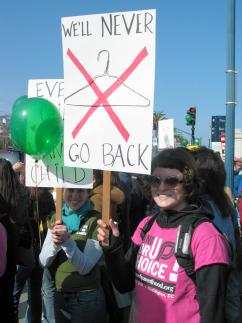
IMG_4835-abortion rights

  1. Judy’s Story – Perilous Days Before Roe v. Wade

I was 18 when I met Judy. We were both employed by a large firm in New York whose specialty was writing employment manuals for employers. I was a proofreader; Judy was a typist, and she was 19, mere months away from reaching twenty.

Judy was ever so much more mature than I was in ways I never imagined myself becoming, and she intrigued me. I still lived in my aunt and uncle’s house, where no matter what, I was sheltered, fed, protected from the world. Judy lived on her own in a one-bedroom apartment in Bay Ridge, where she had to cover the rent, heat, food and clothing for herself and her 4-year-old daughter. On my meager salary, I had a hard time keeping up with the minimal contribution I made to household expenses and found it challenging to buy enough clothing often enough to get to work looking respectable. Judy made less than I did, and in addition to all her other expenses, she had to pay for whatever day care her friends were unable to provide.

Hoping always to find a man who would step up where her deadbeat ex-husband had failed her, Judy dated fairly frequently, and I was her go-to evening babysitter. I loved the solitude of being in her house after her daughter went to sleep; I marveled at her house, so clean, so bright and cheerful. She had curtains on the windows, rugs on the floor, pictures on the wall; her daughter’s bed was a frilly pink wonderland. How did she do it?

I loved Judy’s child, who was smart, funny, talented and spirited. We watched Sesame Street together in its first year, and I took her to meet my friend Northern, who played one of her favorite “real people” characters on the show. I was part of the family, intimately tied to them by an interdependence that suited us all.

Judy could not possibly hope to sustain any more of a burden than she was already managing. She often said to me, “Carla, I gotta be real careful, ya know? I mean I got knocked up the first time because I wasn’t payin’ close enough attention. I cannot afford to have another kid.”

But no matter how careful you were in the 60s, pregnancy was never altogether preventable. After seeing a prospective stepfather for several months, she stayed overnight with him, and despite her protestations that she took EVERY precaution, she became pregnant. In those days, many of my friends and relatives were victims of missed pills, defective condoms, miscalculated dates; Judy’s mishap was no surprise.

“I’m a good mother,” she moaned to me the day she got her test results. “I am. But dammit, Carla, what ’m I supposed to do? I got dreams for my kid. I want her to have a good education, do more with her life than I did. I can’t afford another one.”

I had no words of wisdom. There were no alternatives. The would-be stepfather dropped out of sight as soon as he became a prospective dad. Should the fetus in Judy’s belly grow to childhood, it faced a life of poverty that would also drag its older sister into an abyss, an underfed, underserved existence. Judy was despondent.

Then, for a time, we only saw each other at work . I don’t know how many nights she stewed without confiding her thoughts. But one night after midnight, my phone rang, and it was Judy; she was crying and sounded wrung out. “Carla. I need you to get here right away. Please.”

I lived in Bayside, Queens, a long way from Bay Ridge, Brooklyn. I took a bus to Flushing, where I got a subway to a transfer point in Manhattan and then, following Judy’s instructions, emerged somewhere in Brooklyn, where I hailed a cab. She was waiting for me with Norma, a co-worker with whom we often socialized, a slightly older woman who had brought with her her own 8-year-old daughter. I had been summoned to babysit. They left the minute I got there without explanation, but I knew something was terribly wrong.

Judy had no color in her face and could barely move. Norma had to carry Judy down the stairs, and I watched out the window as she lifted my nearly lifeless friend into the cab. I took both little girls with me to Judy’s bed, and we slept through the night. It was after noon before Norma returned. The girls and I were having breakfast.

“She’s going to be okay,” was all Norma told me. When the children moved closer to the television and engrossed themselves in Days of Our Lives, she explained.

“We decided not to tell you last night. If we got arrested, we wanted you to be clean so you could take care of the girls.”

Judy had had her pregnancy terminated by a local “Gypsy” woman. She nearly bled to death, willing to die rather than bring another child into the world. She was prepared to sacrifice her life rather than throw her daughter’s future away.

I was grateful she got away with it. Still am, as I am certain both she and her daughter are as well. That daughter is a prominent physician today.

12109889_10153245686871313_2204017121307965984_o-e1444841226880

  1. Sally’s Tale  – In Need of A Safety Net

Sally works overseas, only gets to come back to the States once a year. In the country where she lives, she gets inexpensive insurance coverage that ensures that she has unlimited access to comprehensive health care. Whenever she visits home, she cites the high cost of health care as one reason she feels compelled to remain abroad.

Sally is nearing forty, and though her latest love affair, which lasted two years, ended in a break-up, she was delighted to learn that she was pregnant. Professionally secure and ensconced in a comfortable community in her adopted land, she was sure she could manage the challenge of single motherhood. After a visit to her local physician, who did an ultra sound, Sally left for her annual visit stateside confident that she was carrying a healthy fetus. She could not wait to share the news with her family.

By the time she left for her trip, Sally was feeling uneasy. There had been movement in her womb, but all movement had stopped. Since there were no other signs of trouble, however, she carried on with her plans and made her yearly pilgrimmage. But the discomfiture persisted, so she decided it would be a good idea to check in with an American doctor at an American hospital to make sure all was well.

A family friend, a physician himself, recommended a colleague who worked in a highly respected medical group, where fees would be less than exorbitant.

The news was devastating: the pregnancy had self-terminated. But before the gynocologist had confirmed that fact, he took blood tests and performed the sonogram, which cost Sally upwards of $1200. The doctor told Sally to come back for a D & C, but the costs were so astronomical that Sally was determined to let the miscarriage expel itself naturally over time, a choice, which, as anyone who has been there will tell you, was less than wise.

Over the next several days, Sally’s pain grew, and a deep despondency settled in. She had wanted to bear a child, and carrying this failed fetus exacerbated her physical pain. Finally, seeking advice online and a possible support group to join, she found Planned Parenthood.

images

Sally conferred with a lifelong friend, who had been without health insurance for many years. The friend confirmed that Planned Parenthood, the only place she could get low-cost or no-cost cancer screenings and overall checkups, was a good choice. Sally made an appointment, and a day later, a kind nurse gently ushered Sally into a comfortable place where a coterie of empathetic women tended to her, prepared her, comforted her as she endured the actual procedure.

The entire experience cost her  less than $300.

No other institution in this country offered Sally so much life-affirming concern or treated her with such respect. And no one offered the service at a cost that was nearly as affordable.


Pictures on Exhibition at a Class Reunion – Fictionalized Nonfiction in Three Parts: Part III

Geriatric Tryst


I had a bad feeling about it all along, and yet I let it happen.

The minute the man flirted with me online, I should have shot it down. He was, after all, in New Mexico, and I in New York.  But I didn’t.

We had corresponded and talked on the telephone for two months before we met for the first time in Washington, DC. That first encounter was lovely though even then there were warning signs, but it was fun to be a tourist by day, holding hands, eating out, escaping the heat. Our downtown suite had adjoining rooms so we were able to give one another a good night kiss and retire to familiar aloneness. Thus the warning signs that were faintly appearing on the walls were easy to ignore.

One salient sign was that the man did not listen. He had been struck deaf by a childhood illness, and he had a well-tuned habit of allowing the batteries in his hearing aid to die, at which point he would just talk on without acknowledging the malfunction, appearing to listen when he was tuned out. It was impossible for me to know what he actually heard and what he chose to ignore. He would often nod in agreement as though we were on the same page, but I would realize later he had no idea what the conversation had been about.

Nevertheless, the Washington sojourn was successful enough that when he requested a second meeting, I suggested that he join me for the fiftieth year reunion of my small town high school in upstate New York. He was thrilled. After all, he had graduated the same year; he could not wait to share whatever he had in common with my classmates. I disregarded the blaring red flags. As the co-emcee at the main event banquet, I thought I needed an escort. Besides, I still believed in happily ever after. Even at 68.

However, knowing I would have a lot of prep work and would be meeting people I had not seen in fifty years, people who saw me every day of my life for the better part of my childhood, I strongly urged him to fly into Albany or Burlington on Saturday so he could arrive just in time to be with me at the banquet. “I’m not very nice when I’m stressed,” I said honestly. “I’m likely to be unaffectionate, downright prickly.”

“Don’t worry,” he laughed.   “I totally understand.

But he didn’t. Not really.

He confided that he felt intimidated by the east and asked me to guide him into the mountains. “I’ll just be a fly on the wall while you take care of business. You won’t even know I am there.” Furthermore, flights were cheapest into Newark, and besides, Newark was closer to Pennsylvania.

He had his own agenda. Based on our time in DC, he had booked a car rental and appointments to look at houses in the Wilkes-Barre, PA, area, halfway, he said, between his daughter and grandchildren in Ohio and me in NYC.

I met him Thursday morning at his motel in Newark, and as we drove north, he told me he was ready to make a purchase. I said, “I really hate PA.” Did he hear me? I couldn’t tell, as he went on telling me what a great house it was with a room that would be a perfect writer’s office.

Finally, I shook my head vigorously. “Listen,” I said. “I have family all over the desert states and California. Grandchildren in Westchester, a daughter in Hong Kong and cousins in Europe I will want to visit. Any meager travel time and money I have is theirs. I won’t be getting to Pennsylvania.”  He nodded, saying he understood.

But he didn’t. Not really.

We arrived in my home town and checked into the only motel that had had a room for us. We should have had separate rooms, but our reunion, a huge canoe race and the sixtieth reunion of the class that graduated a decade ahead of us had caused a shortage of available space. We had to share a bed, and it was not a great bed to begin with.

Though larger than king size, the mattress was lumpy, with springs that poked my sides, and from sitting in the car for over six hours, my arthritis areas were raw, and I hurt. There was no position in which to lie where something didn’t ache. I did not want to be touched.

Which, to be fair, had been part of our agreement. I had said categorically that while we were in this motel, an old one with flimsy sheetrock walls, I would likely be physically distant. Every sound we made – and he is a noisy man, as is the wont of most who are hard of hearing – would be audible to our neighbors on both sides of our room, men with whom I had gone to school from fourth grade through high school graduation, men with whom I would not be inclined to share my private moments. He said he was fine with that, that he understood.

But he didn’t. Not at all.

In truth, he was incapable of real arousal, so what he craved was touch. Holding hands seemed reasonable except that he insisted on kneading mine long after I asked him to stop. I suggested we cuddle, something I usually love to do, but his cpap, whining and wheezing to maintain continuous positive air pressure, blew percussively on the back of my neck and nipped any tendency toward relaxation in the bud. To complicate matters, he insisted on talking at me all night, but I could not reply without screaming because his hearing aids were on a table by the window.

By morning, as my exhaustion exacerbated my foul mood, things worsened.  At every turn, I did something to infuriate him, and he retaliated by promising me a night of more lecturing, less sleep than I had had the night before.

He, too, was tired, and that augmented the pervasive tension about him, the jealousy. Every time I hugged another classmate, every time I got on my computer or telephone to make another arrangement, he sulked or, worse, he paced. My fly on the wall had become the oversized, nasty aggressive kind, biting and buzzing, growing ever needier and more persistent.

On Friday night, instead of going with me to the Moose Club for the opening night dance, where we could at least have had some couples fun, he threw a temper tantrum, and we missed the party. I reminded him that the following night was the banquet, that I would be a far nicer person, that if I could just get some sleep, we could start over. He nodded and said he understood.

But. . . .

“What do you mean, ‘start over?’” He asked as I was crawling into bed. “I don’t get it.”

“Let’s talk about it in the morning.” He sat on the chair next to the bed shaking his head.

“I don’t get it,” he said.

I began a reply, an angry one, asking him to respect my request to get some sleep, but before I could finish my sentence, he stood up, took out his hearing aids and threw them on the floor.

“Yayayayaya,” he sang in a toddler voice. “I’m not listening to you.”

He was quiet, then, till 4 a.m., when he insisted we had to talk, or rather, that I listen to a litany of my transgressions. I was neglecting him, would rather be with these people than with him. I was ruining this vacation.  But for my neighbors, people who had been out drinking the night before, it was still the middle of the night, and we had their peace to consider.

“Let’s go for a drive,” I said. “ Get out of the motel.” I figured he could yell as much as he wanted to in the car on the highway. We found an open Dunkin Donuts with a safe parking lot and settled in for a real talk.

FullSizeRender-1

I listened long and attentively to his plaintive song of Poor Me, and I said when he was finished, “Let’s put this away, okay? Let’s get through the day. I cannot go back and fix any of the things you say I broke, so let’s just get past the banquet tonight, and then we can begin again.”

“What does that mean?”

“What does what mean?”

“Begin again. What are you saying?”

“We can start over.”

“What is that? What are you talking about?”

It seemed obvious to me, but I really wanted peace. Moreover, I really wanted to believe. . . .

“It was how I dealt with transgressions from my own kids or from my students. Whatever they did, would be dealt with and forgotten; to subvert all guilt and embarrassment, I would promise that we would begin the next day right back where we were before the drama. That way we could extinct all transgressions.”

“Oh,” he nodded. “That makes sense.”

“It really does,” I agreed, hoping this meant we were moving forward. “No one gets to say ‘I told you so,’ no one needs to stay angry. We just re-start.” He smiled. I was so sure he understood.

And we had a lovely day, which culminated in a glorious banquet, where he was ebullient, interacting with everyone there, helping with setup, and enjoying the meal I had ordered for him, a “delectable” salmon. The evening was a success, and everyone laughed, sang, frolicked and enjoyed being together. I was euphoric.

After striking our equipment and collecting our belongings, we headed to the Moose Club, where my classmates gathered around me and my co-emcee, congratulating us, telling us what a wonderful night it had been. I wanted to sit for a while, to bask, to smile effortlessly. To rest.

But he wanted to dance. The more I sat my ground, the more I could see anger gathering in his eyes. About a half-hour in, he came to me, looking like a cartoon bull with fury steaming from his ears, and said, “We are leaving. Now. I am tired. It’s time to go back to the room.”

What is it about me that succumbs to guilt even when guilt has less than zero legitimacy? I should have said “Good night; go back to the room by yourself.” But instead I left with him and drove in sullen silence back to the motel. By now it was well after 2 am, and coping skills were dead.

I threw myself into the bed, curled into a tight ball on the far side of our double king and told him to stay all the way over on his side. I ordered him to put the CPAP under the bed where some of the noise could be absorbed. I turned downright cruel when he propped himself up on his elbow and begun a new round of the familiar monologue that began with, “You could have. . . .” I put a pillow over his head and told him to shut up.

Before the sun came up again, he jumped out of bed and began to pack.

“I’m not putting up with this anymore,” he commanded. “Get ready to leave. Now.”

I tried to control the sound of relief in my voice. “Okay,” I said, getting up and beginning to put my own things into my suitcase. “But I’m not missing the farewell breakfast.”

We said our good byes and slinked off into the amber morning. I felt like a criminal, a usurper though I could not figure out why.

Then, on the muted drive back to Newark, I realized how much I had lost by taking this leap into old age romance. Maybe if I were a silly, sex-obsessed Betty White character, this would have worked out splendidly, where we both fulfilled one another’s fantasies; instead it robbed me of the only real vacation I would have had this year. I relinquished to him my one opportunity to visit places that make me feel peaceful, to stomp through my favorite season in my favorite landscape, to be home. I turned the fiftieth year reunion of my high school class into a drama about him.

Is this what late-in-life love affairs are really made of? Will I be willing to try again?

I don’t know the answers, but I do know one thing. Next time there’s a reunion, I’m going alone.


Bye Bye, Annie . . . why’d ya hafta go?

 When I was a green teacher, and my drama club was the system’s fledgling stepchild, I had the great good fortune to meet Ann DeMatteo.  In those days, her beat for the New Haven Register included the North Haven-Hamden schools, and as soon as she heard we were forming the new club, she came out to interview us and to do a story on the program.

964790_10100270275662657_800719343_o

Ann, partying in her usual, youthful way, with newswoman Heidi Voight, Miss Connecticut 2008.

I liked her immediately.  Who wouldn’t?  She was ebullient, sharp, interested, and her enthusiasm for drama was painted across her whole being.  After that, anytime we had a show or a fundraiser or a special event of any kind, Ann was there, and she wrote about it.  Sometime during my years in North Haven, Ann had her first bout with cancer.  She didn’t skip a beat, kept on covering her beat, took on the teen beauty pageant she produced, raised funds for all kinds of causes, especially for her pageant.

Later, when I moved to East Haven, which happened to be Ann’s home town, I learned a lot more about her and why she had such an affinity for drama.  By this time she’d had plenty of private life drama, none of which she would want me playing across the proscenium of a blogsite, and she had beat the cancer.  And she made the realization of our drama program at EHHS her very own cause célèbre.

In an effort to launch a dramatic arts academy at the brand new high school in East Haven, my music director Judy Polio-Webber and I decided that it would be a good idea to open auditions for Bye Bye Birdie, our first show to the community.  I called Ann in hopes that she would spread the word.  And did she spread the word!

She wrote about the auditions, wrote about the program, interviewed the principal, wrote about him, interviewed townspeople and wrote about them and what the new drama program might mean to them.  Then she made phone calls.  In that debut production, at least half the members of our very large chorus were there because Ann had told them to come out for the show; and Ann, proud to be wearing her bobby sox, saddle shoes and a crinoline that stretched to Milwaukee, was the most salient voice among them.

When I moved to New Haven and on to filmmaking, Ann wrote about my company and our efforts to grow.  She sent around our casting notice and was responsible for the huge turnout we had for our casting sessions at Bar.  Then, she managed to come to every theater production and film screening my partner and I mounted.  I knew the curtain could raise as soon as Annie De Matteo was in the house.

Later, when I moved to NYC, we drifted out of touch somewhat, but she checked in with me periodically, and she blogged about my work; when I initiated a NYC Mob Tour, Ann wrote about the tour, and her writing intrigued Jim Shelton,  wrote a feature article for the Sunday Register.

How do you thank such a woman for that kind of lasting fidelity and willing support?  I sent her tickets to come ride the Mob Tour, but she never got in to the city to use them.  I sent her a videotape of Birdie, but I think she gave it to someone else who was in the cast.  That’s who she was.

When I saw on Facebook the other day that Annie had died, I was stunned.  I guess I saw the signs in the most recent rounds of chemo, radiation, hospitalization, convalescence, but I didn’t believe that anyone with that kind of spirit could actually leave us.  I guess it’s true that it’s better that she is out of pain and out of stress and out of the constant struggle.  But it’s worse for the planet, which is a lonelier and less mirthful place for having lost her presence.

I can only hope that her voice is the loudest in the chorus she’s joined in the great beyond, and she’s making the other angels smile.  I like to imagine she’s wearing that crinoline and the saddle shoes, and she’s got her hands all over the hunkiest Conrad Birdie ever.261733_10200293713198698_1527977597_n

Presentarle . . . Adriana Gandolfi

My sweet “little” cousin — she was six years my junior — has been gone for a year and a week, and she’s been on my mind.

Adriana, 1976

I always thought of her as the tag-along kid, a gentle, exuberant spirit with a huge laugh who glided behind or beside us on gossamer slippers, drinking us in, imbibing our heartbeats but never seeking to judge, only to know our rhythms in order to synchronize hers. . . .

At Devil’s Elbow, Portland, OR, 1977.

She wrote poetry, sometimes in English, sometimes in Italian . . . .

What the eyes take in
The heart cannot contain
In contemplation and wonder,
The landscape unfolds
Changes breathes lives
Choruses of wind and sun
clouds and birds
Welcome bless and dance

Colore vibrante sonoro d’autonno
Il Ginkgo
Solare

Vive l’intensità del suo essere
Una manifestazione delle potenzialità innate
Un seme che porta l’energia dell’espressione
Color parlante entenso
Improvviso concerto d’autunno.

Adriana(far right) with my mother Charlotte (center/pink pants) and her mother Ruth(far left, blue dress) and their cousins Kurt (next to Adriana) and Gjenik (next to Ruth) and their daughters Christina and Christa in Vienna. Only Christine and Christa (left of my mother) are still alive.

We miss her.  She lived in Italy in her last years, and I didn’t see her often enough, and when I did see her, she was in the bosom of a family hungry for her presence, so there was never enough time to just be.  And yet she is all around me. . . .

I wrote this the day after she died, and I am placing it here as my tribute to her dynamic anima, to her abiding love, to her immortality.

To Adriana

The email said you’d gone,

But I know better.

You’re still here.  I know you are.

I sense your presence even in this city,

My city, whose weight you long since left behind.

I feel you in the cooler breezes blowing in off the North Atlantic

Tickling my nose, making me sneeze,

Delighting me with reassurance

This awful summer’s nearly done, and

Joy of autumn color’s  close at hand.

I smell your perfumes in the fragrant salt sea air

That drifts through my window when the city rests,

When the churning gases of industry belch a little less,

And the noxious poverty covers itself with the darkness

That spreads like healing balm around us.

And also in the vanilla-honeyed sweetness of roasting peanuts

At curbside pretzel stands.

I hear your laughter among the children playing hopscotch

Riding scooters past my café table

Where I’ve come to write a remembrance of you.

And there you are singing – Puccini, then Verdi and Bizet—in my IPOD buds.

Now I hear you once again in the murmur

Of voices from beyond.  A murmur I only occasionally notice

But one you heard, distinctly, long before any of us

Knew they were there.

I taste the memory of you, of the meals we cooked in Eugene on

That saffron soft sweet savory day we escaped another summer’s brutal heat

And cavorted on the beach

Knowing even then how fleetingly we flew.

Tears of adolescence long since dried,

We reveled in our abundance of joy.

See what I mean?

The email said you’d gone, but you are everywhere around me.

Vibrant in color, light and sound,

As you were but different, freer,

Moving nimbly, lightly past the pleasure and the pain.

You always seemed as light as air to me,

Moving with the grace of one propelled by spirits

And by a joy from somewhere else.

I see you dancing, always dancing

In the sparkling , gentle brownness of my Abigail’s eyes.

You dance divinely, I tell you, and you smile

So patiently at my pedestrian observation.

You smile on, knowing what we all know . . .

Or will . . . soon enough.

Aging Fantasy

You are a cooling comfort

Flickering gently in the pink-golden light

That tiptoes through the half-open window

Thinking to surprise us with the newborn day.

The city blares a welcome home,

The tree-lined sidewalk already teeming – still teeming –

With the blood-forced pulse that has

Compelled us to come back to where we began –

To the city insanity that revives the

Very marrow of our souls.

We’ve just returned from ruddy respite

In the Tuscan Hills.  Our garden has been tended,

And the villa walls are fortified for the season,

The hills around it are secure.

No winter rains, no summer dust will drive

The ancient heart from our retreat

We can always go back, and we shall.

But for now, we sit in silence

Regenerated by the thrumming rhythmic riffs

Repeated refrains humming in the retreating shadows

At the corners of our sight.

In a little while we’ll dash into the subway to

Chase down a film at the Forum or maybe at MOMA.

Or perhaps tonight you’ll have your own plans

As I’ll have mine . . . whatever they may be.

But for now there is only this scintillating

Silence of our intimate sharing.

Each of us immersed in a separate world of words

I at my computer, coffee mug for strength

You on the couch, Espresso tasse for taste.

You clear your throat, and I no longer cover my ears

Your distraction no longer threatens to obscure the words

At the core of my self.


I no longer simply see you, no longer simply read you

I feel you all around me, in the wash of my emotion,

In the cooling crepuscule of pink-golden light

Tiptoeing gently thru a now-open window and

Tinkling with the laughter of

Taunting, playful, tantalizing dawn.