I See Old People!

Grace and Frankie, a Netflix Original Series, Starring Martin Sheen, Jane Fonda, Lily Tomlin and Sam Waterston.

Grace and Frankie, a Netflix Original Series, Starring Martin Sheen, Jane Fonda, Lily Tomlin and Sam Waterston. (Netflix photo)

Sometimes the things that frighten us most when we are young turn out to be the very things that save us when we are old.

I know this because when I was newly married, I was terrified that I would wake up one morning and realize that oh shit my husband didn’t really love me. I used to have nightmares where he would come to where I was eating a salad or shaving my legs, and he would say, “You know I don’t love you. I never did.” And I would wake up screaming, “Please no. Don’t say that. Noooo.”

But by the time I had been married for twenty-five or so years, I began to see that I could do very well without him, that my fear had set me up to allow myself to be taken for granted, and worse, to be emotionally and verbally abused.

In the end, I was the one who left.

Looking back, realizing that my fears were, in fact, grounded, that we really didn’t love each other enough, that he failed to love me in the way I deserved to be loved, fueled my decision to move out. Ten years later, I have to say, I want to call him up and thank him for all the times he called me names or refused to buy something I needed or threw something at me in a rage. If he had been more loving, I might still be with him, and all my energy would be suffocated out of me instead of channeled into rebuilding my Self. I’m better off.

My experience was not unique. Many women, especially in our blooming boomer days, when being married, being loved were a woman’s salvation, when her route to a credit card or even a bank account was closed off unless she had a man or was fabulously well off, accepted – settled for – less than we actually wanted because we believed we had no choice. Most of us stayed put, and many of those who left were pushed out by that long-feared, oft-dreaded blow. “I just don’t love you anymore.”

Which is the premise on which Grace and Frankie, the Netflix original series, starring Jane Fonda as Grace and Lily Tomlin as Frankie, is based. They are jilted wives set adrift by their husbands Robert (Martin Sheen) and Sol (Sam Waterston), only to discover that being discarded is the greatest gift either husband ever gave them.

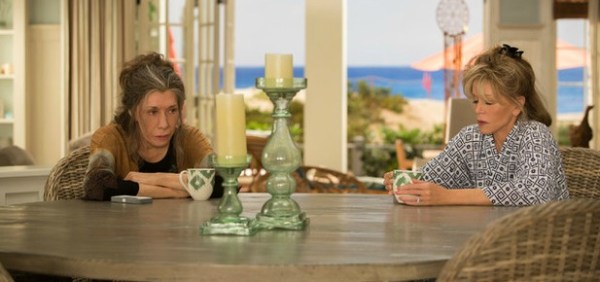
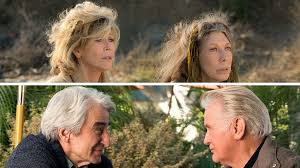
Grace and Frankie: the great divide. (photo from Netflix)

Grace and Frankie: the great divide. (Netflix photo)”The men are never demonized, are heroic in their way.”

At the beginning of Season One, Robert and Sol disclose to Grace and Frankie, women who’ve entered their 70s believing they were in rock-solid marriages, that both marriages are over. For twenty of the forty years they have been together, both men, who shared a law practice and were apparently devoted to their wives and families, have been carrying on a secret love affair. It’s time, they tell the women, that they came out once and for all; they are getting married, and nothing the women can say or do will change their minds.

The women are devastated. How will they ever live without these men, who have been the center of their lives for most of their adulthood? Over the course of the initial thirteen episodes, however, they learn to adjust; in the end both realize from individual epiphanies that they were never fully themselves as married women, that each has compromised herself and has lost sight of who she was to begin with.

perfect and hippie

Too perfect, too hippiedippiedoo (Netflix)

In Season Two, Grace and Frankie have accepted the rearrangement of their lives. They have learned to like each other enough to actually enjoy sharing the beach house to which they have been summarily exiled by their ex-husbands; it is a house the men jointly bought for the two families, and in the past, the women had gone out of their way to avoid getting to know one another intimately. Grace is too body-obsessed, too protocol-conscious, too money-hungry for Frankie’s taste, and as far as Grace is concerned, Frankie is too weird, too hippiedippiedoo, too 60s-leaning addled.But lo and behold, they find that the women buried in the personae they’ve become have more in common than they ever imagined, and together they set about figuring out who they might be under the camouflage.

I do not mean to suggest that Grace and Frankie represent the majority of my sisters. Nor have I stopped believing in happy marriages; I know that those do exist, and Grace and Frankie are by no means the “normal,” which I believe there is such a thing. But I identify with them. They resonate for me in ways female characters of my own generation rarely do. They are fleshy women who transcend the caricatures of older women we are usually presented with: dotty bats or bitchy, lonely success icons. Except that they are too rich and live a life too rife with options, they are real. . . and flawed.

Grace and Frankie are damaged goods. Grace can’t get through a day without excessive amounts of alcohol, and she rarely eats, slavishly catering to her nearly anorexic body, protecting the copious dollars she has expended in preserving her looks. Frankie needs mind alteration and seeks it out in peyote, in ganja, in muscle relaxers; she calls herself an artist but has been unfaithful to her art and has hidden herself in new age homilies and soporifics. Each of them experiences a crisis that leads to a shared epiphany: Frankie’s religious beliefs and spirituality are tested by the dying wish of an old friend, and Grace’s are challenged by the booze and a near affair with an old, still-married flame (Sam Eliot).

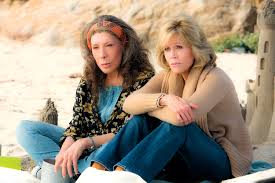
Grace and Frankie at the beach

Grace and Frankie at the beach (Netflix)

At the end of the second season, both women are forced to come to terms with the need to take hold of their lives, when Robert and Sol present yet another fâit-accomplit – they have put the house they have been living in on the market and are planning to move out. The house, which was where Robert and Grace raised their daughters, went to Robert in the divorce settlement, but the announcement that the men are divesting themselves of this vestige of their old lives sets off a firestorm of revelations.

Sol, seeking to clear his tortured conscience before he moves into the next phase of his new life, tells Frankie he fabricated a story of how, when they were very young, he had sold a piece of her art work off the wall of his law office to a famous client. The story has been Frankie’s life raft of self-confidence. She is devastated, protesting, “It’s the one thing that proved to me that I was really an artist!”

A few moments later, Robert gives Grace a carton filled with “thoughtfully” prepared gift boxes, each containing a pre-wrapped item of jewelry, pre-staged with an anticipatory card attached.

There’s a gold necklace: “Sorry you had a bad day.”

And a diamond bracelet: “To Grace. Thinking of you with love. Robert”

An emerald ring. “Happy anniversary to Grace from Robert with love.”

Another and another, each signed “Love, Robert.”

“Seriously?” Grace bellows. “They’re not personal. . . . It’s like a jar of treats for a dog. . . . . “ She stops, lost for words.

“I used to think,” she goes on, fighting the tears, “how nice! Robert went out and got me something because he knew I was sad. Or . . . Robert got me something special because he knew I was right, and he was wrong. But that wasn’t it at all. It wasn’t for me at all. It was for you, so you wouldn’t have to deal with me. So you didn’t even have to think about me. . . . We’d have a fight, and you’d give me a gift from your stash. I used to think you gave me gifts because, I don’t know, you weren’t a talker. But it was to keep me quiet, hunh? To manage me. To handle me. Never, not once was it because you loved me.

“I never understood our marriage until right now.”

All at once, with just the subtlest shift of her body and a gentle sigh, Grace is grateful that her marriage is over. To learn, a year after the divorce, that your husband never really loved you is the worst lie to own up to because it’s a lie you had to be telling yourself or it never would have flown.

Frankie, too, must come to terms with the great lie between her and Sol. She has built her trust on Sol, based on his assertion that he sold her painting so easily because he and the client were so impressed with the art. He thinks he did her a favor.

“I believed in you and wanted you to believe in you too,” he says. He’s sincere. Which makes it all the worse.

Because it is so entirely dismissive. He has robbed her of respect, has failed to trust that she could own her own need to develop her art; he perceived her to be such a child that he needed to candy coat a truth that might have engendered her professional growth.

Grace agrees and accuses Sol of belittling Frankie.

“I was not belittling her,” Sol declares. “I was not dismissing her. . . .”

“Oh really,” Frankie rejoins, “Because ‘her’ is still in the room, and it feels a little dismissive to ‘her’.”

Too pervasively, we women – especially women of the baby boom generation – are programmed to accept men’s condescension, to feel flattered when they humor us, when they patronize us, when they throw us bones. We all have learned to call ourselves happy when our men acquiesce to allowing us to live, even as we stifled our own breath.

Grace and Frankie cogently captures that dynamic, the underlying and agitating essence of what taints too many marriages. It makes the show a continual revelation, a source of satisfying binge watching for this older woman, who hardly expected to see herself represented on the small screen.

Grace and Frankie is not perfect. Although I’m grateful that the show doesn’t pander to the view of older women as finished products, I wish there were less emphasis on the women’s quest to find the right man. They are so much more complete when they don’t kowtow to the opposite sex. But the men they are interested in are far more interesting than the men who have thrown them to the curb, so there is a relief in that.

I also wish that the women’s substance abuse were a subject for more serious investigation. Perhaps it will be in Season 3, when they embark on their next adventure together. I don’t want to see them continue to get in their own way, to stifle their own ability to make themselves happy.

But it is refreshing that neither woman is willing to put up with the stream of put-downs we usually hear in sitcoms; nor is either reduced to silly one-liners that put their men in their places. This is no Everybody Loves Raymond battle of the sexes. It’s rich, convoluted, frustrating, confusing, terrifying, exhilarating real life.

And the men are never demonized. They are easily loveable, even heroic in their own way – after all they have come out to family, friends, colleagues, the world, and have married after 70. That’s courageous. Both former couples are fully fleshed characters, and the actors play them with remarkable aplomb. In a way, because they have clearly found a perfect niche, Sam Waterston steals the show from Sheen, as Jane Fonda does from Tomlin. Still, Tomlin and Sheen are wonderful; this is a full complement of entirely credible actors deftly playing deeply human roles.

I called this a sitcom. That’s not accurate. I guess one would call it a dramedy. I warn you, I cry at least twice in each episode. The stories cut close to the soul, and they can wring emotion I forgot I felt.

I do laugh. But mostly when it hurts.G & Frankie like each other


Cry the Beloved City

I didn’t sleep last night. For the fifth night in a row.

Since the end of June, my nights have been disrupted by neighbors whose disregard for others’ right to [quiet and to safety rule the streets. They are breaking the law, but no law blankets my neighborhood because the gated community that has become NYC sends its resources to patrol the blocks south of 96th, where the bulk of the tourists, who enable the ridiculous cost of membership, are cavorting. Up here even when you call the police, the eruptions go unchecked, and our nights go unquieted.

Those of us who are unfortunate enough to be captive in the city for the summer suffer this abuse through the month of July, but, for some reason, this Independence Day was more invasive, more intrusive, more unconscionable than ever before in the ten years I’ve lived here. The amateur blasting, the popping, the drunken shouting began before sundown and extended well into morning, waning only after the daylight had returned.

I admit that I’ve never much liked the July 4th rituals My idea of celebrating America is quieter; in an effort to refrain from becoming a statistic, I have typically stayed at home, where I have watched home movies of my family’s extensive cross-country explorations or documentaries about the bounties of natural beauty that define this amazing country.   Bombs bursting in air only fill me with dread, remind me that the country is populated by too many who worship weaponry, who perceive military might as right, who continue to craft an economy held hostage by the culture of war and its machinery.

But okay. I concede that fireworks can be lovely. And Macy’s foots the bill for the greatest show on earth. It’s free, and it’s close by, and I encourage all those who love the displays of color and light to seek them out. I heartily applaud my city for throwing such an elaborate, generous birthday bash.images

But the local ILLEGAL practices are a different story. It’s one thing if a group wants to throw a block party that provides a close-knit portion of the neighborhood to celebrate together. I can put up with noise for a few hours, and I am happy that people have a place to comingle. But to continue to make such noise that car alarms cannot be quieted, that keeps pets quaking and agitated, that robs us all of our right to our own preferred pursuit of happiness is no more than group solipsism, criminal entitlement. And it’s terrifying.

The awful disquiet went on throughout the night; the only sound missing was the sound of police cars or fire engines. The noises swelled, then subsided slightly, but they were never checked.

Sometime around 2 this morning, the sounds outside my window changed. Some of the changes were subtle, but they were apparent. The shouting was angrier, heightened a growing barrage of insults, name-calling, threats. The blasts sounded less like homemade duds and more like television violence. How can those of us who are subjected to the abuse discern the difference?

There will be no reports on the news – the news ignores us in Harlem until there is a great drug bust, and they can point to the confiscation of massive stashes to reassure the public that Harlem is under control. The news this morning reported fourteen shootings around the city, but not one was reported here in Harlem, where they happen all too often, where no one is really watching. I called 311 last night, and they told me I had to report my complaint to 911. The fireworks continued without interruption, the noise persisted unabated all through the night. The dispatcher was clearly amused by my report, but I was sure nothing would be done.

Why should there be? Who cares if some old and sick and very young Harlemites are kept awake by loud noises? Who really cares if some homes north of the tony Upper West Side are in danger of being burned, exploded, invaded in some way?

I have never felt so exposed as I did last night. I was as inconsolable as my daughter’s 6-pound Chihuahua, who seems, during this siege, perpetually on the verge of a stroke or worse. It feels like the demons out there, the ones the media won’t let us ignore or forget, are laughing themselves silly at how easy it must be to blend in up here, how simple it would be to hide their noise within the din that the city refuses to hear.


Eagles and Falcons and Hawks . . . oh My!

It was breathtaking. There I was, sitting on a bench at the top of Riverside Park conversing with a colleague, when the sky darkened , and a great swoosh of wings swept up a swirl of dust and leaves, and suddenly, we were in a scene from Jurassic Park. Or perhaps it was a post apocalyptic angel-of-death moment. Anyway, my heart stopped.  Any minute now, I thought, I’ll be grabbed by giant talons, carried away and gone in an instant.

I gathered my courage, looked up, and sure enough, there they were, directly overhead: two giant birds – great red-tail hawks – the larger in the lead, her wings stretching over four feet from tip to tip, her sharp claws pointing downward.

“Wow,” was all either of us could say as the birds flew away.

After a moment, when the wind had settled, and the sun had regained its prominence in the sky, was once more dappling the sidewalk through the leafy gobos, my friend sighed and said, “They’re all over the place all of a sudden. It’s amazing.”

I nodded. “It always surprises me that we are surprised. After all, reclamation is what nature does best.”

“But it feels like it’s happening all of a sudden. I mean, they’re taking over the parks. They didn’t used to be so commonplace, did then? Remember when everyone got excited about Pale Male and Lola, back in the late nineties?”

She was referring to a lone pair of hawks who famously chose a controversial nesting spot in a decorative neo-classical sculpture niche high atop a tony Fifth Avenue apartment house. Today Lola is long since dead, and Pale Male is twenty-four years old, a stalwart survivor, who has outlived at least eleven post-Lola mates, and he is no longer unique in the City. Which leaves city dwellers continually scratching their heads in wonder.

Or quaking in fear.

My daughter has an adopted apple head Chihuahua named Madhu. Though he is just simple enough to greet a falcon diving at him as a welcome invitation to play, he wouldn’t last long, as he weighs less than six pounds and would be easily transported to an urban aerie. My daughter, like her fellow small dog parents, will readily recount a tale, which may or may not be true, about a woman who was picnicking in a park near 125th Street when she looked up and saw a hawk carrying off a wailing, terrified Chihuahua. No protective screaming or rock throwing or batting away at the bird by the horrified pet’s family loosed the predator’s grip. They watched along with that woman and horrified onlookers as the great wings flapped, and the little dog’s pink leash, dangling from its already limp body, trailed off out of sight.

dog in the talons

Story from Out Walking the Dog, illustration by Charlotte Hildebrand

The woman is reported to have famously said, “I hate those birds, all birds of prey. If I had a rifle, I’d shoot them whenever I see them.”

Small pet people share this story with one another wherever they gather, warning one another to stay away from Riverside Park and Central Park and St. Nicholas Park and all the other parks in the city and to keep their guard up even on busy sidewalks – a small dog was nearly snatched from the sidewalk in midtown last week.  “What do you do if one attacks?” They ask each other, never sure there is a right answer.

12303919_10154318814746416_2795602669443676030_o

Madhu

Just yesterday, while walking with Madhu on our residential street, near the local elementary school, my daughter looked up in a tree and saw two hawks peering down. “I swear they were going to attack,” she averred. “I felt them staring.” She scooped Madhu into her arms and scurried home, grateful she had seen them in time.

Madhu notwithstanding, the birds are a miracle. Back in the 1980s, when populations of rats, pigeons and squirrels threatened to force humanity out of the city, poisons became ineffective in keeping populations down because the rapid evolution of the species enabled even more rapid mutations that rendered the rodents and pigeons impervious to the formulae. Birds of prey were introduced, but it was touch and go for a long time. Their sensitive systems were vulnerable to the potions their meals were ingesting, and because the poisons affected their abilities to reproduce, the birds’ evolution was slow.

Today the hunters are beginning to thrive. Not just hawks but also peregrine falcons, eagles, and other birds of prey. They are taking back the treetops, much the way coyotes and raccoons are taking back the bushes. Nature is reminding us she never went away, and we have to learn to live with all her creatures.

But being human, we don’t believe it. Or we choose to deny it. We expect, as we always have with all indigenous beings that we can tame them, bend them to our will,  round them up and put them in zoos and make them stay in their place. If they don’t, we can kill them. After all, we carry guns, and that gives us license to eliminate those we perceive as intruders.

But nature’s not lying down for us, and her minions are not waiting around to be eradicated. They are, like the restless people who are tired of being colonized, putting up a fight. They’re pushing back in small ways now, and perhaps they’ll lose in the short term. But in the long run, we lose by insisting on claiming superiority. Nature has a way of winning. Eventually.

If we kill off the birds here in New York City, we’ll be at the mercy of the disease and filth spread by the unchecked rodent and pigeon populations. We can kill them too, but they’re adaptable, and they will prevail; we stand to lose this island as we stand to lose the planet we have abused too long.

Ultimately, we are here at the mercy of the creatures who naturally inhabit this island. They have been erased before, and they have always found their way back. The alligator in Disney World was no accidental happenstance; one wonders how Disney could have been so blindsided, given their layered history with Captain Hook.  imgresOkay, it was a crocodile, but the point remains.  The swamps that were Florida before the marauding white man decided to tame them belonged first to the alligators. The Disney folk can kill them, but for every one they kill, a dozen will come to the funeral, and unless the humans figure out a way to co-exist peacefully and safely, the gators will be victorious.

The meek do not inherit the earth. The fittest do. Those who can survive on garbage and mud and each other, like gators and rats and pigeons and squirrels and bugs, will long live after us. They don’t need us any more than they need the sunlight or the clean air that we can’t live without.  The creatures will be more than happy to take what we leave behind. And then nature will regenerate, and evolution will replace us with new “higher” organisms.  But we won’t be here to greet them or study them or abuse for our pleasure.

We have to choose. Are we with ‘em?  If we’re not, they’ll most assuredly be against us.


I Got a Kick . . . At the Opera!

As a rule, I am not a big fan of musical theater. I want my mind engaged when I go to the theater, and the familiar tropes and clichés of most musicals work better than personal ohms to make me drift into mindlessness. There are exceptions to my taste aversion, the stellar standouts, which include anything by Stephen Sondheim, Rent, Roar of the Greasepaint, HAMILTON and a few others. But even as a director of educational theater, who helmed at least two musicals a year, I was hard to please.

Which is why I most often chose very difficult musicals for my students to perform – the very operatic Most Happy Fella and Sondheim’s dark and cynical Sweeney Todd, for example. I am a very tough customer. And I am not likely to trust local regional theater, wherever I might be.

Which is curious, considering that I lived for many years in the New Haven, CT, area, and I had access to some of America’s best regional theaters. I trusted Long Wharf Theatre, Hartford Stage, and Yale Repertory, whose productions I attended religiously. But except for one musical at Long Wharf that I rather liked (about an English teacher), I tended to head to New York when I wanted to check out a play for my kids or to see what was new in the musicals canon.

And that is how I failed to discover the Goodspeed Opera House.

Well, that is not exactly accurate. I knew about the Goodspeed.  I  had even been to the building and had walked the premises. But  I had never gone inside, had never seen a production.

Until last week.

My good friend and colleague Denise Lute was featured as the batty Mrs. Harcourt in Anything Goes, and I decided it was time to take the leap, convincing my best buddy to drive with me from New York to Haddam. Well, blow Gabriel, blow and ain’t it de-lovely! If Anything Goes is an example of what’s been going on out there at the Goodspeed, then I have been a fool. Thank goodness I have lived long enough to get past my prejudices and enjoy this epiphany.

Anything Goes was absolute perfection, from start to finish, a joy to behold and a revelation of phenomenal talent.

Which, as Denise pointed out over dinner, should not be a surprise. After all, everyone in the cast has a host of impressive credits. “My Kingsley (Kingsley Leggs, who plays Eli J. Whitney, Mrs. Harcourt’s boyfriend)”, she averred, “was in Color Purple, Sister Act, etc., David (Harris, who plays the romantic lead) is a hot (and I mean HOT) star in Australia, and Rashidra (Scott), well, she’s here because Beautiful let her take a leave of absence. She’s got a feature role in that one!”  High praise coming from Denise Lute, who works more than most actors I know, a veteran of the Actors’ Studio. Still, I would not have been so easily convinced. Anyone can make a resume sound far more impressive than it is.

Rashidra

Rashidra Scott as Reno Sweeney in Goodspeed Opera’s Anything Goes (photo courtesy of CT Post).

But the cast gels in ensemble synchronicity from the stimulating opener to the rousing finish. Rashidra Scott is in almost every scene and leads the ensemble in dancing that runs the gambit from tap to jazz to ballet to salsa with her fleet feet dancing in perfect alignment with her megavoice. She really stands out.

Because she practically carries the show. But honestly, there’s not a bad apple in this crate. Every single person in the cast sings, dances, acts. Even Trixie, the dog Denise’s character carries compulsively through most of the play, is remarkable, so mellow she could have convincingly played a stuffed animal.

Denise and Trixie

Cheeky (Trixie the Pomeranian) in the arms of Mrs. Harcourt (Denise Lute). Photo by Tim Cook/The Day

I would have preferred less mugging and ad-libbing by Stephen DeRosa, who plays Moonface Martin, Public Enemy #2, but that’s because I’m a writer (script sacrosanctity!) and a former acting teacher (be generous, babies; don’t steal the light); the crowd there loved him, and so he mugged harder and ad-libbed all the more vigorously.

To tell the truth, if I were to say to one person in the show “You’re the top,” it would be to choreographer Kelli Barclay. I haven’t seen dancing like this anywhere. The dance in this show was more than just a fun interlude. In many cases, the dance captured pieces of story that were not clearly elucidated or they underscored a subtext the audience could easily have missed. The book is simplicity itself, with no intricate story lines, no metaphorical messages to darken or clutter the story, but the characters might come off as stick figures or cartoons were it not for the choreography. Barclay’s choreography endows Reno Sweeny and Billy Crocker, and even Moonface Martin with a humanity that is not in the script, is not clear in the music.

One of the difficulties of a show like Anything Goes is that the vacuity of story and absence of characterization can leave the audience a bit numb. Even while they are having fun, they might be inclined to turn off a bit, to withhold investment in the people the actors are playing. Barclay’s dances ensure that the audience cares about all of them, even about the ensemble characters we hardly know at all.

Director Daniel Goldstein can take credit for opening a world and for making sure that all the elements of the production are of that world. The design of the set by Wilson Chin is simple but elegant, very old-school theatrical, with small revolves, wagons and flies providing a variety of sub-sets. The costumes by Ilona Somogyi are adorable, respectful of the bodies they adorn and time-period-appropriate, in colors that enhance the set design. Lights, by Brian Tovar are unnoticeable and flawless, but sound was slightly lacking, as there were whole chunks of dialogue that were inaudible or indiscernible where I was sitting in the front left orchestra.

Best of all, what Goldstein has achieved, what directors hope for and too often miss, is a cast and crew that loves being together, loves making this show, loves Cole Porter, loves everything about being in Haddam on the stage of the Goodspeed Opera House. That’s remarkable. It’s hard to pull off a show that’s based on the music of a beloved song writer and refrain from making it more than it is or less than it can be. An American in Paris on Broadway very graphically proved that to me. No one had any fun in that show, at least on the day I saw it. And the writers and director, in adding tried dark drama to the simple storyline, muddied the waters and detracted from the beauty of the music. The actors were great ballet dancers but could not act, and the dancing told no story. The play was merely an exhibition, a total disappointment. And the antithesis of Anything Goes.

Which taught me a valuable lesson. I must lose all NYC snobbery. Theater in the boondocks –like it or not, folks, the Goodspeed Opera House is in the idyllic boondocks, on the banks of the CT River – can be well worth the requisite battle to reach it through horrific Connecticut (worst in summertime) traffic.

goodspeed

It’s too late to see this production of Anything Goes, which closed  June 16. But there will be other productions – check them out here. And be sure to watch for work by people like Rashidra Scott, Denise Lute, Daniel Goldstein, and Kelli Barclay.

Himself and Nora, an off-Broadway show about James and Nora Joyce, about which I was skeptical about until I realized it features Barclay’s choreography, sounds like a great prospect. There’s lots of subtext in that marriage to elucidate through dance. My guess is that it can’t miss.


An open letter to the last in a long line of youngsters who have written me rejection letters. . . .


Dear Young Person Who Just Wrote Me (yet) a(nother) Rejection Letter,

Thank you for taking the time to write me and tell me that the competition for this teaching job, a job, which, like the previous twenty for which I have applied, I could do with my eyes closed and my feet chained together, was so fierce that I just didn’t make the cut. I appreciate that you are sensitive enough to want to let me know that I am unqualified to join your ranks, and I know you mean well.  After all, you did refrain from telling me I am cute.  I should be grateful for small favors.

62129495

Still, I would prefer if you would refrain from the obligatory condescension of telling me I am amazing. I know I am amazing, and I also know that, while you may be attempting to compliment me by saying so, you don’t believe that I am anything more than ridiculous.  You want the young, the brilliant, the beautiful kids with whom I cannot – because people like you won’t let me – compete with to work in your school.

Which is sad. I am a good teacher. Ask any of the people who were in my classroom or my theater groups over the years I put in.  Okay, there was the time in 1980, before I got my first Master’s Degree, when I let the students in the class for which I was substituting in Glendale, AZ, eat donuts while taking a T/F test, but I am over that now.  I promise never to do it again.

Did you notice the part on my CV where it tells you I taught creative writing and acting, coached high school seniors through college essays, guided hundreds of youngsters through reams of literature and directed them in plays?  I was elected Teacher of the Year a couple times, my kids got into great schools, my theater group won awards.  More recently, I have been published in a few periodicals, have an agent pedalling my first book, completed an MFA at Columbia University.  How is it that I am not up to your standards?

Ask me a question.  Any question.  I probably have an answer . . . or I can make one up.  I’m pretty smart, and thanks to my successful teaching career, I have a store of accrued wisdom and patience, a reputation for flexibility and a range of pedagogical techniques, and I have a deep capacity for mentoring.  Additionally, I have a peerless resume of expertise and experiences one can only garner over a long and productive life, through which I have learned to be an adept team player, who is wont to foster camaraderie and collaboration.  My presence would benefit your students in untold ways. Do I not fit your picture of what the ideal artist/teacher should be – a young person, with whom your budding high school geniuses can bond, in whom they can see themselves?   Pardon me for tooting my own horn, but  you clearly don’t realize how much you are depriving them of.

And me too.  How much you are depriving me of. I didn’t apply for this job as a lark. I am not looking to play at being a teacher. I support myself and another person, and I need the salary this job would have provided. Ironically, too, because I collect some Social Security and have a minor pension, the meager salary you offer is just about all I need to keep my rent paid. Unlike my younger counterparts, I wouldn’t have to juggle multiple jobs. My attention would be entirely focused on the youngsters in my care. But I’m guessing that looks are far more important than student-centered instruction.

If my credentials are, in your words, impressive, how is it I just don’t measure up?  Don’t you think it’s a bit backward that we older folks are consigned to the kind of  backbreaking service jobs  we really are too old for?  Isn’t it sad that if I want to draw a salary, I must stand for hours in a retail environment, stock heavy boxes on shelves, run errands for young executives or some such waste of all that I have become in the course of my storied careers as a writer, teacher, mother, mentor, wrangler of teenage actors, director of educational theater, and filmmaker? classroom creativity

Stop lying to me. Stop offering idiotic soporifics like, “You are truly uniquely qualified,” and tell me the truth. Tell me you think I’m too old to be trusted to lead your young charges. Tell me you are disgusted that I have reached this juncture in my life without the accolades you will have amassed by the time you are 40. You want me to be retired, to gratefully stay in my pasture counting the gold pieces my hard work has already accrued.  You don’t want to think you could end up like me, an old neophyte trying to reimagine herself as she was meant to be.  Admit it.  My choice to teach high school and to put motherhood ahead of professional development makes me look like a loser to you, and that somehow makes me toxic and dangerous. I can see that. It’s a veritable powder keg I’m offering you.

Believe me, I know you think you are being kind. Your kindness is killing me.

Thank you for your consideration.

Sincerely,
Carla Stockton