Memory in the Museum*

* re-printed by permission of the Columbia: a journal of literature and art, where it appears on the Blog Site

                                                                                 In the room the women come and go
                                                                        Talking of Michelangelo . . . .
                                                                                                      T.S. Eliot. The Lovesong of J. Alfred Prufrock
museum_hours_film_still_a_l
Museum Hours
recalled an epiphany I experienced on my way to my wedding.

Sauntering from my apartment on Riverside Drive to the chapel at Columbia, seeking to memorize the details of my last moments of freedom, I made a special point of looking into the faces of the people I passed. I had only recently graduated from adolescence into my 20’s, and like most of my cohorts, I saw myself as the center of life and substance in the universe. But, of course, my being on the threshold of a seismic life change was of no consequence to anyone around me. And what surprised me when no one returned my gaze – hardly a soul so much as noted my existence – was that I was not disturbed at how non-noteworthy I was. It felt right. I suddenly saw with utter clarity that my story was just one among all the stories bustling about. Our lives mingled with one another like the aromas of automobiles, coffee, cigarettes, bacon, garbage and spring flowers wafting in the breeze; while each possessed a singular uniqueness, all blended smoothly into a single May morning landscape.

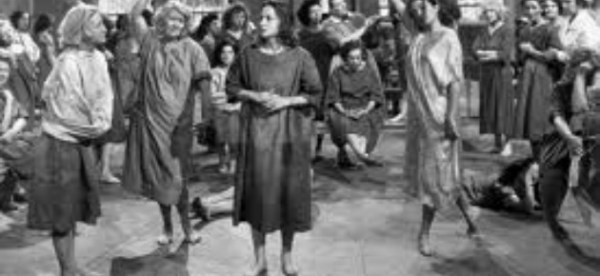
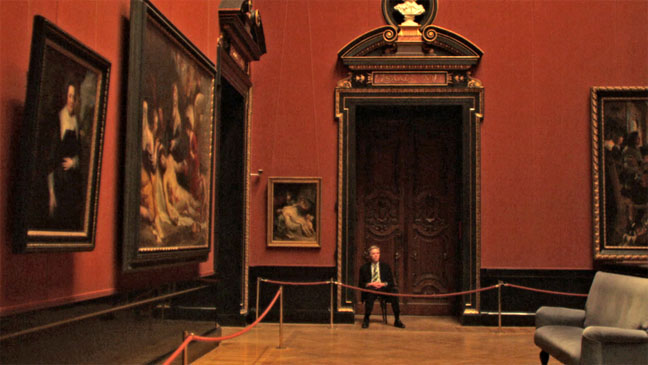
Museum Hours meanders thus, like a leisurely walk across campus or a thoughtful mosey through a gallery. It lingers, at both expected and unexpected intervals, to examine the layers of imagery, the texturing of impressions that create the large and small occurrences that memory accumulates, and it moves from moment to moment without ceremony, shifting from one to the next without releasing the one that came before. The film sees life as both revelatory and mundane in the same instant. And the conversations, colors, music, ambient sounds, sights and smells create a kind of cacophony that conspires both to obscure the individual components and to illuminate the distinct strengths each brings to the choir.1157496_Museum_Hours
The film is a pentimento similar to a masterwork by Peter Breughel the Elder. Breughel’s work is a kind of template for the film. The 16th Century Dutch master’s particular affinity for creating multiple strata of scenarios in every frame, for securing both the key to the broad spectrum of the painting and the insight on each particular picture by way of details illuminated in color and light, resonates here. Like Breughel, Jem Cohen, provides a wide view of life and then through the magic of his medium, which has the added benefit of sound and movement, he hones in on myriad points of view.

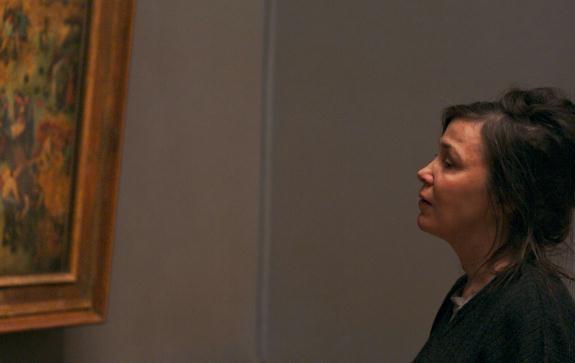
Like the central characters in Breughel’s work, the two apparent protagonists of Cohen’s film serve as foils for the many players that swirl about them in the museum, in the hospital, on the streets, in the local pub, and their stories irradiate innumerable others. Anne (Mary Margaret O’Hara) has been summoned to Vienna to attend the deathwatch of a cousin she grew up with but from whom she has long been separated. She wanders into the Historisches Kunstmuseum and meets Johann (Bobby Somer), a guard there. She asks him for directions and confides her predicament to him; he offers to be her guide and interpreter. Over the course of the movie, they forge a deep friendship, reveal details of their personal lives and provide succor and comfort for one another. For each, the other is a mirror in which a hitherto unseen self appears.

Anne is a babbler. She talks in stream of consciousness at times, the way people do who have lived alone but have much to say. Johann, by contrast, is measured in his speech, not exactly guarded but less apt to simply offer what Anne identifies as her penchant for “too much information”. He never overtly hides anything, but when he discloses, he does so quietly, matter-of-factly. Anne asks Johann if he has friends or family who, like her cousin, have been far away so that “you don’t really know where they are anymore”; he answers that actually he has no one left to keep track of. His parents, a sister, and a partner – “he’s long since been gone”– are all dead. Johann shows Anne his favorite paintings and sculpture, and she reacts. “They don’t even look nude. They look proud. Like they’re not even ashamed. . . . I had a boyfriend, and I was so guilty about sexuality. Oh! This is too much information again!” He smiles, enjoying the discourse, feeling a wholeness he’s been missing. “ I had had my share of noise . . . and now I was enjoying my quiet . . . . Then I realized how much time I had been spending at home, by myself. . . . I had forgotten how much I loved Vienna. I liked seeing the city again, showing her my city.”
museumhours_04

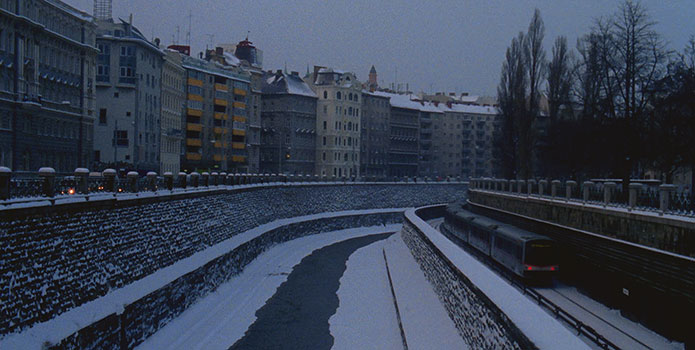
Together, Johann and Anne explore the tourists’ Vienna, but since, as Johann points out, “everything must be inexpensive,” they spend just as much time in obscure parks and in his favorite cafe, watching birds congregate on wires, townspeople relax over dinner, or old men make faces that resemble the museum’s Roman statuary. On their last day together, they walk to the hills overlooking the city in search of a congregation of starlings expected to take flight in unison, but when they arrive, they find no birds and wonder if the birds have already flown. They walk for a bit, then wait and watch while the camera rests on the sweeping view of grass. Eventually, the two stroll across the frame and disappear from sight while the camera continues to wait. The grass undulates, a cloud whispers slightly to the right, and just when you think you have see all you can possibly see, a new figure walks onto the path, and you realize that there are trees there that you hadn’t noticed before. But before you can truly examine the new dimensions, the camera releases you from that image and goes to black though you are still listening to the sound of the man’s feet crossing the grassy plain. In the darkness, you don’t remember Johann, Anne or the stranger so much as specks of color on a grayish canvas, errant birds, trees and cloudy skies.

Like Johann and Anne, we who watch the film will someday discover memories of that time in Vienna imbedded in the sediment of images and textures that have accumulated. Looking back, the gesticulation of fingers will be inextricably fused to the swaying of a roomful of dancers. The sound of a breathing machine will become indistinguishable from the noise of an early morning marketplace.

images-2

What Anne and Johann have spent their Museum Hours discovering and what they’ve shared with us is how the senses discern what the heart will remember, and their discoveries are a joy to behold. Life, like art, never reveals itself all at once. Icarus’s fall from the sky in a painting or a young woman’s pre-nuptial walk through town are mere threads in a fabulous tapestry that can be visited and re-visited without relinquishing its fascination. There will always be more there than meets the eye.

Museum Hours Trailer

Bye Bye, Annie . . . why’d ya hafta go?

 When I was a green teacher, and my drama club was the system’s fledgling stepchild, I had the great good fortune to meet Ann DeMatteo.  In those days, her beat for the New Haven Register included the North Haven-Hamden schools, and as soon as she heard we were forming the new club, she came out to interview us and to do a story on the program.

964790_10100270275662657_800719343_o

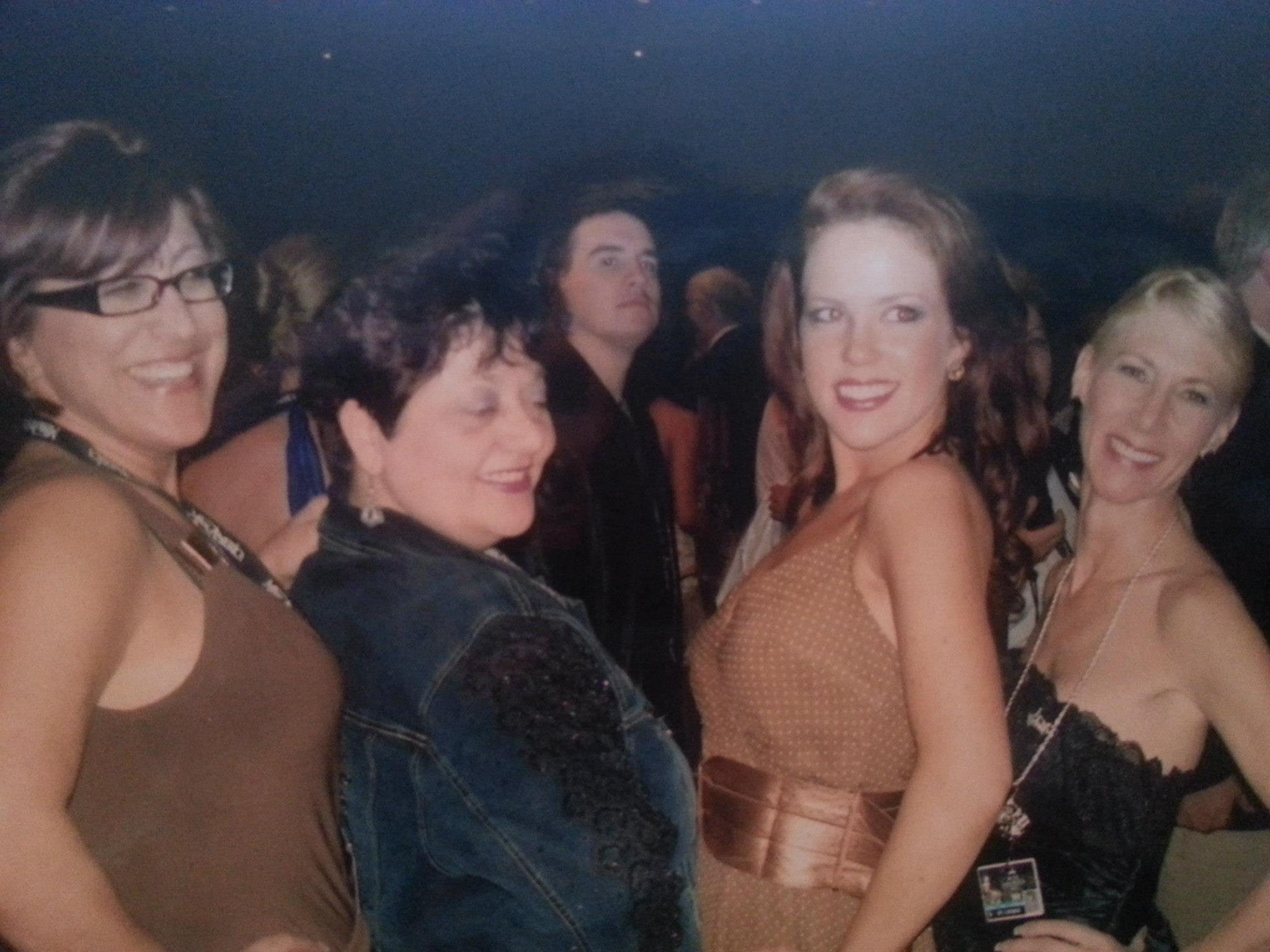
Ann, partying in her usual, youthful way, with newswoman Heidi Voight, Miss Connecticut 2008.

I liked her immediately.  Who wouldn’t?  She was ebullient, sharp, interested, and her enthusiasm for drama was painted across her whole being.  After that, anytime we had a show or a fundraiser or a special event of any kind, Ann was there, and she wrote about it.  Sometime during my years in North Haven, Ann had her first bout with cancer.  She didn’t skip a beat, kept on covering her beat, took on the teen beauty pageant she produced, raised funds for all kinds of causes, especially for her pageant.

Later, when I moved to East Haven, which happened to be Ann’s home town, I learned a lot more about her and why she had such an affinity for drama.  By this time she’d had plenty of private life drama, none of which she would want me playing across the proscenium of a blogsite, and she had beat the cancer.  And she made the realization of our drama program at EHHS her very own cause célèbre.

In an effort to launch a dramatic arts academy at the brand new high school in East Haven, my music director Judy Polio-Webber and I decided that it would be a good idea to open auditions for Bye Bye Birdie, our first show to the community.  I called Ann in hopes that she would spread the word.  And did she spread the word!

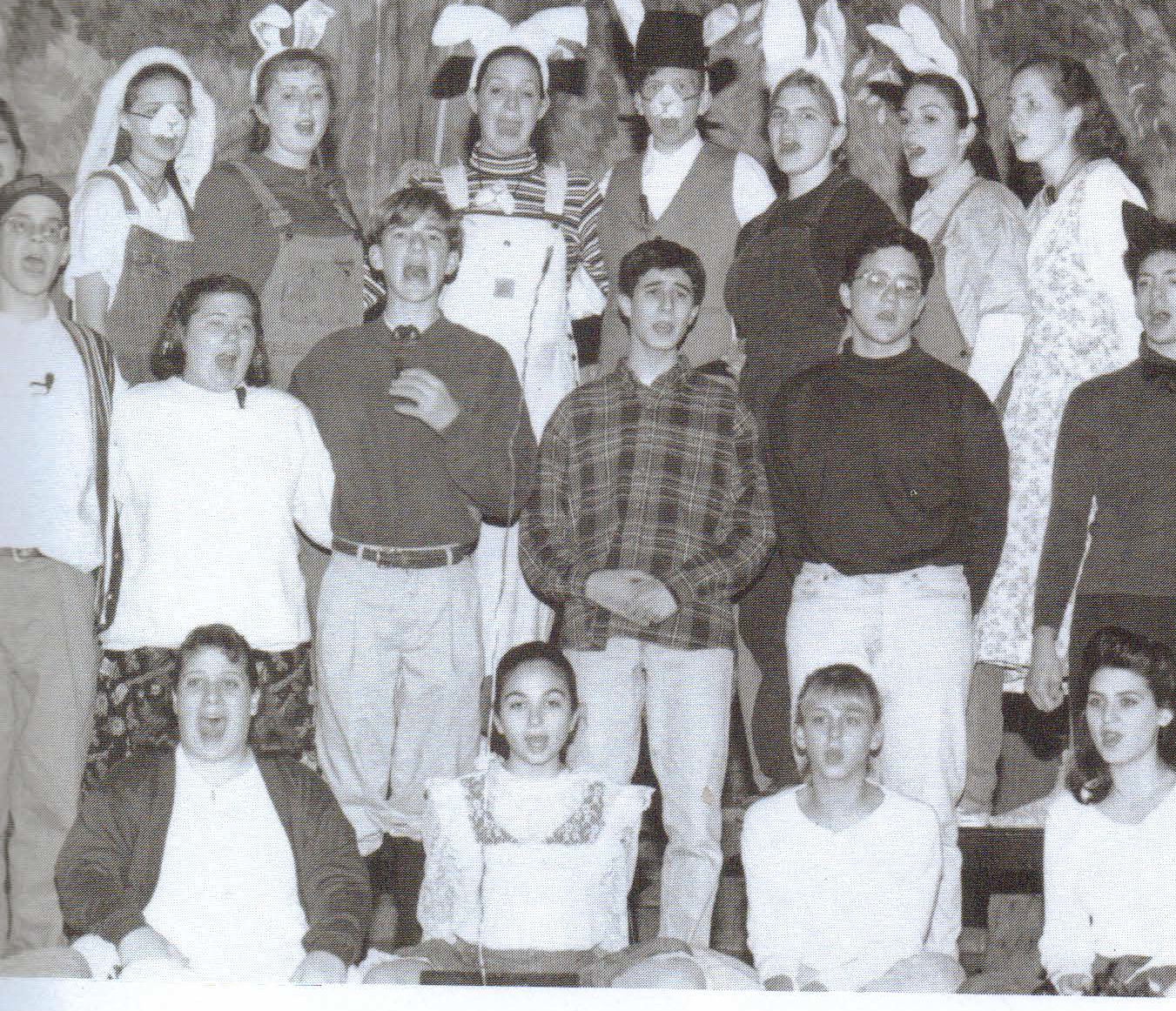
She wrote about the auditions, wrote about the program, interviewed the principal, wrote about him, interviewed townspeople and wrote about them and what the new drama program might mean to them.  Then she made phone calls.  In that debut production, at least half the members of our very large chorus were there because Ann had told them to come out for the show; and Ann, proud to be wearing her bobby sox, saddle shoes and a crinoline that stretched to Milwaukee, was the most salient voice among them.

When I moved to New Haven and on to filmmaking, Ann wrote about my company and our efforts to grow.  She sent around our casting notice and was responsible for the huge turnout we had for our casting sessions at Bar.  Then, she managed to come to every theater production and film screening my partner and I mounted.  I knew the curtain could raise as soon as Annie De Matteo was in the house.

Later, when I moved to NYC, we drifted out of touch somewhat, but she checked in with me periodically, and she blogged about my work; when I initiated a NYC Mob Tour, Ann wrote about the tour, and her writing intrigued Jim Shelton,  wrote a feature article for the Sunday Register.

How do you thank such a woman for that kind of lasting fidelity and willing support?  I sent her tickets to come ride the Mob Tour, but she never got in to the city to use them.  I sent her a videotape of Birdie, but I think she gave it to someone else who was in the cast.  That’s who she was.

When I saw on Facebook the other day that Annie had died, I was stunned.  I guess I saw the signs in the most recent rounds of chemo, radiation, hospitalization, convalescence, but I didn’t believe that anyone with that kind of spirit could actually leave us.  I guess it’s true that it’s better that she is out of pain and out of stress and out of the constant struggle.  But it’s worse for the planet, which is a lonelier and less mirthful place for having lost her presence.

I can only hope that her voice is the loudest in the chorus she’s joined in the great beyond, and she’s making the other angels smile.  I like to imagine she’s wearing that crinoline and the saddle shoes, and she’s got her hands all over the hunkiest Conrad Birdie ever.261733_10200293713198698_1527977597_n

Salvation and Stu Elliott

I was never one of those gifted people who are called to teaching.  In fact, teaching was one of two things my teen self had decided, absolutely, I would never do.  As the oldest of seven children, I was adamant I’d have none of my own, and as a misfit who was terrified by teens, I was intractable in my resolution to eschew any contact with them.

To be a writer was all I wanted, and when I did have children — after all, life and love do intervene —  I envisioned myself a kind of Bohemian Doris Day typing away while her brood ate the daisies, but eventually I needed a profession with a steady income that afforded me the freedom to spend the kids’ vacations with them, and so I landed in teaching.  I got certified and cut my teeth in Phoenix, but my first long-term job was in Connecticut.

By the time I was hired, I knew that I actually liked youngsters, respected their wit and wisdom, felt comfortable among them.  I realized that this might be the result of the fact that those around whom I was actually uncomfortable were my own peers, and I was aware that I would never be good at navigating the rarified world of school system politics.  But over the years, to my own surprise,  I managed to evolve into a competent teacher, a good friend to many of my students, and a strong advocate for them and for my drama program.  I did so because Stu Elliott saved me.

Stu strode into my life as a welcome surprise.  He was a Clintonesque colossus, tall, engaging, boyishly charming and cunningly smart, and he was newly appointed Principal of the school whose grounds abutted the half-acre we had just purchased after our move from the desert. I had dreamily thought — and dismissed as fantasy — that I might be hired to teach there, and to my great delight, Stu chose me to fill a vacancy in the English Department.  When he hired me,  Stu gave me two gifts: some great advice and the drama club.  The drama club came first.

“The school hasn’t had one for years, and I think you’d be good for it, ” he crooned.  Who could resist that?  I could have argued for a Literary Magazine, but I knew, as an English teacher, I would be inundated with student writing, and the Drama Club felt right.

Then, as we shook hands over my contract, Stu looked me in the eye and said, “You’re gonna break the rules.  I know that.  I’m okay with it.  But do me a favor.  Whatever you do in the classroom or in your extracurricular duties, write a rationale.  Give it to me.  If it makes sense to me, then no matter how crazy it seems to the rest of the world, I’ll cover your ass; if it doesn’t make sense to me, I’ll tell you, and you’ll rewrite your plan.”

I never had to do a re-write.  He protected me like a guardian angel, and I loved him in the same innocent, dumbly admiring way the kids did.  He dropped into classes, shook his head in amusement, left singing along with us; he counseled me often when colleagues complained that I “got away with murder.”Stu candid

Too few years later, after a long illness had kept us missing him terribly, when he had just begun to segue back to attending school daily, Stu was hit by a drunk driver during an early morning jog, and he died before the ambulance reached him.  When the shock wore off, when we had accepted his departure as best we could, I would have expected teaching to become unbearable, but he had prepared me.

Before the illness, Stu was reaching up in his career.  He wanted to be a superintendent, and a few opportunities had presented themselves.  Called in to his office one afternoon, I had to nod and agree when he made me promise that I would support and if necessary promote the ascension of our assistant principal to his position.  “She’s not like me, Carla,” Stu said.  “She will drive you crazy because she’s all about the rules.  But she’s good for the school, and so long as you remember to keep writing rationales, you’ll be okay.”

He was actually wrong.  I did campaign for the appointment of his chosen successor, but the rationales never really helped.  Our new principal hated me, told me I was evil because I introduced craziness to the kids, but it didn’t matter.  And the reason it didn’t matter was that Stu had given me the Drama Club, and she could not wrest it from me.

The kids who come out for a drama program are often the smartest, the bravest, the nerdiest kids in school.  They can also be the most beautiful, the most popular, the most conforming.  That’s what is so great about a drama program — it brings the various worlds of high school together in a realm of mutual understanding and respect.  When I recruited the high school football team to play sailors in South Pacific, the cheerleaders came too, and suddenly at the homecoming ball they were all dancing with the “geeks,” singing “There is Nothing Like a Dame,” over the Stevie Wonder single playing on the disk jockey’s turntable.

461280_161681603999838_1382242994_o

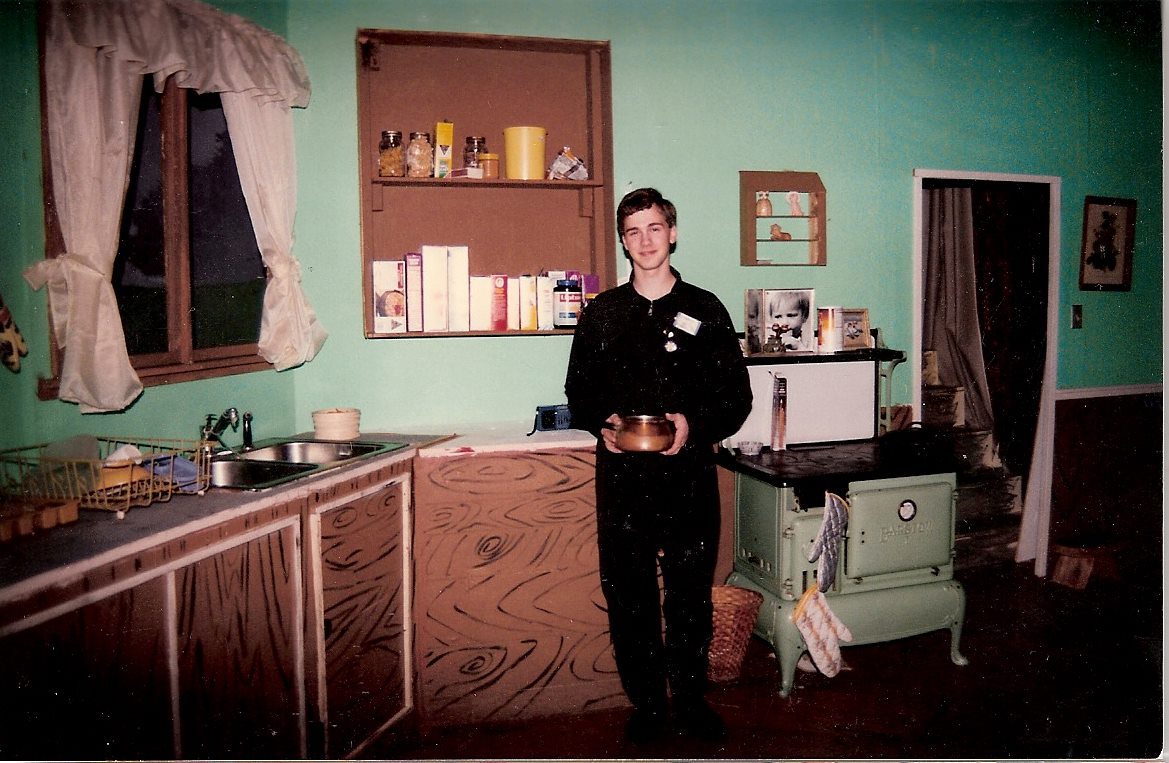
Michael Goglia on the set of Crimes of the Heart, which he designed, 1995

248096_161688117332520_380169990_n

No one had ever trusted me with a screwgun before, and I felt powerful. It was heady

I learned from all my students every day, but the kinds of lessons I learned in drama club, I’d never have learned elsewhere.  When Michael P. Goglia came to me as an 8th Grader and said he would like to “help you out” by designing and building sets, I looked at his skinny little frame and thought, oh sure; but he and his father came every time the auditorium was available, and they indeed built wondrous sets out of the cheapest materials one can imagine, sets Mike had designed.  And unbelievable as it may sound, Mike ran his crew like a well-oiled rig, engaging boys and girls, who had hitherto wielded nothing heavier than a joystick, in the construction of sets, hanging of lights, striking of heavy objects.  More unexpectedly, Michael taught me how to use a Makita (electric drill), how to construct a flat so that it’s sturdy enough to withstand a production but easy enough to dissemble during strike, how to create the illusion of water where none exists, etc.  I had studied acting and had been in productions, but no one had ever trusted me with a screw gun before, and I felt powerful.  It was heady.

When we did Our Town, I fretted about the sight lines for people in the first several rows of the massive auditorium.  Michael said, “Let’s rake it.”  Sure, I thought.  We can do that.  How?  Michael taught the others, and me, and I had no idea how huge this was until later that school year when the town meeting was called to vote on whether to eliminate my nominal stipend from the budget and thereby eradicate our program.  At that meeting, Misha Magoveny, who rarely sought the limelight for anything, addressed the assembled citizenry and explained how she would never have learned what the devil she was studying trigonometry for had it not been for drama.  “See, Ms. Stockton and Mike said we were going to rake the stage, and I couldn’t imagine how you figure out how to do that, but Mike said, ‘You use sin and cosine to find the relationship of the angles, and you go from there.  You know how to do that already.’  And all of a sudden, I understood what my math class was trying to teach me.  We found the angles, and we raked the stage!”

Every day brought new challenges.  The town council rented the auditorium out from under us in the middle of tech week.  The assistant principal approved a cheerleading extravaganza on the stage the same day as a dress rehearsal.  A flood in the storeroom wiped out our expensive muslin (for set construction).  The fencing team made regionals, and half the cast and most of the crew were unavailable for opening night.  Each new stumbling block ended in our laughing at the way we had worked out solutions, creatively, collaboratively.  We all learned the true meaning of teamwork every time we congregated.

Some of our problems were more devastating.  Two of our kids lost fathers within a year of one another; we sustained the loss by suicide, by car accident and by illness of fellow students, and we were assaulted by the insurmountable reality of losing Stu.  Having one another got us through the worst of times, and having one another provided more occasion to celebrate in the best of times.
images-1images

My personal battles with my political foes were rendered worthwhile by the faith my drama kids and I had in one another.  Two of my more schadenfreude-inclined colleagues reported that I was smoking marijuana with the kids in the costume room; another reported that I was perhaps, well, you know.  Because of the kind of relationship I had with the kids, no one ever took any of that seriously, and if I had to pay penance for choosing “subversive” material like For Whom the Southern Belle Tolls or Crimes of the Heart, the fact of our alliance fueled my passion.

We traveled to conventions together, went to shows in New York, participated in competitions, created magic on the stage.  Most importantly, we all grew, expanded our horizons, learned to roll with the punches and go with the flow.  We learned to count on one another, to trust one another, to be unafraid to need one another.  We created a family that never superseded our biological families but that always strengthened our faith that family is the institution that matters.

wind in the willows

The cast of The Wind in the Willows, no-budget, student produced and directed children’s play.

Over time, I oversaw summer programs, several in-school programs, and one fabulous conservatory program funded by the State of Connecticut that brought professional and educational theater under the same roof, where NY actors and tech experts taught, mentored and shared the stage with the kids, and we ALL benefitted equally.

When I left teaching, I left because I could no longer fight, and I was always expected to fight.  There was never enough money for the program, so I spent — to the great detriment of my personal kids — far too many hours alongside the indefatigable drama club members, running car washes, mowing townspeople’s lawns, operating cake sales, selling goods at garage sales, etc., to raise the funds we needed to survive.   Everyone agreed that the theater program was worthwhile, but when money is tight, you eliminate fluff, and a theater program is almost always perceived as pure fluff.  I just got to a point where I was exhausted, depleted, drained of my resources.  So I left, and I have never regretted that I did.

But every once in a while, I like to remind myself how glorious it was to be part of that amazing body of youngsters who peopled my programs, how eternally grateful I am for the love and the wisdom they shared with me, how inextricably changed I remain because of the time I spent with them. They made me a better classroom teacher, one who is equally grateful for those students’ presence in my life, and together they all made me a better person.

I am a lucky, lucky woman.  And I owe it all to Stu Elliott.

Whom I continue to miss . . . every day.

Save Our Souls

My friend buried her older brother Donnie the other day.  Despite the fact that she buried her husband less than a year ago, and she’s still a young woman, my friend carried herself with stalwart grace, and only once did she lose her composure.

“He shouldn’t ‘a’ died so young.  You know?  It was his meds.  No one paid attention to his health.  They just wrote his ‘scripts and sent him on his way.  No time for assessment.  No time for monitoring.  Just move ’em in, move ’em out.  No one in the system’s interested in overseeing the whole person of a mental patient; they treat the symptoms, satisfy themselves that he won’t kill himself or anyone else, and they’re done for another six months.”

I nodded, not knowing what to say.  I’m no fan of the American health care establishment, and I had had another dose of that reality the day before.

imgres-2

A friend whom I’ve known for many years invited me to lunch for the first time in a very long time, and we talked, as one does with an old friend, of many random things.  Finally, after nearly three hours of catching up, I asked about his children.  He talked about one, a college freshman, and laughed with fatherly pride at the son who complained vigorously about all the extraneous displeasures of college life — the food, the noise, the weather — but seemed happy enough with his classes.  After a few uncomfortable minutes, I gathered the courage to ask about his other child.

The answers were vague, and, having had enough experience to know the signs, I sensed that all was not well.  Then I found the wherewithall to ask pointedly how the boy was.  Really.

“He must be at least nearly out of his teens by now,” I averred.  “Last time I saw him, he was so cuddly and so. . .”

“Beautiful.  He was the most beautiful child ever,” replied my friend.  Then he was quiet again.  I waited.  Then I had to ask.

“Is he in school? Working?”

“No.  He’s home.”  A long pause, some throat clearing, fingernail cleaning.  Then,  “He is schizophrenic.  And he’s terrified to leave the house.   To tell you the truth, he’s nearly twenty, and he goes nowhere.  In fact,  I haven’t had a night out since we adopted him.  We can’t leave him alone.  He’s incapable of functioning without at least one of us there. ”

Knowing that my friend’s finances are, to say the least, strained, I nodded.  “I guess you can’t hire help.”

“Ha.  That’s a laugh.  If he were developmentally challenged and needed care for retardation, we could get state help.  But for mental illness?  Nothing.  I finally got him on Medicaid, and they’re trying to take it away because I make too much money — which means I make over $7000 a year — but he’s an adult.  No insurance I could possibly afford helps with any of it; we get some breaks on meds, but . . . ” His voice trails off.  He doesn’t really want to complain.  God forbid he seem to feel entitled.

Our conversation turns to the woeful nature of the American approach to mental health.

Insurance is expensive.  And except for the premium types of coverage, few offer assistance for mental health providers, who are also expensive.   Obsessive compulsions, ADHD, anxiety are not considered sufficient reason to warrant insurance coverage, and yet sufferers can be paralyzed by the effects.   Depression and bi-polar disorder are more readily recognized as debilitating, but in order to be helped, the patient often must first be hospitalized for treatment , then marked for life as a result of a violent act against self or others.

As expensive as they are, drugs have replaced the therapist’s couch as coping mechanisms.  It’s rare, except for those for whom money is no issue, that a psychiatrist spends hours with a patient planning behaviors and exploring strategies for self-preservation.  As it was with Donnie, the psychiatrist’s main function is to write the prescription every several months; no more than a perfunctory visit from a social worker sustains the patient between visits.  The appointments with the psychiatrists take no more than 15-20 minutes, and they are basic question/answer sessions.  “How do you feel?  Any headaches or stomach difficulties?”  No examination accompanies the writing of the prescription even if, as in the case of my friend’s brother, the patient is clearly struggling physically.

Donnie, a strapping man who leanly stood 6’2″before he began taking his meds, had grown morbidly obese.  He labored to breathe, complaining of COPD symptoms and of trouble staying awake.  When he died, he was in his early fifties, and no doctor had taken the time to seek out the causes of his discomfort.  His insurance didn’t allow for more than the annual physical, and there was no alternative to the drugs that controlled the mental disease, drugs that necessarily weakened and abused his body.

The problem is not confined to mental health.  We’ve all seen the ads on television promising that if you just choose a fancy cancer treatment center, you will be cured, that drug addiction will lift away when you fly to that special island where ultimate rehab resides, and we all hope we will be lucky enough to get a transplant in the event one of our organs shuts down.  But choice of hospitals and retreats and transplants are governed by money, which is largely controlled by the extent to which insurance covers us.  When another friend needed a second kidney transplant, his wife was a willing donor, but in order to get that kidney into his body, my friend had to prove that he had the resources to see his doctors regularly and to buy his nearly $40,000 worth of medications EVERY YEAR.

But despite the fact that the problem is universal in the realm of medical care, it’s more likely that a patient who cannot get the necessary treatment for cancer or renal failure or hepatitis, etc., will die than wind up on the street unable to care for himself, a burden to his family, a weight on society’s midsection.  In some ways Donnie was lucky.  He took his meds, was fairly lucid and found some measure of happiness before he dropped dead of a massive heart attack.  The moderately ill person who is handicapped by any one of a number of disorders that render him unable to hold down a job, stick to a path, find personal satisfaction is more likely to disintegrate slowly over time, growing more anxious and depressed and lonely by the day.  She may be homeless or displaced, and she will likely be angry and frightened every day of her life. imgres-3

With financial resources that ensure freedom of choice, anyone can find a good physician for any ill.  If at once you don’t succeed, you know you can always try again.  But for those of us with limited resources, a list of providers is offered, and if no one on that list is expert in the illness for which we need care, we are simply out of luck.  Therapists abound, but a good therapist us a precious commodity, one that is too often impossible to find.

I honestly don’t understand why the masses don’t take to the streets over health care.  Every day families — middle class families, families no one would have heretofore thought of as indigent or needy — bury loved ones, children and parents alike, who should have been cured.  Women die in childbirth in this, the richest country in the world, at an alarming rate, and homeless people wander our cities where they live in misery and threaten our safety because they are not being treated for the illnesses that have disabled them.

We tolerate our own demise.imgres-1

It Hath Made Me Mad

Cold, sharp rain enveloped my city on the February morning when I returned to the neighborhood Loew’s to see Silver Linings Playbook for the second time.

urlI love attending the first show of the day.  Now that I’m a senior, I no longer need the price break; there’s something about the people, whose sparse presence affords me a sense of community while I luxuriate in the near isolation of a private screening.  The audience seems to be there to see the film, seriously, not to make out or have a conversation; people turn their cellphones off before they are instructed to do so, and they eat their popcorn quietly, sipping their water thoughtfully so as not to obstruct their own ability to follow what’s going on on screen.

This day, however, perhaps owing to the nasty weather outside, things began uneasily.  Sitting behind me was a young woman, clearly out of her comfort zone; she was wet, squirmy, audibly unhappy.  Waiting for the previews to finish and the feature to begin, she complained to her companion, “Why is the sound up so loud?  I don’t think I can stand it if they don’t turn it down.  I came here to see a film, not to have my eardrums punctured.” I wondered why the sound bothered her too much.   I read somewhere that hyper-sensitivity to sound is a sign of mental illness.  I tried not to turn around to look at her.

When the film began, I heard the girl sigh mournfully, her breath heavy with equal portions of aggravation and passion. “I thought this was going to be funny,” she complained.  “When will it get funny?”
imgres-4

Then, during most excruciating moment of the film, when Patrick Solitano (Bradley Cooper) accidently slugs his mother (Jackie Weaver) and is attacked by his protective father (Robert DeNiro), the voice from behind me wailed softly, “I need to leave.  This is too painful to watch.”

I no longer thought the speaker aberrant and began to wonder how many others in the theater were experiencing the same level of discomfort.  Promoted as a comedy in the vein of a slightly more mature Judd Apatow kind of project, the film must shock people who settle into their seats and find themselves bombarded with the painful realities of familial dysfunction.  Most of us are at least a little put off.  Who among us has not lived through moments like the most disturbing ones in the film?

The Cooper character is identified as insane.  He has bipolar disorder, and others treat him as though he were contagious, distrusting his pronouncements, which, to be sure, are proclaimed, as he admits, “without a filter.”  They constantly instruct him to take his meds, meds he detests because they make him lose focus.  But look around him.  Is he honestly the craziest person in the group?  Ever?

When I was a kid, I had a relative who was hospitalized for depression.  She underwent shock treatments, was sequestered for months at a time in various institutions; then she was treated like a looney, derided and mistrusted by her nearest and dearest.  She had children, and it was particularly difficult for them, as they were left alone in a gossipy world without her protection.

I often wondered what she could possibly have done that got her put away.  Was it any less “normal” than the fights my father and I would have — physical fights, I’ll have you know — over whether I would go to church or what I would teach my sisters about sex?  Like Cooper, my relative was surrounded by a tribe of entirely unhinged personalities, yet she was the one who wore the scarlet I on her forehead.

When my relation was finally released from her incarceration, she was expected to take all manner of drugs, mostly the kind that made her drool and babble inchoate thoughts.  It was 1968, and the world was turning upside down, yet when she lost herself to uncontrollable weeping over the death of Bobby Kennedy, her doctors upped the dosage on her soporifics.  As if she were out of whack in a sensible world.  Meanwhile, I was running amuck pretending to myself that I was gainfully engaged in a (choose one) protest movement when all I was doing was drowning my fear in sex and cigarettes.  Who among us was sane?

What is the nature of sanity?  What constitutes successful coping?  In Silver Linings Playbook, the “sick” one tries to resolve the conflicts around him, to soothe the raging beasts who founder without ballast.  He counsels his best friend (John Ortiz) to fix his marriage and lose his destructive anger; he responds to his brother’s condescending attempt to make conversation by offering an embrace and saying, “I have nothing but love for you.”  He makes a futile effort to stop the tailgating frenzy that erupts when some of his theoretically rational compadres can’t control their urge to drink, fight and spew racial epithets.  All the while they are calling him the cuckoo, the wacko, the non compis mentis.imgres-3

His fellow nut case Tiffany (Jennifer Lawrence), whose embarrassed family attempts to keep her hidden from the rest of the world, solves the worst crises as they arise and puts broken Pat back together again while her entirely conventional sister is coming apart at every seam.

On the way out of the theater, I strained to hear what my neighbor would have to say.  I wondered, since she had entirely quieted down and had seemed to be engaged in the film, what she would think.

“I hated the first part of it,” she was saying as I slowly pulled my coat on and feigned looking for lost items of clothing.  “He just made me feel so empty.  I’m like that.”

The woman she was with muttered something I couldn’t hear, and they walked backward out of the theater, watching the credits, as I always do.  “I feel insane because I want to do and say what’s right, and it just gets so mixed up so much of the time.  And the world is so distorted.  How can anyone be sane?”

Just like the rest of us, I thought as I turned to take my place at the back of the rest room line.  The assembled women were quiet.  I wished I knew how many of them felt what that young woman had articulated.

I feel it every day.  Never more so than when I try to make sense of the news.

Two months ago, a young man named Adam Lanza took a bushmaster, an AR-15 automatic rifle and enough rounds to eliminate a large platoon of combatants into an elementary school.  There he gunned down twenty-six peaceful, harmless innocents.  The papers said he was insane, that he was being treated for emotional and mental disorders.  Yet it was his mother who owned the weaponry, stockpiled the armory in her home and then left it entirely accessible to her son.  Was she sane? Really?

Ultimately, Pat Solitano was lucky.  He was sent to the hospital by the law as a punishment for beating up his (theoretically reasonable) wife’s lover after he discovered them together in his home shower.  He got good care, found a very helpful doctor (Anupam Kher), and he learned strategies and skills with which to cope.  Most of us have to pay for our treatment, and it’s very expensive.imgres-2

That Adam Lanza’s mother, I, the young woman behind me, so many others probably need the kind of firm and gentle guidance Solitano gets from his Dr. Patel is a given.  But most of us cannot afford it, and health insurances are loathe to provide the needed coverage.  Besides, a good doctor is often very hard to find.

Which means that the vast majority of us are out there, swiping at stationary windmills, shouting at the moon, jostling one another with angry stares in subways and grocery stores, groping for inner peace.  It’s a problem.  A real problem.  One that needs to be dealt with in a big way.

There is nothing cute or dismiss-able about David O. Russell’s  brilliant Silver Linings Playbook.  It is a very real statement on how we view our fellow human beings, how we treat one another, how we drive one another crazy.

And it’s been effective.  Even Joe Biden and Barak Obama are initiating dialogue by citing the film.  But that’s only a start.  We all should be doing more than talking about it. We should be studying it, and we should be discussing what we can do to fix what is shattered and yet preserve what ain’t broke.  We should be insisting that the Nancy Lanzas get help right alongside their messed up kids.  We should be fighting for improved mental health care coverage and non-drug interventions.  Instead of stigmatizing people with emotional and mental disease and disorders, we should be standing with them, insisting they are more like us than different.  We need to recognize that it’s a crazy world we inhabit; loving one another is our best defense.

We must find ways to eliminate the desire to act out our anger, to employ guns to murder and create.  There are alternatives.  We will support them.

The last thing I heard my young neighbor say as she grabbed onto the revolving door to leave the theater and braced herself to meet the pelting sleet was, “It’s growing on me now.  I’m really glad I saw this movie.  You know?  It was really good, really true.  Don’t you think?  She pulled her hood up over her ears.  “It’s nice to know it’s not just me.”